




KEY TAKEAWAYS
- Understanding the fundamentals of coding early in fellowship helps you document correctly, communicate clearly, and avoid costly errors later in practice.
- Every claim links a Current Procedural Terminology code, which tells the insurer what you did, and an International Classification of Diseases, 10th Revision code, which tells them why you did it.
- Modifiers are short, two-character codes that give extra details about the service(s) performed, while J-codes identify a specific medication and dosage, so that the insurer can reimburse appropriately.
Starting retina fellowship brings you a step closer to the complex world of coding. While attendings and billing teams often handle final claims, understanding the fundamentals early helps you document correctly, communicate clearly, and avoid costly errors later in practice. In addition, coding also plays a role in legal documentation by keeping care traceable.
The Current Procedural Terminology (CPT) is a standardized coding system created and maintained by the American Medical Association that describes medical, surgical, and diagnostic procedures and services performed by health care providers. Each CPT code is a five-digit number (plus modifiers, depending on the circumstances) that tells insurers exactly what service or procedure was done (Table 1).
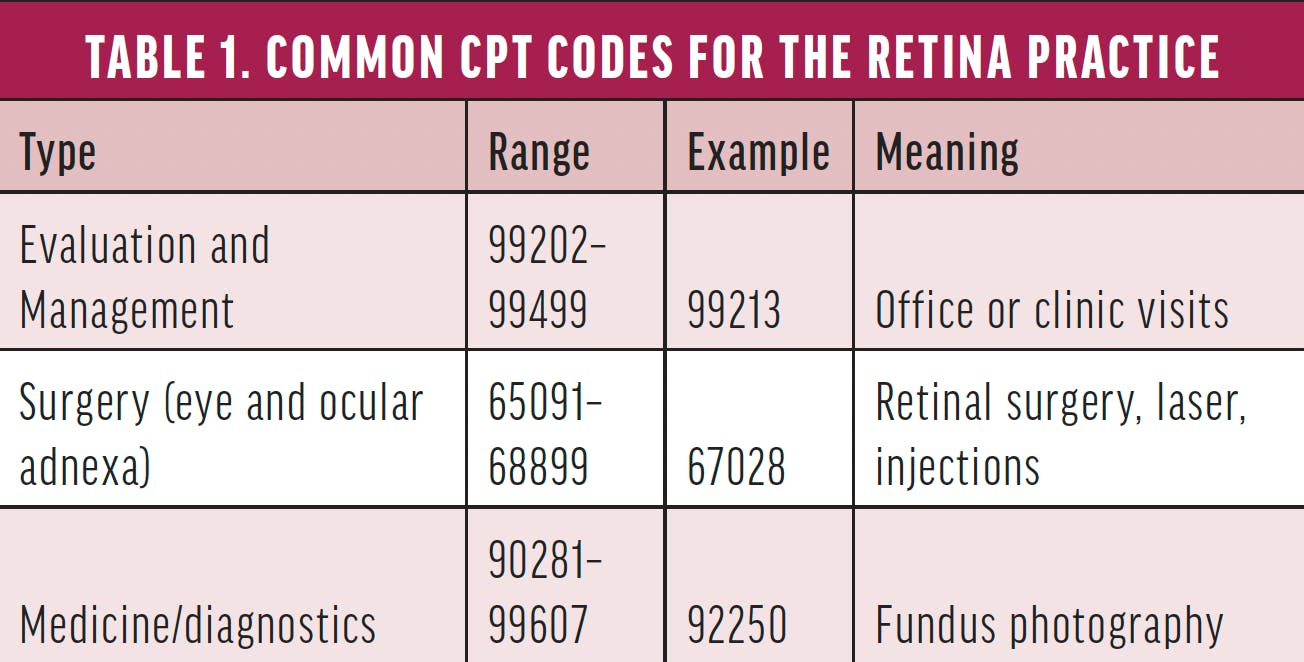
This guide breaks down coding essentials from a retina fellow’s perspective with common examples relevant to retina clinics and surgery.
THE BASICS
Coding is, essentially, a form of standard communication between a specialist and insurer. As specialists, we are required to meet certain criteria for the insurer to demonstrate what happened and why. Every claim links a CPT code and an International Classification of Diseases, 10th Revision (ICD-10) code. Essentially, CPT codes tell the insurer what you did, and ICD-10 codes tell them why you did it. However, each patient encounter is often complex, and it’s not always as simple as that. For each patient seen, we think about their problem and typically apply an intervention to some part of the eye and/or prescribe a medication. Therefore, CPT codes use a range of “sub-codes” to encapsulate this string of events:
- Evaluation and Management (E/M) refers to cognitive work (not all encounters will need this).
- Procedural code communicates the actual service that was performed.
- Modifiers further explain how, where, or why a procedure was done.
- J-codes define the agents administered.
DOCUMENTATION
First and foremost, all the notes we have for an encounter must support the coding. The notes for each patient encounter must have certain elements to be complete. If you are one for mnemonics, ChEAPO works here:
- Chief complaint
- Examination findings
- Assessment and plan
- Procedural details, if performed (specific drug, dose, site, complications, etc.)
- OCT and imaging interpretation
Beware of electronic health record auto-population features. Take an extra minute to review all notes to ensure accuracy and avoid over- or under-documentation. In addition, make sure you update the chart for each encounter so that the visits are not identical for sequential visits.
GETTING INTO THE WEEDS
E/M
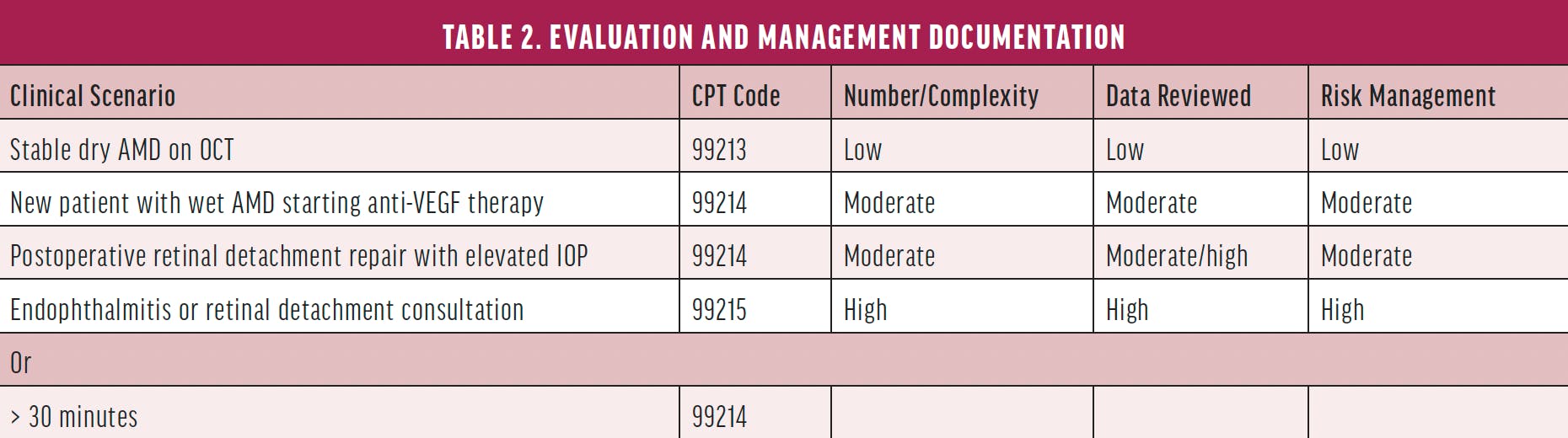
Aligning with the Centers for Medicare and Medicaid Services “Patients over Paperwork” initiative, E/M coding shifted to medical decision making (MDM) or time in 2021. Retina clinics rely primarily on MDM coding, as visits are typically brief and highly complex. However, if you spend extensive time counseling a patient or coordinating care, you may use time-based coding instead (eg, > 30 minutes face-to-face = CPT 99214). Each visit level is determined by (1) the number and complexity of problems addressed, (2) data reviewed or analyzed, and (3) risk management. Each of these categories can be broken into low, moderate, and high levels (Table 2).
Procedural Codes
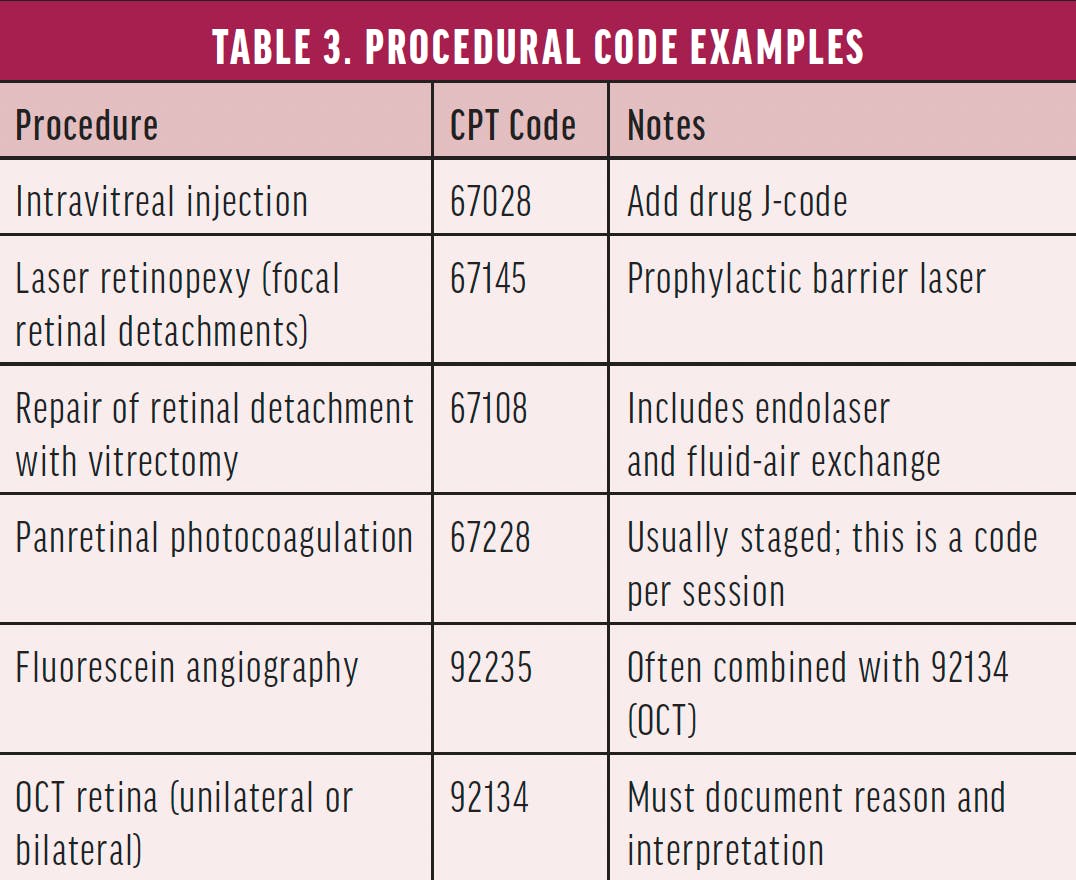
These are often referred to as “CPT codes,” although these are only a key part of the full code, probably because they represent the first thing we think of after the evaluation, which is what we did. Table 3 shows a few common examples of procedural codes.
Modifiers
Modifiers are short, two-character codes added to an E/M code to give extra details about the service(s) performed. They help clarify how, where, or why a procedure was done. For example, if you inject both of a patient’s eyes on the same day and there is a commercial payer, you add -RT and -LT to show which eye each injection was for. If you do both an examination and an injection on the same day, you add -25 to the examination code to show it was a separate, significant service. Think of modifiers as the “fine print” that helps explain special circumstances to the insurer, so your claim is accurate and paid correctly. Commonly used modifiers include:
- -25 = same day, separate examination
- -24 = service performed during postoperative global period for an unrelated issue
- -57 = decision for major surgery
- -RT/-LT = right/left eye, respectively
- -50 = both eyes together
J-codes
J-codes are billing codes that represent drugs and biologic agents administered in a medical setting, such as intravitreal injections. Each J-code identifies a specific medication and dosage, so that the insurer can reimburse appropriately. Each dose billed must match the amount injected, and documentation must include drug name, strength, lot number, expiration date, and quantity used. Common J-codes include:
- J0178 = aflibercept 2 mg (Eylea, Regeneron)
- J2778 = ranibizumab 0.1 mg (Lucentis, Genentech/Roche)
- J9035 = bevacizumab 10 mg (Avastin, Genentech/Roche)
- J3398 = faricimab-svoa 6 mg (Vabysmo, Genentech/Roche)
- J0177 = aflibercept 8 mg (Eylea HD, Regeneron)
- J2781 = pegcetacoplan 1 mg (Syfovre, Apellis)
- J2782 = avacincaptad pegol 0.1 mg (Izervay, Astellas)
COMMON PITFALLS
The Direct to Inject
If a patient comes in for a planned intravitreal injection and there are no new problems, changes in management, or significant reevaluation, then bill only the injection procedure code plus the drug code. Here’s an example:
- CPT code: 67028 (intravitreal injection)
- J-code: eg, J0178 (aflibercept 2 mg)
- Modifiers: -RT or -LT, as appropriate
The Postoperative Period
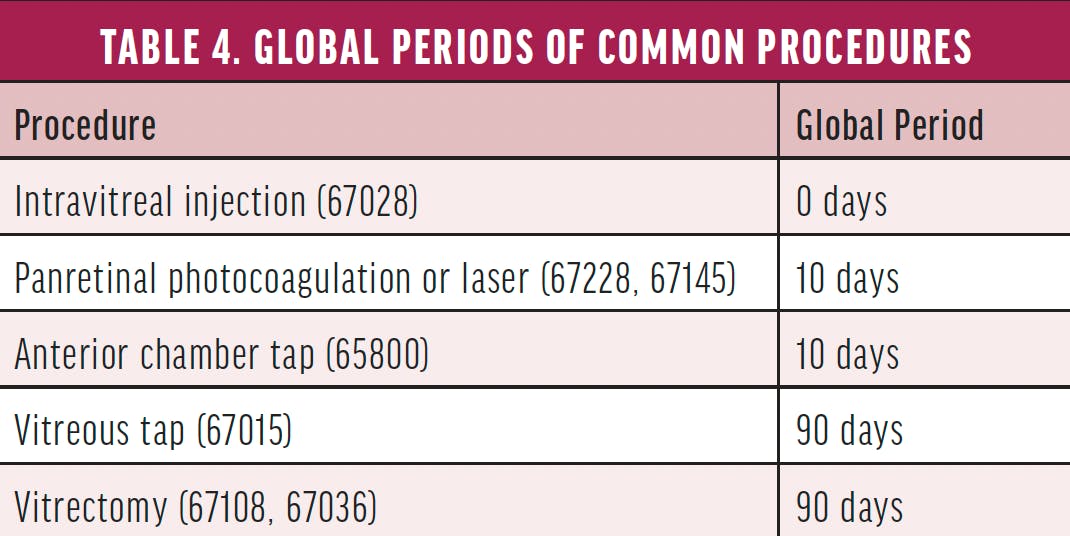
During global periods, a routine postoperative visit cannot be billed separately (Table 4).
IT’S PART OF BEING A DOCTOR
Your attending or billing staff can help you further understand codes, modifiers, and payer quirks. If you can, build out electronic health record templates that match current documentation requirements. Remember, learning how to code is part of your vitreoretinal training. Learning how to document and code properly will ensure you are equipped post-fellowship.


_1773249222.png?auto=compress,format&w=70)


_1784132761.jpg?auto=compress,format&w=75)





