


KEY TAKEAWAYS
- Care pathways for Alzheimer disease (AD) screening remain a major issue, underscoring a large unmet need for low-cost, efficient, noninvasive screening tools.
- When assessing the macula using OCT angiography, there is a measurable reduction in vessel density and perfusion density in AD.
- Larger retinal vascular changes assessed on ultra-widefield fundus photography are also associated with cognitive decline and dementia.
As our population ages, the prevalence of Alzheimer disease (AD) and related dementia is expected to increase significantly.1 Care pathways for AD screening remain a major issue, underscoring the large unmet need for low-cost, efficient, noninvasive screening tools. There is keen interest in identifying AD earlier in the nearly 20-year asymptomatic period along the disease continuum. This would make earlier clinical trial intervention and risk factor modification possible.
The recent FDA approvals of donanemab-azbt (Kisunla, Eli Lilly) and lecanemab (Leqembi, Eisai/Biogen) intravenous infusions for early-stage AD (ie, mild cognitive impairment [MCI] or mild dementia due to AD) further underscores the importance of early diagnosis.2,3
THE RETINA CONNECTION
The retina exhibits findings that mirror those in the cerebrum in its structure and microvasculature, and specialized retinal imaging can visualize AD-specific amyloid-beta (AΒ) deposits and tau protein aggregates. These observations have led to considerable efforts in the development of retinal metrics as surrogate markers for the detection of early neurodegenerative changes in AD.
OCT
Duke Eye Center’s Eye Multimodal Imaging in Neurodegenerative Disease (iMIND) research group has shown key OCT differences, such as thinning of different retinal layers, particularly the ganglion cell layer (measured as a ganglion cell-inner plexiform layer complex due to difficulty in segmenting the two), across the spectrum of MCI and AD. The choroid also offers opportunities to assess changes across the continuum. We have observed a reduction in choroidal vascularity index in individuals with AD compared with MCI and age- and sex-matched controls.4,5
When assessing the macula using OCT angiography (OCTA), there is a measurable reduction in vessel density and perfusion density in AD. These measurements are obtained at a 5 µm resolution and are repeatable in patients with AD, a critical feature for any biomarker. These differences are also present earlier in the disease continuum in individuals with MCI (Figure 1). Differences can also be observed in the peripapillary microvasculature assessed using capillary perfusion density and flux index metrics. Most significantly, macular changes can be detected in individuals who carry the APOE ε4 allele but are not symptomatic. Such detection offers opportunities to alter modifiable risk factors.6
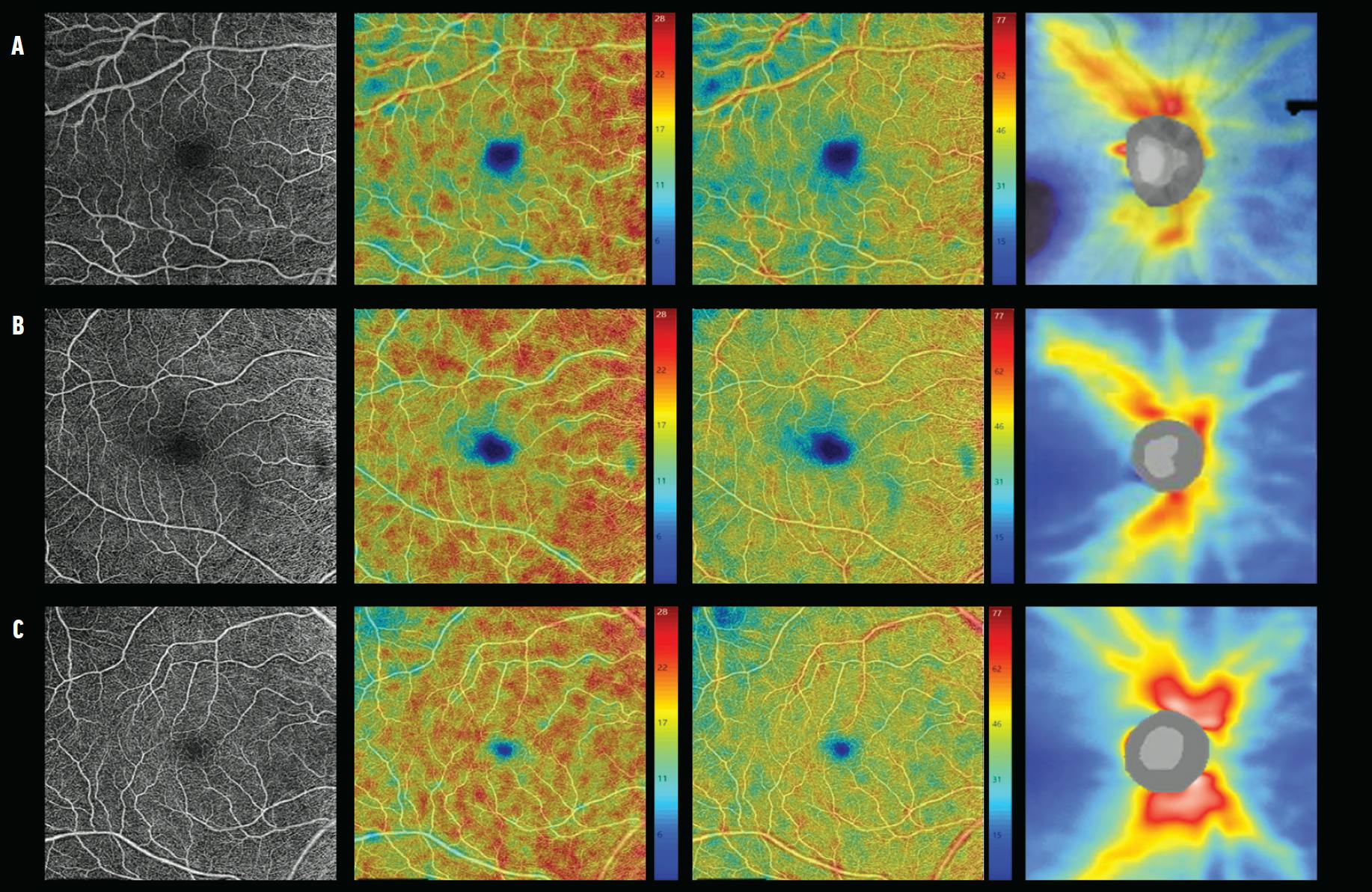
Figure 1. OCTA superficial capillary plexus vessel density and perfusion density maps and OCT retinal nerve fiber layer and ganglion cell layer thickness maps of an individual with AD (A), another with MCI (B), and an age- and sex-matched control with normal cognition (C). Note the reduction in microvasculature density and ganglion cell layer thickness across the spectrum from controls to AD.
When analyzing the data, it is important to consider normal aging and physiologic sex-related differences in the retinal structure and microvasculature, which may be different in AD compared with normal cognition.7,8 When followed over time, there is a significantly faster rate of decline of retinal microvasculature and structure in individuals with neurodegeneration, including those with MCI, compared with normal age-related decline.9 Detection and quantification of such decline may offer opportunities to assess the effect of early interventions over time.
MRI
Our group also demonstrated that a decline in retinal microvascular parameters significantly correlated with hippocampal volume loss and ventricular expansion on volumetric MRI imaging (Figure 2), suggesting these parameters may mirror cerebral neurodegeneration in amnestic MCI and AD.5
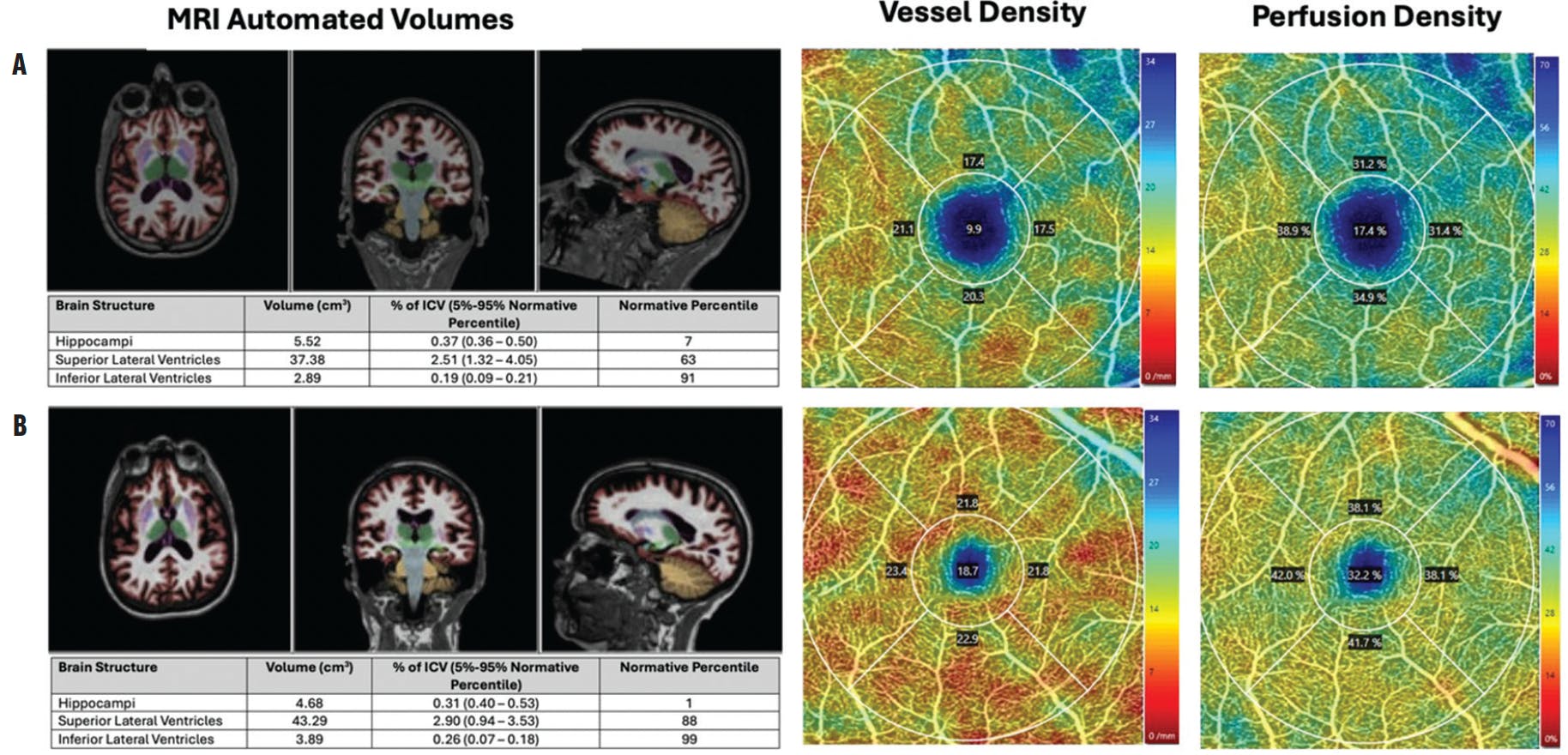
Figure 2. MRI and OCTA images of a patient with AD (A) and another with MCI (B). The OCTA superficial capillary plexus shows vessel density and perfusion density maps of the right eye. Reprinted from Zhao et al in accordance with the terms of the Creative Commons license (creativecommons.org/licenses/by-nc-nd/4.0/).5
Fundus Photography
Larger retinal vascular changes assessed on ultra-widefield fundus photography are also associated with cognitive decline and dementia.10 Metrics such as retinal vessel width gradient and tortuosity, vascular network fractal dimension, and alpha-shape analysis help to further characterize vascular morphology and complexity and provide additional markers for early detection of AD.
Fundus autofluorescence and fluorescence scanning laser ophthalmoscopy have been used to visualize amyloid deposits in the retina. This approach leverages the intrinsic or probe-enhanced fluorescence of amyloid aggregates, most commonly Aβ. In AD, retinal amyloid imaging typically involves the administration of a fluorescent amyloid-binding probe (eg, curcumin), followed by imaging.11 Hyperspectral imaging is another technology being used where different frames are obtained by scanning the source wavelengths to generate a data cube. By capturing wavelength-dependent changes in retinal reflectance, researchers can identify distinct spectral signatures for Aβ and phosphorylated tau.
Other
Blood-based biomarkers are also in development, and the Lumipulse G plasma phosphorylated tau 217/Aβ42 ratio (Fujirebio) was recently approved by the FDA for the detection of AD pathology. Blood offers a more accessible and scalable alternative to cerebrospinal fluid and positron emission tomography and is more specific than conventional retinal imaging.
ONLY THE BEGINNING
As oculomics continues to advance, retinal imaging will be increasingly relevant for risk stratification of systemic diseases. Today, early changes along the AD continuum can be reproducibly detected using widely available conventional retinal imaging. However, these changes are currently specific to AD only in select patient populations without confounding comorbidities. The future likely lies in a screening pathway that integrates retinal imaging with blood-based biomarkers to support risk stratification.
1. 2024 Alzheimer’s disease facts and figures. Alzheimers Dement. 2024;20(5):3708-3821.
2. Lecanemab for Alzheimer’s disease: tempering hype and hope. The Lancet. 2022;400(10367):1899.
3. Livingston G, Huntley J, Liu KY, et al. Dementia prevention, intervention, and care: 2024 report of the Lancet standing Commission. The Lancet. 2024;404(10452):572-628.
4. Robbins CB, Grewal DS, Thompson AC, et al. Choroidal structural analysis in Alzheimer disease, mild cognitive impairment, and cognitively healthy controls. Am J Ophthalmol. 2021;223:359-367.
5. Zhao W, Robbins CB, Grewal DS, et al. Correlating retinal and choroidal vascular parameters with volumetric MRI in Alzheimer’s disease and amnestic mild cognitive impairment. BMC Ophthalmol. 2025;25(1):365.
6. Robbins CB, Rathinavelu J, Ma JP, et al. Peripapillary optical coherence tomography angiography in Alzheimer’s disease, mild cognitive impairment, and normal cognition. Ophthalmic Surg Lasers Imaging Retina. 2024;55(2):78-84.
7. Polascik BW, Thompson AC, Yoon SP, et al. Association of OCT angiography parameters with age in cognitively healthy older adults. Ophthalmic Surg Lasers Imaging Retina. 2020;51(12):706-714.
8. Mirzania D, Thompson AC, Robbins CB, et al. Retinal and choroidal changes in men compared with women with Alzheimer’s disease: a case-control study. Ophthalmol Sci. 2022;2(1):100098.
9. Joseph S, Woo J, Robbins CB, et al. Longitudinal assessment of peripapillary microvasculature using optical coherence tomography angiography in cognitively normal adults. J Vitreoretin Dis. 2024;8(5):571-576.
10. Pead E, Thompson AC, Grewal DS, et al. Retinal vascular changes in Alzheimer’s dementia and mild cognitive impairment: a pilot study using ultra-widefield imaging. Transl Vis Sci Technol. 2023;12(1):13.
11. Alber J, Bouwman F, den Haan J, et al. Retina pathology as a target for biomarkers for Alzheimer’s disease: current status, ophthalmopathological background, challenges, and future directions. Alzheimers Dement. 2024;20(1):728-740.


_1773249222.png?auto=compress,format&w=70)

_1784132761.jpg?auto=compress,format&w=75)





