


KEY TAKEAWAYS
- Current management options for diabetic retinopathy (DR), including vitreoretinal surgery, intravitreal injection of anti-VEGF agents and/or corticosteroids, and laser photocoagulation, are invasive, may have serious negative effects, and are primarily appropriate for advanced stages of DR.
- Oral peroxisome proliferator-activated receptor (PPAR) agonists have the potential to offer pain reduction, ease of administration, safety, and high patient compliance in preventing the development and progression of DR.
- Dual PPAR agonists that activate PPARα and PPARγ may represent a synergistic therapy for DR, in which PPARα activation improves lipid metabolism and reduces vascular inflammation, while PPARγ enhances insulin sensitivity and protects endothelial function.
Diabetic retinopathy (DR) is primarily driven by chronic hyperglycemia, which progressively damages retinal capillaries, resulting in vascular leakage, increased permeability, tissue edema, and structural injury. Several interlinked biochemical pathways are implicated in the pathogenesis of DR, including the polyol pathway, hexosamine pathway, and activation of protein kinase C, each of which exacerbates oxidative stress and inflammation. In addition, excessive extracellular matrix deposition leads to basement membrane thickening, pericyte loss, and endothelial dysfunction. These changes promote the development of microaneurysms and increase the likelihood of vascular occlusion and ischemia. As a compensatory mechanism, abnormal neovascularization occurs; however, these newly formed vessels are fragile and prone to rupture, resulting in hemorrhage and further retinal damage.1-4 Hypertension and hyperlipidemia also contribute to the development of DR.5,6
Management options for DR include vitreoretinal surgery, intravitreal injection of anti-VEGF agents and/or corticosteroids, and laser photocoagulation. These therapies are invasive, may have serious negative effects, and are primarily appropriate for advanced stages of DR.7-9
Strong evidence indicates that strict control of blood pressure and glucose can significantly reduce or delay the onset and progression of DR.10 However, even with optimal management, elevated cholesterol, particularly low-density lipoprotein, has been linked to the development of hard exudates, as well as increased retinal thickness and volume.11,12 In this context, oral medications offer several advantages, including pain reduction, ease of administration, safety, and high patient compliance.13 Notably, research supports the potential benefits of oral peroxisome proliferator-activated receptor (PPAR) agonists in preventing the development and progression of DR.14
PPAR AGONISTS: MECHANISMS AND THERAPEUTIC POTENTIAL
PPARs belong to the nuclear hormone receptor superfamily and function as ligand-activated transcription factors. When bound by specific ligands, they interact with co-activator complexes and bind to peroxisome proliferator response elements within target gene promoters, thereby regulating gene transcription. In the absence of ligands, PPARs associate with co-repressor complexes, suppressing gene expression.15 PPARs are categorized into three subtypes: PPARα, PPARγ, and PPARΒ/δ, each with distinct but overlapping metabolic functions. Collectively, these receptors play a critical role in maintaining energy balance and metabolic homeostasis. PPARα activation reduces triglyceride levels and enhances lipid metabolism, PPARΒ/δ promotes fatty acid oxidation, and PPARγ improves insulin sensitivity while facilitating glucose metabolism.16
PPARα
PPARα is highly expressed throughout the body, including in the liver; enterocytes; non-neuronal cells such as microglia and astroglia; vasculature and immunologic cell types such as monocytes/macrophages; lymphocytes; endothelial cells; and smooth muscle cells. PPARα also presents in cells of skeletal muscles, intestinal mucosa, adrenal glands, brown adipose tissue, the heart, and the retina.17,18
In response to fasting, PPARα is a potent regulator of lipid metabolism and plays a role in maintaining glucose homeostasis equilibrium. A well-known PPARα agonist, fenofibrate, is used to treat hyperlipidemia by raising levels of high-density lipoprotein cholesterol and decreasing triglyceride level.19,20 Fenofibrate has been investigated for the prevention of DR due to its therapeutic effects on the control of lipid metabolism.21
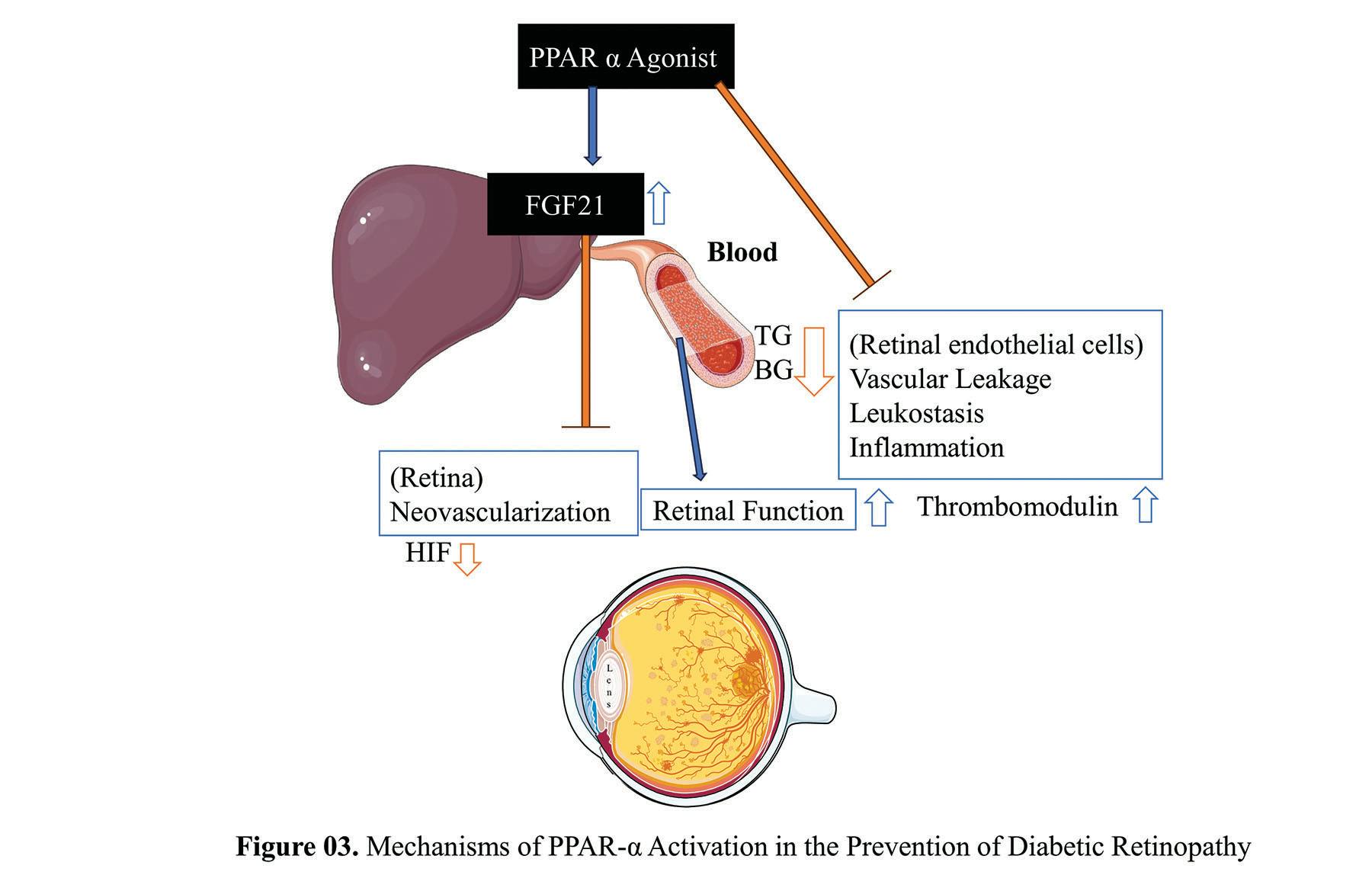
Selective PPARα modulators exert protective effects in DR through both systemic and local mechanisms. Activation of PPARα in the liver stimulates fibroblast growth factor 21 (FGF21) production, which circulates to the retina and retinal endothelial cells. This leads to improved lipid and glucose metabolism, reflected by reductions in triglyceride and blood glucose levels. In the retina, FGF21 suppresses hypoxia-inducible factor activity, thereby inhibiting pathological neovascularization, while also enhancing synaptophysin expression to support neuronal function. In retinal endothelial cells, PPARα activation increases thrombomodulin expression, reducing vascular leakage, leukostasis, and inflammation (Figure 1). Together, these actions help preserve retinal structure and function, mitigating the progression of DR.22
PPARγ
In DR, chronic hyperglycemia induces an upregulation of VEGF and intercellular adhesion molecule-1 (ICAM-1) within the retinal vasculature. Elevated ICAM-1 facilitates leukocyte adhesion (ie, leukostasis) to the capillary endothelium, thereby compromising vascular integrity and enhancing retinal vascular permeability, which contributes to the development of macular edema.
Activation of PPARγ by agonists, such as rosiglitazone (Avandia, GlaxoSmithKline), can downregulate ICAM-1 expression, thereby reducing leukostasis and maintaining endothelial function. This cascade of events leads to decreased vascular leakage and offers a potential mechanism through which PPARγ confers protection against microvascular injury in DR (Figure 2).23
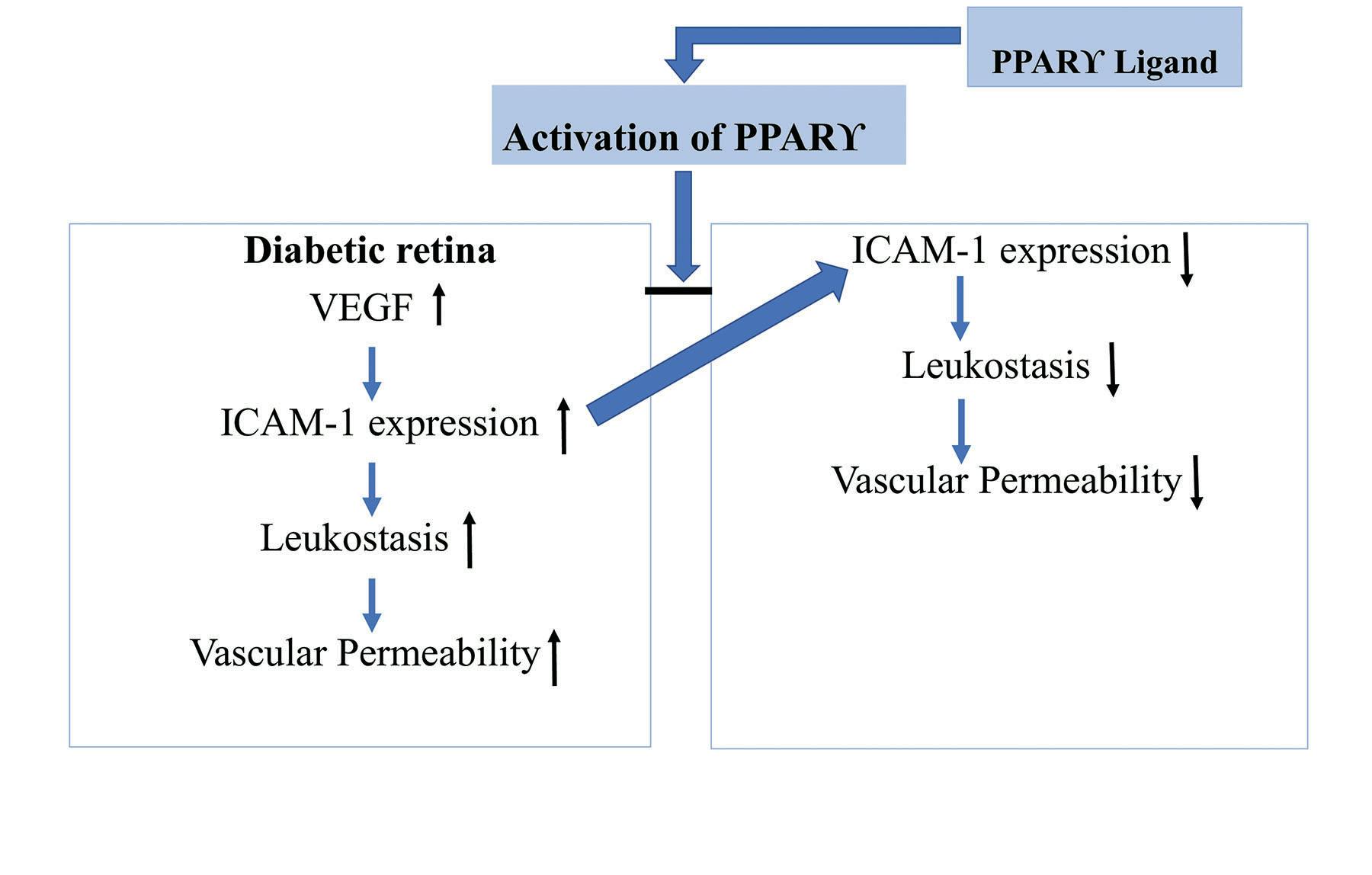
Figure 2. This diagram shows the mechanistic role of PPARγ activation in DR: suppression of ICAM-1 expression, reduced leukostasis, and decreased vascular leakage.
Dual PPAR Agonists
Dual PPAR agonists that activate PPARα and PPARγ represent a potential synergistic therapy for DR in which PPARα activation improves lipid metabolism and reduces vascular inflammation, while PPARγ enhances insulin sensitivity and protects endothelial function. Preclinical studies with aleglitazar (Roche) suggest this class of drug can improve glucose and lipid homeostasis while reducing retinal microvascular inflammation, effects that were more pronounced compared with a single PPAR agonist.24 Despite these encouraging findings, the clinical progress of several early agents has been stalled due to cardiovascular safety concerns.25,26
Saroglitazar (Lipaglyn, Zydus Lifesciences), a newer generation dual PPARα/γ agonist, has demonstrated promising results in experimental models of DR; in streptozotocin-induced diabetic rats, it reduced retinal expression of VEGF, tumor necrosis factor-α, ICAM-1, and vascular-CAM-1. In oxygen-induced retinopathy models, saroglitazar effectively suppressed pathological neovascularization, which suggests potent antiinflammatory, antiangiogenic, and vasoprotective actions with a more favorable safety profile than earlier compounds. As such, saroglitazar may be a promising candidate for clinical development in DR.27
FUTURE DIRECTIONS
Future studies should prioritize large-scale randomized controlled trials to validate the beneficial retinal outcomes observed in animal models and small clinical studies.28-31 In particular, selective PPAR modulators, such as pemafibrate (Parmodia, Kowa Pharmaceuticals), and dual agonists, such as saroglitazar, have shown potent antiinflammatory, antiangiogenic, and neuroprotective effects in experimental models. However, their efficacy and long-term safety require confirmation in a diverse population with diabetes.27,32 Mechanistic studies are warranted to further delineate how PPAR activation modulates pathways involving VEGF, ICAM-1, oxidative stress, and neurovascular coupling in DR.23,32,33
Combination strategies incorporating PPAR modulators with anti-VEGF therapy or use of corticosteroids may provide synergistic benefits, especially in advanced DR.7-9 Integration of randomized trial data with real-world evidence will be crucial to determine the effect of PPAR-targeted therapies in routine clinical practice.34
1. Kim YJ, Walsh AW, Gruessner RWG. Retinopathy. In: Gruessner RWG, Gruessner AC (eds). Transplantation of the Pancreas. Springer, Cham; 2023.
2. Brownlee M. The pathobiology of diabetic complications: a unifying mechanism. Diabetes. 2005;54(6):1615-1625.
3. Fong DS, Aiello LP, Ferris FL, Klein R. Diabetic retinopathy. Diabetes Care. 2004;27(10):2540-2553.
4. Morello CM. Etiology and natural history of diabetic retinopathy: an overview. Am J Health Syst Pharm. 2007;64(17 Suppl 12):S3-S7.
5. Do DV, Wang X, Vedula SS, et al. Blood pressure control for diabetic retinopathy. Cochrane Database Syst Rev. 2023;3(3):CD006127.
6. Yau JW, Rogers SL, Kawasaki R, et al; Meta-Analysis for Eye Disease (META-EYE) Study Group. Global prevalence and major risk factors of diabetic retinopathy. Diabetes Care. 2012;35(3):556-564.
7. Stewart MW. Treatment of diabetic retinopathy: Recent advances and unresolved challenges. World J Diabetes. 2016;7(16):333-341.
8. Mansour SE, Browning DJ, Wong K, Flynn HW Jr, Bhavsar AR. The evolving treatment of diabetic retinopathy. Clin Ophthalmol. 2020;14:653-678.
9. Simó R, Hernández C. Advances in the medical treatment of diabetic retinopathy. Diabetes Care. 2009;32(8):1556-1562.
10. Tarasewicz D, Conell C, Gilliam LK, Melles RB. Quantification of risk factors for diabetic retinopathy progression. Acta Diabet. 2023;60(3):363-369.
11. Das A, Stroud S, Mehta A, Rangasamy S. New treatments for diabetic retinopathy. Diabetes Obes Metab. 2015;17(3):219-230.
12. Sasaki M, Kawashima M, Kawasaki R, et al. Association of serum lipids with macular thickness and volume in type 2 diabetes without diabetic macular edema. Invest Ophthalmol Vis Sci. 2014;55(3):1749-1753.
13. Giovannitti JA, Trapp LD. Adult sedation: oral, rectal, IM, IV. Anesth Prog. 1991;38(4-5):154-171.
14. Hiukka A, Maranghi M, Matikainen N, Taskinen MR. PPARalpha: an emerging therapeutic target in diabetic microvascular damage. Nat Rev Endocrinol. 2010;6(8):454-463.
15. Michalik L, Wahli W. Involvement of PPAR nuclear receptors in tissue injury and wound repair. Journal Clin Invest. 2006;116(3):598-606.
16. Tyagi S, Gupta P, Saini AS, Kaushal C, Sharma S. The peroxisome proliferator-activated receptor: a family of nuclear receptors role in various diseases. J Adv Pharm Technol Res. 2011:2(4):236-240.
17. Heneka MT, Landreth GE. PPARs in the brain. Biochim Biophys Acta. 2007;1771(8):1031-1045.
18. Yu XH, Zheng XL, Tang CK. Peroxisome proliferator-activated receptor α in lipid metabolism and atherosclerosis. Adv Clin Chem. 2015;71:171-203.
19. Tajnšek Š, Petrovič D, Globočnik Petrovič M, Kunej T. Association of peroxisome proliferator-activated receptors (PPARs) with diabetic retinopathy in human and animal models: analysis of the literature and genome browsers. PPAR Res. 2020;1783564.
20. Peeters A, Baes M. Role of PPARα in hepatic carbohydrate metabolism. PPAR Res. 2010;572405.
21. Sharma N, Ooi JL, Ong J, Newman D. The use of fenofibrate in the management of patients with diabetic retinopathy: an evidence-based review. Aust Fam Physician. 2015;44(6):367-370.
22. Tomita Y, Lee D, Tsubota K, Kurihara T. PPARα agonist oral therapy in diabetic retinopathy. Biomedicines. 8(10):433.
23. Yanagi Y. Role of peoxisome proliferator activator receptor gamma on blood retinal barrier breakdown. PPAR Res. 2008;679237.
24. Bénardeau A, Verry P, Atzpodien EA, et al. Effects of the dual PPAR-α/γ agonist aleglitazar on glycaemic control and organ protection in the Zucker diabetic fatty rat. Diabetes Obes Metab. 2013;15(2):164-174.
25. Nissen SE, Wolski K, Topol EJ. Effect of muraglitazar on death and major adverse cardiovascular events in patients with type 2 diabetes mellitus. JAMA. 2005;294(20):2581-2586.
26. Ratner RE, Parikh S, Tou C; GALLANT 9 Study Group. Efficacy, safety and tolerability of tesaglitazar when added to the therapeutic regimen of poorly controlled insulin-treated patients with type 2 diabetes. Diab Vasc Dis Res. 2007;4(3):214-221.
27. Joharapurkar A, Patel V, Kshirsagar S, Patel MS, Savsani H, Jain M. Effect of dual PPAR-α/γ agonist saroglitazar on diabetic retinopathy and oxygen-induced retinopathy. Eur J Pharmacol. 2021;899:174032.
28. Keech AC, Mitchell P, Summanen PA, et al; FIELD study investigators. Effect of fenofibrate on the need for laser treatment for diabetic retinopathy (FIELD study): a randomised controlled trial. Lance. 2007;370(9600):1687-1697.
29. Chew EY, Davis MD, Danis RP, et al. The effects of medical management on the progression of diabetic retinopathy in persons with type 2 diabetes: the Action to Control Cardiovascular Risk in Diabetes (ACCORD) Eye Study. Ophthalmology. 2014;121(12):2443-2451.
30. Lee D, Tomita Y, Negishi K, Kurihara T. Pemafibrate, a potent selective peroxisome proliferator-activated receptor α modulator, a promising novel treatment for ischemic retinopathy? Neural Regen Res. 2023;18(7):1495-1496.
31. Preiss D, Logue J, Sammons E, et al. Effect of fenofibrate on progression of diabetic retinopathy. NEJM Evid. 2024;3(8):EVIDoa2400179.
32. Higuchi A, Ohashi K, Shibata R, Sono-Romanelli S, Walsh K, Ouchi N. Thiazolidinediones reduce pathological neovascularization in ischemic retina via an adiponectin-dependent mechanism. Arterioscler Thromb Vasc Biol. 2010;30(1):46-53.
33. Sun MH, Chen KJ, Sun CC, Tsai RK. Protective effect of pioglitazone on retinal ganglion cells in an experimental mouse model of ischemic optic neuropathy. Int J Mol Sci. 2022;24(1):411.
34. Knickelbein JE, Abbott AB, Chew EY. Fenofibrate and diabetic retinopathy. Curr Diab Rep. 2016;16(10):90.


_1773249222.png?auto=compress,format&w=70)


_1784132761.jpg?auto=compress,format&w=75)





