


With a lead pipeline asset in late-stage clinical development and an experienced management team advised by leading experts, Iveric Bio is on target to developing transformative therapies for retinal diseases.
Iveric Bio’s lead pipeline asset, Zimura® (avacincaptad pegol), a pegylated RNA aptamer that specifically and potently inhibits complement factor 5 (C5),1 is currently being studied in a second phase 3 clinical trial (GATHER2). If the results from that trial are positive, Zimura will be on the precipice of a regulatory submission to obtain marketing approval for the treatment of geographic atrophy (GA) secondary to age-related macular degeneration (AMD), for which there are currently no approved treatments.
Iveric aims to lead with the strength of its science. Its work in complement illustrates that intention: inhibiting C5 preserves crucial physiologic function initiated at earlier steps in the complement pathway while still shutting down activation of inflammatory processes and cell-killing membrane attack complex (MAC).2,3 Iveric works toward cultivating a deep and nuanced understanding of the pathophysiology associated with retinal diseases and then guides drug development efforts based on the data.
An Unexpected (but Fortuitous) Change in Focus
In 2017, what was then called Ophthotech Corporation saw its phase 3 Fovista® (pegpleranib) trials fail to meet their prespecified primary endpoints.4 The board of directors decided to wind down the company’s Fovista development program and to conduct a review, which resulted in the strategy to diversify the company’s portfolio by repositioning the promising Zimura asset already in clinical development with programs in multiple indications, and to embark on a strategy to acquire rights to additional assets (IC-500 and several gene therapy assets). The acquisitions would be guided by three strict criteria: they had to (1) be backed by great science performed by leading scientists; (2) seek to address a significant unmet medical need; and (3) be associated with market viability. As for Zimura, a strong signal of therapeutic benefit with a favorable safety profile in previous phase 1 and 2 studies in dry AMD and wet AMD,5 together with a strong scientific link between complement activation and deposition and retinal disease,6-8 provided the rationale to forge ahead with multiple Zimura development programs.
According to Chief Executive Officer Glenn P. Sblendorio, the board opted for three smaller studies for Zimura: an open-label phase 2 study investigating Zimura administered in combination with Lucentis® (ranibizumab, Genentech) for the treatment of wet AMD (NCT02397954); a phase 2b study testing Zimura in autosomal recessive Stargardt disease (NCT03364153); and a modification of the existing GATHER1 study (previously OPH2003; NCT02686658), a sham-controlled study for treatment of GA secondary to AMD (NCT02686658), based on positive data from a competitor’s complement inhibitor in development for GA with the goal of getting a data read out as efficiently as possible. “We were aiming for several targets, but our biggest bet was on GA,” Mr. Sblendorio said.
In April 2019, the company officially changed its name to Iveric Bio, a play on the Latin veritas, meaning truth. However, despite internal alignment, the investor community continued to express skepticism around complement inhibition. Although the science behind complement’s role in AMD pathogenesis is well known in the clinical ophthalmic community, a play for a GA treatment seemed a risky pursuit to those external to the company.
“We were limping along over the next couple of years.
In 2017 we started the revamped Zimura program; in 2018, we finished enrollment in GATHER1; and in October 2019, we turned the card with the results from GATHER1,” Mr. Sblendorio said.
A Corporate Philosophy in Action
In hindsight, the release of 12-month data from GATHER1 was a bellwether moment for Iveric. On the heels of a positive data release, the company started preparing for GATHER2 in earnest and raised approximately $42.5 million in net proceeds in December 2019 to fund the study. Following a brief pause to the GATHER2 program as a result of COVID-19, this momentum would continue, when the company raised an additional approximately $150 million in net proceeds in June 2020. The data release from GATHER1 also affirmed the philosophy Mr. Sblendorio has continually sought to instill in the company culture—if Iveric can establish strong scientific rationale for its pipeline candidates, the market will follow. That idea would soon be put into practice with the hire of Pravin U. Dugel, MD, as Chief Business and Strategy Officer in March 2020.
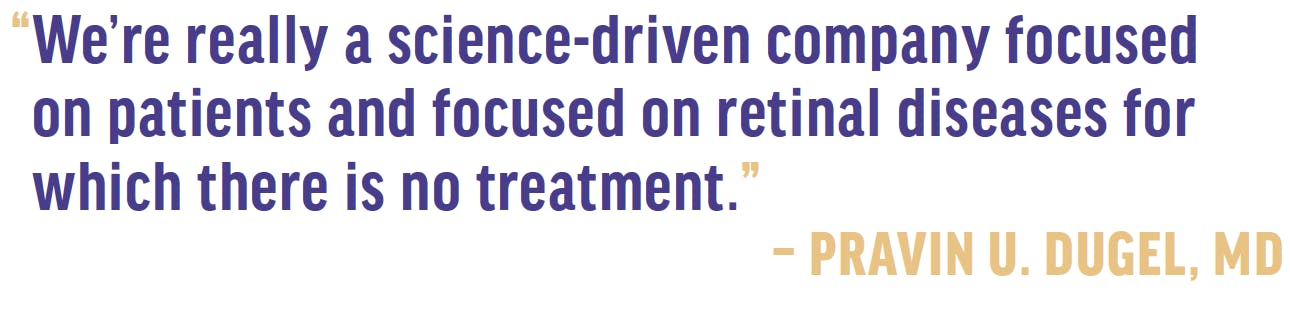
Over the course of his decades-long career as a private practice retina physician and practice owner, and through his interactions with industry, Dr. Dugel had been tracking Iveric and its pipeline. “This is a situation where we are going where nobody’s gone before, and that to me was extraordinarily attractive,” Dr. Dugel said. “This was an opportunity to drive decisions based on science that will serve providers and patients. It’s the belief that if the science is done properly, the shareholder value will follow. We’re really a science-driven company focused on patients and focused on retinal diseases for which there is no treatment.”
Dr. Dugel was promoted to become the company’s president in May 2021. The company also hired Dhaval Desai, PharmD, as their Chief Development Officer and recently hired Chris Simms as their Chief Commercial Officer. Iveric also boasts a deeply experienced board of directors, led by current Chairman Adrienne L. Graves, PhD.
Today, Iveric has completed patient enrollment for GATHER2 4 months ahead of schedule and looks forward to reporting top-line data from the trial in the second half of next year. During the pandemic, Iveric implemented innovative measures to ensure study sites could safely manage patient encounters, including supplying personal protection equipment and helping patients attend study visits by arranging travel services. Those moves proved prescient in helping recruitment and retention. In an effort to leave no doubt about the data coming out of the study, Dr. Dugel said the company plans to report injection fidelity as a metric of retention.
“Our target for injection fidelity in GATHER2 at 12 months is to be above 90%. In GATHER1, injection fidelity at 12 months was 87%,” Dr. Dugel said (unpublished data).
Iveric also received a written agreement for the overall design of GATHER2 under a Special Protocol Assessment (SPA) from the US Food and Drug Administration (FDA).
“We believe obtaining the SPA from the FDA for GATHER2 validates our regulatory pathway for Zimura in GA and provides us a path forward for seeking approval,” Dr. Dugel said.
Looking to the Future
Along with the promise of Zimura, the company is building a deep portfolio of therapeutic and gene therapy product candidates that broaden the company’s potential to provide treatment options for other devastating retinal conditions with unmet needs. Zimura and IC-500 target two different pathways associated with the development and progression of AMD, complement and HtrA1, respectively. Both therapeutic approaches are backed by genetic association studies and other preclinical data and scientific literature, and together provide a potentially comprehensive strategy for the various stages of AMD. Beyond that are a suite of adeno-associated virus (AAV) delivered gene therapy research and development programs, including IC-200 for BEST1-related inherited retinal diseases. The company is also pursuing multiple mini-gene research and development programs (spliced portions of larger genes packaged to fit into standard AAV vectors) for Leber congenital amaurosis type 10, autosomal recessive Stargardt disease, and USH2A-related inherited retinal diseases, such as the retinal degeneration associated with Usher syndrome type 2A.
According to Mr. Sblendorio, having potentially game-changing science to tout is one reason Iveric continues to attract interest in its pipeline. The more crucial element is that Iveric stays true to ensuring that science continues to guide its strategy, and that the company is supported by strong leadership and management that steers it forward with integrity. Iveric has continued to grow its team to support the development of its business.
1. Jaffe GJ, Westby K, Csaky KG, et al. C5 inhibitor avacincaptad pegol for geographic atrophy due to age-related macular degeneration: a randomized pivotal phase 2/3 trial. Ophthalmology. 2021;128(4):576-586.
2. Kassa E, Ciulla TA, Hussain RM, Dugel PU. Complement inhibition as a therapeutic strategy in retinal disorders. Exp Opin Biol Ther. 2019;19(4):335-342.
3. Xu H, Chen M. Targeting the complement system for the management of retinal inflammatory and degenerative diseases. Eur J Pharmacol. 2016;787:94-104.
4. Ophthotech announces results from third phase 3 trial of Fovista® in wet age-related macular degeneration [press release]. Ophthotech; New York, NY; August 14, 2017. Available at: https://www.businesswire.com/news/home/20170814005286/en/Ophthotech-Announces-Results-Phase-3-Trial-Fovista.
5. Ophthotech provides update on Zimura® complement programs for treatment of eye diseases [press release]. Iveric Bio; New York, NY; September 19, 2017. Available at: https://investors.ivericbio.com/news-releases/news-release-details/ophthotech-provides-update-zimurar-complement-programs-treatment.
6. Bora NS, Matta B, Lyzogubov VV, Bora PS. Relationship between the complement system, risk factors and prediction models in age-related macular degeneration. Mol Immunol. 2015;63(2):176-183.
7. McHarg S, Clark SJ, Day AJ, Bishop PN. Age-related macular degeneration and the role of the complement system. Mol Immunol. 2015;67(1):43-50.
8. Warwick A, Khandhadia S, Ennis S, Lotery A. Age-related macular degeneration: a disease of systemic or local complement dysregulation? J Clin Med. 2014;3(4):1234-1257.
