


When the newly renamed Samsara Vision, Inc. (formerly VisionCare Inc.) announced in May 2020 that it had garnered a CE Mark for a foldable version of the Implantable Miniature Telescope (IMT) delivered via a preloaded injector through a 6.5-mm incision, it was both the culmination of years of research efforts and an additional step in a thoughtful rebranding effort the company had already started.
Samsara, taken from Sanskrit, describes a path of rebirth and growth. The new name reflects an organizing philosophy and commitment to addressing the needs of an underserved population of patients. The fundamental idea behind the IMT has always been that it improves vision and quality of life for individuals with late-stage age-related macular degeneration (AMD); however, a name that invokes the notion of rebirth more aptly reflects the fact that rejuvenating eyesight also revives the spirit, allows patients to reconnect with the things in life they love to see and do, and provides them the ability to achieve functional improvement beyond what is measurable in visual acuity outcomes.
IMT: Optical Principles and Impact Beyond the Data
Samsara Vision’s heritage is tied to the IMT, the prosthetic device invented by Dr. Isaac Lipshitz that is the first and only implantable medical device approved by the US Food and Drug Administration proven to improve vision and quality of life in individuals with end-stage AMD.1
From a technical perspective, the 4.4-mm long wide angle (WA) IMT is the only Galilean telescope implant on the market and achieves 2.7X magnification. The air bubble interface enables this level of magnification, which is often required for these patients to be functional. Furthermore, the fact that the device is implanted inside the eye, as opposed to being used in front of the eye, helps widen the impact of increased field of view, providing dynamic eye scanning movements and high magnification. A commercial external telescope with 3.0X magnification offers about 5-6° of viewing while the implantable telescope offers a 20° field of view, and so patients wind up seeing bigger and wider because of where it is situated on the visual axis (Figure 1).
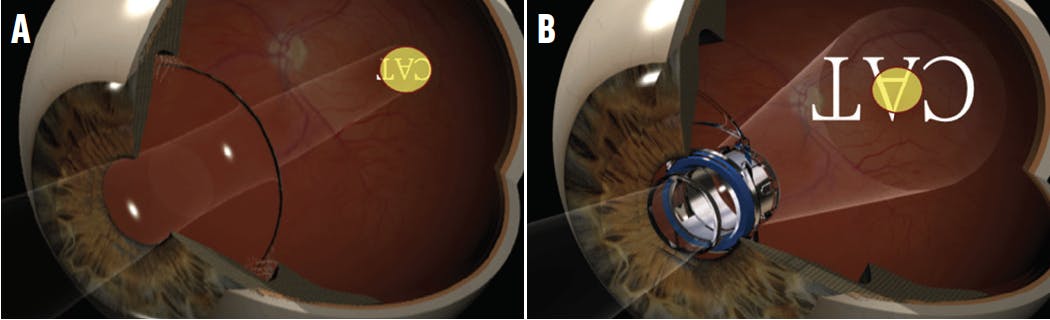
Figure 1. A simplified demonstration of an eye with a central macular scar due to AMD before (A) and after implanting an IMT (B).
Marc H. Levy, MD, of the Sarasota Retina Institute, who has personally implanted the device in two dozen patients, says the device essentially reduces the significance of the blind spot on central vision tasks—the size of the scotoma does not change, but the degree to which it compromises visual ability is mitigated.
“When I’m describing to people how the IMT works, I say, ‘Take your two fists, put them together, and put them about 12 inches in front of both eyes. And when you look, you see you’re missing what you’re looking at, because you can’t use your peripheral vision for fine focusing. Now take those same fists and put them all the way out at full arm extension. What you’ve done is you’ve reduced the size of the scotoma by two thirds. That’s the difference,’” Dr. Levy said.
First approved by the US Food and Drug Administration in 2010, the WA IMT has since been implanted in hundreds of patients worldwide. Long-term follow-up shows that patients receiving the WA IMT gain a mean 2.41 lines of best-corrected distance VA at 60 months, and that about 47% of patients achieve a 3-line gain.2 But the numbers do not tell the whole story. According to Dr. Levy, a principal investigator in the initial IMT studies, a quantitative assessment of IMT outcomes misses the important changes seen in people’s lives postoperatively.
“In my opinion, this device allows patients to see better, it is safe, it is effective, and it can get patients to have a better life, performing more activities of daily living, and it actually allows them to be safer,” Dr. Levy said. “It allows my patients to be able to see again and enjoy their remaining years on this earth.”
The dichotomy between data and real-world impact is evident in the pivotal IMT-002 study that led to market approval. The study met its primary endpoint: Eyes implanted with the IMT gained a mean 3.0 lines of vision or more compared to a roughly 0.5-line change in all fellow control eyes, and a quarter of patients achieved at least 5 lines of gain. In addition, results from a secondary analysis on change in National Eye Institute Visual Function Questionnaire (NEI VFQ-25) score helped demonstrate the clinically meaningful changes patients who received the device experienced: statistically significant improvements in overall quality of life, general vision, near activities, distant activities, social functioning, dependency, mental health, and role difficulties.1
Next Generation IMT: Same Results, Better Delivery
Although the WA IMT improves the lives of patients blinded by late-stage AMD,1 the first-generation device is not without its faults. Indeed, Samsara Vision has learned valuable lessons that it has used to re-engineer the device so it could be delivered by a preloaded injector. While the optics of the SING IMT™ (smaller-incision new-generation IMT) remain the same, it is constructed with a silicone foldable haptic and silicone restrictor, considerations that make the device easier to use and more accessible for surgeons, while significantly reducing the operation time, endothelium cell loss, and need for intraocular manipulation (Figure 2).
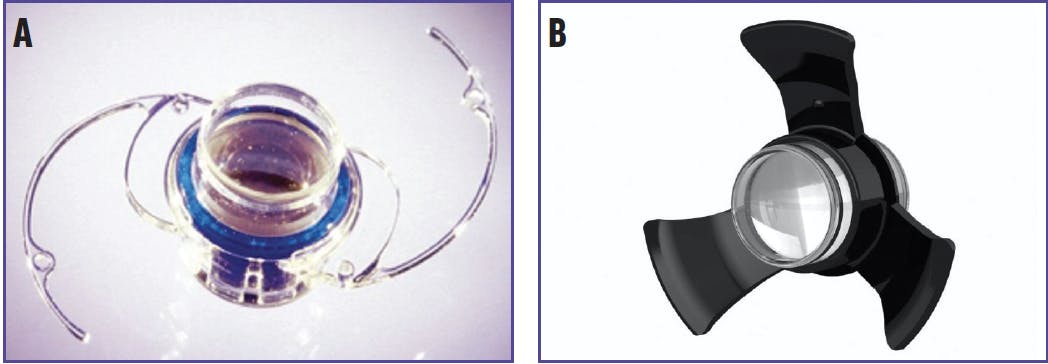
“It is a foldable and injectable technology—and both of those things contribute to a smaller incision and a more repeatable surgery,” said Prof David Keegan, PhD FRCOphth FRCSI(Oph), a Consultant Vitreoretinal Surgeon and Head of Department at the Mater Misericordiae University Hospital, Dublin, Ireland, and a principal investigator in studies evaluating the safety and efficacy of the SING IMT.
There have also been valuable lessons regarding how the device is used in practice: Whereas IMT-002 studied the implant in the worse-seeing eye, patients achieve greater results when the better eye is targeted.
One of the most important things that has been recognized is that motivated patients are more likely to be successful with the IMT: patients must learn to use vision with an implantable telescope, and so they should be diligent about working with a low vision specialist. Patients also need to be counseled to reasonable expectations (for example, resuming driving is contraindicated in patients who receive the IMT) and properly educated as to what they can expect postoperatively.
The requirements for careful patient selection, education, and counseling might mean that surgeons and their staff will take up chair time talking with patients. But according to Prof Keegan, at least offering the implantable telescope empowers patients to make a choice about their outcome, and getting other clinic staff members involved may reduce the impact on efficiency.
“It’s the right technology in the right patients. Patient selection is crucial, but the device works for those in whom we get it right—when it works, it works great, probably better than what we might expect,” said Prof Keegan. “If you’ve got a good occupational therapist or vision rehab optometrist who works with you, then have them do the consult, get them experienced, get them talking to the Samsara Vision team about what to do, and let them have the conversation with the patients as well.”
1. Hudson HL, Lane SS, Heier JS, et al; IMT-002 Study Group. Implantable miniature telescope for the treatment of visual acuity loss resulting from end-stage age-related macular degeneration: 1-year results. Ophthalmology. 2006;113(11):1987-2001.
2. Boyer D, Freund KB, Regillo C, et al. Long-term (60-month) results for the implantable miniature telescope: efficacy and safety outcomes stratified by age in patients with end-stage age-related macular degeneration. Clin Ophthalmol. 2015;9:1099-1107.
About WA Implantable Miniature Telescope (IMT, FDA Approved US Versions), and SING IMT (CE Marked, EU version)
The Implantable Miniature Telescope (by Dr. Isaac Lipshitz) is indicated for monocular implantation to improve vision in patients who are 65 years of age and older and with stable severe to profound vision impairment (best-corrected distance visual acuity 20/160 to 20/800) caused by bilateral central scotomas (blind areas) associated with End-Stage AMD in the United States.
In the EU, the SING IMT is indicated for patients 55 years and older and with stable severe to profound vision impairment (best-corrected distance visual acuity 20/80 to 20/800) caused by bilateral central scotomas (blind areas) associated with End-Stage AMD. The SING IMT is not available in the United States.
The telescope implant is not a cure for End-Stage AMD. As with any medical intervention, potential risks and complications exist with the telescope implant. Possible side effects include decreased vision or vision-impairing corneal swelling. The risks and benefits associated with the telescope implant are discussed in the Patient Information Booklet available at www.SamsaraVision.com.
Patients and physicians can find more information about the telescope implant and related treatment program by visiting www.SamsaraVision.com or calling 1-877-997-4448.
