

Some retina cases, such as the two described herein, can benefit from a bimanual technique. In both cases—placement of a scleral-fixated IOL (SFIOL) after repair of a ruptured globe and repair of a complex tractional retinal detachment (TRD)— employed bimanual techniques utilizing the Bausch + Lomb lighted infusion (Figure 1).
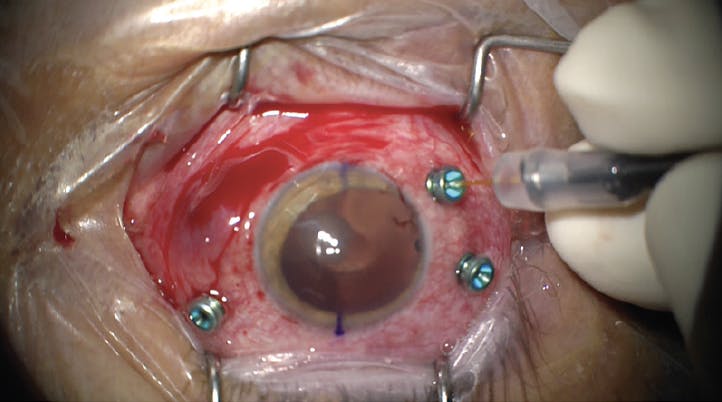
Figure 1. The Bausch + Lomb lighted infusion can be placed in the regular infusion trocar, avoiding the need for an extra sclerotomy in cases that may benefit from bimanual technique.
Case 1: SFIOL Placement
A 43-year-old man experienced a ruptured globe, traumatic cataract, intraocular foreign body, and retinal detachment in the right eye. He underwent ruptured globe repair, pars plana vitrectomy, lensectomy, removal of the intraocular foreign body, and repair of the retinal detachment with silicone oil tamponade; he was left aphakic. The patient also had a traumatic irregular pupil.
Six months after surgery, the retina remained attached, and we decided to proceed with silicone oil removal and placement of an SFIOL, using a trocar-assisted technique with a 3-piece IOL. The lighted infusion facilitated a bimanual technique to help move the IOL into position with one forceps so that a second forceps could grasp the tip of the haptic (Figure 2) to externalize it and place it in the intrascleral tunnel.1,2 The IOL was well-centered at this 3-month postoperative visit.
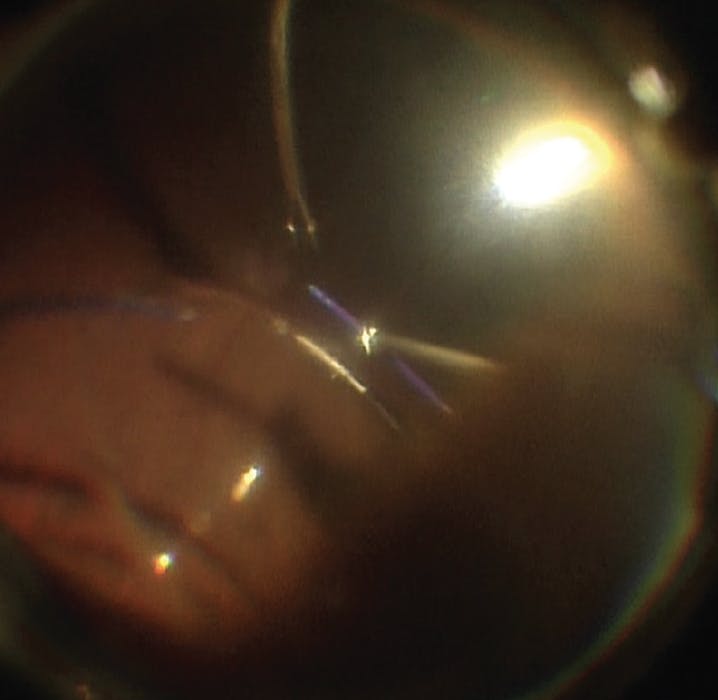
Figure 2. Bimanual technique for SFIOL cases involves using one forceps to move the IOL in an optimal position to be grasped at its tip by a second forceps for externalization through the trocar/scleral tunnel.
Case 2: Repair of Complex TRD
A 46-year-old man with a history of type 2 diabetes presented with a TRD in the right eye with hand-motions vision. His left eye previously underwent surgery for a TRD and has hand-motions vision. He had a tightly adherent tractional membrane across his macula and nasal retina (Figure 3).
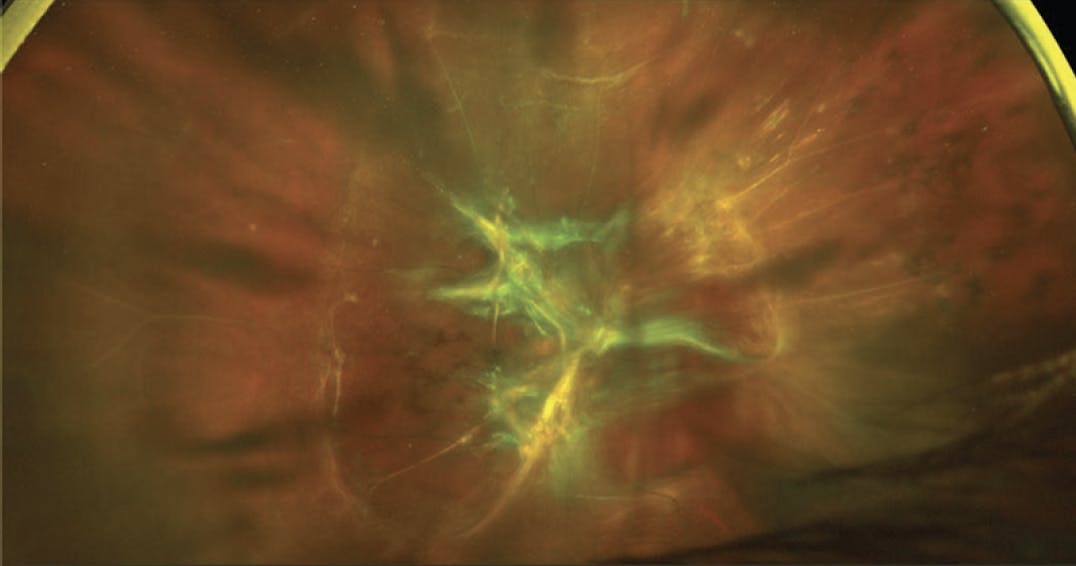
Using the cutter, we performed a vitrectomy and removed a portion of the tractional membrane. I employed a bimanual technique, facilitated by the lighted infusion, to remove the remainder of the most adherent portions of the tractional membrane. A fluid-air exchange was performed, and the retina flattened. Endolaser was applied around retinal breaks and in a 360° panretinal photocoagulation pattern. Silicone oil tamponade was placed in the eye, and all sclerotomies were sutured. The retina has remained flat under oil for 5 months (Figure 4) with plans for silicone oil removal.
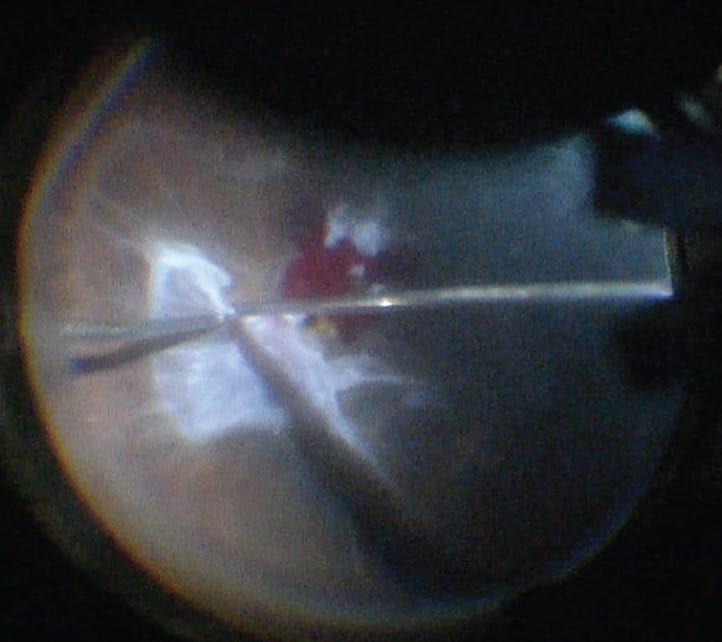
Figure 4. Bimanual technique for TRD repair cases involves using a forceps to elevate a flat, adherent tractional membrane to provide the space for the cutter to safely engage and remove the adherent membrane.
Discussion
Bimanual technique can be utilized to aid several different vitreoretinal surgeries. The ability to manipulate tissues or implants with two instruments can aid the completion of certain surgeries, such as the SFIOL and TRD cases described here.3,4 These cases demonstrate the utility of the illuminated infusion to facilitate bimanual techniques, avoiding the need for an extra sclerotomy with chandelier illumination.
Conclusion
The illuminated infusion is a helpful tool to facilitate bimanual techniques in vitreoretinal surgery.
Watch Related Case Videos on Eyetube
1. Patel KG, Yazdani A, Abbey AM. Twenty-five and 27-gauge sutureless intrascleral fixation of intraocular lenses: clinical outcomes and comparative effectiveness of haptic flanging in a large single-surgeon series of 488 eyes. Retina. 2021;41(12):2485-2490.
2. Patel LG, Starr MR, Ammar MJ, Yonekawa Y. Scleral fixated secondary intraocular lenses: a review of recent literature. Curr Opin Ophthalmol. 2020;31(3):161-166.
3. Shroff CM, Gupta C, Shroff D, et al. Bimanual microincision vitreous surgery for severe proliferative diabetic retinopathy: outcome in more than 300 eyes. Retina. 2018;38 Suppl 1:S134-S145.
4. Iyer SSR, Regan KA, Burnham JM, Chen CJ. Surgical management of diabetic tractional retinal detachments. Surv Ophthalmol. 2019;64(6):780-809.
