


Our Department of Ophthalmology (DoO) at University Hospital, Bonn, Germany (Head: Professor Dr. Frank G. Holz) specializes in researching and treating retinal diseases, particularly age-related macular degeneration (AMD). Both of us had had prior experience using the NIDEK MP-1S fundus-controlled perimetry (microperimetry) device, which includes scotopic function. When Dr. Ach introduced the Mirante SLO/OCT device (NIDEK) to our clinic this past year, we were excited to incorporate structural analysis of the posterior segment with NIDEK’s updated MP-3 type S device. The fundus-controlled perimetry provides functional analysis, including scotopic analysis. Using the two devices in tandem gives us more detailed information about the correlation of structural changes with topographic or spatially resolved functional losses of the retina.
Combining Structural and Functional Analysis in Clinical Research
Over the past few months, we have been developing software tools that overlay and correlate functional data from the MP-3 with structural data from the Mirante on the exact same location in the eye, as well as other modalities. Landmarks within these imaging modalities allow us to precisely overlay their view of an eye and correlate their data calculations, including functional data. The software (which is independent from NIDEK) allows us to not only report retinal function and structure at AMD-specific lesions in parallel, but to also correlate the data, and to do so for individual patients.
It is well known that retina function declines over time in eyes with dry AMD as the disease progresses. One of our research questions is whether functional decline correlates directly with specific morphologic lesion changes. Fundamentally, which comes first: does the decline in the eye’s function result in structural deterioration, or does its structure degrade first and cause functional decline? Ultimately, we believe it may be possible to build predictive models, or at least identify prognostic indicators that suggest a risk of progression. If we are able to discover key inciting events in the dry AMD cascade, we can then explore the question of whether and how to intervene at the very earliest stages of its pathophysiology to prevent structure-function loss associated with late-stage dry AMD.
Creating Flexible Microperimetry Patterns With the MP-3
We are conducting a two-part study with the NIDEK Mirante and MP-3. The first step is to use these devices to analyze dry AMD lesions to learn more about how they disrupt the eye’s normal, healthy structure and function. The MP-3 contains a customized pattern that we use in our clinic for research in AMD patients (Figure). Thanks to the Pattern Editor tool available in the MP-3, our team is attempting to develop additional test patterns that might be a better fit for AMD, and to get spatially resolved retinal sensitivity testing accepted as a new functional outcome measurement for clinical studies. We would like to develop test patterns tailored to each eye so we can identify certain structural lesions and then be able to adjust them for each patient. We are still in the process of developing those grids, because we have to integrate the data capture as an additional step in our outpatient procedures. At present, we have initiated a study aiming to enroll 150 patients with intermediate AMD being followed in Dr. Saßmannshausen’s clinic.
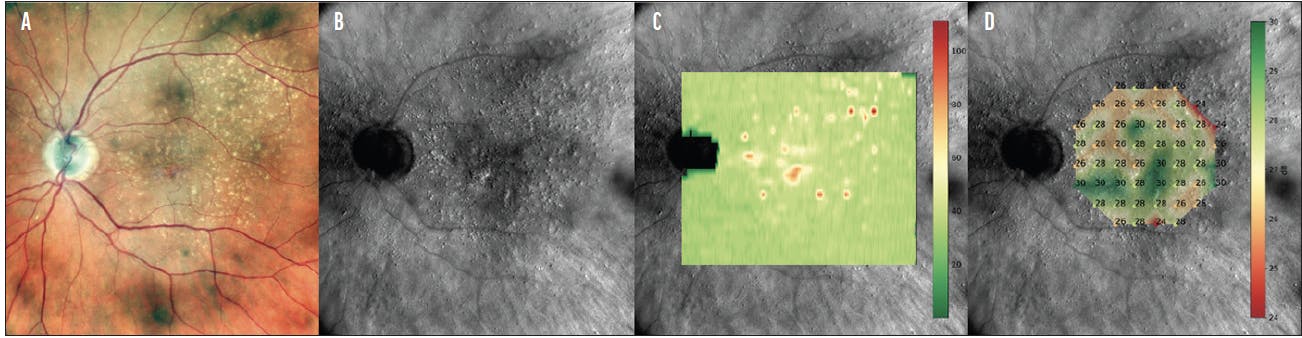
Figure. Multimodal retinal imaging of a patient with subretinal-pigment epithelium (RPE) drusen and reticular pseudodrusen (subretinal drusenoid deposits) secondary to intermediate AMD. From left to right: multicolor image (A), Retro mode image (B), Retro mode image with en-face projection of a heat map of the sub-RPE drusen volume extracted from the OCT (C), and the Retro mode image with the en-face projection of results deriving from mesopic microperimetry testing (D).
In the second part of the study, we will examine eyes without an AMD diagnosis and others that demonstrate early changes in the retina in the hopes of developing screening tools for AMD. Our hypothesis is that we will learn a great deal from a structure-function analysis of healthy eyes and those with early-stage AMD that will contribute to our overall understanding of progression.
One important outcome we hope to achieve with our research is to develop new endpoints that can be used in clinical trials. For example, most dry AMD treatment studies use the primary endpoint of slowing or preventing the progression of geographic atrophy. However, in the natural history of dry AMD, geographic atrophy is a slow process, and so it may not be the most ideal endpoint for short-duration clinical trials. What is needed are relevant biomarkers of change in geographic atrophy that can be followed in 12- to 24-month studies, which we believe we can derive from individualized structure-function analysis of the retina.
Conclusions
Although we are focusing here on the use of the Mirante and the MP-3 in clinical research, their usefulness in this setting derives from their clinical utility. The main advantage of the Mirante is the way it combines multiple functions, including color; autofluorescence in blue, green, and near-infrared; and Retro mode, fluorescein angiography, and indocyanine green angiography imaging in ultra-widefield and high-definition with Fly Through function and wide-area OCT. We do not have to switch our patients between devices or rooms to take various measurements, and we do not have to address compatibility issues between different devices. It gives us easy access to a full range of analyses. The Mirante is quite easy to handle and is effective and efficient to use, and so it would be useful to retinal specialists in private practice, particularly those with limited space.
Retina medicine has advanced significantly over the past 2 decades, and a fundamental driver of this change is that our field has gained access to new ways of gathering clinically relevant information. The evolution from time-domain to spectral-domain OCT is one example, and the recent trend toward an increased use of multimodal imaging is another. We believe an important next step in how we use clinical data will be to combine structure and function analysis in the early and/or intermediate stages of AMD. This capability will have direct clinical relevance for prognostic and predictive purposes, and if treatments become available, will also help drive decision-making. As well, analysis of structure-function relationships has great importance for clinical research, which in turn will impact the real-world management of eyes with dry AMD.
In short, the ability to assess structural and functional changes in the posterior segment of the eye over time will help us develop better endpoints for AMD clinical trials. Currently, there are no available treatments for dry AMD. The endpoint for clinical trials is late-stage AMD, yet the patients in our trial are a few years away from end-stage AMD. If we can pinpoint the correlation between structural and functional changes at specific timepoints, we may be able to delay the disease’s progression.
