

Despite remarkable advances in the treatment of neovascular AMD (nAMD), we still face the challenge of detecting conversions from dry to nAMD earlier. Only about one-third (34%) of patients who convert to nAMD have VA of 20/40 or better at conversion; the average is usually about 20/83.1 Our goal is not only to treat these patients but to identify them when they still have the potential to retain good vision with our current therapies. The ForeseeHome AMD Monitoring Program (Notal Vision Monitoring Center) was designed to help us do that.
About ForeseeHome
The ForeseeHome AMD Monitoring Program consists of three key elements.
1. First is the patient who uses the monitoring device at home to perform a basic preferential hyperacuity perimetry (PHP) test, which is analyzed by the program’s proprietary artificial-intelligence algorithm and sent to the Notal Vision Monitoring Center.
2. Second is the clinician who receives feedback from the program through a secure online portal and is alerted when a significant change from baseline is detected and warrants further evaluation. At each follow-up visit, I make a point of reviewing with patients how they’re doing with the system, offering consistent feedback and encouragement. When patients see that this is important to me, they understand that it’s important to them.
3. The third element is the Notal Vision Monitoring Center, which enrolls patients into the program and provides comprehensive patient education, training, and compliance management.
In the AREDS2-HOME study,2 this system worked very well, and in my practice it works well, but how does it work in many practices in the real world over time? Answering that question was the purpose of the ALOFT study.3
Long-term Results
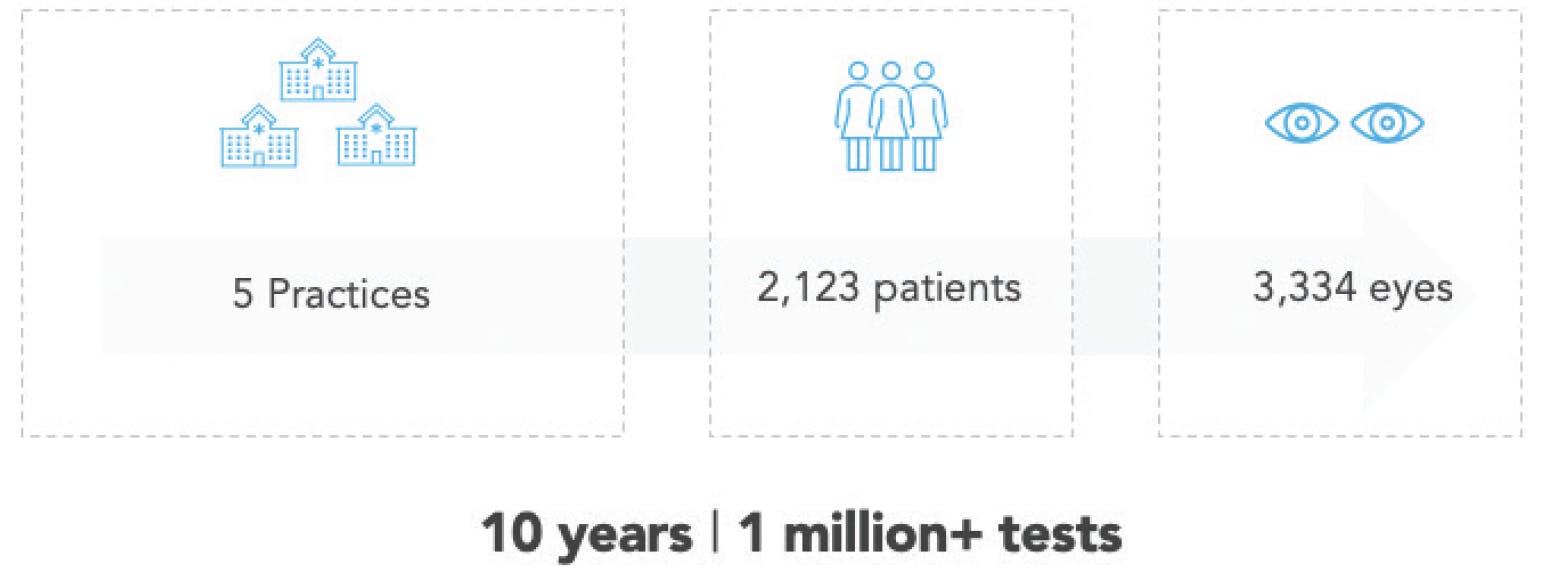
The ALOFT study enrolled 2,123 patients (3,334 eyes) with average baseline VA of 20/30 (Figure 1). Outcomes from the study were compared with real-world data from the IRIS® Registry of the AAO.3
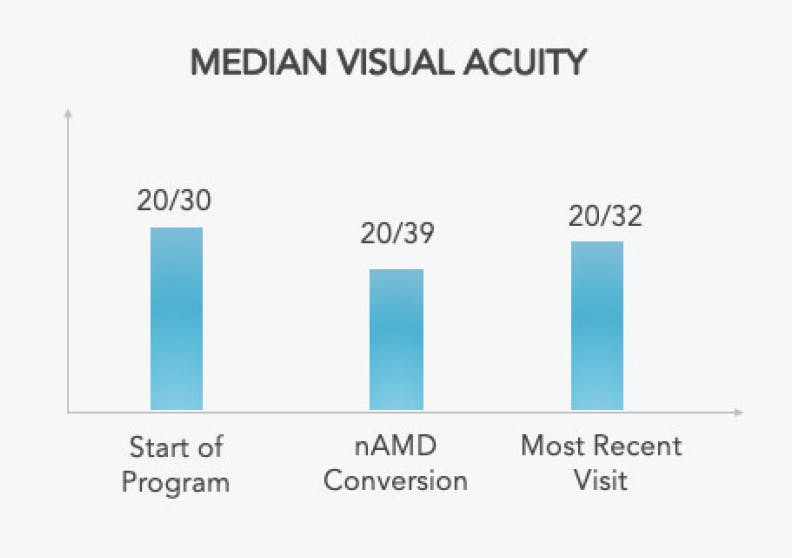
On average upon conversion to nAMD, VA was 20/39 before therapy was initiated. At the most recent visit, the ForeseeHome patients had achieved and maintained 20/32 VA (Figure 2). This was in contrast to patients in the IRIS Registry who had converted to nAMD and whose last available VA reading was 20/83.
As for compliance, patients tested an average of 5.2 times per week over 10 years. I believe this excellent compliance speaks to the patients’ understanding that this is an important safety net for them. This is underscored by consistent feedback and encouragement from physicians and staff, as well as engagement and support from the Notal Vision Monitoring Center. My practice has found referring patients to the service an easy and seamless process, where the monitoring center takes over all of the details after a simple prescription.
Proven Value of Earlier Detection
The ALOFT study showed us that the ForeseeHome AMD Monitoring Program can make an appreciable difference in our patients’ outcomes. We have the ability to potentially improve vision by starting treatment earlier and by maintaining treatment longer, regardless of the underlying reason. This program provides a model for remote monitoring in the future for medicine and particularly for ophthalmology.
1. Ho AC, Kleinman DM, Lum FC, et al. Baseline visual acuity at wet AMD diagnosis predicts long-term vision outcomes: an analysis of the IRIS registry. Ophthalmic Surg Lasers Imaging Retina. 2020;51(11):633-639.
2. AREDS2-HOME Study Research Group, Chew EY, Clemons TE, et al. Randomized trial of a home monitoring system for early detection of choroidal neovascularization home monitoring of the Eye (HOME) study. Ophthalmology. 2014;121(2):535-544.
3. Mathai M, Reddy S, Elman MJ, et al. Analysis of the long-term visual outcomes of ForeseeHome Remote Telemonitoring: the ALOFT study. Ophthalmol Retina. 2022;6(10):922-929.
