



Introduction
In September of 2021, the FDA approved ByoovizTM (ranibizumab-nuna, Biogen) as the first biosimilar to Lucentis (ranibizumab injection, Genentech) for the treatment of several eye diseases and conditions, including neovascular (wet) age-related macular degeneration (nAMD), myopic choroidal neovascularization (mCNV), and macular edema following retinal vein occlusion.1 The introduction of biosimilars in other disease areas, such as oncology and immune-mediated inflammatory diseases, has had a positive impact on disease management. These benefits may also be realized in ophthalmology. (See the two sidebars, What is a Biosimilar? and Assessing the Totality of the Evidence, for more information).
Notions of cheaper medications gaining regulatory approval and preferred status may engender concerns similar to those with step therapy mandates to use off-label anti-vascular endothelial growth factor (anti-VEGF) medications. We are all frustrated with the idea of mandates, but this would be different, particularly because biosimilars would be on-label and FDA-approved for the indication. More importantly, biosimilars offer some unique opportunities for our patients, and so it may be worth looking beyond the economic argument to understand their potential impact in real-world practice.
This supplement, supported by Biogen, and prepared in collaboration with Diana V. Do, MD, and David Brown, MD, has two purposes: (1) to provide information about biosimilars that we believe addresses prominent misconceptions about this class of medications; and (2) to update readers on the relevant data on the first FDA-approved biosimilar in ophthalmology, ranibizumab-nuna.
Why are we addressing biosimilars, a topic we know invites some skepticism from retina specialists? Because being skeptical—at first—about new things is natural, and we would argue, it’s healthy for our field if we are asking how that change will affect our patients and our practices. That said, we should also be willing to challenge the current treatment paradigm and ask if doing things a little differently in the clinic might have a positive impact on patients and the system. When it comes to biosimilars, they should have minimal impact on our clinical operations, but a potentially large impact on getting patients access to on-label anti-VEGF therapy and to health care resources more broadly.
It is worth noting that a similar sense of skepticism from the retina community greeted anti-VEGF drugs when they started to come into use: about whether they would be safe and effective; about whether they would be practical to use; and what the impact would be on our clinical workload. Yet, our field remained open to the possibility of change, and over time, anti-VEGF therapy has proven crucial in protecting the retinal health of millions of patients. That same spirit of open-mindedness should now be applied to biosimilars.
— Peter K. Kaiser, MD
1. FDA. FDA Approves First Biosimilar to Treat Macular Degeneration Disease and Other Eye Conditions. Available at: https://www.fda.gov/news-events/press-announcements/fda-approves-first-biosimilar-treat-macular-degeneration-disease-and-other-eye-conditions. Accessed October 25, 2022.
Assessing the nAMD Treatment Landscape
Peter K. Kaiser, MD: Over the past 2 decades, the treatment for nAMD has evolved with the revolutionary development of intravitreal anti-VEGF therapy (ITV). We also know from our experiences in the clinic that there are challenges in effectively deploying this intervention in our clinical practice. On the one hand, we have evidence that delaying treatment increases the risk of poor visual outcomes,1 as well as studies that show a positive correlation between the number of injections and an improvement in best-corrected visual acuity (BCVA).2 On the other hand, the treatment and monitoring burden is a barrier for patient adherence to the treatment schedule. Are there other considerations?
Diana V. Do, MD: Cost is an additional barrier nAMD patients face when they encounter the health care system. The mean annual outpatient cost associated with nAMD in the United States is about $11,000 per year.3 Although the cost per agent is variable, the majority of overall cost is due to the anti-VEGF agent. Our patients benefit from the variety of agents available in the clinic, but there is still a need for solutions that address this and other real-world barriers.
Dr. Kaiser: Other areas of medicine that have adopted biosimilars, such as oncology and rheumatology, have realized cost benefits to the patient and health care system.4 In one estimate, expanded use of biosimilars in the United States could generate close to $100 billion in cost savings by 2025.5 Biosimilars could represent a similar opportunity for ophthalmology in significantly reducing the costs of delivering care to our patients.
David Brown, MD: There are a couple of ways you can look at cost. A large percentage of the patient population in my clinic is covered by very large self-insured plans where the employer absorbs a large percentage of the cost. We can demonstrate a benefit to those plans with lower drug acquisition cost, which is great for employers, helping them to use those precious health care dollars for other services. The cost to patients is another thing. As mentioned, the cost is significant, and many of these patients rely on copay assistance programs. Anything we can do to help those patients afford their treatments is a win, because even small amounts of costs can be detrimental to patients who don’t have another income stream other than their social security.
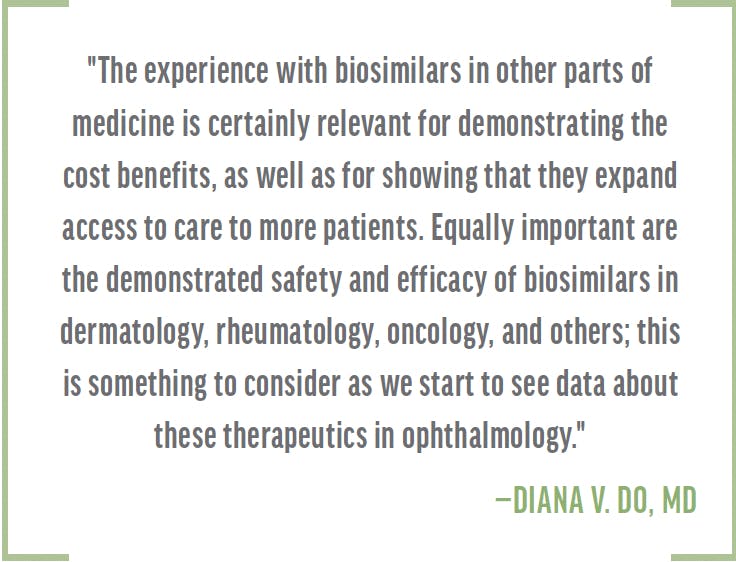
Dr. Do: The experience with biosimilars in other parts of medicine is certainly relevant for demonstrating the cost benefits, as well as for showing that they expand access to care to more patients. Equally important are the demonstrated safety and efficacy of biosimilars in dermatology, rheumatology, oncology, and others; this is something to consider as we start to see data about these therapeutics in ophthalmology.
Dispelling Myths Around Biosimilars
Dr. Kaiser: One of the key reasons biosimilars are more favorable in terms of cost is that they are subjected to a different development and regulatory pathway compared to originators. However, different does not mean a less rigorous regulatory pathway; it does mean that the FDA and other regulatory bodies consider a totality of evidence in making a determination if a biosimilar application is approved.
With biosimilars, regulators place more emphasis on analytical and comparative clinical and non-clinical studies versus the traditional clinical trials. From a regulatory perspective, if the biosimilar is demonstrated to be similar to the reference medicine analytically [analytical testing can be highly sensitive and often detects small differences that may not be detected clinically], it should be associated with similar safety and efficacy. Then, if a biosimilar manufacturer demonstrates similarity to a reference biologic in one disease state clinically, it might be granted approval for other indications on the reference product’s label based on a process called extrapolation. That is how we get a drug like ranibizumab-nuna, which was approved in a sensitive population of patients with nAMD, and then the drug also was approved for mCNV, and macular edema following retinal vein occlusion.
Dr. Do: The lower development costs also do not have an effect on the manufacturing and production process. In fact, all biologics manufacturers, whether they are originators or biosimilars, are required to demonstrate compliance with good manufacturing practices in their application for approval.
Dr. Kaiser: There is also some important context for understanding the clinical trial endpoints used to assess ranibizumab-nuna relative to the originator molecule (See Phase 3 Clinical Trial Data for Ranibizumab-nuna). For example, efficacy was assessed at 4- and 8-week endpoints for central subfield thickness and BCVA, respectively, which may incorrectly be perceived as a way to reduce cost, but that is not actually the case—in fact, there’s a good reason regulatory bodies are asking for reviews at those timepoints. In all of the pivotal anti-VEGF trials, the greatest variability of clinical response occurred early during the trial at 4- and 8-weeks post-injection. With biosimilars, if you can show similarity in the same timeframe, it makes a compelling argument that the two molecules are highly similar.
Dr. Kaiser: The 4- and 8-week endpoints refer to the efficacy outcomes. Of course, safety was followed for the full 52 weeks. These products are also subjected to rigorous post-market safety reviews.
Real-World Implications
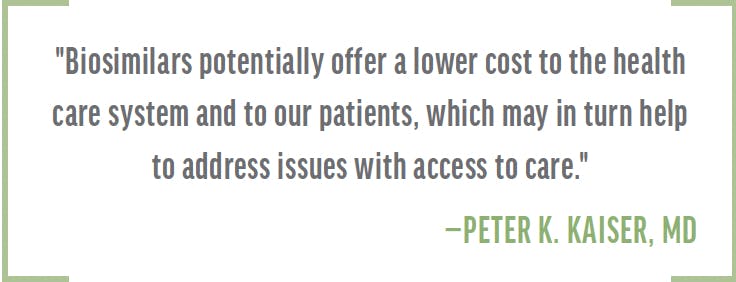
Dr. Kaiser: Biosimilars potentially offer a lower cost to the health care system and to our patients, which may in turn help to address issues with access to care. Although the potential benefits are manyfold, many retina specialists may wonder if the introduction of this category will be disruptive. Are there any market forces to be aware of that may spur adoption
of biosimilars?
Dr. Brown: Recent health care reform has introduced some incentives for biosimilars. The Centers for Medicaid and Medicare Services (CMS) prices reference biologics at average sale price (ASP) plus 6%; for eligible biosimilars, it’s ASP plus 8%. We know from experience that private payors tend to follow suit, and the cost factor is attractive to payors of all types. Insurance companies may have a significant voice in driving some of our practice in this respect. My personal perspective is that I am comfortable with the change, because I know the safety and efficacy data, and I am confident with how biosimilars are studied and produced. That said, there are a number of biosimilars coming to the ophthalmic market over the next 5 years, so there will be a need to differentiate.
Dr. Kaiser: What factors will you assess as the number of biosimilar options expands?
Dr. Brown: I will evaluate the company behind the product. You want to make sure it’s from a big company with experience in biosimilars. And then it’s about the services: the copay assistance programs, the replacement programs; you want to make sure that they offer education for your staff. You want to make sure the company supports you and your patients before you go forward.
Dr. Kaiser: What does the conversation sound like when you are switching or introducing a patient to biosimilars?
Dr. Brown: Part of my confidence with ranibizumab-nuna is that our center was involved in the clinical trial. We followed patients for safety, and we found nothing that alarmed us, so I would consider its on-label use for just about any patient for whom I am thinking about the reference ranibizumab. We have also found that patients’ acceptance and confidence could be leveraged by highlighting the in-depth and heavy testing programs biosimilars have to undergo in order to prove they are highly similar and be approved by regulatory bodies.
Some will appreciate the economic argument, but where we find the most success with that is in patients on copay assistance programs, especially if they are getting bilateral injections. Ranibizumab-nuna is an opportunity to potentially help those patients stretch their copay assistance dollars a little further.
Key Takeaways
- Anti-VEGFs are effective therapies that may prevent further vision damage and reverse vision loss in retinal vascular diseases,6,7 but more treatment options are needed to fit patients’ budgets and growing needs.8,9
- Biosimilars, which are distinct from generics in development requirements, manufacturing, and regulatory status, offer a favorable cost profile due to lower cost of development.
- Regulatory bodies around the world approve biosimilars predominantly on the weight of analytical evidence demonstrating similarity to a reference biologic medicine already on the market; as such, they are assumed to demonstrate similar biologic activity.
- Clinical trial data constitute a smaller portion of regulatory review; for biosimilars, clinical trial endpoints are designed to demonstrate comparable efficacy and safety as a reference biologic medicine.
- In September 2021, ByoovizTM (ranibizumab-nuna, Biogen) became the first FDA-approved biosimilar in ophthalmology on the basis of analytical data showing similarity to the reference biologic Lucentis, as well as phase 3 clinical trial data in an nAMD patient population, demonstrating comparable efficacy and safety, with additional follow-up to 52 weeks confirming the latter. It is also approved for mCNV and macular edema following retinal vein occlusion.
- Biosimilars offer an opportunity to introduce cost-friendly options into the treatment paradigm for nAMD and other retinal vascular diseases that benefit from VEGF inhibition.
Indications and Important Safety Information
INDICATIONS
BYOOVIZ™ (ranibizumab-nuna), a vascular endothelial growth factor (VEGF) inhibitor, is indicated for the treatment of patients with:
- Neovascular (Wet) Age-Related Macular Degeneration (AMD)
- Macular Edema Following Retinal Vein Occlusion (RVO)
- Myopic Choroidal Neovascularization (mCNV)
IMPORTANT SAFETY INFORMATION
CONTRAINDICATIONS
- BYOOVIZ is contraindicated in patients with ocular or periocular infections or known hypersensitivity to ranibizumab products or any of the excipients in BYOOVIZ
- Hypersensitivity reactions may manifest as severe intraocular inflammation
WARNINGS AND PRECAUTIONS
Endophthalmitis and Retinal Detachments
Intravitreal injections, including those with ranibizumab products, have been associated with endophthalmitis and retinal detachments. Proper aseptic injection technique should always be used when administering BYOOVIZ. In addition, patients should be monitored following the injection to permit early treatment should an infection occur
Increases in Intraocular Pressure
Increases in intraocular pressure have been noted both pre-injection and post- injection (at 60 minutes) while being treated with ranibizumab products. Monitor intraocular pressure prior to and following intravitreal injection with BYOOVIZ and manage appropriately
Thromboembolic Events
Although there was a low rate of arterial thromboembolic events (ATEs) observed in the ranibizumab clinical trials, there is a potential risk of ATEs following intravitreal use of VEGF inhibitors. Arterial thromboembolic events are defined as nonfatal stroke, nonfatal myocardial infarction, or vascular death (including deaths of unknown cause)
Neovascular (Wet) Age-Related Macular Degeneration
- The ATE rate in the three controlled neovascular AMD studies (AMD-1, AMD-2, AMD-3) during the first year was 1.9% (17 of 874) in the combined group of patients treated with 0.3 mg or 0.5 mg ranibizumab compared with 1.1% (5 of 441) in patients from the control arms. In the second year of Studies AMD-1 and AMD-2, the ATE rate was 2.6% (19 of 721) in the combined group of ranibizumab-treated patients compared with 2.9% (10 of 344) in patients from the control arms. In Study AMD-4, the ATE rates observed in the 0.5 mg arms during the first and second year were similar to rates observed in Studies AMD-1, AMD-2, and AMD-3
- In a pooled analysis of 2-year controlled studies [AMD-1, AMD-2, and a study of ranibizumab used adjunctively with verteporfin photodynamic therapy (PDT)], the stroke rate (including both ischemic and hemorrhagic stroke) was 2.7% (13 of 484) in patients treated with 0.5 mg of ranibizumab compared to 1.1% (5 of 435) in patients in the control arms [odds ratio 2.2 (95% confidence interval (0.8-7.1)]
Macular Edema Following Retinal Vein Occlusion
- The ATE rate in the two controlled RVO studies during the first 6 months was 0.8% in both the ranibizumab and control arms of the studies (4 of 525 in the combined group of patients treated with 0.3 mg or 0.5 mg ranibizumab and 2 of 260 in the control arms). The stroke rate was 0.2% (1 of 525) in the combined group of ranibizumab-treated patients compared to 0.4% (1 of 260) in the control arms
ADVERSE REACTIONS
- Serious adverse reactions related to the injection procedure have occurred in < 0.1% of intravitreal injections, including endophthalmitis, rhegmatogenous retinal detachment, and iatrogenic traumatic cataract
- The most common adverse reactions (reported more frequently in ranibizumab- treated subjects than control subjects) are conjunctival hemorrhage, eye pain, vitreous floaters, and increased intraocular pressure
- As with all therapeutic proteins, there is potential for immunogenicity. The clinical significance of immunoreactivity to ranibizumab products is unclear at this time
Please see full Prescribing Information.
1. Navarrete A, Vofo B, Matos K, et al. The detrimental effects of delayed intravitreal anti-VEGF therapy for treating retinal pathology: lessons from a forced test-case. Graefes Arch Clin Exp Ophthalmol. 2022;260(7):2201-2208.
2. Moshfeghi AA, Pitcher JD, Lucas G, et al. Visual acuity outcomes in patients receiving frequent treatment of neovascular age-related macular degeneration in clinical practice. J VitreoRetinal Dis. 2021;5(3):221-226.
3. Almony A, Keyloun KR, Shah-Manek Bet al. Clinical and economic burden of neovascular age-related macular degeneration by disease status: a US claims-based analysis. J Manag Care Spec Pharm. 2021;27(9):1260-1272.
4. IQVIA Institute. The impact of biosimilar competition in Europe. September 2018. https://ec.europa.eu/docsroom/documents/31642/attachments/1/translations/en/renditions/pdf. Accessed February 2022.
5. IQVIA Institute. Global medicine spending and usage trends: outlook to 2025. IQVIA April 2021. https://www.iqvia.com/-/media/iqvia/pdfs/institute-reports/global-medicine-spending-and-usage-trends-outlook-for-2025/iqvia-institute-global-medicines-and-usage-trends-to-2025-0421-forweb.pdf. Accessed February 2022.
6. Bakri SJ, Thorne JE, Ho AC, et al. Safety and efficacy of anti-vascular endothelial growth factor therapies for neovascular age-related macular degeneration: a report by the American Academy of Ophthalmology. Ophthalmology. 2019;126(1):55-63.
7. Thomas CJ, Mirza RG, Gill MK. Age-related macular degeneration. Med Clin North Am. 2021;105(3):473-491.
8. Hariprasad SM, Gale RP, Weng CY, et al. An Introduction to biosimilars for the treatment of retinal diseases: a narrative review. Ophthalmol Ther. 2022;11(3):959-982.
9. Oshima Y, Ishibashi Y, Umeda N, et al. Correlation between improvement in visual acuity and QOL after Ranibizumab treatment for age-related macular degeneration patients: QUATRO study. BMC Ophthalmol. 2021;21(1):58.
