


NIDEK is pleased to announce the 3rd Annual NIDEK IMAGEs OF THE YEAR Award. While continuing the theme “invisible to visible,” this year’s contest highlighted how the Mirante Scanning Laser Ophthalmoscope (NIDEK) helps retina specialists find obscure anatomical structures with its multiple imaging techniques, especially its unique Retro mode modality.
Eye care professionals from around the world voted online to choose a striking set of color and Retro mode images captured by the Mirante. The winning images for 2022 come from Guido Ricciotti, MD, and Alexandra Miere, MD, PhD, from the Department of Ophthalmology, Centre Hospitalier Intercommunal de Créteil, France.
We have been using the Mirante, developed by NIDEK, for approximately 6 months. Generally, we use the device’s Retro mode imaging modality for most of our retina patients to see what features of the macula we can detect compared with other imaging techniques. For certain diseases, such as optic disc drusen, we find that Retro mode produces a better image compared to fundus autofluorescence. The benefit of the Mirante device is that it offers multiple imaging techniques in one machine.
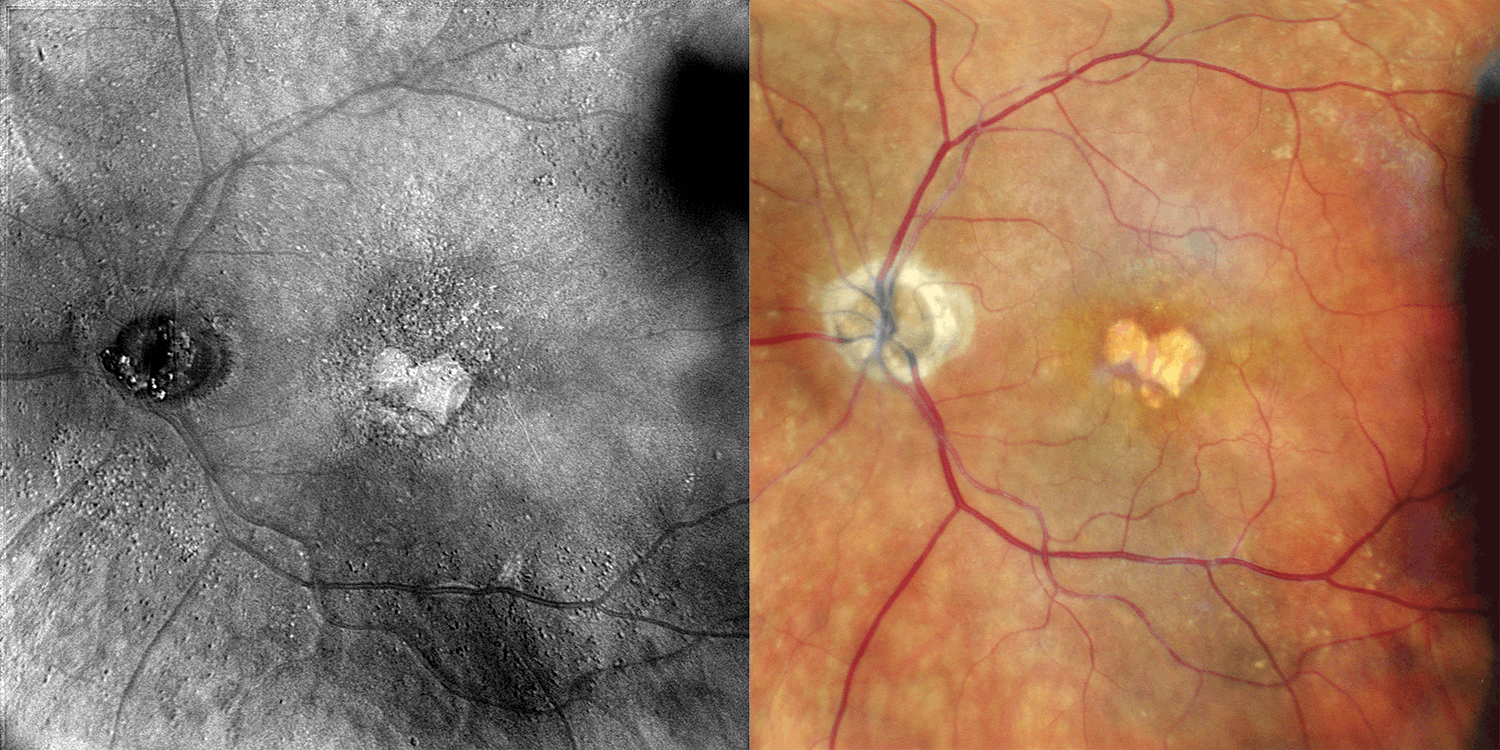
Figure. Retro mode (left) and Multicolor (right) images of a 93-year-old male with macular atrophy captured by the Mirante Scanning Laser Ophthalmoscope (NIDEK). Both Retro mode and Multicolor images show the macular atrophy borders, while the Retro mode shows pseudo-3D representation of the drusenoid deposits.
Presentation
This is the case of a 93-year-old male patient whom we have been following at Créteil University Hospital since 2009 for age-related macular degeneration (AMD) and primary open-angle glaucoma (POAG). At his first visit, the patient’s BCVA was 20/25 OD and 20/40 OS. Over time, he developed macular neovascularization in both eyes, which we treated with intravitreal anti-VEGF injections. Despite the treatment, the patient progressively developed macular atrophy that resulted in poor residual visual acuity (20/160 OD and 20/125 OS). We have found no neovascular complications in this patient.
Advantages of Retro Mode Imaging
We took images of the patient’s left eye using Multicolor and Retro mode performed with the Mirante (Figure). The macular atrophy is clearly visible in both the Retro mode (left) and Multicolor (right) images, with the former providing a pseudo-3D visualization of the outer retinal changes. Retro mode is particularly useful in determining the extent of the macular atrophy, because it clearly delineates the borders of the lesion. Additionally, the imaging technique allows us to identify drusenoid deposits, which appear as small concave or convex crater-like lesions surrounding the macular lesion.
Another important feature that we can clearly detect with Retro mode is superficial optic disc drusens (ODD). The shape, borders, and distribution of superficial ODD are very clear in the Retro mode.
Ongoing Monitoring and Discussion
We implemented regular monitoring of this patient’s condition every 6 months using the Mirante, in addition to other imaging techniques like OCT, fundus autofluorescence, and fundus photography, to track the evolution of his macular atrophy.
Overall, this case highlights the importance of regular monitoring and imaging in the management of AMD, as well as the usefulness of advanced imaging techniques such as Retro mode in identifying specific features of the disease.
WHAT IS RETRO MODE?
Retro mode is a unique noninvasive technique for detecting pathologic changes in the retina.
This imaging modality uses scattered IR light to detect abnormal reflections in the retina caused by drusen, edema, and other subtle chorioretinal pathologies.
