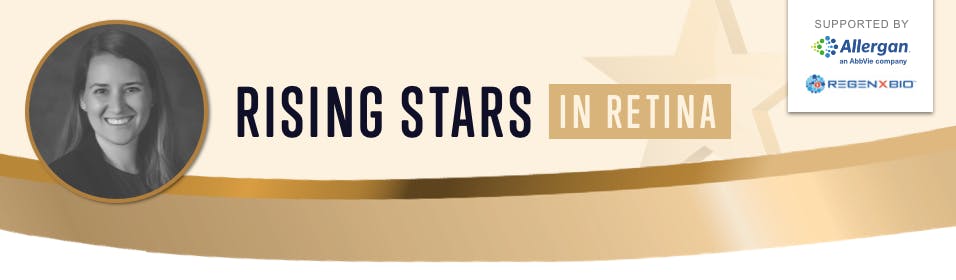

Retina Today: When did you first know that you wanted to become a retina specialist?
During college and medical school, I thought I was going to pursue neurosurgery. Then I spent a Howard Hughes Medical Institute research year at Boston Children’s Hospital, where I met Mary Whitman, MD, PhD, and David Hunter, MD, PhD. They welcomed me into their clinics and showed me that ophthalmology was a better fit. During my residency at Duke, I was fortunate to work with several phenomenal retina attendings and fellows on cutting-edge research and learn from them in the clinic and OR. The complexity of retinal pathology, imaging technology, and the excitement in the field for innovations to restore vision solidified my decision.
First Career Milestone
Dr. Michalak will be practicing adult and pediatric retina at Dartmouth Hitchcock Medical Center in Lebanon, New Hampshire.
RT: Who do you look to as mentors in the field?
As is likely the case for most retina fellows, I wouldn’t be where I am now without my mentors. At Duke, I was lucky to work closely with Lejla Vajzovic, MD, and Cynthia Toth, MD. They included me in every aspect of the retina department, even as a resident: teaching me vitreoretinal surgical principles, integrating me into weekly vitreoretinal rounds, and showing me how to conduct clinical trials. In fellowship at Stanford, I have been in awe of each member of our retina faculty and consider all of them to be my mentors, particularly my fellowship director, Prithvi Mruthyunjaya, MD. I am constantly impressed by their dedication to teaching while providing exceptional clinical and surgical evidence-based care.
RT: What has been one of the most memorable experiences of your fellowship thus far?
One weekend, I received a consult from an outside hospital about a patient with a VA of light perception from endogenous endophthalmitis. Due to a nursing strike, the patient could not be easily transferred, and Darius Moshfeghi, MD, immediately requested emergency privileges so we could perform a bedside tap and inject at the outside hospital. At that time, we noted that the patient also had a retinal detachment. Dr. Moshfeghi and Ehsan Rahimy, MD, worked tirelessly to transfer the patient to Stanford, where we performed bilateral, sequential vitrectomies the following evening. Miraculously, the patient eventually regained his baseline vision.
Other memorable experiences include sailing in a regatta with my mentors in Dubrovnik, Croatia, at the Club Jules Gonin meeting and countless hours discussing cases with my amazing co-fellows.
RT: What are you hoping to accomplish once you are in practice?
My goals are to provide exceptional, compassionate retina care to patients of all ages and to mentor future generations. I have been very involved in research during residency and fellowship and plan to continue working to further our knowledge as a field.
RT: What advice can you offer to residents who are considering retina?
Retina can seem intimidating from the outside, but the field is full of incredible and kind people who are eager to help. In addition to rewarding bread-and-butter retina, you can become an expert in complex proliferative vitreoretinopathy, secondary IOLs, pediatric retina, ocular oncology, or uveitis. There is something for everyone! Please reach out if there’s anything I can do to help.
