


Summary
On February 17, 2023, Apellis Pharmaceuticals, Inc. (Apellis) received approval by the U.S. Food and Drug Administration (FDA) for SYFOVRE® (pegcetacoplan injection) as the first treatment for geographic atrophy (GA) secondary to age-related macular degeneration (AMD). The approval was based on the ability of SYFOVRE to reduce the rate of GA lesion growth and a well demonstrated safety profile following approximately 12,000 injections in the phase 3 DERBY and OAKS studies. No cases of vasculitis were identified in any of the SYFOVRE clinical trials, representing more than 24,000 injections to date. In the spring, initial cases of retinal vasculitis were reported with use of SYFOVRE in the real world. With an estimated 73,000 real-world injections performed as of August 22nd, these cases have been rare and sporadic, at a rate of approximately 0.01% per injection. Notably, only three confirmed cases of infectious endophthalmitis were reported for the same period, or approximately 0.005% per injection. The objectives of this paper are to:
- Present insights on case reports of retinal vasculitis and how Apellis actively monitors and adjudicates these events.
- Discuss why Apellis issued a field correction related to the 19-gauge filter needles included in certain Apellis injection kits (images included in Figures 1-3)
The following common questions are associated with these rare events. For the subsequent description of the events, the last data cut of August 22, 2023, has been used.
How have the rare cases of retinal vasculitis presented following treatment with SYFOVRE?
Patients developed visual symptoms from eight to 18 days following treatment with SYFOVRE with a median of 11 days. Reported cases of retinal vasculitis had a broad spectrum of clinical presentation. Some cases had focal intraretinal hemorrhages and vascular leakage, while others presented with peripheral non-perfusion. One case presented with fibrin in the anterior chamber similar to an endophthalmitis clinical presentation. There have been no consistent unifying factors from medical history across all patients. Some of the variables that were considered in Apellis’ investigation included prior or concomitant use of anti-VEGF therapy, history of glaucoma, and previous COVID vaccination. One case that was originally reported by the physician as intraocular inflammation (IOI)/suspected retinal vasculitis was adjudicated by two external review processes: an external panel of retina experts, and a reading center. The determination by both parties was not retinal vasculitis but rather peripapillary choroidal neovascularization (CNV) and IOI. This demonstrates the complexity of these cases and the fact that the diagnosis of retinal vasculitis can be challenging.
One of the most critical data points to follow is the visual outcome of the patients, and varying results have been observed. To date, the majority of cases have resulted in partial or full recovery of vision, although some cases were associated with severe visual impairment. Long-term follow up may be required to determine visual outcomes.
How are cases evaluated and reported?
Drug Safety and Pharmacovigilance is an integral part of Apellis’ process and culture, safeguarding patient safety at all times.
Apellis’ Safety & Medical Team reviews all post-market events reported with SYFOVRE. Any new suspected events of IOI, including retinal vasculitis, are systematically assessed and adjudicated based on all available information. Where information is missing, targeted follow-up (i.e., specific questionnaire, collection of imaging) is performed by internal Apellis team members. Requested data includes baseline patient characteristics, imaging (angiography, OCT, fundus photography) and long-term visual outcomes. All suspected retinal vasculitis cases are also independently evaluated and adjudicated by two external sources: a panel of four retina and uveitis experts (Thomas Albini, M.D., Carl Regillo, M.D., Charles Wykoff, M.D, PhD, and Steven Yeh, M.D.), and an independent reading center, Digital Angiography Reading Center (DARC). Key major criteria to identify cases of retinal vasculitis include:
- Retinal vessel leakage observed on fluorescein angiography (FA)
- Optic nerve leakage observed on FA
- Retinal vascular occlusion observed on FA (for occlusive cases only)
- Vessel sheathing on fundus photography
Apellis submits all reported adverse events to the FDA and other applicable Regulatory Agencies consistent with reporting guidelines and regulations for drug manufacturers. Apellis and the American Society of Retina Specialists (ASRS) Research and Safety in Therapeutics (ReST) Committee are in close communication regarding reported cases of retinal vasculitis following SYFOVRE treatment. While the adjudication of vasculitis may differ between ASRS and Apellis, the visual outcomes are most important, and are monitored closely by both parties.
The cases of confirmed and suspected retinal vasculitis are described in the table below. The cases have occurred sporadically over time, with two in April, four in May, three in June, and one in August.
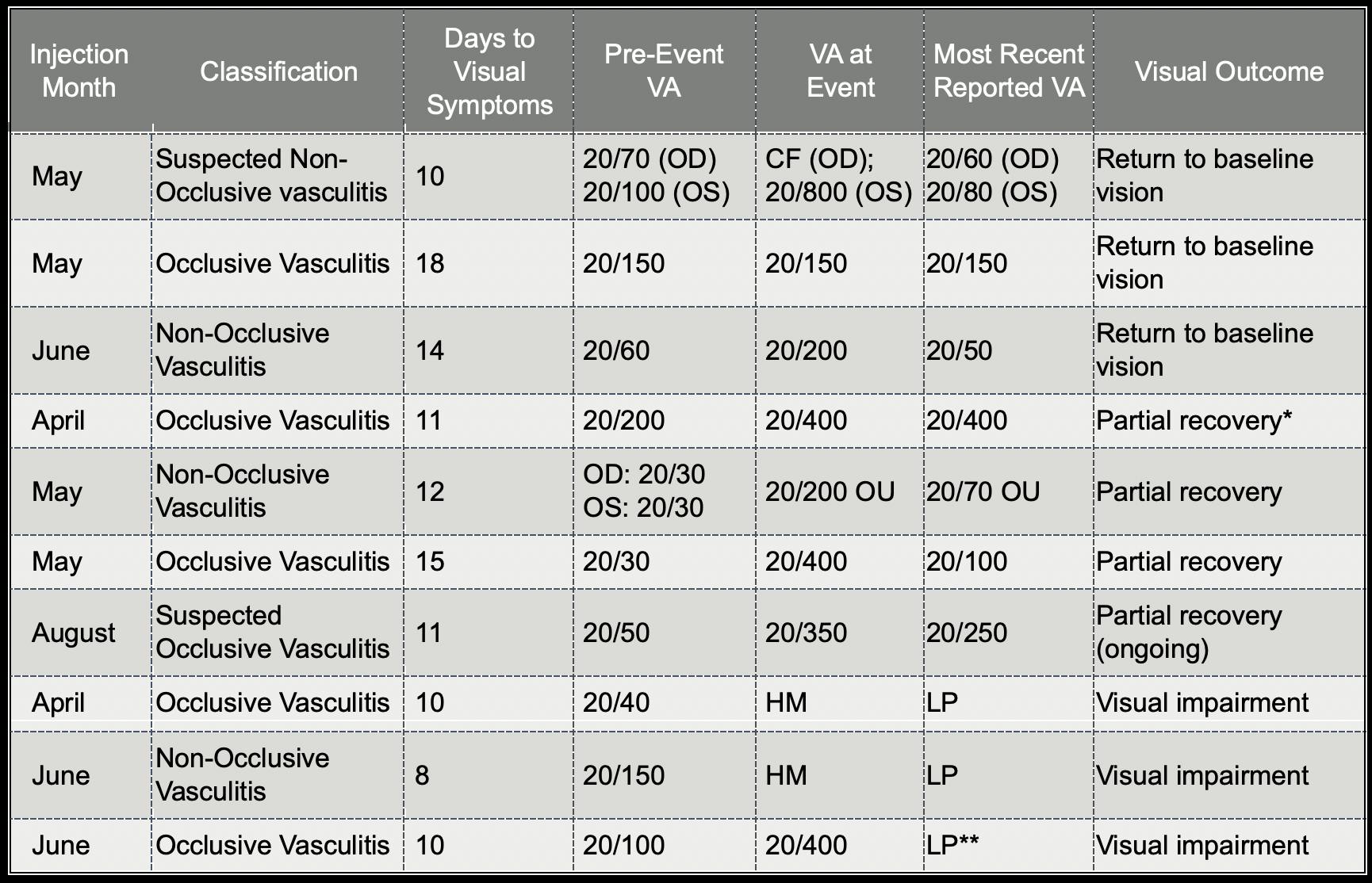
Table of events is as of August 22, 2023
*Post event worst VA was reported as “hand motion” and improved back to VA 20/400. In addition, the event of “occlusive vasculitis” was reported as resolved.
**Post event worst VA was reported as “NLP” and improved back to “LP”, as reported by the physician.
Why did Apellis issue a field correction on the 19-gauge filter needle included in the Apellis injection kits?
Zero cases of retinal vasculitis were identified in the clinical trials; thus, a critical focus of the investigation has been to analyze the differences between the real-world experience and the clinical trials with SYFOVRE. One notable difference is that in the clinical trials, a vial adapter with a 5-micron filter was used to extract SYFOVRE from the vial in which it was provided. For SYFOVRE commercial product, a filter needle was used as these are more commonly used with intravitreal injections.
In order to meet demand and build redundancy in the supply chain, one of two types of filter needles (18-gauge and 19-gauge) were provided in the injection kits supplied to physicians. The 19-gauge filter needle contains a monofilament nylon, woven mesh filter. The 18-gauge filter needle has a three-dimensional, microscopically porous filter, which is the same filter material included in the vial adapter used in the clinical trials. Notably, the 18-gauge filter needle was also used with certain subjects during the early clinical trial experience.
During the investigation of these two filter needles, Apellis found structural variations associated with the 19-gauge filter needle that caused concern. Specifically, the nylon mesh in certain 19-gauge filter needles had non-optimal features, such as double- or triple-packed filters, exposed filter material, or inadequate filter seams. These variations present a potential risk of device-related particulates inadvertently being introduced into the eye. The variations were found with light microscopy and high-resolution computed tomography (CT) scanning performed by an external vendor. Below are images of the structural variations observed in these 19-gauge filter needles.
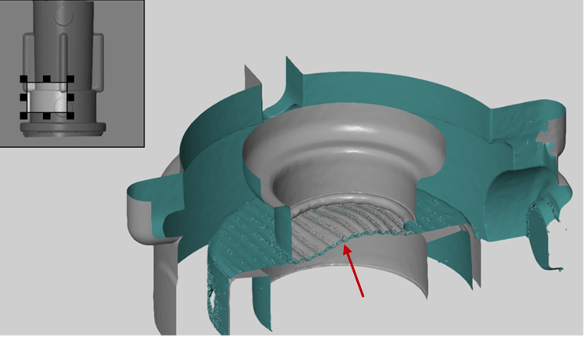
Figure 1 Computed Tomography (CT) scan cross-section view of the 19g Filter Needle demonstrating optimal construction with single filter (arrow).
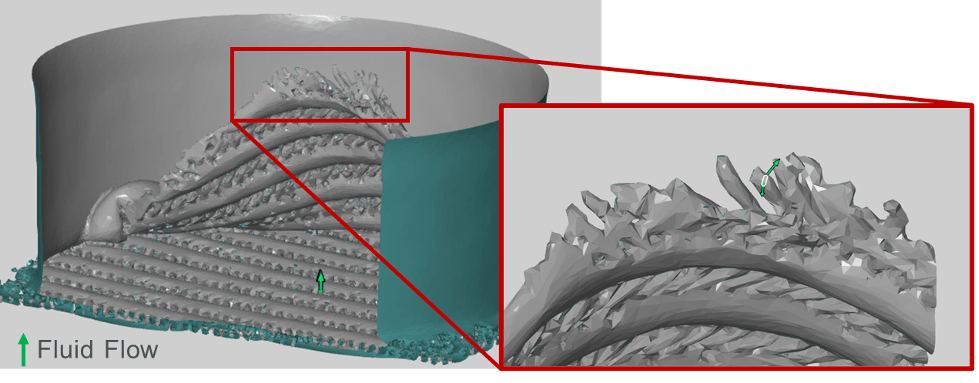
Figure 2 CT cross-section view of a 19g Filter Needle inadvertently manufactured with two filters with one only partially sealed. The inset image shows the edges of the second nylon filter material exposed to the syringe side of the fluid path.
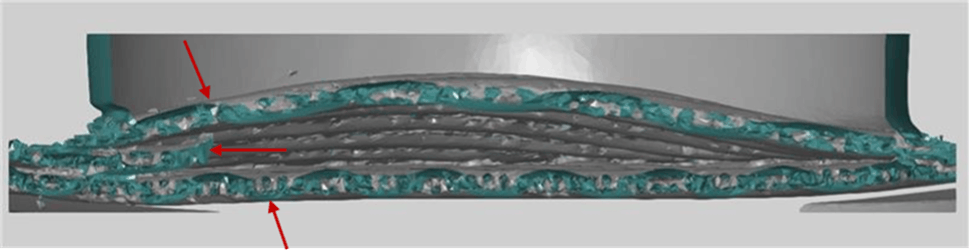
Figure 3 CT cross-section view of a 19g Filter Needle inadvertently manufactured with three filters (arrows). One filter has unsealed edges in the fluid path.
A statistical analysis was conducted to determine probable association with either the 18-gauge or 19-gauge filter needle used in each of the cases of vasculitis. This analysis consisted of assigning a case of vasculitis to a particular needle when the association was known, and to assign probabilities to either needle based on the number of 18-gauge versus 19-gauge filter needles distributed to the physician practice (or distribution center, if site information was not available).
Based on this analysis, there was more than a five-fold difference between the 18-gauge and 19-gauge filter needles in the estimated per-injection rate of retinal vasculitis. The estimated rate associated with the 19-gauge filter needle was 1 in 5,600 injections, and the estimated rate associated with the 18-gauge filter needle was 1 in 32,000 injections.1 As of the cutoff date of this analysis, supply chain shipment data has estimated that approximately 69% of post-marketing injections utilized the 19-gauge filter needles and the remaining 31% utilized the 18-gauge needles.
While no definitive causal relationship may be established, based on these findings and out of an abundance of caution, Apellis decided to issue a field correction and remove the 19-gauge filter needles from circulation.
Will there be more cases of vasculitis?
Yes, retinal vasculitis occurs in the general population at an annual rate of 1-2 per 100,000 people and has been associated with all types of intravitreal injections.2
It will take time to evaluate the potential impact of the exclusive use of the 18-gauge needle on the vasculitis case rate associated with the use of SYFOVRE. The rate remains at 0.01% per injection and will be tracked over time as usage of SYFOVRE continues. Should there be a change in the rate, Apellis will continue to notify the retina community to ensure physicians have the information needed to make the best decisions for patients.
Conclusion
SYFOVRE, the first FDA-approved treatment for GA, has been available to patients in the U.S. since February 2023. In the spring, rare cases of severe IOI associated with retinal vasculitis started to emerge as an adverse event associated with treatment. To date, these cases are rare with a rate of approximately 0.01% per injection. This rate was established after a thorough analysis of real-world evidence following more than 78,000 vials shipped since launch (as of August 22, 2023), and has remained consistent in the months since the initial cases were reported. While in some cases severe vision loss has occurred, the majority of cases resulted in partial or full recovery of vision.
While the root cause may not be determined, an association was found with the use of the 19-gauge filter needle that is provided in some of the injection kits. These needles have been removed from distribution but may still be found in storage in individual practices. Practitioners are encouraged to immediately discontinue use of, remove from inventory, and dispose of any remaining injection kits that contain the 19-gauge filter needle, and recommend that practitioners use the injection kits with the 18-gauge filter needle. Additional recommendations include:
- Closely follow the FDA-approved label instructions when drawing up the product.
- Due to the viscosity of SYFOVRE, let the product fill the syringe slowly over approximately 30 seconds. During this process, avoid unnecessary manipulations of the syringes or needles, such as aggressive plunging.
- Intravitreal injections with SYFOVRE should be done with the thin-wall 29-gauge needles that are provided with the injection kits. SYFOVRE is not approved for use with 30-gauge injection needles to perform intravitreal injections.
Apellis has committed to partner with the retina community to provide further updates on SYFOVRE safety, and long-term outcomes.
What should I do if I have a suspected case of vasculitis following use of SYFOVRE?
Any safety information should be reported to Apellis Safety (via Med Info):
- Phone: 1-833-866-3346
- Email: medinfo@apellis.com
- Minimum information to be included
- Patient identifier (e.g., date of birth, age, gender)
- Description of event(s)
- Apellis product
- Reporter’s contact details
1. Estimation was based on adjudicated cases with a data cut-off date of 8/19/2023
2. Hughes EH, Dick AD. The pathology and pathogenesis of retinal vasculitis. Neuropathology and applied neurobiology. Aug 2003;29(4):325-340
MED-US-PEGGA-23-00256
