

WHERE IT ALL BEGAN
As a native of Vancouver, British Columbia, it comes as no surprise that Scott Walter, MD, wanted to be a ski lift architect as a child. It wasn’t until his senior year at Stanford that he began to consider medicine as a career. After completing a master’s in evolutionary anthropology, he landed at the University of Pennsylvania for medical school. A serendipitous 1-week clerkship in ophthalmology opened his eyes to the breadth of pathology that ophthalmologists treat, and he was hooked. It was the perfect specialty for him, “combining surgery and longitudinal patient care without being tied to the hospital,” he said.
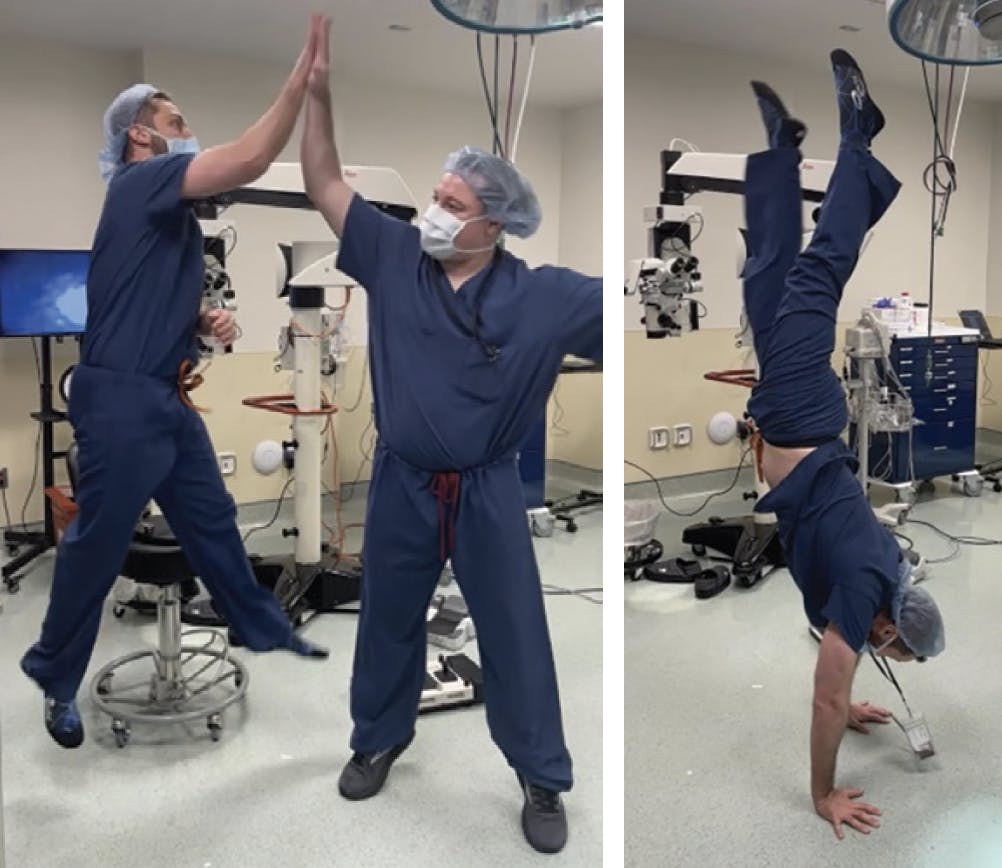
Dr. Walter’s Advice: Don’t rule out private practice, even if you’re an academically minded retina specialist. There’s tremendous opportunity to thrive in this space.
HIS PATH TO RETINA
Dr. Walter’s love of retina was apparent during residency at the Bascom Palmer Eye Institute in Miami. He gained significant experience performing intravitreal injections, lasers, and surgery for patients with advanced stages of diabetic eye disease. Dr. Walter also worked with Harry W. Flynn, MD, to launch the Diabetic Retinopathy Pipeline Project, connecting underserved patients with primary care services. For Dr. Walter, it was an important contribution to the local community and a turning point in his career—the start of “a lifelong passion for all things retina.”
SUPPORT ALONG THE WAY
Dr. Walter attended the Duke Eye Center in Durham, North Carolina, for his vitreoretinal surgery fellowship. He connected with Duke faculty member Lejla Vajzovic, MD, a former Bascom Palmer resident. He was inspired by Dr. Vajzovic’s growth as a surgeon and the innovative thinking she brought to the OR early in her career. Together, they used intraoperative OCT to create a dynamic 3D model of platelet-rich plasma in complex macular hole surgery.
Sharon Fekrat, MD, was another inspirational mentor. On his VA rotation, Dr. Walter was confronted with an influx of patients requiring secondary IOLs. Dr. Fekrat encouraged him to try not one but three new techniques, and then write about each of them in the Duke Manual of Vitreoretinal Surgery.
Dr. Walter was inspired by Prithvi Mruthyunjaya, MD, MHS, to combine a career in retina with ocular oncology. He returned to Bascom Palmer for additional post-fellowship training in ocular oncology with former research mentor, J. William Harbour, MD, before establishing himself in private practice as the only ocular oncologist in Connecticut.
Dr. Walter was the first “out” resident at Bascom Palmer. He is grateful for the emergence of visible LGBTQ+ leaders within the field, including Vivienne S. Hau, MD, PhD, with whom Dr. Walter worked closely to establish the Underrepresented in Retina Mentorship Program.
AN EXPERIENCE TO REMEMBER
Dr. Walter cherishes “the intensity of the specialty,” he said. Recently, he and a visiting medical student performed nine vitrectomies, including two combination cases with an anterior segment surgeon, quickly changed out of their scrubs into suits, and traveled to New York City to give a talk to the fellows and faculty at New York University.
In addition, he loves the variety of complex cases he sees in private practice and the doors they open, including the opportunity to perform the first autologous retinal transplant and retinal gene therapy in Connecticut.
