WHERE IT ALL BEGAN
Coming from a family of doctors, I was eager to buck the tradition after studying political science and philosophy at Carleton College in rural Minnesota. I took a job in marketing at General Mills and was in charge of new product development for the Fruit Roll-Ups franchise. However, I realized that I didn’t want my boss’s job, so I began to evaluate other careers. Hearing my family talk about their job satisfaction in caring for patients and the intellectual challenge and stimulation of medicine drew me back into the family business. I completed a post-baccalaureate at Bryn Mawr College and then spent a year working in a pediatric obestity clinic at the University of California San Francisco (UCSF) while I applied for medical school—perhaps a redemption for my time selling all those fruit snacks.
I then attended the University of Pennsylvania for medical school and also completed an MBA at Wharton. I enjoyed the creative aspects of business and wanted to see if I could find training and a career in which I could still engage that creativity.
MY PATH TO RETINA
I very much remember the first time I looked through the microscope to see a retinal detachment repair during medical school. It was an incredible opening to a secret 3D world that required many instruments, techniques, and knowlege. I was hooked.
SUPPORT ALONG THE WAY
I am fortunate to have many wonderful mentors. First and foremost is my uncle, Dan Schwartz, MD, a retina specialist at UCSF who has been a model for my career with numerous, creative high-impact projects in retina and beyond. I now share an office with him at UCSF, so we frequently discuss science, patients, and San Francisco sports. Other wonderful mentors include Eugene De Juan, MD; Cynthia A. Toth, MD; and Mark S. Blumenkranz, MD, MMS, all of whom have been role models in their development of new technologies and outstanding academic careers. Each of these mentors has guided me, supported my research, and become a lifelong friend.
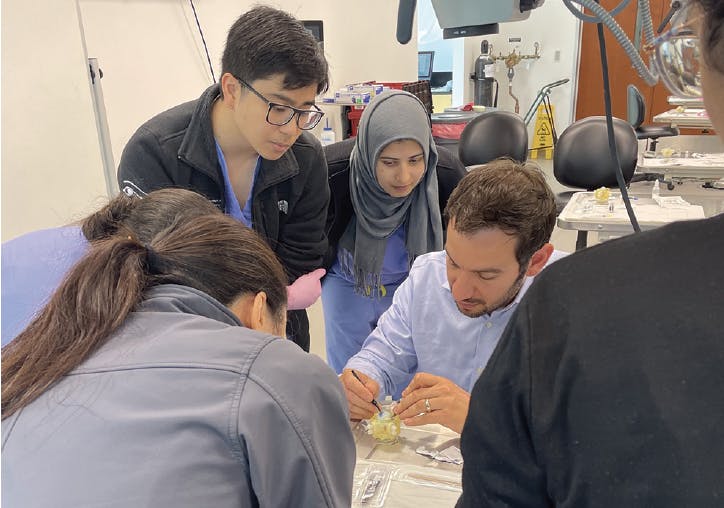
Dr. Brodie’s advice: Time is by far the most valuable asset. Worry less about your salary and more about how you will spend your time. Make sure you have great partners; they will be the ones caring for your patients, teaching you, and supporting you. I couldn’t ask for better partners, and it makes the job infinitely more fun and satisfying.
AN EXPERIENCE TO REMEMBER
Prior to vitreoretinal fellowship I took a postdoctoral year at Stanford in Ophthalmic Device Innovation. My team developed a new type of intraocular surgical device, and saw the project through from the earliest prototypes to 3D models and testing with ex vivo pig eyes. We patented the device, and a startup company licensed it. This past year, they conducted a clinical trial to implant the device in a patient for the very first time. It was incredibly exciting and rewarding to see what had started as a sketch come to life and be used to help a patient.
