

The EURETINA Clinical Trends Survey has been carried out over the past several years, with the most recent survey conducted in the fall of 2022, coinciding with the EURETINA Congress held in Hamburg. In total, the survey posed 91 questions, and feedback was gathered from 2,017 EURETINA delegates.1 This included a number of questions on the diagnosis and treatment of dry age-related macular degeneration (AMD) and geographic atrophy (GA).
On average, respondents saw 43 patients per month that have dry AMD and had follow-up appointments with these patients every 6 months. Unsurprisingly we see more patients at an earlier stage than the late stages, as according to the survey delegates report an average of 32% and 31% of dry AMD patients to have early and intermediate dry AMD, respectively, and just 20% are indicated to have GA.
The top three imaging techniques used in the diagnosis were OCT, fundus photography, and fundus autofluorescence. Crucially, it’s not only the choice of imaging techniques for diagnosing dry AMD that matters but also the regularity of their use. It is imperative to integrate these imaging techniques into our daily routine, just as we routinely screen for neovascular AMD. As treatments are emerging, early detection before dry AMD progresses to advanced stages can yield substantial benefits for our patients.

The main hallmarks used by respondents to monitor the progression of dry AMD were visual loss and atrophic lesion growth, representing both functional and structural markers. When asked which parameter defines successful GA management, a majority, 68% of respondents, highlighted visual acuity as the key factor (Figure 1). While visual acuity aligns with the patient’s perspective and their primary concern in seeking effective GA management, a lack of or slowed encroachment of atrophic lesions on the fovea should be the top parameter to define successful GA management.
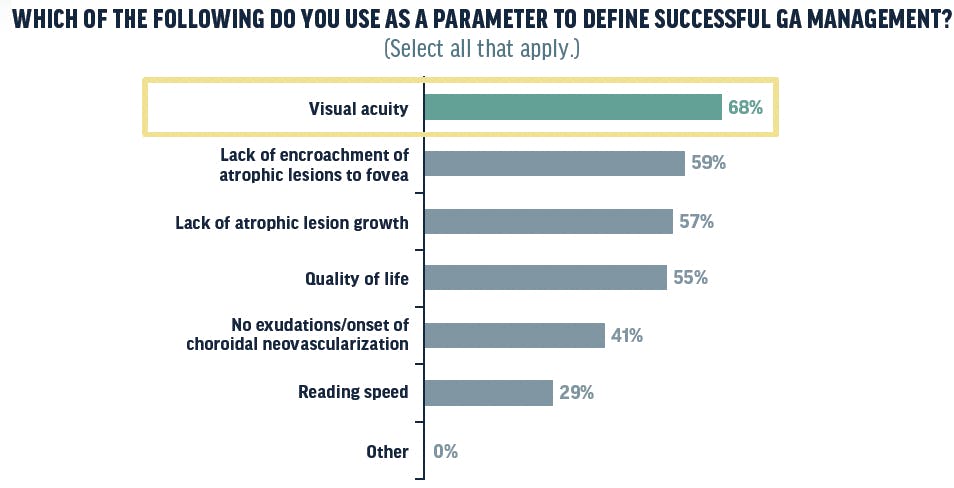
Figure 1. The 2022 EURETINA Clinical Trends Survey found that visual activity is the most common parameter used to define successful GA management.1
Disclosures:
Advisory boards and lecture fees from Novartis, Novartis Global, Bayer, Bayer Global, Allergan, Roche, Apellis, Alcon, Stada, Biogen and Janssen Global
Steering Committee for Genentech and Mescape
Received Research grants from Novartis and Bayer
The views and opinions expressed in this content may not necessarily represent those of Bryn Mawr Communications or Retina Today.
1. European Society of Retina Specialists (EURETINA) Clinical Survey 2022.
