WHERE IT ALL BEGAN
I grew up in Riverside, California, and went to Brown University, double-majoring in neuroscience and film studies before attending medical school at Icahn School of Medicine at Mount Sinai. I was interested in medicine at an early age because my father, whom I deeply admire, is an astute clinician; to this day, I have never heard him complain about anything, ever.
MY PATH TO RETINA
I entered residency at the Wilmer Eye Institute interested in oculoplastics but quickly gravitated toward the retina consults. My first-year assistant chief of service, Roomasa Channa, MD, taught me the fundamentals of retina, and I am grateful to all the Wilmer retina faculty for solidifying my choice to pursue retina.
SUPPORT ALONG THE WAY
Two of my biggest mentors are Prithvi Mruthyunjaya, MD, and Jim Handa, MD. They are both brilliant clinicians, and I can only hope to one day influence a mentee as much as they have me. I also frequently seek advice from Fasika A. Woreta, MD, an academic machine and a wonderful human being. I was fortunate to learn from fantastic clinician scientists during my fellowship at Stanford under the strong leadership of Darius Moshfeghi, MD (and all the Stanford faculty). I am also grateful to learn from the impressively productive Ehsan Rahimy, MD, and Arshad M. Khanani, MD.
Finally, the best part of my current position at the University of California Irvine is learning from my colleagues who have quickly become close mentors. Our chairperson Baruch D. Kuppermann, MD, PhD, is a true polymath who has been immensely supportive, and Stephanie Lu, MD, our retina division chief, is a natural leader who has guided me in countless ways.
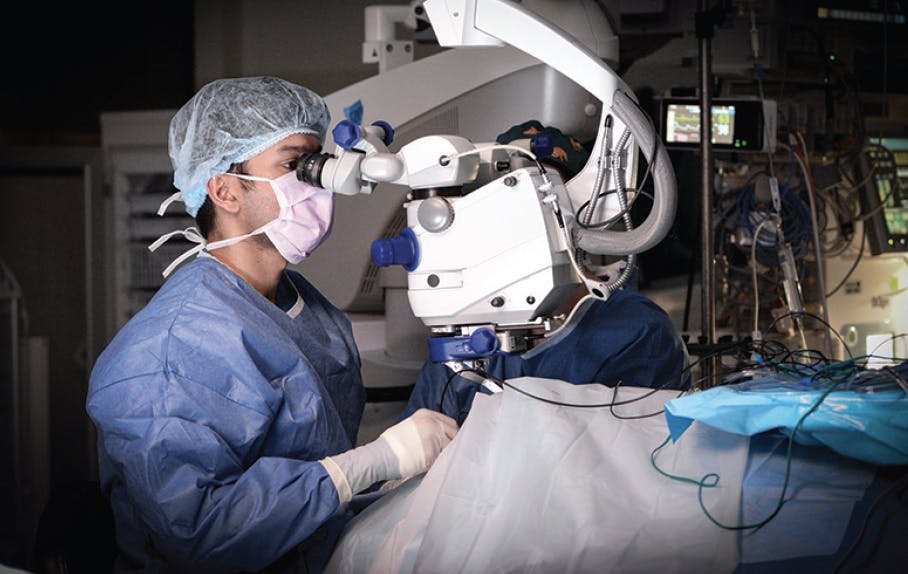
Dr. Mishra’s advice: Always be available, affable, and able. Stay humble and respect every procedure—from a simple injection to an end-stage tractional retinal detachment. Finally, never forget that even on your worst clinic day, you still go home at the end of the day. Image courtesy of John Barreto.
AN EXPERIENCE TO REMEMBER
During my year as co-assistant chief of service with my close friend Narine Viruni, MD, we had the opportunity to engage with some of the best minds in our field. I will always remember when Albert M. Maguire, MD, during a conference presented a talk on the journey of voretigene neparvovec-ryzl (Luxturna, Spark Therapeutics). At the end of the talk, a tearful Morton F. Goldberg, MD, stood up and congratulated Dr. Maguire on finally bringing a treatment to those seemingly destined for blindness.
Another memorable experience was visiting the Aravind Eye Institute in Pondicherry, India, run by Rengaraj Venkatesh, MD. Every member of the eye hospital embodied the founder’s mission to eliminate preventable blindness. I watched clinicians work full-time Monday through Saturday, then travel for hours on Sunday to a remote village to screen patients for ocular disease. They subscribed to their mission and worked tirelessly to achieve it.
