




_1751045240.png?auto=compress,format)
_1751045254.png?auto=compress,format)
More than a century after Johannes Conrad Grieshaber began developing surgical instruments for Swiss eye surgeons, the Alcon Grieshaber facility in Schaffhausen, Switzerland, remains an epicenter of ophthalmic innovation. The team at this facility produces more than 1.4 million ophthalmic instruments and accessories annually,1 each of which is hand-crafted with the precision the Swiss watchmaking community is known for.
Overall, the company is committed to investing 8% to 10% of its sales into research and development (R&D) in 2025.1 As part of its longstanding commitment to innovation, Alcon Grieshaber opened the doors to a new R&D facility and wet lab in neighboring Neuhausen am Rheinfall in October 2024, where the R&D team and surgeons come together to innovate and bring new ophthalmic surgical tools to market.1
As the company celebrates the 110th anniversary of the Alcon Grieshaber facility in Schaffhausen, Franck Leveiller, Senior Vice President of Global R&D and Chief Scientific Officer for Alcon; Niels Abt, Director of R&D at Alcon Grieshaber; and Thomas O’Neill, Vice President and Site Head for Alcon Grieshaber, recently reflected on the company’s heritage and vision for the future (Figure 1). To view the full interview with Mr. Leveiller, scan the QR code (Figure 2).
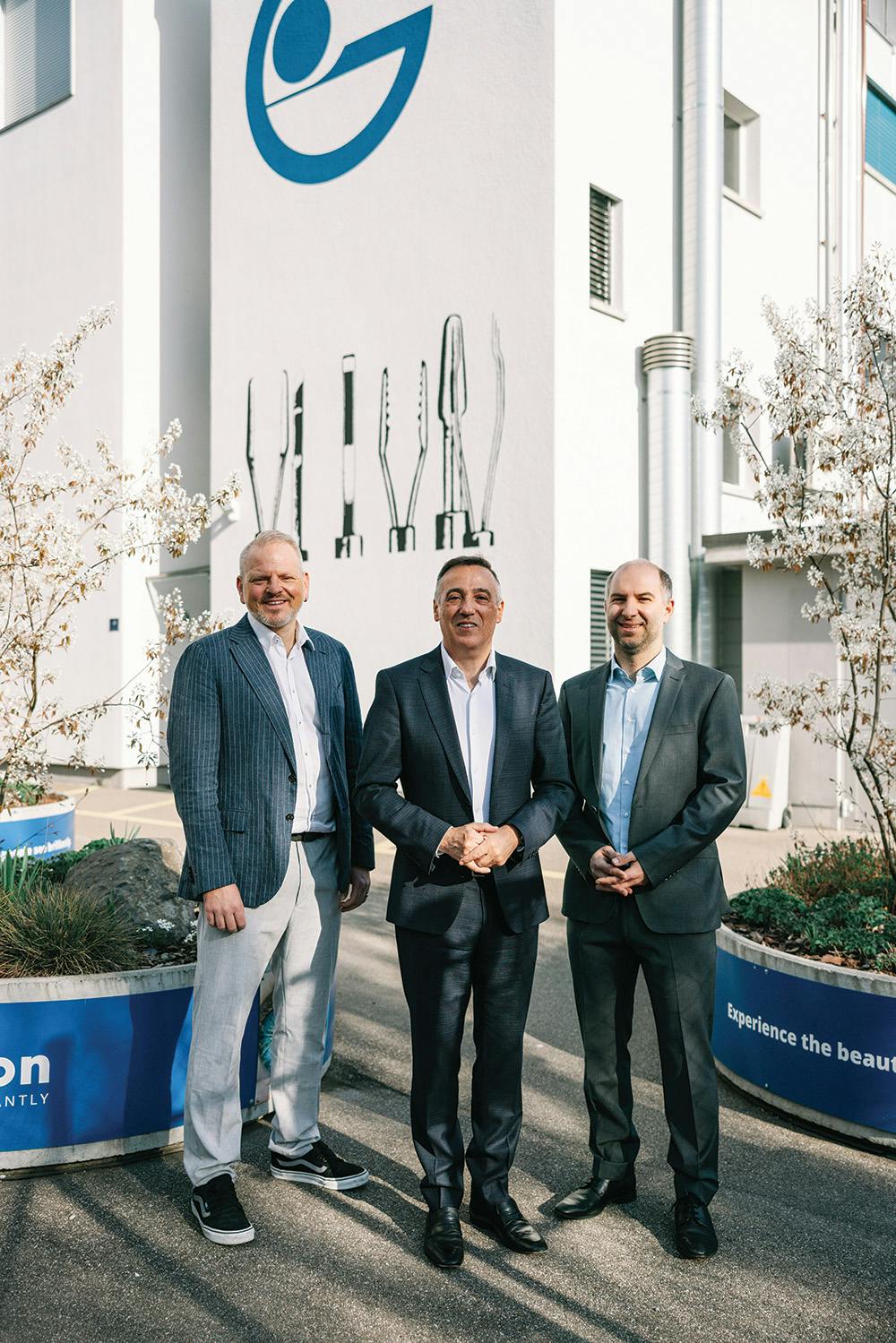
Figure 1. To celebrate 110 years of Alcon Grieshaber, Franck Leveiller (middle) joined Niels Abt (left) and Thomas O’Neill (right) at the facility for a media event in April.

Figure 2. Rebecca Hepp from Retina Today (right) sits down with Franck Leveiller (left) to discuss the Alcon Grieshaber legacy.
Why is it important to share this facility’s history and heritage with the industry?
Mr. Leveiller: The journey with Grieshaber started 25 years ago when Alcon acquired the company. At that time, Grieshaber already had a reputation for quality and precision within the surgical community, and combining the Alcon and Grieshaber names was a perfect marriage. Alcon embraced what Grieshaber started, and they’ve continued developing high-precision, quality microsurgical instruments that are used by surgeons worldwide.
The name Grieshaber was kept to honor that legacy and to continue the path of innovation. It also is a testament to our customer-centric mindset and commitment to the industry.
Alcon is a Swiss company, and we are very proud of the precision and quality the people of Switzerland provide. Grieshaber is integral to Alcon as we leverage the extraordinary talent here. It’s very important that our customers—the doctors and their patients—understand that our heritage is at the heart of our innovation.
How do you balance the need for automation with the craftsmanship that’s required for manufacturing instruments?
Mr. Leveiller: Automation is necessary for parts of the process, but there are critical steps that require the very skilled hands of the talent we employ. In fact, only about 20% of the process is automated. That’s another reason why we acquired Grieshaber here in Switzerland—the epicenter of watchmaking. The level of precision and craftsmanship required for watchmaking is very similar to what we need for our microsurgical instruments.
Mr. Abt: An instrument suitable for peeling the internal limiting membrane, which is very fragile and thin, must match that size and precision—you cannot do fine work with rough instruments. The tool must be very precise and, of course, very predictable. We at Alcon Grieshaber achieve this with our people, who all have the Swiss mindset of quality, precision, and dedication.
Mr. O’Neill: We have access to incredibly skilled people here, many of whom have degrees from the renowned ETH Zurich engineering school. Because of that, we have a lot of experience within our facility, and many of our team members have been with Alcon Grieshaber for 15, 20, and even 30 years.
There’s a great sense of pride in what we do here.
How does Alcon Grieshaber work with surgeons to innovate where it’s needed most?
Mr. Leveiller: It’s a true partnership as we develop products for surgeons and their patients. Once we initiate a program, we collaborate with renowned surgeons around the world during the design phase to get their input on the product. Based on that feedback, we build prototypes and coordinate wet labs to allow surgeons the opportunity to use the instrument in various eye models and provide further feedback. It’s an iterative process, and the doctors remain deeply involved throughout.
Mr. Abt: From the very beginning, we have worked in collaboration with surgeons. The instrument maker by himself cannot make a great product, and the surgeon by himself cannot make a great outcome—you need both. Our company’s rich history over 110 years shows consistently how this symbiosis between the two has resulted in improved surgical procedures and smaller, more predictable surgical tools. This has been possible through a lot of work between the Alcon Grieshaber R&D team and these pioneers in their respective specialties.
Alcon Grieshaber Fun Facts
With more than a century of innovation, craftmanship, and quality under its belt, the Alcon Grieshaber facility boasts some impressive statistics, including the following1:
- 1 million high-precision microsurgical instruments and accessories are manufactured per year.
- 1,500 procedures are performed each day using Alcon Grieshaber products.
- 100 different types of products are produced, 90% of which are in the vitreoretinal space.
- 100 markets reached.
- 100 microscopes are housed in the facility.
- 10 years of employment is common for many Alcon Grieshaber employees.
1. Alcon Data on File, 2025.
How has Alcon stayed true to its mission of helping patients see brilliantly?
Mr. Leveiller: This is the core of the company, and every associate lives and breathes for this purpose. In R&D in particular, people wake up every day and they want to help the surgeons by giving them the best tools and treatments for the patients.
There’s nothing more satisfying than seeing a patient remove the bandage after ophthalmic surgery and suddenly see the world with fantastic visual acuity or brighter colors. This is what makes all of us go to work every day, and that’s the magic of Alcon Grieshaber.
We work with our customers and for our customers, and we maintain a level of quality and excellence that has always been the signature of the company.
1. Alcon. Alcon Celebrates 110 Years of Swiss Precision and Innovation in Ophthalmic Microsurgery [press release]. April 10, 2025. www.alcon.com/media-release/alcon-celebrates-110-years-swiss-precision-and-innovation-ophthalmic-microsurgery. Accessed April 21, 2025.
Driving Efficiency in the Ophthalmic OR
Alcon’s latest ophthalmic surgery console, the UNITY® Vitreoretinal Cataract System (VCS), received regulatory approval in Australia, Japan, and the United States in 2024 and CE mark in 2025, marking the next generation of vitreoretinal and cataract surgery.1 Here, Franck Leveiller, Senior Vice President of Global Research and Development and Chief Scientific Officer for Alcon, and Steve Charles, MD, FACS, FICS, FASRS, discuss the innovations included in the UNITY® VCS.
What can clinicians expect with the launch of the UNITY® VCS?
Mr. Leveiller: With the UNITY® VCS, everything is brand-new, and we really pushed the limits to deliver first-to-market innovations with cataract and vitreoretinal consoles. The biggest advantage, particularly for our global surgeons, is having one console for anterior and posterior surgery.2-6 It requires less space in the OR, and surgeons can remove a cataract and move to a vitrectomy without changing the machine.6 It’s very convenient, and it offers groundbreaking innovations and superior efficiency for cataract and vitreoretinal surgery.2-4,7,§ While the new interface will require some training, it is intuitive and yet familiar.
As for new features, the UNITY® Intelligent IOP offers precise surgical stability at the surgeon’s desired IOP by dynamically compensating for leakage and pressure changes.6,8,*,† Research shows maintaining more physiological IOP can cause less stress on the eye and less pain for the patient.9-11 The new console enables the use of another innovative product, the UNITY® TetraSpot, a multi-spot illuminated laser probe that reduces laser application time, delivering 1, 2, or 4 spot versatility.3,‡
When designing the UNITY® VCS, we collaborated with surgeons and the nurses who often set up and maneuver the machines. When nurses expressed frustration with the cables, we created a wireless pedal,6 added cable pushers to the wheels, and reduced the number of connections to the system; when they shared concerns with the ergonomics of the tray, we adjusted it. These small details make a big difference for them; for example, the overall console setup and teardown time with UNITY® VCS is significantly faster (25%) than that of the CONSTELLATION® Vision System.12,††,‡‡,§§ The entire OR experience is more efficient for everyone.
From a surgeon’s perspective, why is this innovation so important?
UNITY® By the Numbers
UNITY delivers innovations in vitreoretinal and cataract surgery for superior efficiency,§ helping optimize patient outcomes.
In vitreoretinal:
- 50% faster vitrector cutting speeds.6,7,13,Δ
- 3.1X faster laser application.3,‡
- 27+DS Illumination Probes 1.7X stiffer than 25+.4
- Less than 1 minute for silicone oil injection.15,°,II
- Less than 3 minutes for silicone oil extraction.15,Ω
- Reduced blue light delivered to the eye.6
In cataract:
- 2X faster nucleus removal than OZIL.2,§
- 41%** less energy into the eye.2,†
- 44% lower surge break volumes than Centurion with Active Sentry.2,§
- 48% less cumulative dissipated energy than torsional phaco.2,†,§
*Mean fluctuation at flow vs. setpoint of 2.36 ± 2.13, 4.19 ± 1.97, 1.84 ± 2.82, and 2.13 ± 2.86 mmHg during phacoemulsification, irrigation/aspiration (IA), vitrectomy, and extrusion/fragmentation, respectively.
†IOP setpoint as low as 16 mmHg (posterior) and 20 mmHg (anterior) without exceeding a mean fluctuation of 4.19 ± 1.97 mmHg.
‡Multi-spot Laser Probe (MSLP) (4) is 3 times faster than single-spot laser probe (SSLP).
**Based on N=10 HPs, Artificial cataract lens IOP 55mmhg vacuum of 450 mmHg.
§Based on bench data.
††Compared to Constellation Vision System.
‡‡For posterior segment surgeries/posterior cassette pack ‡ (P < 0.001).
§§ ~1.5 minutes faster.
ΔCompared to Constellation HYPERVIT 20k vitrectomy probe.
°1,000 cSt silicone oil.
IIAll gauges (23 Ga, 25 Ga, and 27 Ga entry system).
Ω1,000 cSt silicone oil through 25 Ga cannulas.
1. Alcon. Alcon’s Latest Equipment Breakthrough Technologies, Unity VCS and Unity CS, Receive U.S. FDA 510(k) Clearance [press release]. June 2024. www.investor.alcon.com/news-and-events/press-releases/news-details/2024/Alcons-LatestEquipment-Breakthrough-Technologies-Unity-VCS-and-Unity-CS-Receive-U.S.-FDA-510k-Clearance/default.aspx. Accessed April 22, 2025.
2. Alcon Data on File, 2024, REF 24379.
3. Alcon Data on File, 2024. REF-24615.
4. Alcon Data on File, 2024. REF-24576.
5. UNITY Phaco Handpiece Directions for Use
6. UNITY VCS and CS User Manual.
7. Alcon Data on File, 2024. REF-24644.
8. Alcon Data of File, 2024. REF-24899.
9. Vasavada V, Agrawal D, Vasavada SA, Vasavada AR, Yagnik J. Intraoperative performance and early postoperative outcomes following phacoemulsification with three fluidic systems: a randomized trial. J Refract Surg. 2024 May;40(5):e304-e312. doi: 10.3928/1081597X-20240314-02. Epub 2024 May 1. PMID: 38717085.
10. Scarfone HA, Rodriguez EC, Rufiner MG, Riera JJ, Fanego SE, Charles M, Albano R. Vitreous-lens interface changes after cataract surgery using active fluidics and active sentry with high and low infusion pressure settings. J Cataract Refract Surg. 2024 Apr 1;50(4):333-338. doi: 10.1097/j.jcrs.0000000000001359. PMID: 37938025; PMCID: PMC10959530.
11. Liu Y, Hong J, Chen X. Comparisons of the clinical outcomes of Centurion® active fluidics system with a low IOP setting and gravity fluidics system with a normal IOP setting for cataract patients with low corneal endothelial cell density. Front Med (Lausanne). 2023 Nov 23;10:1294808. doi: 10.3389/fmed.2023.1294808. PMID: 38076276; PMCID: PMC10704024.
12. Alcon Data on File, 2024. REF-25374.
13. Vasavada AR, et al. Impact of high and low aspiration parameters on postoperative outcomes of phacoemulsification: randomized clinical trial. Journal of Cataract & Refractive Surgery. 2010:36(4);588-593. [WP1]
14. Alcon Data on File, 2020. REF-09694.
15. Alcon Data on file 2024. REF-25563.
GRIESHABER® DSP
INDICATIONS FOR USE: The GRIESHABER® DSP Aspheric Macular Lens is used to visualize the fundus and retinal structures during vitreoretinal surgery. It is designed as a self-retaining contact lens to allow hands-free operation.
CAUTION: Federal (USA) law restricts this device to sale by, or on the order of, a physician.
WARNINGS AND PRECAUTIONS: The device may be used only by well trained physicians and personnel. Potential risk from reuse or reprocessing include: reduced optical quality, surface damage on the optics, and foreign particle introduction to the eye. The surgeon’s team has to ensure that sufficient viscous fluid is available throughout usage of the lens for continuous humidification of the cornea. Attention: Reference the Directions for Use for a complete listing of indications, warnings, and precautions.
CAUTION: Federal (USA) law restricts this device to sale by, or on the order of, a physician.
INDICATIONS FOR USE: GRIESHABER® DSP instruments are a line of single-use vitreoretinal micro-instruments which are used in ophthalmic surgery, for cases either in the anterior or the posterior segment. The GRIESHABER® Advanced Backflush Handles DSP are a family of instruments for fluid and gas handling in vitreoretinal surgery.
WARNINGS AND PRECAUTIONS: Potential risk from reuse or reprocessing GRIESHABER® DSP instruments include: foreign particle introduction to the eye; reduced cutting or grasping performance; path leaks or obstruction resulting in reduced fluidics performance. Verify correct tip attachment, function and tip actuation before placing it into the eye for surgery. For light fiber instruments: Minimize light intensity and duration of exposure to the retina to reduce risk of retinal photic injury. The light fiber instruments are designed for use with an ALCON® illumination source. Good clinical practice dictates the testing for adequate irrigation and aspiration flow prior to entering the eye. If stream of fluid is weak or absent, good fluidics response will be jeopardized. Use appropriate pressure supply to ensure a stable IOP. If unwanted tissue gets engaged to the aspiration port, it should be released by interrupting aspiration before moving the instrument.
UNITY® VCS and CS Important Product Information
Caution: Federal (USA) law restricts this device to sale by, or on the order of, a physician.
Indications / Intended Use:
UNITY VCS:
The UNITY VCS console, when used with compatible devices, is indicated for use during anterior segment (i.e. phacoemulsification and removal of cataracts) and posterior segment (i.e. vitreoretinal) ophthalmic surgery. In addition, with the optional laser this system is indicated for photocoagulation (i.e. vitreoretinal and macular pathologies), iridotomy and trabeculoplasty procedures.
UNITY CS:
The UNITY CS console, when used with compatible devices, is indicated for use during anterior segment (i.e. phacoemulsification and removal of cataracts) ophthalmic surgery.
Warnings:
Appropriate use of UNITY VCS and CS parameters and accessories is important for successful procedures. The console supports various accessories to perform various surgical procedures. Accessories include handpieces and probes, as well as tips and sleeves when necessary. Different accessories are required for different procedures and operating modes.
Test for adequate irrigation and aspiration flow, reflux, and operation of each accessoryprior to entering the eye.
The consumables used in conjunction with ALCON® instrument products constitute a complete surgical system. To avoid the risk of a patient hazard, do not mismatch consumable components or use settings not specifically adjusted for particular consumable component combinations.
AEs/Complications:
Inadvertent activation of functions that are intended for priming or tuning accessories while the accessory is in the eye can create a hazardous situation that could result in patient injury. During any ultrasonic procedure, metal particles may result from inadvertent touching of the ultrasonic tip with a second instrument. Another potential source of metal particles resulting from any ultrasonic handpiece may be the result of ultrasonic energy causing micro abrasion of the ultrasonic tip.
ATTENTION:
Refer to the Directions for Use for the accessories/consumables and User Manual for a complete listing of indications, warnings, cautions and notes.
© 2025 Alcon Inc. GLB/IMG-UVC-2500055
