


When Astellas Pharmaceuticals announced its acquisition of Iveric Bio, most observers saw the move as an expansion into a new therapeutic area by a company better known for its work in oncology and urology.
What few in the eye care field may have appreciated, however, was that the acquisition of Iveric Bio was an inflection point in a longer-term strategy launched by Astellas over a decade ago, when the company decided to start developing next-generation technologies and modalities involving cell and gene therapy.
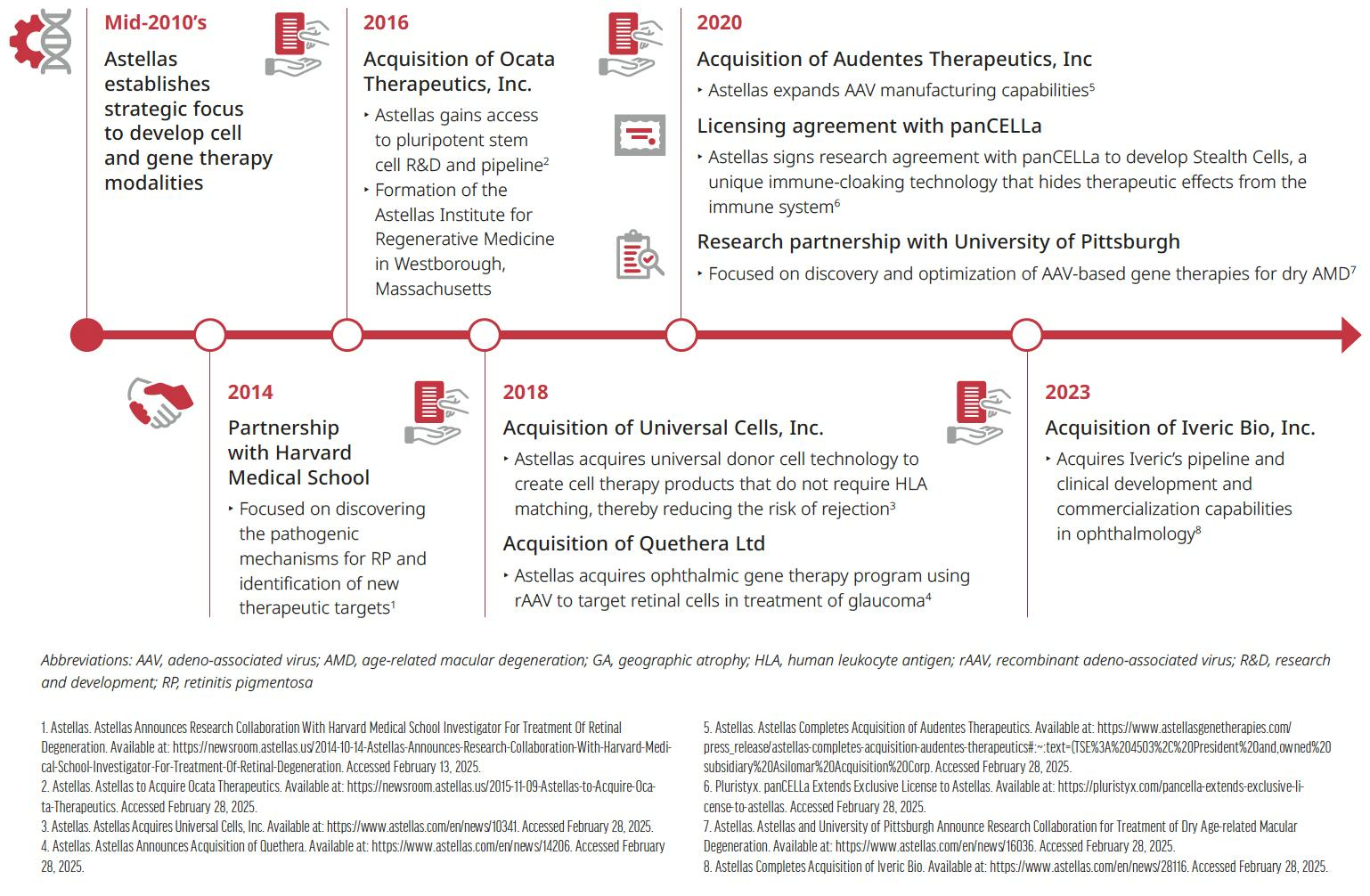
One of the first instances of Astellas engaging in ophthalmology was in 2014, when it began joint research with Harvard Medical School, focusing on discovering the pathogenic mechanisms for retinitis pigmentosa and identification of new therapeutic targets.1 That extramural relationship would be the first in a series of moves that have netted access to research and development capabilities in the areas of pluripotent stem cells, universal donor cell technology, and gene therapy using adeno-associated virus (AAV) (see Timeline).
“Over the last decade, we’ve really been focused on building capabilities—internal capabilities in terms of the science and the pipeline, and also capabilities related to cell and gene therapies which we believe are going to be the game changers for ophthalmic diseases,” said Marci English, Senior Vice President, Head of Biopharma and Ophthalmology Development at Astellas. “We are committed to decreasing the rate of vision loss, preventing vision loss, and, aspirationally, to reversing vision loss. And we think we can make progress across our various modalities based on the investment we’ve made and will continue to make in our capabilities over the past 10 years.”
Building a Footprint
According to Jotaro Suzuki, PhD, Vice President, Primary Focus Lead, Blindness and Regeneration at Astellas, cell and gene therapy for the eye was strategically chosen with the aim of realizing regenerative medicine. For instance, as an isolated organ, the eye can be directly targeted, thereby facilitating easier routes of transduction compared to other systemic approaches. Another consideration is that because the eye is an immune-privileged organ, systemic exposure is limited, and so there would be safety advantages.
However, Dr. Suzuki noted the most compelling reason to target the eye for cell and gene therapy is the tremendous unmet need for modalities that can replace sight, preserve sight, and restore the function of cells that are critical for sight. Ultimately, ophthalmology was attractive to Astellas because the company saw high unmet medical needs.
“Above all, there are many diseases of the eye, particularly of the retina, that are difficult to treat using existing modalities and technologies, and we have determined that some of these can be resolved through cell and gene therapy,” Dr. Suzuki said.
Strategic Focus for the Future
At first glance, the acquisition of Iveric Bio in 2023 might seem like a capstone in Astellas’ grand vision for the ophthalmic space, but it is better understood as a steppingstone in a longer journey.
“We’re looking at the spectrum of diseases in eye care and thinking, ‘Where can we use the investments that we’ve made to find the next-generation therapies that are going to help patients who are affected by retinal conditions?’” said Ms. English.
The acquisition of Iveric Bio advances that objective through the integration of its rich pipeline. In addition to building out Astellas’ pipeline, commercialization of a treatment for geographic atrophy (GA) secondary to age-related macular degeneration (AMD) in the United States is expected to contribute to a growing revenue stream.
“Importantly, we now know more about the patients. Before treatments for GA were available in the US, the knowledge of patients in the real world was limited. But now that patients are getting treatment, we know how their disease progresses and the impact of treatment. So, now we are very confident we can develop more drugs in this area,” said Dr. Suzuki.
One such program that Astellas is currently pursuing is a cell therapy dubbed ASP7317, introduced as part of the acquisition of Ocata Therapeutics in 2016. Currently in phase 1B trials (NCT03178149), ASP7317 is a retinal pigment epithelium cell being studied for its potential to treat GA secondary to AMD.
Another program currently making its way through preclinical research is a gene therapy program aiming to offer neuroprotective benefits in glaucoma. More broadly, though, Astellas is pursuing research and development projects that fit the vein of regenerative medicine, which is a tremendous unmet need in ophthalmology.
“We focus on retinal diseases where vision deteriorates due to the slow degeneration of specific cells in the retina, and treatment effects can be expected by suppressing this degeneration or replenishing new cells,” said Dr. Suzuki.
Fundamentally, the acquisition of Iveric Bio helped enrich a pipeline, added access to medical experts, further built capabilities, and accelerated Astellas’ longer-term ambitions in ophthalmology. But the strategic move has had another impact, as well, by signaling to the ophthalmology community a long-term commitment to developing next-generation therapies and modalities.
“We want the ophthalmology community to embrace the work that we’re doing, to be there on the journey with us, working with specialists, working with eye care practitioners. We can’t do what we intend to do without their partnership,” said Ms. English.
1. Astellas. Astellas Announces Research Collaboration With Harvard Medical School Investigator For Treatment Of Retinal Degeneration. Available at https://newsroom.astellas.us/2014-10-14-Astellas-Announces-Research-Collaboration-With-Harvard-Medical-School-Investigator-For-Treatment-Of-Retinal-Degeneration. Accessed February 13, 2025.
