

Recently, there’s been a lot of excitement about the new pharmacologic treatment options for symptoms of presbyopia that have come to market, and eye care providers of all stripes are considering adding these miotic drops to their armamentariums. Personally, I’ve adopted Qlosi™ (pilocarpine hydrochloride ophthalmic solution) 0.4% (Orasis Pharmaceuticals Inc.), which was approved by the FDA in October 2023 for the treatment of presbyopia in adults and launched in the United States on April 7, 2025. It’s been helpful to have another option to offer patients who present with complaints of presbyopia. Presbyopes can be hard to please, and having a non-surgical option for them to try prior to considering surgery has been a relief. My patients have thus far been very eager to learn more and get started with Qlosi™.
Yet, there are certain patient-selection criteria we must consider before prescribing Qlosi™. We need to screen for certain ocular pathologies, especially those pertaining to the retina (see the sidebar, A Retina Specialist’s Experience With Qlosi). Herein, I’ll share my patient selection criterion for Qlosi™ and the clinical red flags I look for during my examinations.
Qlosi™ EyeQ Formulation™ and Findings
Qlosi™ has the lowest effective concentration of pilocarpine (0.4%) currently available, a near-neutral pH for optimal bioavailability, and a preservative-free formulation that contains two lubricating agents, HA and HPMC. By achieving an ideal pupil size of 2 to 3 mm, Qlosi™ gives patients better near focus through the pinhole effect without compromising their distance vision.
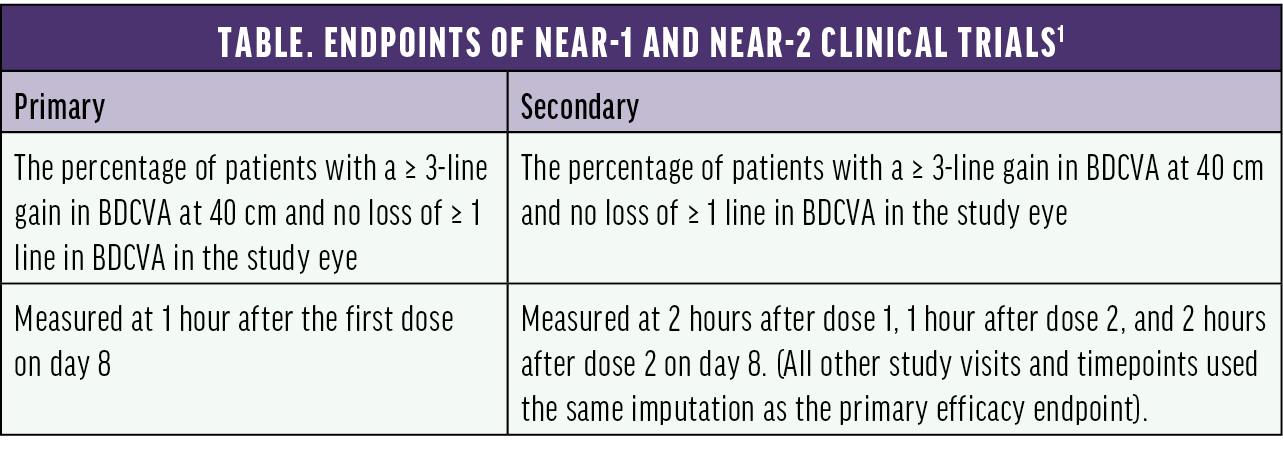
To summarize the findings from the Qlosi™ phase 3 NEAR-1 and NEAR-2 clinical trials, the eyes randomized to receive Qlosi™ (the active group, n = 309) showed significant improvement in near visual performance: 40.1% of monocular patients achieved the primary endpoint of greater than or equal to a 3-line gain in mesopic DCNVA and no loss of greater than or equal to 1 line of CDVA (Table). Comparatively, only 19.1% of the vehicle group (P < 0.0001) showed a response (n = 304).1
By day 8, most Qlosi™ patients achieved greater than or equal to a 2-line improvement with no loss of 1 line or more of distance visual acuity. Also, eyes that received Qlosi™ sustained functional near vision from 20 minutes up to 8 hours, per the number of participants who achieved 20/40 or better DCNVA. Additionally, patients achieved higher DCNVA (20/40 or better) via binocular summation than with just the study eyes alone.1
My Ideal Qlosi™ Candidate
As a miotic, Qlosi™ is best suited for adult patients experiencing symptoms of mild-to-moderate presbyopia who aren’t ready for glasses or refractive surgery. Qlosi™ can be a great bridge for mitigating those mild symptoms until they advance to the point that the patient feels ready for surgery.
Qlosi™ may be less ideal for eyes with advanced presbyopia and conditions such as larger, non-reactive pupils, retinal pathologies, and high myopia/hyperopia. Thus, it’s critical for patients to undergo a comprehensive eye examination that includes a peripheral retinal examination to confirm their candidacy for Qlosi™.
During the retinal exam, I am on the lookout for peripheral retinal pathologies such as lattice degeneration, retinal holes, retinal tears, and, of course, retinal detachments. Other pathologies to avoid include vitreomacular traction, and I also would use caution or even avoid using Qlosi™ in moderate-to-high myopes above -4.50 sphere. Also, remember to check if a patient has had prior myopic LASIK—a patient who appears to be a “plano-presbyope” could actually be a high myope in disguise. While their refractive status has improved, they still have an increased risk for retinal pathology.
In general, I am looking for a patient with healthy eyes as determined by a fully-dilated ophthalmic examination and who is a mild-to-moderate presbyope with a desire to reduce their need for readers.
Setting Patients’ Expectations
Qlosi™ provides up to 8 hours of functional near vision, but it also gives patients the flexibility to dose one drop and follow that up with a second drop 2 to 3 hours later as it suits their visual needs. It’s helpful to counsel patients to expect their near point to change and that it may require some adaptation time. In the Qlosi™ clinical trials, patients’ near visual acuity improved as early as day 1 once adaptation took effect. It is recommended to tell the patient to apply Qlosi™ twice a day for the first week to encourage neuroadaptation to take place.
And, although Qlosi™ will broaden patients’ range of presbyopic correction, they must understand that it will not be a replacement for reading glasses—they may still need readers for close-range acuity and small print.
A RETINA SPECIALIST’S EXPERIENCE WITH QLOSI™
By Rishi Singh, MD

As the prevalence of presbyopia is expected to grow over the next 10 years,1 the advent of novel treatments in the form of pilocarpine ophthalmic drops has been a timely innovation. For example, Qlosi™ (pilocarpine hydrochloride ophthalmic solution) 0.4% (Orasis Pharmaceuticals Inc.), is an important, inventive treatment designed specially with the patient in mind; it has the lowest concentration of pilocarpine available in a formulated dose (0.4%). Additionally, this drop has a near-neutral pH for bioavailability and is preservative-free, containing two lubricating agents, HA and HPMC.
Qlosi™ is available for adult patients with presbyopia, but we retina specialists and our primary eye care colleagues want to ensure that our patients do not have any risk of retinal tears or detachments prior to administering Qlosi™. We learned about this risk from previous releases of drops in similar treatment categories. Fortunately, the risk of retinal tears or detachments appears to be quite low with Qlosi™. Still, it’s our duty as specialists to recommend that patients who are prescribed this treatment are evaluated via a comprehensive ophthalmic examination to make sure our patients are going to experience the best course of treatment by their primary eye care provider.
We also learned that patients with high myopia are at a greater risk for retinal detachment, and so this is another patient cohort that requires comprehensive eye examinations prior to receiving any pilocarpine agents.
Miotics have been of great benefit to patients with presbyopia. As a retina specialist, I recommend a comprehensive, dilated eye examination for all patients to evaluate for any signs of retinal tear or detachment, lattice retinal degeneration, or retinal holes. Orasis Pharmaceuticals continues to educate the retina community as well as the broader eye care community on the benefits of low-dose pilocarpine in the presbyopic patient population, as it offers significant potential to improve these patients’ vision without having to resort to surgery until they are ready.
Rishi Singh, MD
- Ophthalmologist and retinal specialist; Clevland Clinic, Florida
- SINGHR@ccf.org
- Financial disclosures: Personal fees (AbbVie, Alcon, Apellis, Bausch + Lomb, EyePoint, Genentech, Iveric Bio, Orasis, Regeneron, Regenxbio, Zeiss), Research Grants (Jannsen)
Patient Comfort With Qlosi’s™ >EyeQ Formulation™
The patient feedback about the ocular comfort of Qlosi™ has been very positive, both in the clinical trials and in my patient population so far. Although a small subset of trial participants reported experiencing mild side effects like headaches and slight burning/stinging upon drop instillation, mean scores for comfort on day 1 of the studies were 1.0 for the vehicle and 1.5 for the CSF group, and all mean values at all time points were below 2 on a scale from 0 (very comfortable) to 10 (very uncomfortable). Most of the adverse events with Qlosi™ were reported as mild, transient, and quickly self-resolving.1
Accessing Qlosi™
Qlosi™ can be obtained from two specialty pharmacies via the practice’s EMR: BlinkRx and Medvantx. During the launch of Qlosi™, the specialty pharmacies will encourage the patient to have a comprehensive eye exam with their primary eye care provider. It is a cash-pay product, and Orasis offers multiple options and subscription services to access Qlosi.™
An Exciting New Option for Presbyopes
It’s empowering for us clinicians to have a pharmacologic option to offer our presbyopic patients who are navigating changes in their visual performance. Although Qlosi™ isn’t for every presbyope, with its low percentage of pilocarpine, preservative-free formulation with lubricating agents, and high safety and efficacy profile, I feel confident prescribing Qlosi™ to the appropriate patients.
1. Holland E, Karpecki P, Fingeret M, et al. Efficacy and safety of CSF-1 (0.4% pilocarpine hydrochloride) in presbyopia: pooled results of the NEAR Phase 3 randomized, clinical trials. Clin Ther. 2024;46(2):104-113.
INDICATION AND USAGE
Qlosi™ is indicated for the treatment of presbyopia in adults.
IMPORTANT SAFETY INFORMATION
Contraindications
Hypersensitivity
Warnings and Precautions
Advise patients to not drive or operate machinery if vision is not clear (e.g., blurred vision). Exercise caution in night driving and other hazardous occupations in poor illumination.
Rare cases of retinal detachment have been reported with miotics. Examination of the retina is advised in all patients prior to initiation of therapy.
Advise patients to seek immediate medical care with sudden onset of flashes of lights, floaters, or vision loss.
Qlosi™ is not recommended to be used when iritis is present.
Qlosi™ should not be administered while wearing contact lenses. Remove lenses prior to the installation of Qlosi™ and wait 10 minutes before reinsertion.
Avoid touching the tip of the vial to the eye or any other surface.
Adverse Reactions
The most common adverse reactions (5% to 8%) are instillation site pain and headaches.
For more information, see the full Prescribing Information.
