

Early detection of retinal diseases, particularly age-related macular degeneration (AMD), is essential for preserving vision but remains a challenge in clinical practice. Advancements in modern diagnostic technologies enable the identification of key biomarkers for early detection and disease progression, leading to improved patient outcomes.
Advancements in Retinal Diagnostics
Optical coherence tomography (OCT) remains the cornerstone of retinal disease diagnosis, with ongoing improvements in both resolution and analytical capabilities. These advancements have greatly improved the identification of critical biomarkers, enabling clinicians to predict disease progression more accurately in patients with intermediate AMD. OCT can now identify early indicators of choroidal neovascularization (CNV) or geographic atrophy (GA) development, as well as predict pigment epithelial detachments (PEDs).
For neovascular age-related macular degeneration (nAMD), monitoring GA progression has emerged as a crucial development. Identifying patients with rapidly advancing GA is pivotal for clinicians to determine which individuals may benefit from emerging treatments, paving the way for personalized treatment strategies and more timely interventions.
AI’s Role in Enhancing Early Detection
Artificial intelligence (AI) is becoming an indispensable tool in improving early detection of retinal diseases. One notable example is Preferential Hyperacuity Perimetry (PHP), an FDA-approved technology that detects the onset of neovascular disease in patients with intermediate AMD. PHP leverages hyperacuity, the ability to perceive a misaligned dot, offering superior sensitivity compared to traditional visual acuity testing. Over time, PHP has expanded from retinal specialists to general ophthalmologists and optometrists, making it more accessible as an early detection tool.
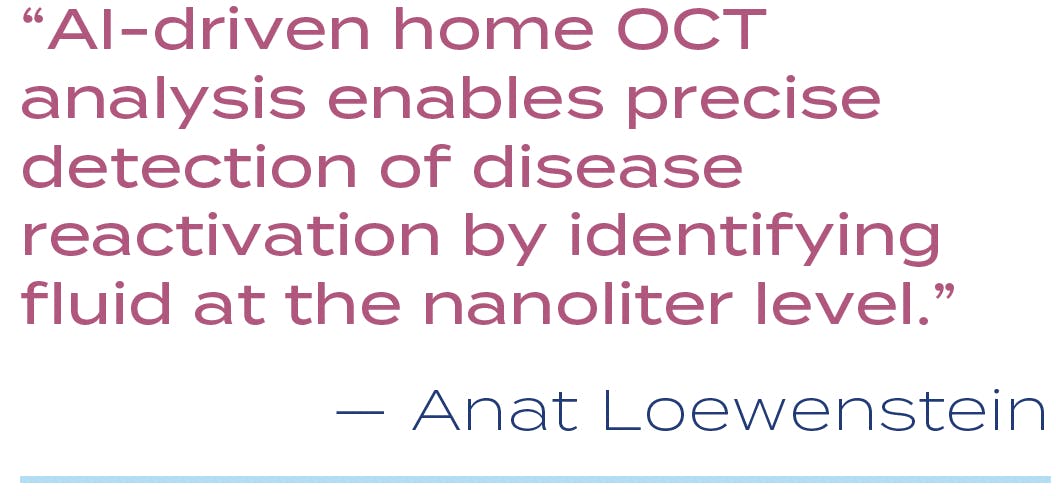
AI is also transforming OCT by enabling precise identification, measurement, and tracking of intraretinal and subretinal fluid at the nanoliter level. AI-integrated home OCT devices allow for earlier intervention and improved disease management. Additionally, AI models assist in predicting GA progression by analyzing longitudinal imaging data, enabling clinicians to identify cases likely to progress rapidly and make more informed treatment decisions.
Imaging Modalities for Disease Prediction and Monitoring
Fundus autofluorescence (FAF) and OCT have been widely studied in clinical trials and real-world applications. FAF helps identify patterns that predict rapid GA progression, guiding clinicians in disease risk assessment and follow-up schedules.1 As the focus on OCT-based biomarkers intensifies, automated measurements and AI-driven analysis will further enhance diagnostic accuracy and treatment decisions.
Updated disease classifications, such as incomplete retinal pigment epithelium and outer retinal atrophy (iRORA) and complete retinal pigment epithelium and outer retinal atrophy (cRORA), introduced by the Classification of Atrophy Meeting (CAM) group, have provided additional insights into disease progression. Clinicians now track the transition from iRORA to cRORA as a key indicator of advancing disease.
Key Diagnostic Hallmarks for AMD
The clinical examination is the first step in diagnosing AMD, with drusen being a key diagnostic feature. If further investigation is warranted, OCT imaging provides detailed information about retinal layers, while autofluorescence helps identify areas of retinal dysfunction.
According to the 2023 EURETINA Clinical Trends Survey, 64% of respondents identified autofluorescence patterns as the most important OCT-based biomarker for evaluating GA progression risk (Figure 1).
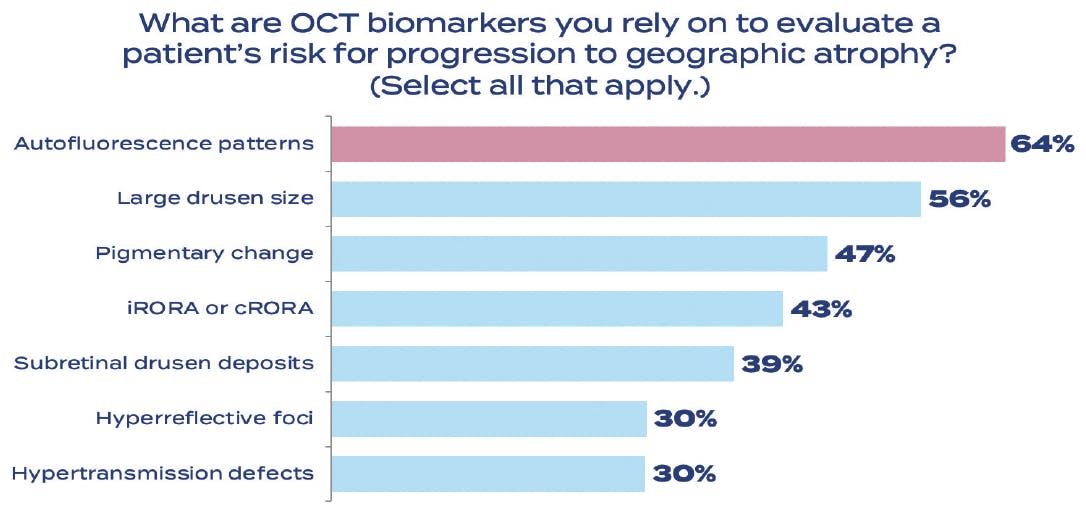
Figure 1. According to the 2023 EURETINA Clinical Trends Survey, 64% of respondents rely on autofluorescence patterns to assess the risk of progression to GA.
Impact of Collaboration and Early Referrals
Collaboration among healthcare professionals is essential to optimizing patient outcomes. As new treatments for AMD emerge, it is critical for healthcare professionals to remain informed about the latest advancements. Historically, general ophthalmologists and optometrists primarily monitored patients due to the lack of effective treatments. However, with the advent of new therapies, early referrals to specialists have become increasingly important. Encouraging collaboration and timely referrals ensures that patients have access to the most appropriate treatments, improving overall outcomes.
Conclusion
Advancements in retinal diagnostic technologies, including OCT, AI, and new imaging methods, are enhancing early detection and management of retinal diseases like AMD. These innovations enable precise biomarker identification and disease tracking, leading to personalized treatment and timely interventions. Collaboration among healthcare professionals is vital for ensuring optimal patient outcomes through early referrals and access to emerging treatments.
1. Holz, F. G. et al. Progression of geographic atrophy and impact of fundus autofluorescence patterns in age-related macular degeneration. Am J Ophthalmol 143, (2007).
The views and opinions expressed in this content may not necessarily represent those of Bryn Mawr Communications or Retina Today.
