


Macular telangiectasia type 2 (MacTel) is a chronic, bilateral neurodegenerative disease that usually begins in the temporal juxtafoveal area of the retina. Although initially believed to be vascular in origin, we now know MacTel is a neurodegenerative condition involving a primary dysfunction of Müller glial cells, which lend structural, homeostatic, and metabolic support for the neurons in the macula. Neurodegeneration of Müller cells leads to outer retinal atrophy and retinal thinning, ultimately resulting in photoreceptor atrophy and vision loss.1 We are still unsure of the precise etiology behind the Müller cell degeneration seen in patients with MacTel.2
Until recently, there has been no US Food & Drug Administration (FDA) approved treatment for MacTel. Traditionally, management of MacTel consisted of monitoring for the emergence of macular neovascularization, which can be treated with anti-vascular endothelial growth factor (anti-VEGF) agents; otherwise, there were no proven therapies.
With the FDA approval of the first therapy for adults with idiopathic macular telangiectasia type 2, ENCELTO (revakinagene taroretcel-lwey).3 ENCELTO is an encapsulated cell-based gene therapy and consists of a tiny semi-permeable capsule, about the size of a grain of rice (approximately 6.5 mm long and approximately 1.2 mm wide), which is sutured to the pars plana in an outpatient procedure. The capsule contains living cells that have been genetically modified to continually produce and release recombinant human ciliary neurotrophic factor (rhCNTF),4 which has a neuroprotective role and has shown the ability to slow the loss of photoreceptors in patients with MacTel.5 ENCELTO permits the flow of nutrients from the vitreous but protects the cells from antibodies and host immune cells.6
ENCELTO has been shown to reduce disease progression by slowing the loss of photoreceptors; with this in mind, we must shift the paradigm of MacTel management. While the traditional “watch and wait” approach was acceptable when there were no approved options available, we must now play a more active role in identifying and diagnosing adult patients with MacTel who may benefit from receiving this therapy.
Recognizing MacTel progression
MacTel can be a challenging disease to track as structural progression often precedes loss of visual acuity, and patients may report a decline in day to day visual function while maintaining acceptable best-corrected visual acuity (BCVA). Patients with MacTel may be driven into the clinic by symptoms like decreased reading ability and metamorphopsia.7 As such, imaging is vital to understanding disease progression in MacTel.
Optical coherence tomography (OCT) is essential and the gold standard for monitoring MacTel. One of the first noteworthy OCT signs is a temporal widening of the foveal pit, caused by thinning of the juxtafoveal retina. Cystic-like spaces without retinal thickening can also develop, which do not have typical petaloid leakage on fluorescein angiography. These degenerative cavities arise due to atrophy of Müller glial cells and retinal neurons, which in some cases leads to characteristic “draping” of the internal limiting membrane over the cavity. Small crystals in the central macula may be seen clinically, and are typically much smaller than the hard exudates seen in other retinal conditions.1
The most important OCT finding for tracking progression, however, is disruption of the ellipsoid zone (EZ), which presents as a break in the inner segment/outer segment layer, and can be considered a surrogate measure for loss of photoreceptors. While the rate of photoreceptor loss in MacTel is nonlinear and variable from person to person, it has been found to gain momentum once the first break appears, after which the area grows more rapidly before reaching a plateau near the full extent of the “MacTel area.”8
There is heterogeneity in the rate of EZ loss among patients with MacTel and even between eyes of those with bilateral disease. Location of the EZ break also seems to play a significant role in loss of visual acuity, with EZ breaks in the foveal center highly correlating with a functional decline in vision and loss of BCVA.8
Among patients with a non-central EZ break at baseline, 45% will progress to EZ loss in the foveal center within 5 years,9 underscoring the importance of early intervention to preserve vision in these patients.
Multimodal imaging can be beneficial in MacTel, as early-stage findings on OCT may be subtle. Blue fundus autofluorescence (FAF) typically demonstrates a loss of the physiologic central hypoautofluoresence, consistent with macular pigment loss; this is often an early MacTel sign. On fluorescein angiography (FA), typical findings may include telangiectatic capillaries in the deep plexus or blunted, right-angled venules, and fluorescein leakage in the absence of edema. Fundus photography can also be useful for identifying retinal greying and the presence of crystals in the inner retinal surface.1 However, these methods may not be as useful for tracking progression over time as OCT, since the changes observed via FA and fundus photography are harder to quantify.
Therapy for a once untreatable condition
The approval of ENCELTO represents the culmination of decades of research into both the pathophysiology of MacTel and the engineering of encapsulated cell therapy (ECT). ENCELTO provides sustained retinal delivery of CNTF, which would be impossible to accomplish with bolus injections due to its extremely short half-life (on the order of minutes).6 In fact, a retrospective analysis found that explanted ECT implants from patients with multiple indications were shown to continually produce and release sustained, steady levels of bioactive CNTF for up to 14.5 years. A histological evaluation comparing preimplant cells to those that had been explanted revealed similar distribution and morphology.10*
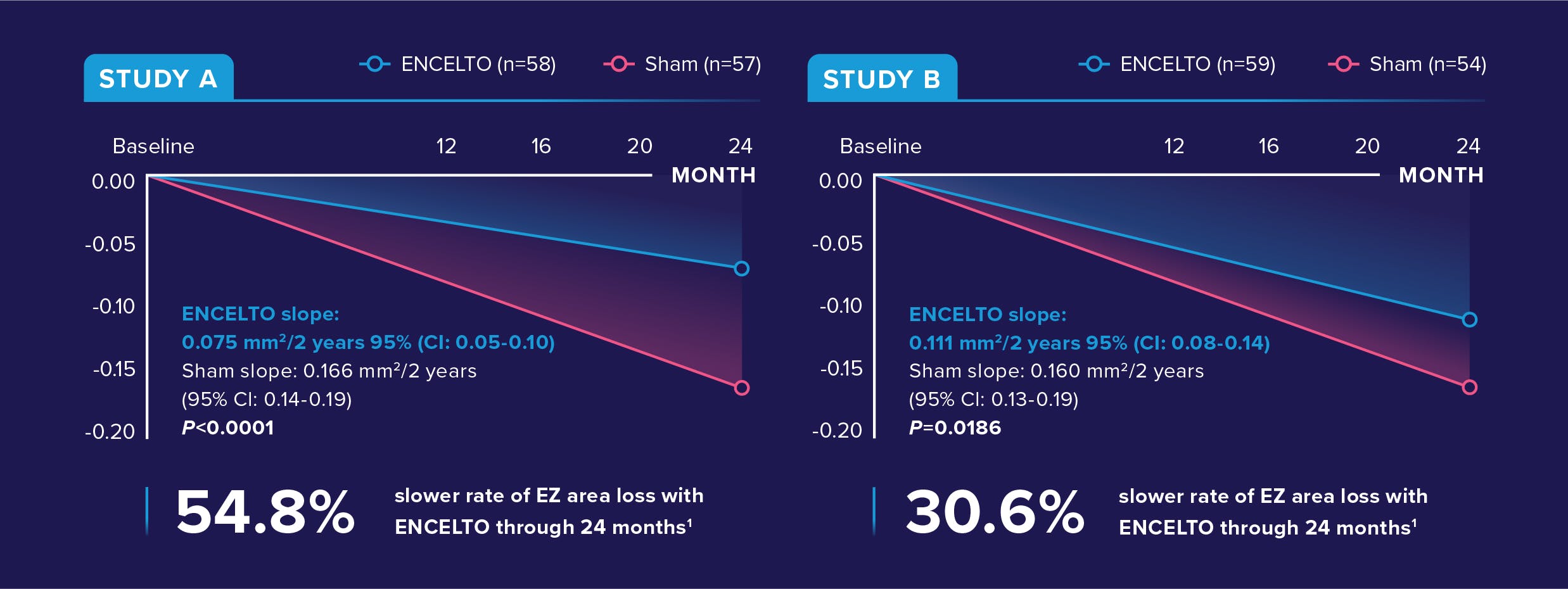
ENCELTO was approved for the treatment of adults with idiopathic MacTel type 2 by the FDA based on the results two identically designed, multicenter, randomized sham-controlled phase 3 trials (NTMT-03-A and NTMT-03-B, study A and B, respectively). These trials included a total of 115 participants in study A (ENCELTO, n=58; sham, n=57) and 113 in study B (ENCELTO, n=59; sham, n=54), all of whom were between 21 and 80 years of age with MacTel in ≥1 eye confirmed by FA leakage, and evidence of ≥1 of the following features: retinal opacification, crystalline deposits, right-angle vessels, hyperpigmentation, or loss of luteal pigment visualized by FAF.11
Baseline characteristics between treatment groups and the two trials were largely similar. Notably, baseline lesion sizes were smaller overall in study A vs B. In both studies, however, treatment with ENCELTO significantly reduced the rate of EZ area loss through 24 months, with participants who received ENCELTO having 54.8% and 30.6% less EZ loss than participants treated with sham in studies A and B, respectively (Figure 1).11
In these trials, ENCELTO was generally well tolerated, with most ocular treatment emergent adverse events (TEAEs) being mild to moderate in severity, transient, and related to surgery. There was no difference in loss of ≥15 letters of BCVA or rate of macular neovascularization in participants who received ENCELTO or sham in either trial.11
The most common adverse reactions (incidence ≥2%) were conjunctival hemorrhage, delayed dark adaptation, foreign body sensation, eye pain, suture-related complications, miosis, conjunctival hyperemia, eye pruritus, ocular discomfort, vitreous hemorrhage, blurred vision, headache, dry eye, eye irritation, cataract progression or formation, vitreous floaters, severe vision loss, eye discharge, anterior chamber cell, and iridocyclitis.4
Through 24 months, 6 (5.1%) ENCELTO-treated eyes and 1 (0.9%) fellow eye in the sham group experienced a serious ocular AE. In the ENCELTO eyes, these were suture-related complications (5), including exposed sutures or knots that required intervention, and device extrusion (1).11
Most nonocular TEAEs were mild to moderate, and no serious related nonocular TEAEs were reported. No explants were required in either clinical study.
Conclusion
The approval of a therapy for MacTel is a pivotal moment for our field, but an even more important moment for our patients who have suffered from this condition without any hope of forestalling their visual decline. It is up to us to make sure as many appropriate patients as possible have the opportunity to slow their disease progression.
Supplied by Neurotech. The views and opinions expressed here may not reflect those of Bryn Mawr Communications or Retina Today.
1. Kedarisetti KC, Narayanan R, Stewart MW, Reddy Gurram N, Khanani AM. Macular telangiectasia type 2: a comprehensive review. Clin Ophthalmol. 2022;16:3297-3309.
2. Gantner ML, Eade K, Wallace M, et al. Serine and lipid metabolism in macular disease and peripheral neuropathy. N Engl J Med. 2019;381(15):1422-1433.
3. Neurotech’s ENCELTO (revakinagene taroretcel-lwey) Approved by the FDA for the Treatment of Macular Telangiectasia Type 2 (MacTel). Press release. Neurotech Pharmaceuticals, Inc. Published March 6, 2025. Accessed April 1, 2025. Neurotech press release PDF
4. ENCELTO [important safety information]. Cumberland, RI: Neurotech Pharmaceuticals, Inc.; 2025.
5. Chew EY, Clemons TE, Jaffe GJ, et al. Effect of ciliary neurotrophic factor on retinal neurodegeneration in patients with macular telangiectasia type 2: A randomized clinical trial. Ophthalmology. 2019;126(4):540-549.
6. Kauper K, McGovern C, Sherman S, et al. Two-year intraocular delivery of ciliary neurotrophic factor by encapsulated cell technology implants in patients with chronic retinal degenerative diseases. Invest Ophthalmol Vis Sci. 2012;53(12):7484-7491.
7. Heeren TF, Clemons T, Scholl HP, Bird AC, Holz FG, Charbel Issa P. Progression of vision loss in macular telangiectasia type 2. Invest Ophthalmol Vis Sci. 2015;56(6):3905-3912.
8. Pauleikhoff D, Bonelli R, Dubis AM, et al. Progression characteristics of ellipsoid zone loss in macular telangiectasia type 2. Acta Ophthalmol. 2019;97(7):e998-e1005.
9. Peto T, Heeren TFC, Clemons TE, et al. Correlation of clinical and structural progression with visual acuity loss in macular telangiectasia type 2: MacTel Project Report No. 6-The MacTel Research Group. Retina. 2018;38 Suppl 1(Suppl 1):S8-S13.
10. Kauper K, Nystuen A, Orecchio L, et al. Long-term durability of ciliary neurotrophic factor-releasing revakinagene taroretcel-lwey in individuals with retinal degenerative disorders. Invest Ophthalmol Vis Sci. 2025;66(11):3.
11. Chew EY, Gillies M, Jaffe GJ, et al. Cell-based ciliary neurotrophic factor therapy for macular telangiectasia type 2. NEJM Evid. 2025;4(8):EVIDoa2400481.
INDICATIONS AND USAGE
ENCELTO is an allogeneic encapsulated cell-based gene therapy indicated for the treatment of adults with macular telangiectasia type 2 (MacTel).
IMPORTANT SAFETY INFORMATION
CONTRAINDICATIONS
ENCELTO is contraindicated in patients with active or suspected ocular or periocular infections, and in patients with known hypersensitivity to Endothelial Serum Free Media (Endo-SFM).
WARNINGS AND PRECAUTIONS
ENCELTO implantation surgery and/or implantation related procedures have been associated with the following:
Severe Vision Loss
Severe vision loss defined as three or more lines of visual acuity loss [≥15 Early Treatment Diabetic Retinopathy Study (ETDRS) letters] has occurred following ENCELTO implantation.
Monitor patients for signs and symptoms of vision loss
and manage as clinically indicated.
Infectious Endophthalmitis
Infectious endophthalmitis may occur following ENCELTO implantation. Signs and symptoms of infectious endophthalmitis include progressively worsening eye pain, vision loss, or scleral
and conjunctival injection. To mitigate the risk of endophthalmitis, use proper aseptic surgical technique for ENCELTO implantation. Monitor patients for signs or symptoms of infectious endophthalmitis. Remove ENCELTO implant if infectious endophthalmitis occurs and manage symptoms according to clinical practice.
Retinal Tear and Detachment
Retinal tears and retinal detachment may occur following ENCELTO implantation. Signs and symptoms of retinal tears include acute onset of flashing lights, floaters, and/or loss of visual acuity.
Signs and symptoms of retinal detachment may include progressive visual field loss and/or loss of visual acuity. Use standard vitreoretinal surgical techniques during ENCELTO implantation
to minimize the risk of retinal tears and retinal detachment.
Monitor for any signs or symptoms of retinal tear and/or retinal detachment. Treat rhegmatogenous retinal detachment and retinal tears promptly. Remove ENCELTO implant, if vitrectomy with a complete gas fill or silicone oil fill is required.
Vitreous Hemorrhage
Vitreous hemorrhage, which may result in temporary vision loss, has occurred following ENCELTO implantation. Patients receiving antithrombotic medication (e.g., oral anticoagulants, aspirin, nonsteroidal anti-inflammatory drugs) may be at increased risk of vitreous hemorrhage. To reduce the risk of vitreous hemorrhage, interrupt antithrombotic medications prior to the ENCELTO implantation. Vitrectomy surgery may be necessary to clear
severe, recurrent, or non-clearing vitreous hemorrhage.
If the patient has a late onset vitreous hemorrhage (greater than one year following ENCELTO implantation surgery), examine the ENCELTO implantation site for possible implant extrusion.
If implant extrusion has occurred, surgically reposition ENCELTO.
Implant Extrusion
Implant extrusion through the initial scleral wound has occurred following ENCELTO implantation. Signs and symptoms of implant extrusion include recurrent uveitis, vitreous hemorrhage,
eye pain more than one year after implantation, or visibility of titanium fixation loop under the conjunctiva. To reduce the risk of implant extrusion, carefully follow the specific surgical steps for
ENCELTO implantation.
Evaluate patients after 6 months to confirm proper positioning of ENCELTO and then annually. If ENCELTO begins to extrude, surgically reposition ENCELTO to a proper scleral wound depth either in the same site or in the opposing inferior quadrant of
the vitreous cavity.
Cataract Formation
Cataract formation, including cataract cortical, cataract nuclear, cataract subcapsular, cataract traumatic, and lenticular opacities, has occurred following ENCELTO implantation. To reduce the risk of ENCELTO-related cataract formation or progression, carefully follow the specific surgical steps for ENCELTO implantation.
Suture Related Complications
Suture related complications, including conjunctival erosions
due to suture tips and suture knots, have occurred following
ENCELTO implantation.
To mitigate the risk of suture related complications, carefully follow
the specific surgical steps for ENCELTO implantation and manage suture-related complications as clinically indicated.
Delayed Dark Adaptation
Delayed Dark Adaptation, a delay in the ability to adjust vision from a bright lighting condition to a dim lighting, has occurred following ENCELTO administration which remained unchanged for the duration of study follow up. Advise patients to take caution while driving and navigating in the dark.
ADVERSE REACTIONS
The most common adverse reactions (≥2%) reported with ENCELTO were conjunctival hemorrhage, delayed dark adaptation, foreign body sensation, eye pain, suture related complications, miosis, conjunctival hyperemia, eye pruritus, ocular discomfort, vitreous hemorrhage, blurred vision, headache, dry eye, eye irritation, cataract progression or formation, vitreous floaters, severe vision loss, eye discharge, anterior chamber cell, iridocyclitis.
US-EO-PM-251000001 11/25
Manufactured for:
Neurotech Pharmaceuticals, Inc.
Cumberland, RI 02864
ENCELTO, the ENCELTO logo, and the Neurotech logo are registered trademarks of Neurotech Pharmaceuticals, Inc.
