


Macular telangiectasia type 2 (MacTel) is a progressive bilateral disease of the macula that leads to vision loss and can potentially reduce quality of life.1 Although previously considered vascular in nature,2 it is now believed to be a neurodegenerative condition in which Müller glial cells, responsible for structural support and which produce neurotrophic factors like ciliary neurotrophic factor (CNTF) to support photoreceptor survival, become dysfunctional, leading to irreversible photoreceptor loss.1
The photoreceptor loss in MacTel begins temporal to the fovea; as such, affected patients’ best corrected visual acuity (BCVA) may remain intact over a prolonged period, making BCVA a relatively insensitive measure of visual acuity. Even when BCVA is maintained, patients may experience significantly reduced reading ability and difficulty with other activities due to central visual field defects.1 As the disease progresses and encroaches on the foveal center, patients may experience a significant drop in BCVA. In advanced stages, MacTel can also lead to neovascularization or macular hole development, both of which are also associated with significant loss of visual function.3
RECOGNIZING EARLY SYMPTOMS
Because the ellipsoid zone (EZ) loss in MacTel begins in the outer retina, early symptoms of MacTel that patients often notice include reduced reading speed and metamorphopsia4; color sensitivity may also be affected, and patients may report difficulty distinguishing different shades.5,6
Due to the vague presentation of early symptoms in MacTel, the use of imaging is invaluable for its accurate diagnosis. Among available imaging modalities, optical coherence tomography (OCT) is commonly used to help diagnose MacTel. Key findings on OCT may include cavitations in the inner and outer retina, draping of the internal limiting membrane (ILM) over the cavitations (known as the “ILM drape sign”), breaks in the EZ layer, and foveal thinning. OCT-angiography is also very useful for capturing pathologic vascular changes that occur in early MacTel, such as right-angled venules and telangiectatic vessels in the deep capillary plexus, and for capturing neovascularization in later stages.7 (Figure 1)
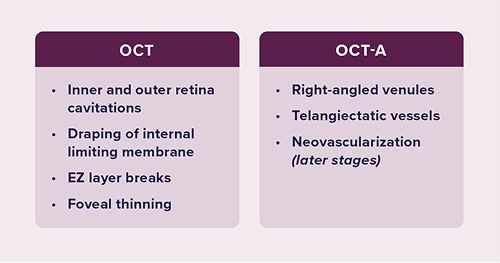
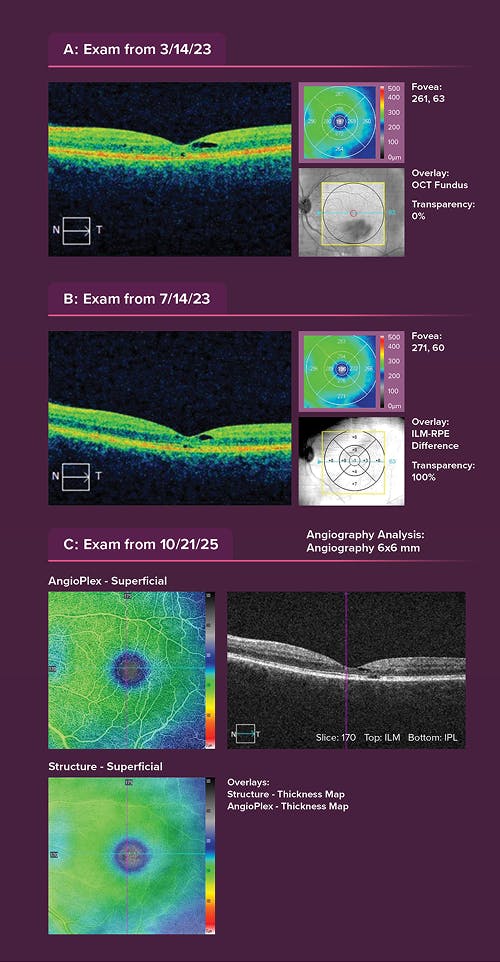
Figure 1. Images A and B show nascent MacTel findings, including inner retina cavitary changes and early outer retina changes. Image C, taken 2 years later, shows progressive loss of IS/OS on OCT-A.
SLOWING IRREVERSIBLE STRUCTURAL DAMAGE
Despite anti-vascular endothelial growth therapies addressing neovascular complications, no approved treatment previously existed for MacTel.8 Approved March 2025,9 ENCELTO (revakinagene taroretcel-lwey; Neurotech Pharmaceuticals, Inc.) represents the first FDA approved therapy for the treatment of adults with idiopathic macular telangiectasia type 2 (MacTel). Prompt recognition, diagnosis, and treatment of MacTel are key to managing structural progression.
ENCELTO is an encapsulated cell-based gene therapy that consists of a tiny semi-permeable capsule, approximately 6.5 mm long and approximately 1.2 mm wide, which is surgically implanted into the vitreous and anchored to the sclera in an outpatient procedure using standard surgical techniques. The capsule contains living cells genetically modified to produce and release recombinant human CNTF, a protein thought to initiate glial signaling that may promote photoreceptor survival10; however, ENCELTO’s mechanism of action is not fully understood.5
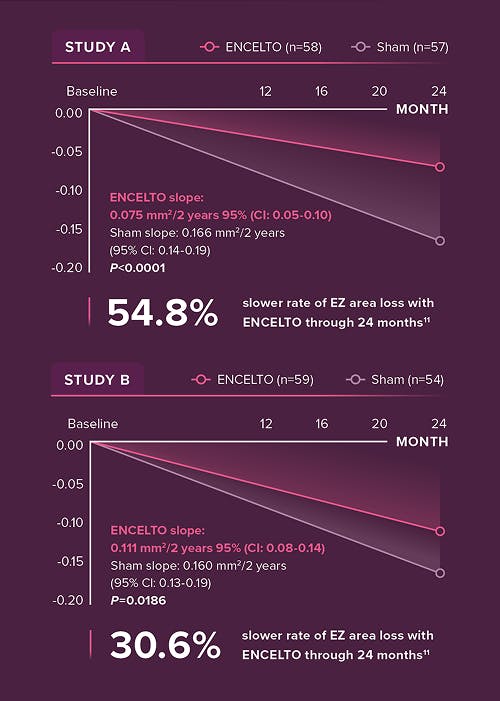
The clinical efficacy of ENCELTO was established in two identically designed, multicenter, randomized, sham-controlled, phase 3 clinical trials (NTMT-03-A and NTMT-03-B [study A and B, respectively]). In these studies, a total of 228 participants with MacTel across 47 sites (115 in study A and 113 in study B) were randomized to receive either ENCELTO intravitreal implant or sham procedure, with the primary endpoint being rate of EZ area loss through 24 months. Participants who received ENCELTO experienced a 54.8% (in study A) and 30.6% (in study B) reduction in the rate of EZ area loss from baseline relative to sham through 24 months.11 (Figure 2)
ENCELTO was generally well tolerated in these trials. Most ocular treatment emergent adverse events (TEAEs) were mild to moderate in severity, transient, and related to surgery.11
The most common adverse reactions (incidence ≥2%) were conjunctival hemorrhage, delayed dark adaptation, foreign body sensation, eye pain, suture-related complications, miosis, conjunctival hyperemia, eye pruritus, ocular discomfort, vitreous hemorrhage, blurred vision, headache, dry eye, eye irritation, cataract progression or formation, vitreous floaters, severe vision loss, eye discharge, anterior chamber cell, and iridocyclitis.7 Rates of macular neovascularization and loss of BCVA of 15 letters or more did not differ between participants who received ENCELTO or sham in either trial.11
Through 24 months, 6 (5.1%) ENCELTO-treated eyes and 1 (0.9%) fellow eye in the sham group experienced a serious ocular TEAE. In the ENCELTO eyes, these were suture-related complications (5), including exposed sutures or knots that required surgical intervention, and device extrusion (1).11
Most nonocular TEAEs were mild to moderate, no serious related nonocular TEAEs were reported, and no explants were required in either clinical study.11
ILM, internal limiting membrane; IPL, inner plexiform layer; IS/OS, inner segment/outer segment; MacTel, macular teleangiectasia type 2; OCT, optical coherence tomography; OCT-A, optical coherence tomography angiography; ORCC, outer retina to choriocapillaris; RPE, retinal pigment epithelium; VRI, vitreoretinal interface.
Conclusion
The approval of ENCELTO, the first and only FDA approved therapy for adults with idiopathic MacTel type 2, marks an important milestone for patients with this condition and the retina community as a whole. It is incumbent upon us as retina specialists to be familiar with the symptoms of MacTel and its characteristics on imaging, which will help us to appropriately identify patients who are eligible for ENCELTO treatment.
1. Kedarisetti KC, Narayanan R, Stewart MW, Reddy Gurram N, Khanani AM. Macular telangiectasia type 2: a comprehensive review. Clin Ophthalmol. 2022;16:3297-3309.
2. Charbel Issa P, Gillies MC, Chew EY, et al. Macular telangiectasia type 2. Prog Retin Eye Res. 2013;34:49-77.
3. Heeren TFC, Chew EY, Clemons T, et al. Macular telangiectasia type 2: visual acuity, disease end stage, and the MacTel area: MacTel Project Report Number 8. Ophthalmology. 2020;127(11):1539-1548.
4. Heeren TF, Holz FG, Charbel Issa P. First symptoms and their age of onset in macular telangiectasia type 2. Retina. 2014;34(5):916-919.
5. Simunovic MP, Hess K, Gillies MC. Impairments in cone pigment regeneration and absolute threshold in macular telangiectasia type 2. Retina. 2022;42(3):569-575.
6. Simunovic, MP, Gillies, MC. Impairments of l-cone/m-cone and s-cone–mediated color discrimination in macular telangiectasia type II. Retina. 2022;42(3):576-580.
7. Moir J, Amin SV, Khanna S, et al. Use of OCT angiography to diagnose and manage atypical presentations of macular telangiectasia type 2. Int J Mol Sci. 2022;23(14):7849
8. Khodabande A, Roohipoor R, Zamani J, et al. Management of idiopathic macular telangiectasia type 2. Ophthalmol Ther. 2019;8(2):155-175.
9. ENCELTO [package insert]. Cumberland, RI: Neurotech Pharmaceuticals, Inc.; 2025.
10. Chew EY, Clemons TE, Jaffe GJ, et al. Effect of ciliary neurotrophic factor on retinal neurodegeneration in patients with macular telangiectasia type 2: A randomized clinical trial. Ophthalmology. 2019;126(4):540-549
11. Chew EY, Gillies M, Jaffe GJ, et al. Cell-based ciliary neurotrophic factor therapy for macular telangiectasia type 2. NEJM Evid. 2025;4(8):EVIDoa2400481.
