

Key Takeaways
- The subthreshold laser (STL) remains a valuable tool for both center-involved and non–center-involved DME, especially when central thickness ≤ 400 µm.
- The STL promotes biological healing through retinal pigment epithelium and Müller cell activation, reducing inflammation and fluid accumulation.
- AI-based analysis provides objective confirmation of the procedure’s efficacy and may help standardize outcome measurement.
- When integrated with anti-VEGF regimens, the STL offers a safer, cost-effective, and durable adjunct or alternative therapy for selected DME patients.
For many years, ophthalmologists treated diabetic macular edema (DME) primarily with focal and grid laser thermal photocoagulation. With the advent of anti-VEGF therapy, the approach shifted dramatically, and laser therapy lost its place as a first-line treatment. Yet, as laser technology evolved—especially with the introduction of the subthreshold laser (STL)—we began to rediscover its potential.
Here, I will share my clinical experience with Lumibird Medical’s SubLiminal® subthreshold laser, a treatment that has proven to be both safe and highly effective in specific cases of DME. When applied properly, this treatment continues to play a valuable role in retinal care.
How Laser Therapy Lost—and Regained—Its Place
The skepticism surrounding laser therapy dates back to the Diabetic Retinopathy Clinical Research (DRCR.net) Protocol I, which compared prompt and deferred laser treatments combined with ranibizumab (Lucentis, Genentech).1 After 5 years, results between the groups were similar, but deferred treatment showed better functional outcomes in eyes with poorer baseline vision. This led many to conclude that conventional laser therapy might even be harmful in some DME cases.
Consequently, guidelines shifted. Laser therapy was relegated to a secondary or “relative” indication, reserved for non–center-involved DME, eyes with vasogenic subforms, or persistent microaneurysms identified on fluorescein angiography.
However, these conclusions were drawn from the performance of conventional threshold lasers, not from the newer, non-destructive subthreshold approaches like the SubLiminal® subthreshold laser.
In recent years, studies like the DIAMONDS trial in the UK2 have shown that STL therapy yields equivalent visual and anatomical outcomes compared with standard laser, but without retinal burns or scarring—a decisive advantage for preserving tissue integrity.
The Science Behind Subthreshold Laser
The rationale for the STL lies in its non-thermal, tissue-sparing mechanism. Unlike continuous-wave lasers, which generate visible burns, an STL delivers short bursts of energy with “off” intervals that allow heat to dissipate. This prevents photoreceptor and RPE damage while triggering beneficial cellular responses.
Mechanistically, the STL stimulates the retinal pigment epithelium (RPE) to produce heat-shock proteins, which suppress VEGF expression and reduce inflammation. It also activates Müller cells,3 which are central to fluid homeostasis in the retina. One study demonstrated that the STL reduces biomarkers like GFAP and Kir4.1, as well as inflammatory chemokines such as RANTES and FasL.4
This dual anti-inflammatory and neuroprotective effect forms the physiological mechanism of action of the subthreshold approach, and it explains how the procedure works with the eye’s biology rather than overwhelming it with heat.
A Safe and Reproducible Treatment Protocol
One of the challenges with STL therapy has always been its titration—how to deliver the correct amount of energy without causing damage. “Barely visible” burns are subjective and depend on multiple factors, including pigmentation and media clarity.
To overcome this issue, I devised a fixed-parameter regimen for Lumibird Medical’s 577-nm yellow laser in a high-density, fully confluent fashion on the entire macular area:
- Spot size: 160 µm
- Exposure time: 200 ms
- Duty cycle: 5%
- Power: 250 mW
I apply this treatment in a high-density, confluent pattern, targeting the entire leaking area rather than isolated microaneurysms. This standardized approach ensures a uniform therapeutic effect without risking injury to the photoreceptors. It also minimizes variability and increases the procedure’s safety profile.
Clinical Experience: Real-World Case Studies
Case 1: Persistent Edema After Multiple Anti-VEGF Injections
A patient presented with 20/50 BCVA in the left eye after undergoing seven anti-VEGF injections. The examination revealed a serous neurosensory detachment and mild intraretinal fluid. My team and I applied the STL therapy, carefully avoiding the central fovea.
Within 1 month, the eye’s vision improved to 20/32 BCVA, and follow-up imaging showed:
- Resolution of the subretinal fluid
- Reduction of the intraretinal cysts
- Decrease in hyperreflective foci (markers of inflammation)
Using AI-assisted analysis via the Ophthal software on the Mr. Doc platform (Mr. Doc s.r.l., Italy), we quantified this patient’s improvement: a decrease in both neurosensory detachment volume and intraretinal fluid, which confirmed the laser’s anti-inflammatory and stabilizing effect5 (Figure 1).
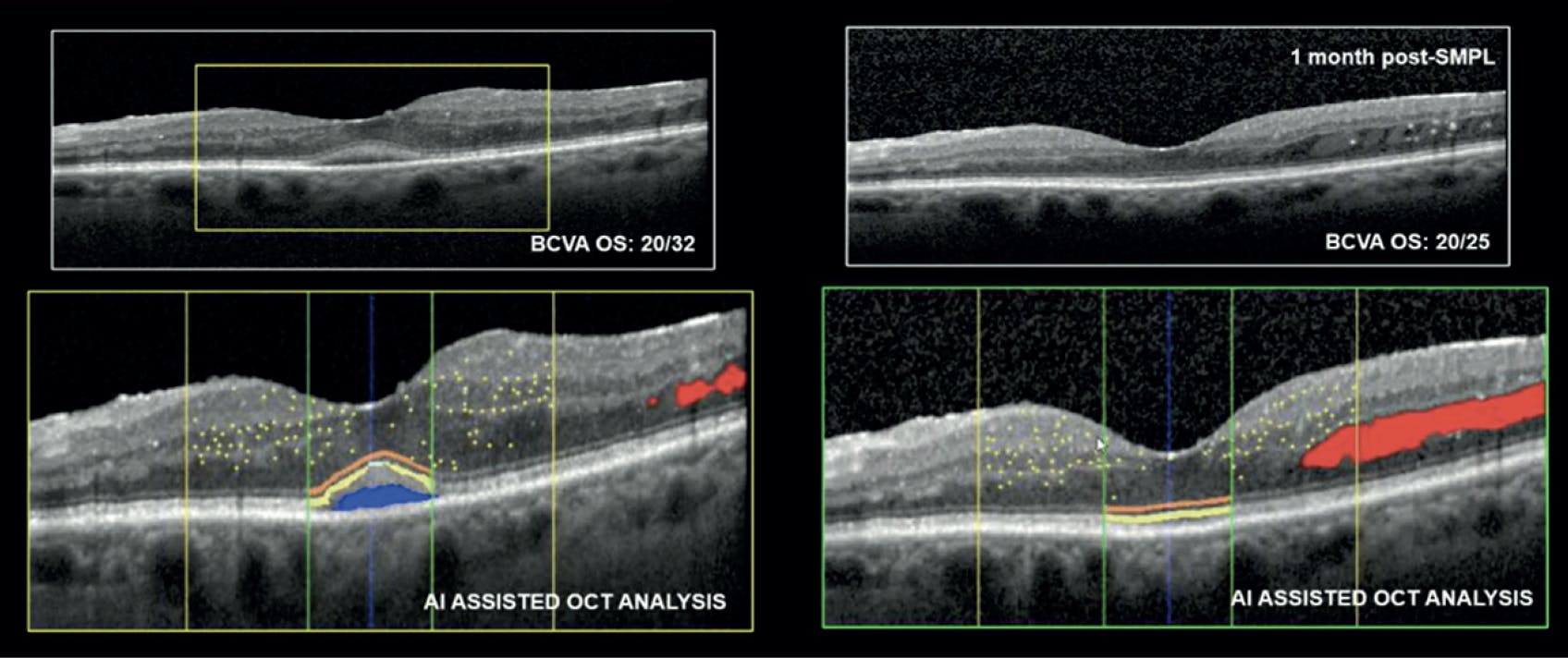
Figure 1. AI-assisted OCT images taken at the 1-month follow-up visit of an eye with serous neurosensory detachment and mild intraretinal fluid after treatment with Lumibird Medical’s SubLiminal® laser.
This outcome reinforced what we often see clinically following STL treatment, specifically the combination of structural restoration and functional gain without any signs of retinal scarring.
Case 2: Serous Detachment With Outer Retinal Integrity
A patient with a 20/50 baseline BCVA and serous detachment in the left eye underwent the same SMPL protocol. After 1 month, his vision improved to 20/25 BCVA. Structural OCT confirmed the preservation of the outer retinal layers, including the ellipsoid zone, and a reduction of hard exudates—findings that are difficult to achieve, even with repeated pharmacologic therapy (Figure 2).
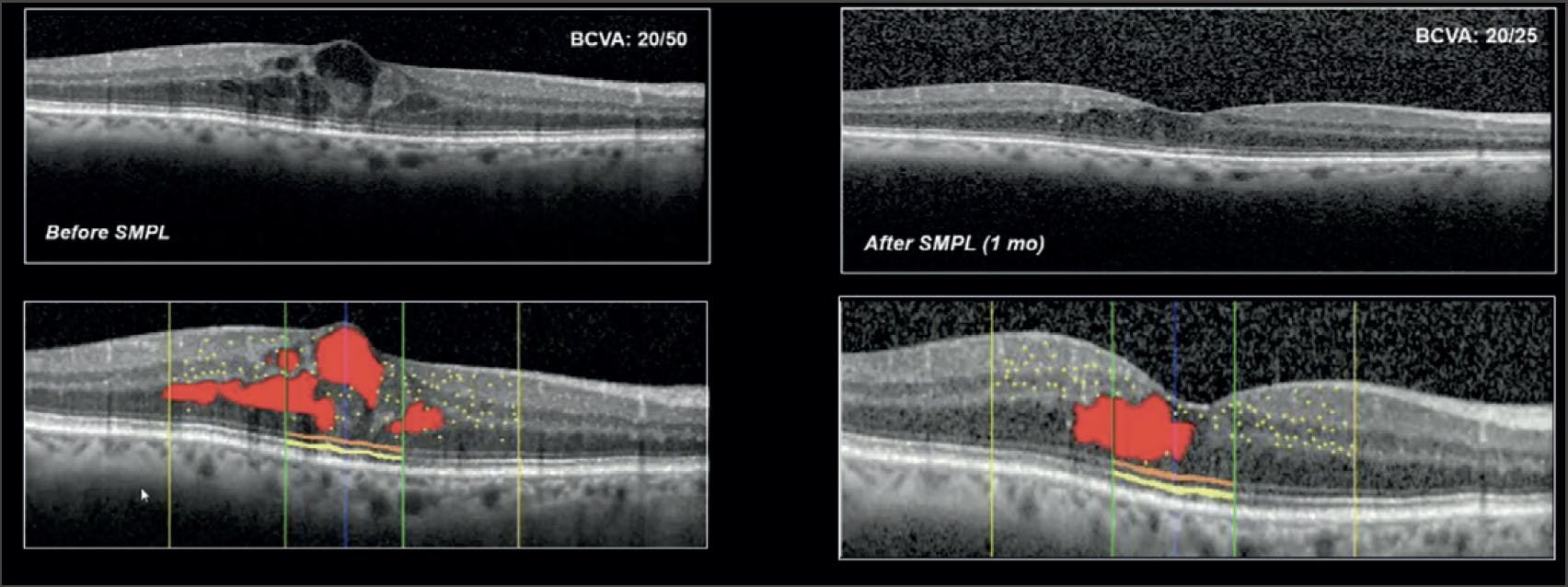
Figure 2. OCT images of an eye with serous detachment taken 1 month after treatment with the SubLiminal® laser show intact outer retinal layers, including the ellipsoid zone, and fewer hard exudates.
Slit-lamp examination of the macula showed a clear regression of lipid deposits and hemorrhagic components in the eye, providing evidence of effective fluid resorption and microvascular stabilization.
Lessons From Research and Practice
Clinical trials such as the DIAMONDS study have validated these observations. The study demonstrated equivalent efficacy between subthreshold and conventional lasers for DME with central subfield thickness ≤ 400 µm, in terms of both BCVA change and reduction in central retinal thickness. Furthermore, quality-of-life and visual field outcomes were similar, while the subthreshold group avoided permanent retinal burns entirely.2
When combined with anti-VEGF therapy, the STL can also reduce injection frequency, as shown in meta-analyses and real-world data. In my experience, the combination approach offers the best of both worlds: rapid fluid reduction from anti-VEGF and long-term stabilization from the laser’s RPE-modulating effects.
Safety and the Future of Subthreshold Therapy
What differentiates STL technology from conventional laser therapy is its safety profile and the ability to treat without causing visible burns. When applied properly, the 577-nm yellow SubLiminal® laser achieves therapeutic results without histological damage, allowing repeat treatments if necessary.
Beyond DME, this same principle is being explored for central serous chorioretinopathy, macular telangiectasia, and other retinal disorders where inflammation and RPE dysfunction play key roles.
Conclusion
Our evolving understanding of DME has led us full circle: from destructive lasers to pharmacotherapy and now to biologically intelligent laser modulation. With Lumibird Medical’s SubLiminal® technology, we are stimulating repair instead of burning tissue to induce healing. Subthreshold laser therapy represents a step toward a safer, smarter, and more sustainable future in retinal disease management.
1. Diabetic Retinopathy Clinical Research Network. Elman MJ, Aiello LP, Beck RW, et al. Randomized trial evaluating ranibizumab plus prompt or deferred laser or triamcinolone plus prompt laser for diabetic macular edema. Ophthalmology. 2010;117:1064–1077.
2. Lois N, Campbell C, Waugh N, et al. Diabetic macular edema and diode subthreshold micropulse laser: a randomized double-masked noninferiority clinical trial. Ophthalmology. 2023;130(1):14–27.
3. Midena E, Bini S, Martini F. Changes of aqueous humor Müller cells’ biomarkers in human patients affected by diabetic macular edema after subthreshold micropulse laser treatment. Retina. 2020;40(1):126–134.
4. Midena E, Micera A, Frizziero L, et al. Sub-threshold micropulse laser treatment reduces inflammatory biomarkers in aqueous humour of diabetic patients with macular edema. Sci Rep. 2019;9:10034.
5. Midena E, Toto L, Frizziero L, et al. Validation of an automated artificial intelligence algorithm for the quantification of major OCT parameters in diabetic macular edema. J Clin Med. 2023;12(6):2134.
