


Every year, the Aspen Retinal Detachment Society honors its founders—William O. Edward, MD, and Ottiwell Wood Jones III, MD—with an award lecture that speaks to the original goal of the meeting: to advance the field of retina surgery by gathering global leaders to share knowledge and exchange ideas. At the 2021 meeting in Snowmass, Colorado, Dennis P. Han, MD, did just that, with his Founders Lecture focused on the question of whether wet AMD patients presenting with advanced vision loss can benefit from anti-VEGF therapy.
THE MISSING PIECES
Dr. Han began the session by asking a question: Which patients with macular degeneration should we treat, and why? Although plenty of studies show that patients with mild to moderate wet AMD benefit from anti-VEGF therapy, the data are less clear on what to do for patients who already have severe vision loss. Most large clinical trials exclude patients with VA worse than 20/320, leaving clinicians unsure about the correct treatment approach, Dr. Han said.
The only randomized trial that included wet AMD patients with severe vision loss who underwent anti-VEGF treatment, he said, was published in 2012.1 However, the study was highly underpowered with only 11 patients in a treatment group and 10 in the control group. The findings showed a tendancy toward lower logMAR scores for patients in the treatment arm, suggesting improvement over time, according to Dr. Han. Had these findings been confirmed with a larger number of enrolled patients, he said he suspects the data would have reached statistical significance.
NEW DATA
With little else to inform a clinician’s choice to treat wet AMD patients with severe vision loss, Dr. Han and his colleagues decided to look at the visual outcomes and prognostic indicators in treating patients with severe visual loss with anti-VEGF therapy.2 The study was a retrospective chart review of 1,410 patients with wet AMD treated with anti-VEGF therapy. Inclusion criteria included a baseline VA of 20/200 or worse and a minimum follow-up of 6 months; exclusion criteria included any vision-limiting eye condition such as massive subretinal hemorrhage and any previous treatment with anti-VEGF therapy. A total of 131 patients met the study criteria, and 97 were followed for 12 months. The mean age was 82 years, and, interestingly, the mean number of injections at 12 months was only 4.2, although with a wide variation, according to Dr. Han. This emphasized the chronic problem of undertreatment that had been observed early in the era of anti-VEGF therapy, he noted.
Roughly half of the patients received bevacizumab (Avastin, Genentech) and half received ranibizumab (Lucentis, Genentech), with no difference in outcomes, he said. The baseline VA was approximately 1.38 logMAR (20/480 Snellen equivalent), which improved by a mean of 0.23 logMAR (P < .0001) at 6 months and 0.17 logMAR (P = .003) at 12 months. Patients improved by roughly 2 lines, on average, Dr. Han explained.
The Benefits of Anti-VEGF for Advanced Vision Loss in Wet AMD
There was ≥ 3 lines of visual improvement in almost 50% of patients, no change in about 30%, and worsening of 3 lines or more in about 20%. Dr. Han referred to this observation as the Han Rule: 50%, 30%, and 20% estimates the chances of a patient experiencing visual acuity improvement, no change, or worsening by 3 lines or more, respectively, in patients presenting with severe vision loss who received clinician-guided anti-VEGF therapy.
The study also found that patients with VA worse than 20/400 tended to have greater visual improvements than patients whose VA was 20/400 or better.
As for prognostic indicators, the study found that subretinal fluid and retinal hemorrhage were associated with improved prognosis, whereas intraretinal fluid and retinal pigment epithelial detachment were associated with a worse prognosis. Other factors associated with greater improvement were poor vision at baseline and a larger number of injections, Dr. Han said. These gains are sometimes not appreciated by patients because they continue to have some degree of impairment, and patient-centered benchmarks such as reading and driving may not be met.
BENEFITS BEYOND VISION
Visual loss is an independent risk factor for accidental falls, and wet AMD is associated with a nearly twofold heightened risk of injurious falls.3 In addition to visual acuity, loss of binocularity and contrast sensitivity are also important predictors of a patient’s risk for falls.4,5 Thus, visual acuity may not be the only appropriate measure of whether a patient might benefit from anti-VEGF treatment, he suggested.
According to the AMA Council on Industrial Health, the positive impact on patient functioning of any visual improvement is two- to threefold greater if the patient has a poor fellow eye (Figure).6 Dr. Han provided an example to help explain the true benefit based on the fellow eye’s vision, calculated with the AMA criteria. If the fellow eye has good vision, a moderate treatment benefit in an affected eye can reduce the patient’s impairment of the visual system from 24% to 17%; that’s a difference of 7%. However, if the fellow eye’s vision is poor, that same treatment might reduce the patient’s impairment by a larger amount, from 97% to 75%, which is a difference of 22%.
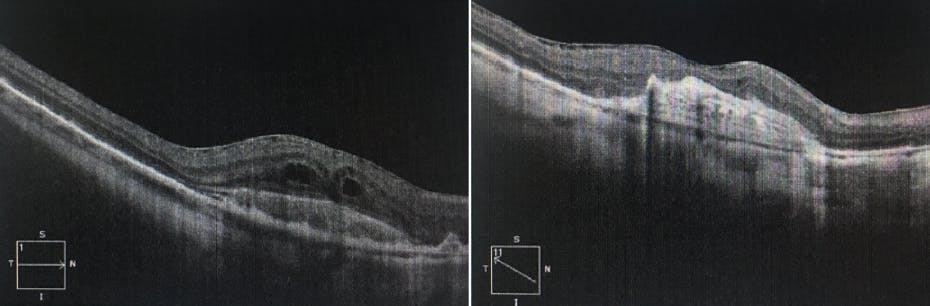
Figure. This patient presented with a baseline VA of 20/200 and struggled to fixate centrally. After 9 months of monthly treatment with bevacizumab, VA improved to 20/80 with central fixation. Although the patient was not impressed with his visual improvement, VA in his other eye was counting fingers at 3 feet. Dr. Han believes he saved the vision in this patient’s good eye from becoming just as bad and preserved meaningful visual function overall for the patient.
MANAGEMENT CONSIDERATIONS
Dr. Han wrapped up the session with a look at some of the management pearls he gleaned from the study.
- Hemorrhage and subretinal fluid may be reversible contributors to visual loss, he said, and should not preclude treatment, even if fibrosis and intraretinal fluid are present.
- Clinicians must manage expectations based on the prognosis. The Han Rule (50, 30, 20) is a rough estimate of what can happen when treating wet AMD patients with severe vision loss, and it can help patients decide whether or not to commit to treatment.
- Consider stopping treatment for two reasons: futility and excessive treatment burden. If, after a sustained course of treatment, there is no active exudation but the visual acuity is not useful to the patient, further treatment is probably futile.
- Alternatively, nonstop therapy should be considered if after 6 to 12 months of continuous fixed interval injections the vision is of functional value to the patient. At that point, Dr. Han then considers at least a treat-and-extend approach with up to a maximum interval of 8 to 10 weeks between injections (using bevacizumab or aflibercept [Eylea, Regeneron]).
1. Parodi MB, Cascavilla M, Papayannis A, Kontadakis DS, Bandello F, Iacono P. Intravitreal bevacizumab in advanced-stage neovascular age-related macular degeneration with visual acuity lower than 20/200. Arch Ophthalmol. 2012;130(7):934-935.
2. Vogel RN, Davis DB, Kimura BH, et al. Neovascular age-related macular degeneration with advanced visual loss treated with anti–vascular endothelial growth factor therapy: clinical outcome and prognostic indicators. Retina. 2017;37(2):257-264.
3. Szabo SM, Janssen PA, Khan K, Lord SR, Potter MJ. Neovascular AMD: an overlooked risk factor for injurious falls. Osteopros Int. 2010;21:855-862.
4. Coleman AL. Sources of binocular suprathreshold visual field loss in a cohort of older women being followed for risk of falls: an American Ophthalmological Society thesis. Trans Am Ophthalmol Soc. 2007;105;312-329.
5. DeBoer MR, Pluijm SMF, Lips P, et al. Different aspects of visual impairment as risk factors for falls and fractures in older men and women. J Bone Miner Res. 2004;19:1539-1547.
6. Physicians Desk Reference for Ophthalmology, Section 6. Evaluation of Permanent Visual Impairment. 23rd Edition. Medical Economics: 1995.


-1_1638377570.jpg?auto=compress,format&w=70)


_1773249222.png?auto=compress,format&w=75)





