




AT A GLANCE
- The use of small-gauge vitrectomy with the lift-and-shave technique can streamline the removal of fibrovascular tissue and traction with minimal need for ancillary instrumentation.
- The best way to understand the lift-and-shave technique is to see it as unimanual-bimanual dissection—you perform both functions with the vitrectomy probe sequentially, not simultaneously.
- You must control any bleeding. Adjunctive preoperative bevacizumab (Avastin, Genentech) can be helpful for highly vascular tissue.
The surgical management of tractional retinal detachments (TRDs) can be challenging, and complications such as the creation of iatrogenic breaks may be associated with poor visual prognosis.1 The use of small-gauge vitrectomy, particularly 27-gauge, with the lift-and-shave technique, can streamline the removal of fibrovascular tissue and traction with minimal need for ancillary instrumentation.2
Our preferred platform is the 27-gauge Hypervit Dual Blade Vitrectomy Probe (Alcon) with a cutting speed of 20,000 cpm. The parameters are set at the maximum cutting rate and vacuum, and aspiration is controlled with the foot pedal. Beginners can set the aspiration at 400 mm Hg until they feel at ease with the increased flow of the cutter. The 27-gauge Hypervit system permits increased flow rates that allow efficient removal of vitreous and controlled aspiration through the small 27-gauge vitrectomy probe opening.
PREOPERATIVE CONSIDERATIONS
Imaging with spectral-domain OCT prior to surgery provides invaluable information for the surgical plan. For example, imaging can help the surgeon determine if the fovea is attached, if epiretinal membranes are present, and if there is significant traction.
If vitreous hemorrhage precludes visibility, B-scan echography is essential to confirm whether the retina is attached, the vitreous is detached, or there are areas of traction.
If the fibrovascular tissue is significantly vascular, pretreatment with bevacizumab (Avastin, Genentech) 1 to 5 days before surgery is beneficial.
SURGICAL STEPS
1. Perform a core vitrectomy and remove all of the peripheral vitreous. TRDs are accompanied by at least partial detachment of the vitreous with strong attachments around the fibrovascular plaques. Begin to remove the hyaloid in the detached areas and cut the attachments around the fibrovascular plaques. To detach the vitreous, use the vitrector with aspiration at the maximum setting. Control the traction with the foot pedal to prevent breaks.
2. To remove the fibrovascular tissue, use only aspiration to lift the tissue and create a space between the retina and the fibrovascular tissue. Place the vitrector under the tissue and blunt-dissect it to separate it from the retina. If you experience any resistance, cut the fibrovascular tissue. Once the tissue is separated, change the aspiration setting to the cutter setting, and segment or back-cut. Switch the probe to aspiration again to continue lifting the fibrovascular tissue from the retina; cut any epicenters with the vitrector. Alternate like this between aspiration and cutting until all of the fibrovascular tissue is removed.
3. In some eyes, the fibrovascular tissue is tightly adherent to the retina, and no safe elevation is possible in the peripheral areas. In this event, detach the fibrovascular tissue around the optic nerve and dissect bluntly from the inside out. The area between the optic nerve and the fovea is often a good access point because it rarely has strong tissue attachments.
4. Once all of the fibrovascular tissue has been removed, aspirate any remaining blood from the retinal surface with the vitrector, or use reflux to lift it from the retina prior to aspiration.
5. Perform panretinal photocoagulation, particularly in the periphery up to the ora serrata. Do not apply laser to areas of elevated retina.
6. If the posterior pole was detached due to traction, perform a fluid-air exchange at the end of surgery, and instruct the patient to maintain a prone position for 1 to 2 days to help flatten the posterior pole.
7. Check sclerotomies for patency and use needling or suturing if needed.
IMPORTANT CONSIDERATIONS
- Removal of all traction is not necessary unless a rhegmatogenous component is present or iatrogenic breaks are created.
- Removal of all vitreous attachments to the fibrovascular tissue is important to prevent increased traction later.
- At the end of the procedure, intravitreal bevacizumab can be injected, particularly in highly vascular cases.
- If postoperative vitreous hemorrhage occurs, perform an in-office fluid-air exchange.
SURGICAL POINTERS
The best way to understand the lift-and-shave technique is to see it as unimanual-bimanual dissection. That is, instead of lifting the tissue with forceps in one hand and cutting with scissors or the vitrector in the other, you perform both functions with the vitrectomy probe sequentially, not simultaneously. This is possible because of the delicate aspiration allowed by the small opening in the 27-gauge vitrectomy cutter tip and the minimal traction exerted on the retina during cutting, made possible by the high cutting speed. You can then lift the tissue and cut from the epicenters once resistance is encountered, repeating these two steps until all the traction is relieved.
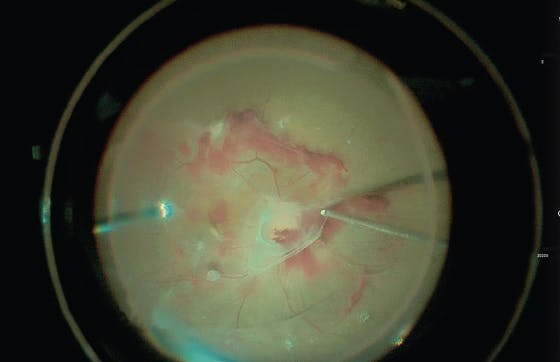
RD Repair with the Lift-and-Shave Technique
You can perform blunt dissection with the vitrector in a manner similar to viscodissection, entering in the plane between the retina and the membrane and blunt-dissecting the tissue laterally. Once you create a separation between the fibrovascular tissue and the retina, you can cut the tissue.
You must control any bleeding. Adjunctive preoperative bevacizumab can be helpful for highly vascular tissue. Be careful that systemic hypertension is controlled during the surgery, and increase IOP if bleeding occurs. If bleeding does not stop with increased IOP, apply direct pressure to the bleeding vessel with the vitrector for a minute, or apply continuous laser or diathermy to the bleeding areas.
Technological advances continue to improve our ability to manage difficult vitreoretinal pathologies and improve visual and anatomic outcomes. The constantly evolving technology calls for the creation of new techniques to take full advantage of these advances.
1. Thompson JT, de Bustros S, Michels RG, Rice TA. Results and prognostic factors in vitrectomy for diabetic traction retinal detachment of the macula. Arch Ophthalmol. 1987;105(4):497-502.
2. Berrocal MH. All-probe vitrectomy dissection techniques for diabetic tractional retinal detachments: lift and shave. Retina. 2018;38(Suppl 1):S2-S4.


-1_1638377570.jpg?auto=compress,format&w=70)
_1784132761.jpg?auto=compress,format&w=75)





