



AT A GLANCE
- Chronic cystoid macular edema (CME), a common finding in retina practices, is most likely to occur in eyes that have undergone multiple surgeries.
- Most cases of CME will resolve after one or several intravitreal corticosteroid injections, but some are truly chronic, with edema returning after repeated therapy.
- A sustained-release approach can help to reduce patients’ injection burdens and eliminate the peaks and troughs of inflammation that can occur with shorter-acting steroids.
- Close follow-up is warranted to ensure that patients with an intravitreal implant do not develop steriod-induced IOP elevation and to confirm reduction of inflammation and uvietic macular edema on OCT.
Pseudophakic cystoid macular edema (CME) is one of the most common causes of visual loss after cataract surgery,1 although modern phacoemulsification and small-incision cataract surgery have reduced its incidence.2 Pseudophakic CME occurs as a result of a cascade of inflammatory events, leading to the synthesis of prostaglandins and other inflammatory mediators in the anterior segment.3 Patients with diabetes, autoimmune conditions, narrow angles, concomitant ocular disease, or complicated surgery are at heightened risk for CME after cataract surgery.2
Uncomplicated pseudophakic CME usually resolves spontaneously within 12 months after cataract surgery,4 but it can become chronic in some complex cases. Chronic CME, a common presentation in retina practices, is most likely to occur in eyes that have undergone multiple surgeries subsequent to cataract extraction, complex surgeries that irritated the uvea (eg, from IOL suturing), or in the setting of trauma.
These cases are often frustrating to manage, either because traditional methods of treatment don’t resolve the findings or because the need for long-term therapy becomes burdensome to the patient.
In my clinical experience, chronic CME is often a manifestation of noninfectious posterior uveitis. A close look at the posterior segment in patients with postoperative CME often reveals uveitic or vascular changes associated with the ongoing inflammation. Among the most common associated findings noted on examination are few to numerous cellular reflections on OCT imaging, just anterior to the macula. Another common finding is asymmetric optic nerve hyperfluorescence seen on fluorescein angiography.
CASE EXAMPLES
Case No. 1. An 87-year-old White woman was referred to me with chronic CME (Figure 1A). Her history included cataract extraction with IOL implantation, a selective laser trabeculoplasty, two trabeculectomies, and placement of a microinvasive glaucoma surgery device. Although one would initially avoid using a steroid implant in a patient with glaucoma, this patient had a glaucoma drainage device, a functioning trabeculectomy, and no history of a steroid response to topical or shorter-acting intravitreal steroids. Under these circumstances, I felt comfortable giving her a long-acting steroid in the form of a fluocinolone acetonide 0.18 mg implant.
The patient has done well since implantation, with vision maintained at 20/25 to 20/32 in the affected eye and no macular edema (Figure 1B). Her injection burden was reduced, from receiving an intravitreal dexamethasone implant every 2 to 4 months to receiving the one fluocinolone acetonide implant followed by two booster intravitreal dexamethasone implants over the subsequent 2 years.
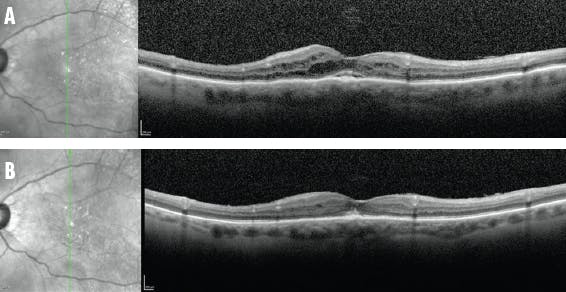
Figure 1. This patient with chronic pseudophakic CME (A) achieved long-term resolution of the edema after injection of a sustained-release steroid (B).
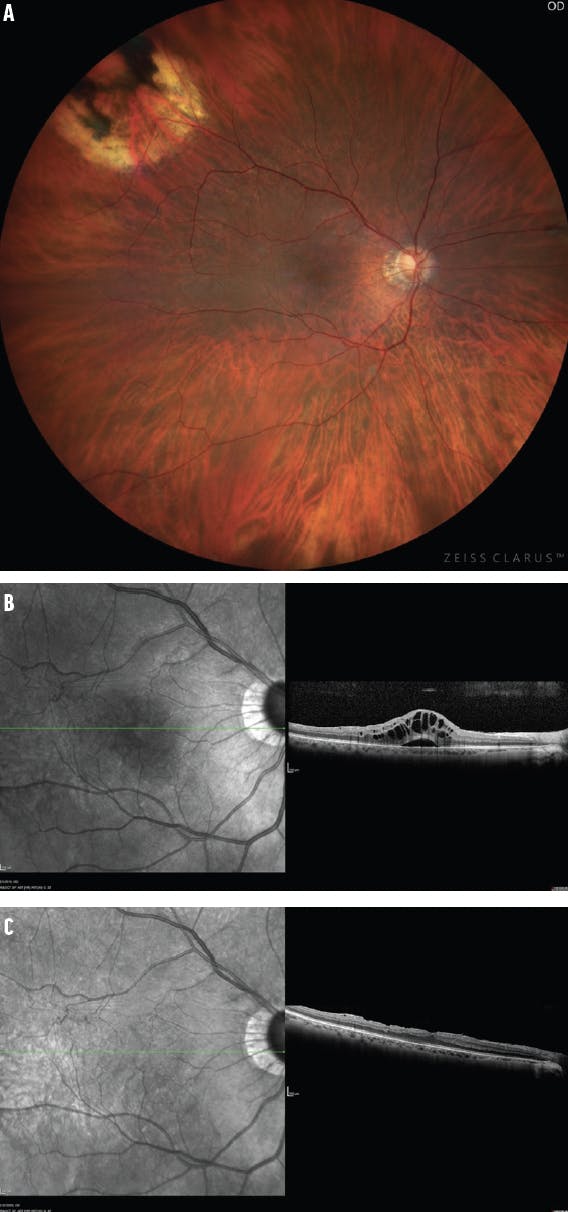
Case No. 2. A 69-year-old White woman presented with CME associated with posterior uveitis (Figure 2A and 2B). She had undergone vitrectomy surgery to repair a retinal detachment with a posterior tear, followed a short time later by cataract surgery and subsequent surgery for a macular pucker. I treated her with topical steroids, a sub-Tenon injection of triamcinolone acetonide (Kenalog, Bristol Myers Squibb), and then dexamethasone intravitreal implants every 2 to 3 months over several years (a total of eight to 10) before implanting the fluocinolone acetonide 0.18 mg implant when it became available. Her IOP is maintained with a single topical glaucoma drop. The ability to control the edema (Figure 2C) while avoiding multiple injections has significantly improved the patient’s satisfaction with treatment.
MANAGEMENT
In most patients with CME, treatment begins with topical steroids, followed by sub-Tenon steroid injection. My next step, in the presence of posterior uveitic findings, is intravitreal injection of a dexamethasone intravitreal implant 0.7 mg (Ozurdex, Allergan), which releases dexamethasone for 3 to 6 months. Most CME will resolve after one or several of these injections, but some are truly chronic, with edema returning even after response to repeated corticosteroid therapy.
If CME persists or recurs and uveitic signs have been documented, the historical next-line antiinflammatory therapy is the saturable fluocinolone acetonide intravitreal implant 0.59 mg (Retisert, Bausch + Lomb). This has been a reasonable option, but it requires the patient to consent to an OR procedure, and it has a significant risk of increased IOP.5 Some authors have advocated for the use of anti-VEGF injectable therapy to treat uveitic CME, but there is often limited applicability of VEGF inhibition in the multi-cytokine-rich environment of intraocular inflammation.5
Recently, I have had success treating patients with uveitic CME using the fluocinolone acetonide 0.18 mg injectable implant (Yutiq, EyePoint Pharmaceuticals). This implant is indicated for the treatment of chronic noninfectious uveitis of the posterior segment. The active ingredient is eluted at a low dose (about 0.2 µg per day) over approximately 3 years. I use it in eyes that have not manifested significant IOP elevation after previous shorter-acting steroid injections (Case Examples).
Most patients with chronic CME don’t need a lot of steroid, but they do need ongoing inflammatory control over an extended period of time—perhaps indefinitely. Thus, the pharmacokinetics of sustained-release options, offering a slow trickle of steroid to maintain suppression of inflammation, can be beneficial in some patients with chronic CME. A long-term sustained-release approach can help to reduce injection burden and eliminate the peaks and troughs of inflammation that can occur with shorter-acting steroids.
INJECTION PEARLS
There is a learning curve for administering any injectable implant; unboxing and preparing the implant for injection are the most technically challenging parts of the procedure. In preparing a pre-filled injector for use, it is important to avoid inadvertently removing the rear plunger and to keep the injector tilted upward above parallel; otherwise, there is a risk of the implant dislodging from the injector after the trombone wire is removed. In my experience, the fluocinolone acetonide 0.18 mg implant’s siliconized 25-gauge needle makes the injection smooth, and the procedure is well tolerated by patients.
After injecting the implant, I see patients every 2 to 4 months for the expected duration of the sustained-release therapy. Close follow-up is needed to ensure that patients do not develop steroid-induced IOP elevation and to confirm the reduction in inflammation and absence of uveitic macular edema on OCT.
As the drug is released from the implant over time, it is important to watch for breakthrough inflammation, an indication that a new implant may be needed.
If I observe breakthrough inflammation or edema, I may consider inserting a dexamethasone intravitreal implant while the fluocinolone acetonide implant is in place. In general, I have found that two implants can coexist well. There is space in the vitreous for both implants at the same time; the dexamethasone intravitreal implant will eventually dissolve or bioerode. Although there is limited literature on using multiple implants, clinicians must be aware of the potential for exacerbating steroid-induced increases in IOP when multiple implants are placed.
Some patients with chronic inflammation may require maintenance with a repeated long-acting steroid implant every 2 to 3 years.
FINAL THOUGHTS
We are fortunate to have a variety of good options now to manage posterior noninfectious uveitis and associated uveitic CME. For patients with chronic edema and inflammation, retina specialists should carefully examine the posterior segment for signs of uveitis and then treat accordingly, using longer-acting steroids if indicated.
1. Nelson ML, Martidis A. Managing cystoid macular edema after cataract surgery. Curr Opin Ophthalmal. 2003;4(1):39-43.
2. Yonekawa Y, Kim IK. Pseudophakic cystoid macular edema. Curr Opin Ophthalmol. 2012;23(1):26-32.
3. Sheppard JD. Topical bromfenac for prevention and treatment of cystoid macular edema following cataract surgery: a review. Clin Ophthalmol. 2016;10:2099-2111.
4. Shelsta HN, Jampol LM. Pharmacologic therapy of pseudophakic cystoid macular edema: 2010 update. Retina. 2011;31(1):4-12.
5. Shah KK, Majumder PD, Biswas J. Intravitreal therapeutic agents in noninfectious uveitic macular edema. Indian J Ophthalmol. 2018;66(8):1060-1073.


-1_1638377570.jpg?auto=compress,format&w=70)


_1784132761.jpg?auto=compress,format&w=75)





