


Every ophthalmic procedure has a designated global surgical period—that is, a period during which charges for normal pre- and postoperative care are bundled into the global surgery fee. Knowing the global period associated with each surgical code is a crucial step in correctly coding and appropriately billing for office visits.
Major surgeries have a designated 1-day preoperative period and 90-day postoperative period included in the surgical payment, in addition to the intraoperative services performed. Minor surgeries include preoperative relative values for the day of the procedure plus either a 0-day or 10-day postoperative period. Let’s explore some of the important differences in the global periods that may affect coding and billing for ophthalmic procedures.
EXAMINATION PERFORMED PREOPERATIVELY
When separately billable examinations are performed during the preoperative period, a coding modifier is necessary. To determine the global period and the appropriate modifier, the first consideration is whether the surgery is major or minor (Table 1).
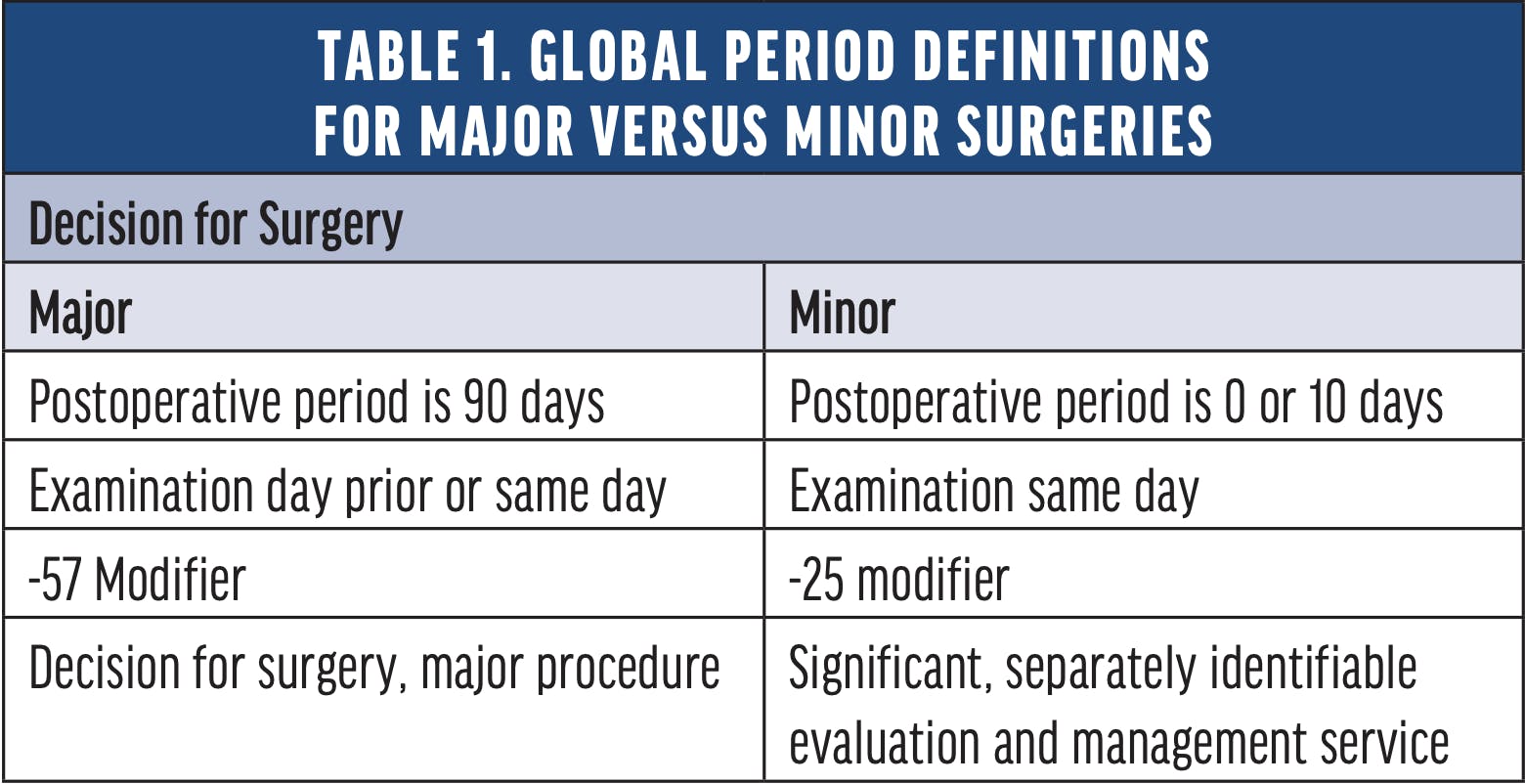
For examinations performed 1 day prior or on the same day as a major surgery, append the -57 modifier to the appropriate evaluation and management (E/M) or Eye Visit code. For a retinal detachment repair with vitrectomy, CPT code 67108, the global postoperative period is 90 days (Table 2).
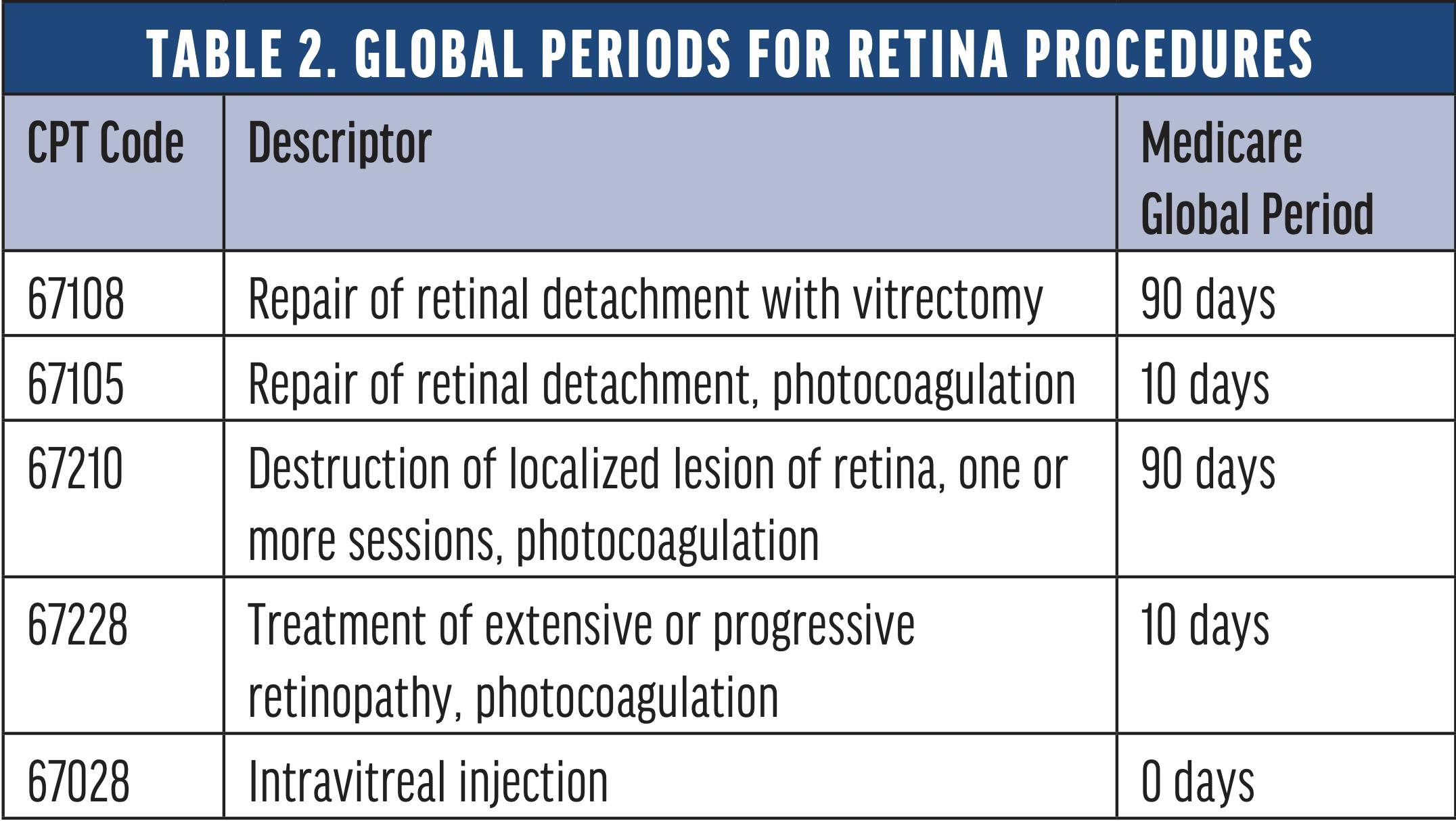
The global period for retinal laser procedures can vary, depending on whether they are considered major or minor surgery. For example, CPT code 67210 has a 90-day global period, whereas CPT codes 67105 and 67228 each have a 10-day global period and are considered minor surgeries.
In coding for a retinal laser procedure, first determine the appropriate CPT code, which will allow you to identify the global period. For an examination performed on the same day, the appropriate modifier is different for laser procedures defined as major or as minor surgery. For minor surgery laser, the examination must meet the definition of a significant, separately identifiable service (modifier -25).
DURING THE GLOBAL PERIOD
Postoperative visits during the designated global period are not separately payable when they are related to the reason for surgery. Complications evaluated during the global period are also included in the global fee, even if the diagnosis is different from the reason for surgery.
If a patient presents with an unrelated complaint during the postoperative period—for example, a symptom in the fellow eye—and this leads to a new diagnosis or unrelated problem, this service can be billed for. Modifier -24, unrelated E/M service during a postoperative period, is appended to the E/M or Eye Visit code.
If additional surgery is performed, confirm if it falls within the global period. If it is outside the postoperative period, no additional modifiers are necessary. If it is performed during the global period, consider which of the following surgical modifiers, followed by the eye modifier, is appropriate:
- 58 modifier: staged or related procedure or service performed by the same physician during the postoperative period.
- New postoperative period begins.
- 78 modifier: unplanned return to the OR or procedure room by the same physician following initial procedure for a related procedure during the postoperative period.
- No new postoperative period.
- 79 modifier: unrelated procedure or service by the same physician during the postoperative period.
- New postoperative period begins.
TRACKING THE POSTOPERATIVE PERIOD
Based on the surgical modifier used, the postoperative period end date may vary. Use of modifiers -58 and -79 will restart the postoperative period while use of -78 modifier will not, and the original global period end date will remain the same. Consider the following examples.
Case No. 1:
67210-RT, performed on 6/1/2021: 90-day postoperative period ends 8/30/2021
67210-79-LT, performed on 7/25/2021: 90-day period restarts, now ending 10/23/2021
Case No. 2:
67108-LT, performed on 6/25/2021: 90-day postoperative period ends 9/23/2021
67108-78-LT, performed on 7/15/2021: postoperative period does not restart, global period still ends 9/23/2021
Appropriately tracking the entire postoperative period is crucial for correct coding. If additional surgery is performed during a global period, the correct modifier must be used. If it falls outside the postoperative period, the appropriate E/M or Eye Visit codes can be billed for office visits as medically necessary.
WHAT ABOUT OTHER SERVICES?
Medically necessary diagnostic tests are not included in a global surgical package. Modifiers are not necessary in coding for a testing service performed during the postoperative period. Confirm, however, that the indication, testing frequency, and documentation meet the payer’s guidelines.
Extended ophthalmoscopy, for example, is not separately payable when it is performed during the global period, unless it is unrelated to the reason for surgery, according to local coverage determinations from the Medicare Administrator Contractors CGS and NGS Medicare.
GROUP PRACTICES SHARE GLOBAL PERIODS
Physicians in the same group ophthalmic practice share the global surgical package. If an associate of the operating surgeon in the same practice sees that surgeon’s patient during the postoperative period, the office visit would still be covered under the global period.
PAYER NUANCES
As noted, Medicare has defined postoperative periods per surgical code. Other payers’ global periods may vary from these, however. For example, as of January 2016, Medicare revised the postoperative period for CPT 67228, treatment of extensive or progressive retinopathy (eg, diabetic retinopathy), photocoagulation, from 90 days to 10 days. Many insurance payers subsequently followed Medicare’s change—but not all. Some Medicaid plans, for instance, continue with a 90-day global period for CPT 67228. For this payer, therefore, this laser procedure is considered a major surgery. When an examination is performed on the same day as the procedure, the -57 modifier is correct.
WHERE TO LOOK
The Medicare Fee Schedule Database (www.cms.gov/Medicare/Medicare-Fee-for-Service-Payment/PFSlookup) lists the global surgical period for each CPT code. Another source is the AAO’s 2021 Retina Coding: Complete Reference Guide (store.aao.org/2021-retina-coding-complete-reference-guide.html).
Remember that global periods can change each year and can differ by payer. Staying current and creating internal resources to use as guides are two of the best ways to ensure correct coding in your retina practice.

-1_1638377570.jpg?auto=compress,format&w=70)


_1784132761.jpg?auto=compress,format&w=75)





