


AT A GLANCE
- Creating a retinal detachment around a macular hole can help to release firm adhesions between the neurosensory retina and retinal pigment epithelium to facilitate closure of the hole.
- A human amniotic membrane patch placed under a recalcitrant macular hole helps resorb subretinal fluid that may surround the hole, leading to improvement in visual acuity.
- The goal of the rug technique is to release internal limiting membrane (ILM) tension over the hole by creating a single continuous sheet of ILM that ends with a superior hinge beyond the hole; this sheet is then draped back over the hole.
Macular hole is one of the most common indications for retinal surgery, and the procedure for small, uncomplicated holes is relatively standard: pars plana vitrectomy (PPV), induction of a posterior vitreous detachment (PVD), internal limiting membrane (ILM) peeling, and fluid-gas exchange. This approach is successful in 93% to 98% of cases when the macular hole is small.1-3
Despite this high success rate, however, there are some types of macular hole that tend to have a higher failure rate. The most challenging are macular holes that are > 400 µm diameter, that have been open for more than 6 months, that present in high myopes, or that are recurrent.4 For macular holes > 400 µm, the closure rate varies widely, with about a third of cases resulting in a flat open configuration with minimal visual improvement.4,5
In this article we share our favorite techniques for attempting to close large, chronic, recurrent, or myopic macular holes. We presented these techniques at the 2021 Vit-Buckle Society Annual Meeting.
MASSAGE THE MACULA
By Daniela Meizner, MD
This technique, first described by George A. Williams, MD, in 2013, has proven to be successful for even the most challenging macular holes.6
Perform a 25-gauge three-port PPV and induce a PVD if one is not already present. Stain the ILM with brilliant blue dye and peel it as wide as possible. Next, mount a 38-gauge subretinal cannula onto a silicone oil injection system (12 psi to 25 psi) filled with balance saline solution. Introduce the cannula into the subretinal space at three to four sites and inject the solution to produce a localized retinal detachment around the macular hole. Proceed then to gently massage the borders centripetally with a Finesse Flex Loop (Alcon) or a soft-tip cannula to carefully move the edges closer together.
Continue by taking a close look at the entire anterior retinal periphery using a scleral depressor to check for retinal breaks. Once you are satisfied that there are no breaks, perform a fluid-air exchange using a soft-tip cannula.
Finally, inject an isovolumetric concentration of SF6 gas into the vitreous cavity and suture the sclerotomies, if needed. Postoperative facedown posturing is recommended for 3 days.
Creating a retinal detachment around the macular hole can help to release the firm adhesions between the neurosensory retina and retinal pigment epithelium (RPE) to facilitate the closure of the hole. This technique and the injection of the balanced saline solution require a very careful hand to prevent damage to nearby structures such as the nerve fiber layer bundle and the RPE.
There are subtle variations of this technique; for example, the surgeon can decide whether to massage the borders of the hole and whether to use gas or oil as a tamponade. To avoid making extra holes in the macula, some surgeons prefer to inject the balanced saline solution through the original macular hole.
AMNIOTIC MEMBRANE GRAFT
By Jessica Lee, MD
Several innovative surgical techniques have improved the success rate of macular hole closure, including variations of ILM peeling.7-9 The inverted ILM flap, ILM free flap, and ILM insertion techniques have all led to varying degrees of improvement in success rates.8 Others have described the use of perifoveal radial incisions; detaching and reattaching the macula; and autologous blood or serum and platelet-rich plasma.10,11 The use of an autologous retinal autograft has also been proposed, with good success and resulting in improvement in vision.11
The use of human amniotic membrane is one of the latest trends in surgical technique for the treatment of recalcitrant macular holes, although it was first described in 1957 by researchers in Germany.12-14 More recently, Rizzo et al published on the use of human amniotic membrane for the repair of retinal breaks, recurrent macular holes, and macular holes in the setting of pathologic myopia.12
A human amniotic membrane patch placed under a macular hole helps to resorb subretinal fluid that may surround the recalcitrant macular hole, leading to improvement in visual acuity. Researchers have suggested that the amniotic membrane in the subretinal space serves as a scaffold for glial cell migration and enhances adherence of the edges of the hole to the underlying RPE.15
Here are some tips for performing surgery with human amniotic membrane grafts for recalcitrant macular holes:
- This technique is not for standard macular holes;
- Use a cornea punch biopsy tool;
- Use chandelier light to facilitate a bimanual technique;
- 25-gauge surgery is fine, as the membrane does not get stuck in the valved trocar;
- Use a soft-tip cannula;
- Make sure the sticky side of the amniotic membrane is down;
- You don’t need perfluoro-n-octane (PFO);
- You don’t need silicone oil.
ILM FLAP: THE RUG TECHNIQUE
By Prethy Rao, MD, MPH
The rug technique is a useful go-to option for all primary, large, chronic, or traumatic macular holes with existing ILM in adult and pediatric patients. It is a variation of an ILM technique first described by Tian et al in 2019, with the exception that PFO is not used in our technique.16 The goal of the technique is to release ILM tension over the hole by creating a single continuous sheet of ILM that ends with a superior hinge beyond the hole; this ILM sheet is then draped back over the hole. The advantage of this technique is its ability to restore or maintain the integrity of the Müller cell footplates, which helps patients achieve a more physiologic postoperative foveal contour with less distortion. Here are the basic steps.
Starting approximately 2 to 3 disc diameters directly inferior to the hole and using a pinch-and-peel technique with ILM forceps or a Finesse Flex Loop, initiate a flap carefully and pull superiorly a few millimeters. Repeat this step starting next to the edge of the initial flap to create a continuous sheet. To prevent amputation of the flap, carefully “walk” the ILM sheet superiorly in parts or segments and stay close to the retina while pulling the flap superiorly. The end of the flap (the superior hinge) should conclude about 2 to 3 disc diameters superior to the hole so that it remains tethered to the surrounding retina.
Initiate a fluid-air exchange. During the last 10% to 20% of the exchange, place the soft-tip cannula inferior to the hole (at the level where you initiated the flap) to allow the last fluid wave to roll the ILM flap back over the hole to its original physiologic position (Figures 1 and 2). A noticeable gap may exist between the inferior edge of the flap and the initial site, suggesting release of the ILM tension on the hole.
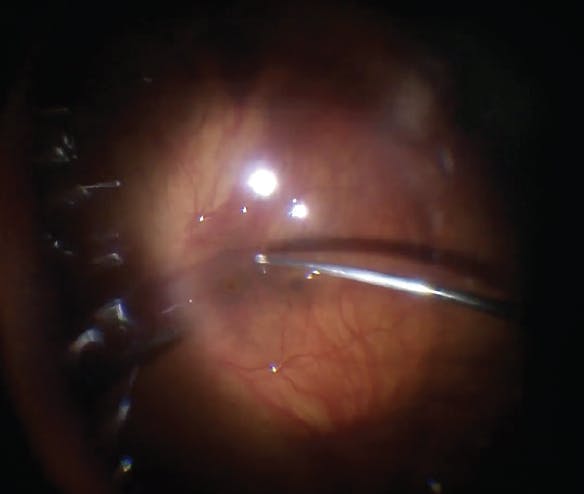
Figure 1. This 60-year-old patient with a full-thickness macular hole underwent a successful macular hole repair with the rug technique. In the final step of the procedure, the surgeon uses the last fluid wave of the fluid-air exchange to roll the ILM flap back over the hole.
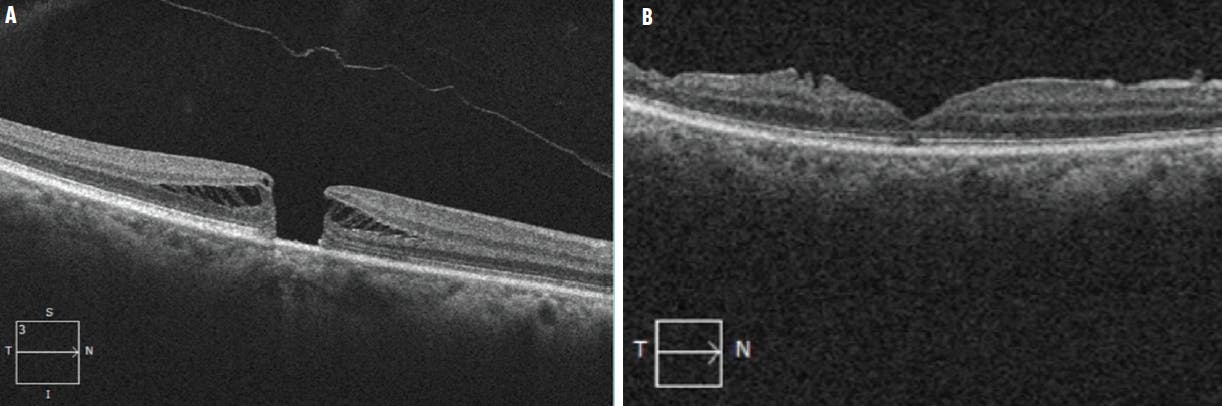
Figure 2. Preoperatively, the patient’s VA was 20/70 (A). Postoperatively, VA improved to 20/40 (B).
Surgeons should avoid using this technique in the presence of a concurrent epiretinal membrane due to the risk of regrowth and reopening of the hole.
FINAL THOUGHTS
There is still no perfect approach to manage challenging macular hole cases, and we continue to learn and innovate with new techniques and tools. When faced with a challenging macular hole surgery, consider these techniques. One of them just might lead to a successful outcome.
1. Rahimy E, McCannel CA. Impact of internal limiting membrane peeling on macular hole reopening. A systematic review and meta-analysis. Retina. 2016;36:679-687.
2. Lai MM, Williams GA. Anatomical and visual outcomes of idiopathic macular hole surgery with internal limiting membrane removal using low-concentration indocyanine green. Retina. 2007;27:477-482.
3. Park DW, Sipperley JO, Sneed SR, Dugel PU, Jacobsen J. Macular hole surgery with internal-limiting membrane peeling and intravitreous air. Ophthalmology. 1999;106:1392-1398.
4. Reis R, Ferreira N, Meireles A. Management of stage IV macular holes: when standard surgery fails. Case Rep Ophthalmol. 2012;3(2):240-250.
5. D’Souza MJJ, Chaudhary V, Devenyi R, Kertes PJ, Lam W-C. Re-operation of idiopathic full-thickness macular holes after initial surgery with internal limiting membrane peel. Br J Ophthalmol. 2011;95(11):1564-1567.
6. Wong R. Novel surgical technique for closure of large full-thickness macular holes. Retina. 2013;33(9):1977-1979.
7. Smiddy WE, Feuer W, Cordahi G. Internal limiting membrane peeling in macular hole surgery. Ophthalmology. 2001;108(8):1471-1476; discussion 1477-1478.
8. Velez-Montoya R, Ramirez-Estudillo JA, Sjoholm-Gomez de Liano C, et al. Inverted ILM flap, free ILM flap and conventional ILM peeling for large macular holes. Int J Retina Vitreous. 2018;4:8.
9. Kannan NB, Kohli P, Parida H, Adenuga OO, Ramasamy K. Comparative study of inverted internal limiting membrane (ILM) flap and ILM peeling technique in large macular holes: a randomized-control trial. BMC Ophthalmol. 2018;18(1):177.
10. Korobelnik JF, Hannouche D, Belayachi N, Branger M, Guez JE, Hoang-Xuan T. Autologous platelet concentrate as an adjunct in macular hole healing: a pilot study. Ophthalmology. 1996;103(4):590-594.
11. Grewal DS, Mahmoud TH. Autologous neurosensory retinal free flap for closure of refractory myopic macular holes. JAMA Ophthalmol. 2016;134(2):229-230.
12. Rizzo S, Caporossi T, Tartaro R, et al. A human amniotic membrane plug to promote retinal breaks repair and recurrent macular hole closure. Retina. 2019;39:S95-S103.
13. Caporossi T, Pacini B, De Angelis L, Barca F, Peiretti E, Rizzo S. Human amniotic membrane to close recurrent, high myopic macular holes in pathologic myopia with axial length of ≥30 mm. Retina. 2020;40(10):1946-1954.
14. Csapody I. [Amnion implantation in therapy of macula hole]. Ophthalmologica. 1957;134(4):272-276.
15. Zeng Q, Karahan E, Hondur A, Tezel TH. Comperative anaysis of gliosis induced by covering of macular holes with a patch of retinal autograft vs. human amniotic membrane. Invest Ophthalmol Vis Sci. 2020;61(7):4392-4392.
16. Tian T, Chen C, Peng J, et al. Novel surgical technique of peeled internal limiting membrane reposition for idiopathic macular hole. Retina. 2019;39(1):218-222.

-1_1638377570.jpg?auto=compress,format&w=70)


_1773249222.png?auto=compress,format&w=75)




