


AT A GLANCE
- The eye is at the forefront of the gene therapy and genome editing fields, with its surgical accessibility, relative immune privilege, and the effect of blinding genetic diseases.
- CRISPR/Cas has revolutionized our ability to edit the human genome.
- New CRISPR tools are now available for gene regulation, epigenetic editing, and multiplexed genome targeting.
Clustered, regularly interspaced, short palindromic repeats (CRISPR), an ancient feature of bacteria’s adaptive immune system, refers to DNA sequences in bacteria left behind after viral infections; when bacteria encounter those viruses again, their CRISPR-associated (Cas) proteins recognize and bind to these sequences in the virus.
This system has been harnessed for precise gene targeting in human cells by using two components: a Cas9 nuclease that cuts DNA and a programmable guide RNA (gRNA) that directs Cas9 to specific loci within the genome. When Cas9 and gRNA are delivered into the same cell, they generate a double-stranded break (DSB) in the DNA, which can then be repaired by the cell’s intrinsic DNA repair machinery to delete a gene (ie, knockout) or add additional code to the DNA using the cell’s homology-directed repair (HDR) machinery. The main advantages of CRISPR technology are its efficiency, programmability, and precision.
The eye is at the forefront of the gene therapy and genome editing fields, with its surgical accessibility, relative immune privilege,1 and the unquestionable effect of blinding diseases. The first in vivo CRISPR clinical trial, BRILLIANCE, is underway to investigate the treatment of Leber congenital amaurosis with EDIT-101 (Editas Medicine). More recently, molecular engineering has expanded the powers of CRISPR/Cas beyond gene editing (Figure).
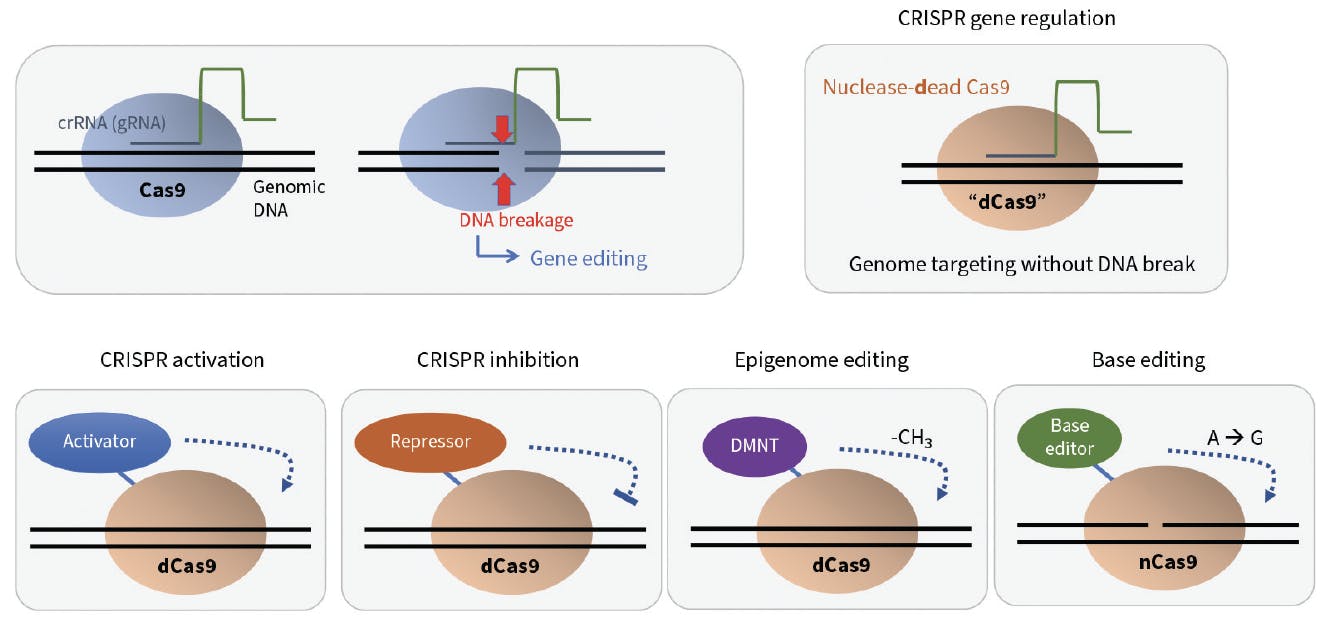
Figure. In addition to traditional gene editing, CRISPR/Cas systems now include regulated gene expression, base editing, prime editing, and other novel approaches.
CONTROLLING GENE DOSAGE
By inactivating the DNA-cutting ability while keeping its other functionalities intact, a nuclease-dead Cas9 (dCas9) maintains its precise genome-targeting capability without causing DNA damage.2 dCas9 proteins can be fused to a variety of modulator proteins to enable expanded capabilities, such as tuning the level of gene expression.
This type of CRISPR-based gene activation can be therapeutically useful for inherited retinal diseases (IRDs) that involve mutations in genes with functionally equivalent homologs that are normally expressed in other cell types. For example, retinitis pigmentosa (RP) involves mutations in the rhodopsin gene in rod cells, but increasing expression of a cone-opsin gene in rod cells could indirectly compensate for genetically defective rhodopsin. One group tested dCas9 fused to an activator to increase the expression levels of a cone-opsin gene and showed that delivery by an adenoviral-associated viral (AAV) vector slowed retinal degeneration in a mouse model of RP.3 CRISPR-based activation of functionally equivalent genes could be particularly useful for the replacement of large genes in common IRDs, such as ABCA4 or MYO7A, that exceed the packaging limitations of AAVs.
CRISPR BASE EDITING
In the early days of CRISPR/Cas9 technology, correcting a point mutation relied on the rate of HDR following the formation of a DSB by the Cas9 nuclease. However, the rates of HDR can be quite low, especially in non-dividing cells such as photoreceptors, which leaves most cells uncorrected. Furthermore, the DSB that is created by the Cas9 nuclease may generate undesired genomic mutations or occur at an off-target location.
CRISPR base editing involves the fusion of a base editor (an enzyme that can directly convert one specific DNA base pair to another base pair) to a Cas9 enzyme that is engineered to avoid DSBs in DNA. In a mouse model of Leber congenital amaurosis, a CRISPR base editing system corrected the pathogenic mutation in the RPE65 gene, restoring therapeutically relevant gene levels and rescuing the function and survival of cone photoreceptors on a long-term basis.4,5
Although base editing only corrects single-gene mutations, it may prove to be useful for many IRDs. A cross-sectional study examined more than 12,000 alleles that are too large for AAV vector delivery (eg, ABCA4, CDH23, MYO7A, CEP290, USH2A, and EYS) and concluded that 53% of pathogenic alleles are correctable with existing base editing technology, and 76% of patients who received diagnoses through a genetic service possessed an allele amenable to base editing.6
CRISPR PRIME EDITING
Prime editors are one of the latest additions to the CRISPR genome engineering toolkit. Prime editors use an engineered reverse transcriptase enzyme fused to a Cas9 nickase, which only generates a break in one DNA strand. Prime editing systems use a prime editing gRNA that contains both the sequence directing the Cas9 nickase to its desired genomic target and another sequence that specifies the desired sequence change. The new sequence is reverse-transcribed by the nearby enzyme and used as a template for correcting the host genetic sequence.
In a proof of concept study, a prime editing system was delivered by dual AAV vectors in the rd12 model of RP and precisely corrected the pathogenic point mutation and improved optomotor response measurements in mice.7
MULTIPLEXED GENOME TARGETING
Given the large number of human diseases that are polygenic, the ability to target multiple genes simultaneously holds clinical promise. Editing multiple sites with Cas9 is challenging, but the discovery of the Cas12 system has expanded the possibilities for multiplexing. Cas12 can take an array of gRNAs, cut them into individual gRNAs, and simultaneously target multiple sites in the genome. This opens the possibility of treating more complex retinal diseases, including those caused by mutations in two or more genes. Furthermore, a nuclease-dead Cas12 (dCas12) can be used for multiplex gene regulation, but the low efficiency of the protein hindered its applications. Recently, an engineered version of dCas12, hyperCas12a, enabled simultaneous activation of multiple genes in mouse retina.8,9
THE FUTURE FOR CRISPR GENE THERAPY
With nearly 300 different genes that cause retinal diseases, and new mechanisms being uncovered at a rapid pace, there is ample opportunity to apply CRISPR technology for gene editing and gene regulation. But there are also challenges. For one, the high genetic heterogeneity of IRDs makes personalized therapy a daunting task. At the 2022 American Society of Gene & Cell Therapy meeting, Francis Collins, MD, PhD, the acting White House chief science advisor and former National Institutes of Health director, paid tribute to the global scientific effort that generated the first draft of the human genome sequence in 2003 and highlighted the tour-de-force from the Telomere-to-Telomere consortium that finally completed the full human genome in 2022. The Human Genome Project has identified more than 7,000 human genetic disorders, most of which have no treatment and cannot be treated by an ex vivo therapy approach. In his keynote speech, he said that “delivery is the real challenge” and called for greater progress in making in vivo genome editing scalable to treat more patients.
Our toolkits for sophisticated genome engineering are growing, with potential for providing new waves of first-in-class gene therapies. The retina stands as a critical testing ground for translating these innovative tools into therapeutics not only for IRDs, but also for forging new paths to tackle other diseases of mankind.
1. Toral MA, Charlesworth CT, Nget B, et al. Investigation of Cas9 antibodies in the human eye. Nat Commun. 2022;13:1053.
2. Qi LS, Larson MH, Gilbert LA, et al. Repurposing CRISPR as an RNA-guided platform for sequence-specific control of gene expression. Cell. 2013;152(5):1173-1183.
3. Böhm S, Splith V, Riedmayr LM, et al. A gene therapy for inherited blindness using dCas9-VPR-mediated transcriptional activation. Sci Adv. 2020;6(34):eaba5614.
4. Suh S, Choi EH, Leinonen H, et al. Restoration of visual function in adult mice with an inherited retinal disease via adenine base editing. Nat Biomed Eng. 2021;5(2):169-178.
5. Choi EH, Suh S, Foik AT, et al. In vivo base editing rescues cone photoreceptors in a mouse model of early-onset inherited retinal degeneration. Nat Commun. 2022;13:1830.
6. Fry LE, McClements ME, Maclaren RE. Analysis of pathogenic variants correctable with CRISPR base editing among patients with recessive inherited retinal degeneration. JAMA Ophthalmol. 2021;139(3):319-328.
7. Jang H, Jo DH, Cho CS, et al. Application of prime editing to the correction of mutations and phenotypes in adult mice with liver and eye diseases. Nat Biomed Eng. 2022;6(2):181-194.
8. Guo LY, Bian B, Davis AE, et al. Multiplexed genome regulation in vivo with hyper-efficient Cas12a. Nat Cell Biol. 2022;24(4):590-600.
9. Kempton HR, Love KS, Guo LY, Qi LS. Scalable biological signal recording in mammalian cells using Cas12a base editors [Preprint published online May 30, 2022]. Nat Chem Biol.


_1784132761.jpg?auto=compress,format&w=75)





