





Debates are a long-standing tradition at the Vit-Buckle Society’s (VBS) annual meeting. This year, experts put on a spirited show defending their stance on techniques and technologies that are forcing many to rethink their in-office and OR strategies.
DEBATE 1: INTRAOPERATIVE OCT
The first discussion was kicked off by Dilraj S. Grewal, MD, from Duke University, arguing that intraoperative OCT (iOCT) is necessary, and Katherine E. Talcott, MD, from Cleveland Clinic, stating that iOCT is useless. Dr. Grewal revisited the evolution of surgical microscopes, which now can incorporate heads-up display and iOCT. This new technology offers a “Google Street View” and “takes the guesswork out of surgery,” he stated. Dr. Grewal emphasized several advantages of iOCT, including better tissue visualization. He described a case of optic disc maculopathy for which iOCT was helpful in visualizing platelet rich plasma. In addition, iOCT offers unique depth feedback, such as the proximity of instruments to intraocular tissues. iOCT can also help surgeons obtain more accurate volumetric measurements, which is useful during subretinal delivery. Furthermore, iOCT can be valuable for training surgical fellows. In the future, real-time feedback may be possible when iOCT is integrated with artificial intelligence. He concluded that iOCT is necessary for further innovation in retina.
Dr. Talcott argued that iOCT does not change clinical decision making in the OR for most bread-and-butter cases. To drive home her point, she walked the audience through a typical OR day with cases such as a non-clearing vitreous hemorrhage in proliferative diabetic retinopathy, macular hole, traumatic subluxed intraocular lens, and retinal detachment. In these cases, iOCT did not change her surgical plan; instead, it caused longer operating times. She also pointed out other disadvantages, such as increased cost and lack of reimbursement. She stated that iOCT images make for great presentations but are not practical for everyday use.
In the discussion that followed, some attendees and moderators agreed that iOCT can be a distraction because the surgeon must monitor it during each case and using iOCT successfully has a learning curve. Others admitted that iOCT comes in handy for complex cases, such as pediatric retinal detachments, or high-precision cases like macular holes. Ultimately, the room consensus was that current systems are not well-equipped to accommodate iOCT but as technology evolves, it will become cheaper, easier to use, and allow for faster surgeries. In the future, robotic-assisted surgery may be employed, and iOCT will be necessary in these cases.
DEBATE 2: WET AMD THERAPIES
The next debate focused on changes to our wet AMD armamentarium, highlighting the port delivery system (PDS) with ranibizumab (Susvimo, Genentech/Roche) and gene therapy versus standard anti-VEGF therapy.
Ashley M. Crane, MD, of the Retina Vitreous Associates of Florida, presented on the PDS and outlined its implantation procedure and refill process. She noted possible complications, including dislocation of the implant, and the device’s black box FDA warning of a threefold higher risk of endophthalmitis. The risk is associated with conjunctival erosion. Still, 95% of patients did not require supplemental treatment during the 24-week period. Critically, 92% of patients preferred the PDS over intravitreal injections, she stated.
Next, Robert L. Avery, MD, of California Retina Consultants, discussed how gene therapy is poised to revolutionize the treatment of AMD. The benefit of a gene therapy treatment is that it is one and done, Dr. Avery said. One study found that treatment with Regenxbio’s RGX-314 gene therapy candidate led to a 97% reduction in the need for anti-VEGF injections at 2 years. He discussed a patient who required 13 injections in the year prior to treatment with RGX-314—and zero rescue injections after treatment.
Finally, Esther Lee Kim, MD, of Orange County Retina, rocked the house with her lecture on the continued use of anti-VEGF injections. She began by emphasizing that anti-VEGF therapy is the standard and provides excellent visual acuity gains. We have given millions of injections with a < 0.1% risk of endophthalmitis, she said. Further, injections don’t require a trip to the OR, and they provide good durability with 45% of patients treated with either aflibercept (Eylea, Regeneron) or faricimab (Vabysmo, Genentech/Roche) able to extend to injections every 16 weeks.
After her impassioned presentation, the audience overwhelmingly agreed that anti-VEGF injections remain the treatment of choice.
DEBATE 3: MANAGING RETINOPATHY OF PREMATURITY
The final debate addressed retinopathy of prematurity (ROP) treatments. Safa Rahmani, MD, MS, a pediatric retina surgeon at Northwestern University, first defended laser photocoagulation for ROP, followed by Eric Nudleman, MD, PhD, a pediatric retina surgeon at Shiley Eye Institute at the University of California San Diego Health, who argued for the use of anti-VEGF therapy.
Dr. Rahmani noted that laser photocoagulation for ROP is an effective treatment with easy follow-up and no surprise reactivations. She emphasized the 30-year history of success with lasers, stating that the Early Treatment for Retinopathy of Prematurity study is already 2 decades old. Laser treatment is still the current standard, she said. For patients who are at risk for poor follow-up, performing adequate laser treatments is often enough, she added, while anti-VEGF injections come with a risk for reactivation. Dr. Rahmani highlighted other negatives of using anti-VEGF injections, such as the possibility of systemic side effects of anti-VEGF therapy in developing infants.
Dr. Nudleman then defended the use of intravitreal anti-VEGF injections for the treatment of ROP, highlighting advantages such as its rapid response, potential for larger visual field with reduced myopia, and its ability to be performed bedside. He also acknowledged the disadvantages of late recurrence and systemic side effects. In theory, anti-VEGF injections could have neurodevelopmental systemic risks, he admitted. However, he noted that studies have not shown any difference in these risks between groups that did and did not use anti-VEGF agents. He then brought up the increased risk of adverse effects of anesthesia required for laser photocoagulation in the smallest, sickest infants. He ended by saying that if infants have persistent avascular retina, you can always laser when the patient is older.
These talks were followed by a lively discussion of the importance of laser as a more permanent option for ROP, which should be considered for patients at-risk for loss to follow-up. Still, some argued that many patients may not even need laser after anti-VEGF therapy. Audience members expressed their preference for laser versus anti-VEGF therapy. Dr. Nudleman added that he uses anti-VEGF agents initially in the inpatient setting and follows patients closely to see if they need additional laser. He noted that about 75% of patients eventually need laser photocoagulation, but 25% of them can revascularize. Another great pearl by session moderator Sandra R. Montezuma, MD, from the University of Minnesota, was that you can minimize the risks of anti-VEGF treatments by using the SAFER mnemonic: Shorter needle (32-gauge, 4 mm), using Antiseptic iodine, Follow-up after the procedure, Extra attention to personal protective equipment, and Return in 1 to 2 weeks.
After a great discussion of the nuances of choosing laser versus anti-VEGF injections, there was overwhelming support for the use of anti-VEGF therapy in infants with ROP.
THE PATH FORWARD
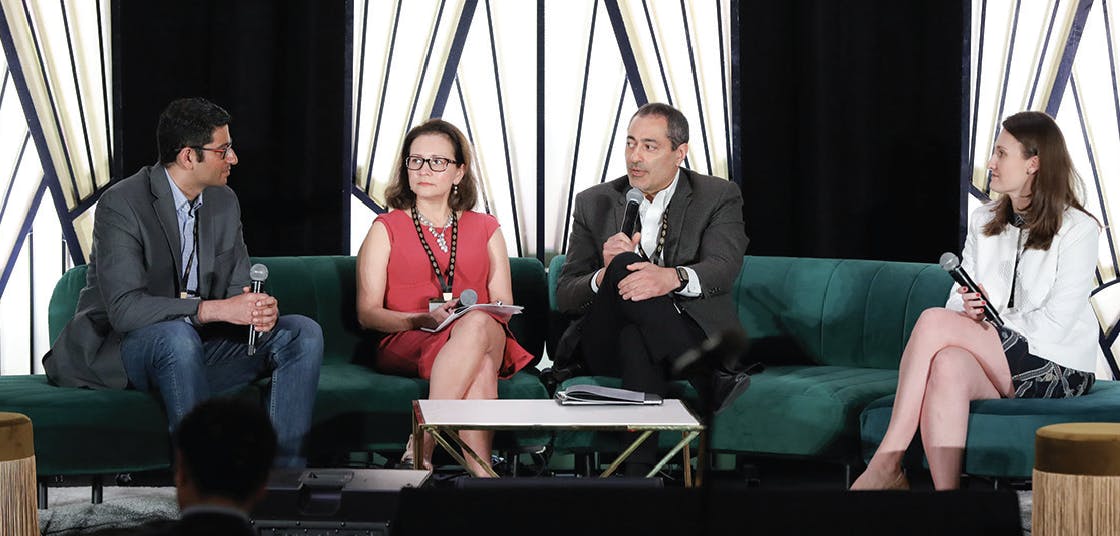
Active audience participation that followed each debate made clear the importance of collaboration—and keeping an open mind (Figure). iOCT is still in its infancy, as are many AMD therapies and ROP approaches. While these therapies and technologies did not win this year, advances in the field may lead to very different outcomes in the years to come.


_1784132761.jpg?auto=compress,format&w=75)





