


Asynchronous learning, also known as e-learning or mobile learning, has become increasingly popular in medical education.1 In addition, the COVID-19 pandemic generated a need to rapidly adapt educational environments, creating a surge in remote teaching modalities such as virtual conference sessions, online classes, recorded lectures, blogs, and podcasts.2-5
The field of medicine has witnessed dramatic increases in the uptake of educational podcasts, especially within the field of retina.6 In a survey of the three largest retina societies in the United States (the American Society of Retina Specialists, the Retina Society, and the Macula Society), 41.1% of respondents reported listening to at least one medical podcast on a weekly basis.7
Podcasts can offer a variety of benefits to retina specialists and trainees. Research-focused podcasts provide updates to specialists on the latest advances in their field, while education-focused podcasts provide an overview of common presentations encountered in retina clinics. These episodes may allow specialists to refresh their diagnostic skills and trainees to glean knowledge to support their learning. Additionally, some podcasts, such as Straight from the Cutter’s Mouth: A Retina Podcast, have partnered with a society (AAO, in this case) to grant continuing medical education credits to their listeners. Should this trend continue, it will surely impact the accessibility and delivery of continuing education in the future.
While podcasts can be incredibly useful, listeners may find it daunting to identify a podcast that suits their needs.8 This article reviews the currently available retina-specific podcasts to help trainees and retina specialists navigate this new medium for medical education.
THE SEARCH
To find all the podcasts specific to retina, we used the keywords “retina” and “rétine” in the following podcast hosting platforms: Anchor, Apple Podcasts/iTunes, Breaker, Castbox, Eyetube, Google Podcasts, Overcast, Player FM, Pocket Casts, Podbean, RadioPublic, Spotify, and Stitcher. In addition, we searched for “retina podcast” in Google to ensure completeness of the results. We included podcasts that were free, had a primary focus on retina (> 50% of content focused on medical retina, surgical retina, or both), and were recorded in English, French, or Spanish. Each identified podcast was analyzed based on its lifetime, number of episodes, release schedule, year of activity, affiliation, geographic region, language, number of hosts, and host status (ophthalmologist or not).
RESULTS
As of December 1, 2021, 18 podcasts were available for retina specialists—14 of which were active at the time of data collection (Table). Four focused on medical retina, two on surgical retina, and twelve included both medical and surgical retina. The lifetime of these podcasts varied between 11 weeks and 19 years, with the average podcast lasting approximately 4 years. Podcasts had between one and 298 episodes, with an average of 50 episodes in any given podcast. The podcasts were released between 2006 and 2021, and release schedules varied between simultaneous release and sporadic release.
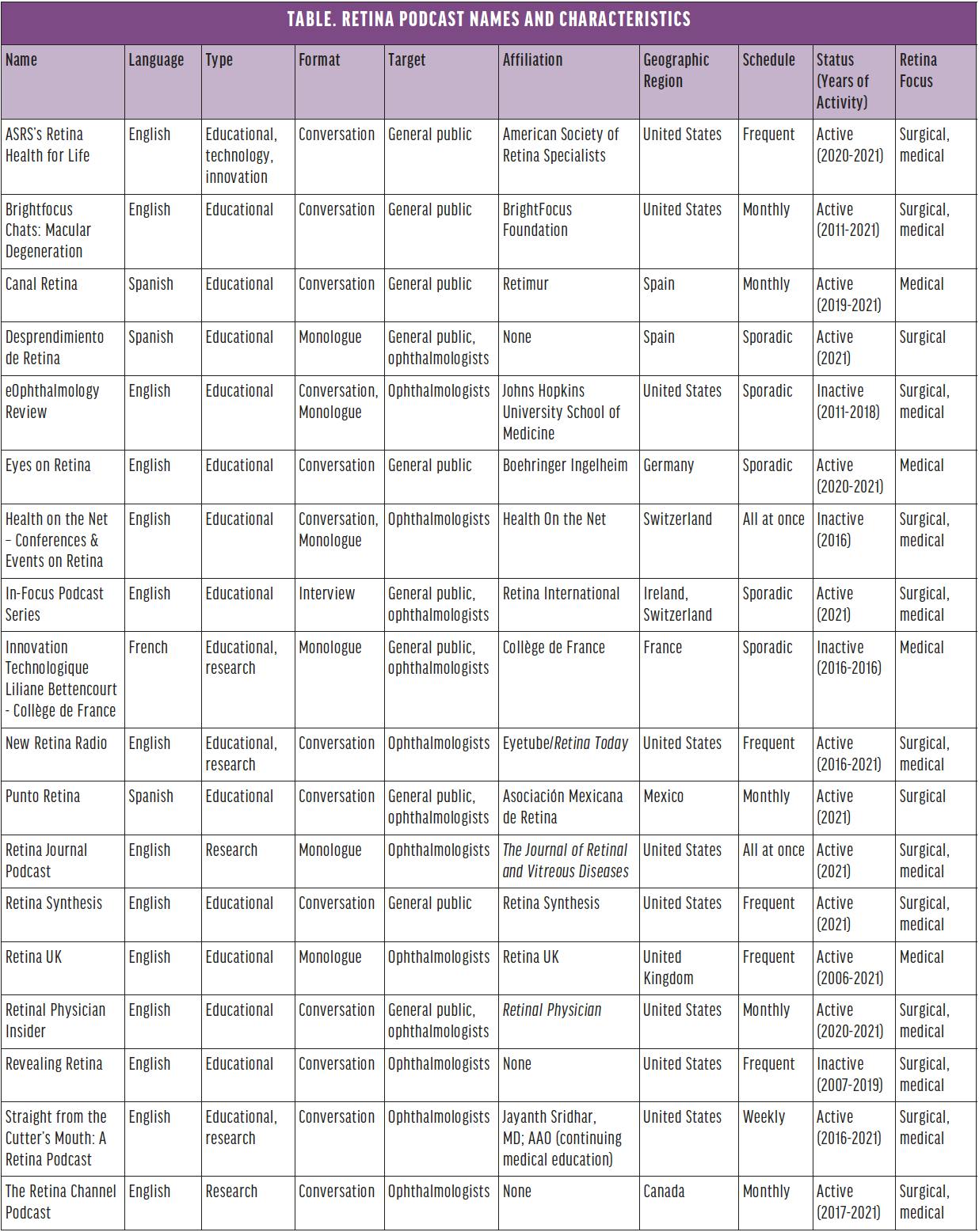
Most podcasts are affiliated with an organization, whether that be a society, academic institution, or retina trade publication. Nine podcasts were based in the United States, seven in Europe, one in Mexico, and one in Canada. Fourteen podcasts were recorded in English, three in Spanish, and one in French. Twelve podcasts were hosted by a single individual, and 10 podcasts were hosted by ophthalmologists. All 18 podcasts serve educational purposes: five discussed research and one elaborated on topics related to technology and innovation. Eight podcasts were specifically designed for ophthalmologists, five for the general public, and five for both. Fourteen podcasts were conversational (interview style), and four contained monologues.
DISCUSSION
This study provides a comprehensive review of podcasts available to the retina community. All 18 retina podcasts were created with the purpose of educating listeners, whether they are medical experts (ophthalmologists, optometrists, and other health care professionals) or the general public. Host factors were analyzed to determine the demographic characteristics of those currently responsible for creating podcast content for retina specialists.
While podcasts are becoming increasingly popular as a medium for education, our results suggest that retina podcasts are still lacking, with only 18 retina podcasts across 13 podcasting platforms. Of the podcasts directed toward medical experts, very few offer continuing medical education credits for the time and effort spent listening. Future podcast creators may wish to address this gap to continue to expand the use of podcasts and incentivize podcast listening in ophthalmology continued education.
1. De Gagne JC, Park HK, Hall K, Woodward A, Yamane S, Kim SS. Microlearning in health professions education: scoping review. JMIR Med Educ. 2019;5(2):e13997.
2. Shabila NP, Alkhateeb NE, Dauod AS, Al-Dabbagh A. Exploring the perspectives of medical students of application on e-learning in medical education during the COVID-19 pandemic. Work. 2021;70(3):751-762.
3. Kipp M. Impact of the COVID-19 Pandemic on the Acceptance and Use of an E-Learning Platform. Int J Environ Res Public Health. 2021;18(21).
4. Naciri A, Radid M, Kharbach A, Chemsi G. E-learning in health professions education during the COVID-19 pandemic: a systematic review. J Educ Eval Health Prof.
5. Ifedayo AE, Ziden AA, Ismail AB. Podcast acceptance for pedagogy: the levels and significant influences. Heliyon.
6. Berk J, Trivedi SP, Watto M, Williams P, Centor R. Medical Education Podcasts: Where We Are and Questions Unanswered. J Gen Intern Med.
7. Venincasa MJ, Kloosterboer A, Zukerman RJ, et al. Educational Impact of Podcasts in the Retina Community. Ophthalmol Retina. 2020;4(9):958-961.
8. Nguyen AX, Ruparelia S, Sun F. Social media for pupils: evolution of podcasts in ophthalmology. [Preprint published online ahead of print June 28, 2022] Clin Exp Ophthalmol.


_1784132761.jpg?auto=compress,format&w=75)





