


AT A GLANCE
- A laboratory’s ability to accurately report genetic findings depends on a thorough patient history.
- It is essential to choose the best test for each patient with respect to the differential diagnosis, privacy preferences, and information desired.
- There are many benefits to working with genetic counselors, including cost savings, better patient management, and increased patient satisfaction.
Primary Findings: Negative. A patient’s genetic testing report returned with a non-diagnostic result. However, under the heading of Additional Findings, I noticed two variants of uncertain significance in MKKS. Knowing that these variants are associated with autosomal recessive Bardet Biedl syndrome (BBS), I recognized the real meaning of the report. I was also reminded of just how valuable genetic counselors and inherited retinal disease (IRD) specialists can be for patients and clinicians who are seeking answers.
Although a thorough history was obtained at our initial visit, the patient disclosed the key to unlocking the meaning of this unclear report during our review of the results. He stated that he was born with extra fingers and has a learning disability. These features, with his history of retinitis pigmentosa and obesity, were consistent with a diagnosis of BBS. Because this phenotypic information was initially missing from the documents provided to the laboratory, it did not report the MKKS variants as primary findings.
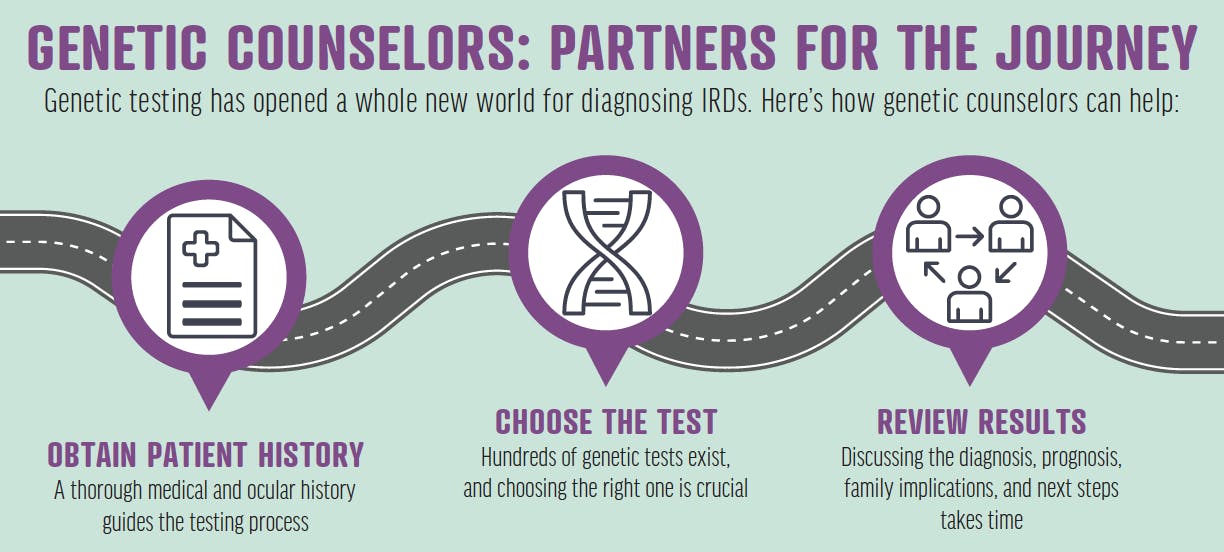
Genetic testing has the power to diagnose and provide prognostic guidance; still, a laboratory’s ability to accurately report genetic findings depends on the inclusion of relevant information and history. As this patient’s genetic counselor, I adhered to a carefully curated process of obtaining patient history, selecting the appropriate test, and reviewing the results. The time I took to build rapport with the patient is what ultimately led to clarity for him and his care team.
Genetic counseling sessions are an environment in which patients should feel confident discussing their medical and ocular history in detail. These sessions are also a dedicated space for patients to receive information about their genetic testing—why it’s being ordered and what it might reveal—as well as a space for them to provide information to their counselors. In some cases, this information is critical enough to turn a negative report into a positive result.
TESTING IS KEY
Medical care is moving in the direction of precision health, and the integration of genetic testing into daily practice is already here. Rapidly evolving technologies, including next-generation sequencing, have made genetic diagnosis faster and cheaper than ever before.1 A new breed of genetic testing for IRDs has gained momentum: the no-charge, or sponsored, gene panel. These panels contain more than 300 genes associated with IRDs and are paid for by pharmaceutical companies, providing patients with high quality, comprehensive testing free of charge.
However, the innumerable benefits of a genetic diagnosis and the convenience of performing sponsored IRD panels can overshadow the potential risk for ethical and personal dilemmas. Receiving genetic information is different from regular test results, as it is deeply complex and intertwined with the patient’s identity. Even though patients do not have to pay for this type of testing, the service is not truly “free” in every sense. Pharmaceutical companies pay for this testing in exchange for patient data, which can limit a patient’s privacy. The results could leave a patient vulnerable to insurance discrimination if it reveals a predisposition for a new medical condition. True biological relationships, including consanguinity and nonpaternity, may also come to light. Patients should be made aware of these nuances prior to testing, and providers should have a conversation with the patient to ensure informed consent.
Complicating matters further, hundreds of genetic tests exist with numerous options for sponsored IRD panels. It is essential to choose the test that is best for each patient with respect to the differential diagnosis, preferences for privacy, and the level of information desired. Genetic tests vary in panel content, coverage, reporting, and turnaround time.
Returning results is also a process that should include careful education and counseling. A genetic testing result should be reviewed thoroughly, using databases and resources to assess the relevance of the findings. Using the patient’s clinical history to guide the conversation, as in the example of our patient with BBS, is critical. Patients must understand what a genetic test means for their own diagnosis and management, and they should be counseled on who else in their family may be at risk. Genetic counselors are careful to explain variants of uncertain significance and negative results in the context of evolving interpretations and information.
A TEAM APPROACH
Genetic counselors guide families through the entire genetic testing process, including: obtaining a detailed medical and family history, critically assessing genetic testing options, interpreting results, and reviewing the report. They also assist in identifying genotype-specific clinical trials and can assess baseline eligibility for interested families.
There are many benefits to working with genetic counselors, including cost savings, better patient management, and increased patient satisfaction.2,3 As part of the care team, genetic counselors provide education and optimum test selection for providers. They serve to empower both patients and physicians to use genetic testing technology in the safest and most beneficial manner.
As I prepare to see the patient with BBS for follow-up with his updated genetic testing report in hand, I am reminded that, although sponsored genetic testing panels have increased access to genetic diagnosis, they do not diminish the need for careful and thorough clinical evaluation. Retina clinics caring for individuals with IRDs have a unique opportunity to provide multidisciplinary specialty care that includes genetic counselors.4 For example, at Wills Eye Hospital, we have developed a model where a genetic counselor is available to any subspecialty service and functions as an independent care provider.
Genetic counseling is vital to providing high-quality, comprehensive care and should be offered to patients receiving genetic testing.
1. Katsanis SH, Katsanis N. Molecular genetic testing and the future of clinical genomics. Nature reviews. Genetics. 2013;14(6):415-426.
2. Kieke MC, Conta JH, Riley JD, Zetzsche LH. The current landscape of genetic test stewardship: A multi-center prospective study. J Genet Couns. 2021;30(4):1203-1210.
3. Perera CN, O’Sullivan S, Pachter N, Tan JJ, Cohen PA. Patient satisfaction with private genetic counselling for familial cancer in Western Australia: a prospective audit. Asian Pac J Cancer Prev. 2021;22(10):3253-3259.
4. Stoll K, Kubendran S, Cohen SA. The past, present and future of service delivery in genetic counseling: Keeping up in the era of precision medicine. Am J Med Genet C Semin Med Genet. 2018;178(1):24-37.


_1784132761.jpg?auto=compress,format&w=75)





