


Clinical Trials at the Summit (CTS), the brainchild of Arshad M. Khanani, MD, MA, and Charles C. Wykoff, MD, PhD, is a new annual conference that brings together retina specialists and industry partners. This meeting focuses on the logistics of clinical research and showcases clinical trials for new treatments, devices, and breakthroughs. The second (first in-person) meeting covered everything from new imaging and functional biomarkers to trials investigating AMD, diabetic retinopathy, diabetic macular edema, delivery approaches, devices, and gene therapy. The unique panel format—four presenters, two panelists, and a moderator—created a fast-paced discussion that kept attendees on their toes.
RESEARCH BEHIND THE SCENES
The first session focused on how to start and manage a successful clinical research department. Carl J. Danzig, MD, reminded new investigators to always consider logistics such as practice type, location, staffing, and equipment. Caesar K. Luo, MD, suggested eager researchers start with investigator-initiated trials to establish themselves in the field before conducting larger industry led trials.
IMAGING AND BIOMARKERS
During the second session, Frank G. Holz, MBBS, introduced photoreceptor laminae thickness and relative ellipsoid zone reflectivity as new efficacy biomarkers for the treatment of intermediate AMD and geographic atrophy (GA).
Karl G. Csaky, MD, PhD, provided an update on contrast sensitivity testing for clinical trials and discussed the utility of quantitative contrast sensitivity function as a testable parameter for patients with intermediate AMD.
Caroline R. Baumal, MD, presented on the use of OCT angiography as an endpoint for clinical trials, recognizing that while it’s faster than fluorescein angiography, the lack of standardization and the difficulty it creates for some patients can be limiting. However, OCT angiography can determine the type of choroidal neovascularization (CNV), show vascularized drusen and quiescent macular neovascularization, and determine diabetic retinopathy stages, she said.
THE PIPELINE
In the next session, Julie Clark, MD, presented on results from the GATHER1 trial, which showed that treatment with avacincaptad pegol (Iveric Bio) reduced the growth of GA by 27% over 12 months and caused a reduced rate of conversion from incomplete retinal pigment epithelium (RPE) and outer retinal atrophy (iRORA) to complete RPE and outer retinal atrophy (cRORA) with no serious safety signals. Editor’s note: GATHER2 results were announced in September.
Federico Grossi, MD, PhD, then discussed pegcetacoplan (Apellis Pharmaceuticals). The phase 3 OAKS trial met its primary endpoint, but the phase 3 DERBY did not. Reductions in GA progression were seen from months 6 to 18, at a rate reduction of 26% for patients with extrafoveal involvement and 13% for those with foveal involvement. Ninel Z. Gregori, MD, and SriniVas R. Sadda, MD, mentioned that they would use these drugs in patients at risk for foveal atrophy but that clinicians will have to consider the treatment burden and the risks versus benefits.
Nikolas J.S. London, MD, presented on IONIS-FB-LRX (Ionis Pharmaceuticals), a subcutaneous antisense oligonucleotide injectable that degrades target RNA of complement factor B. The phase 1 study in young, healthy patients demonstrated safety and a dose-dependent level of plasma factor B. Dr. Gregori expressed concerns about the drug’s risk for unwanted systemic effects for patients with comorbidities.
DELIVERY IS KEY
An exciting panel on surgical delivery and devices began with Steve Charles, MD, presenting on stem cells to treat GA with an iPSC-RPE patch.
Carlos Quezada Ruiz, MD, discussed the safety of the port delivery system with ranibizumab (Susvimo, Genentech/Roche). He noted that patients have experienced a variety of adverse events, but the safety profile has improved as the surgical technique evolves. Allen C. Ho, MD, suggested that the port delivery system may work best for diabetic patients who usually have decreased compliance, while Rahul N. Khurana, MD, stated that a permanent foreign body in the eye is a cause of concern in the average patient.
Sherri Van Everen, PharmD, presented on Regenxbio’s subretinal gene therapy, RGX-314, for wet AMD and said that the drug seems safe while maintaining or improving visual outcomes in patients in the phase 1/2a trial.
Eduardo Uchiyama, MD, discussed the suprachoroidal triamcinolone acetonide (Xipere, Bausch + Lomb and Clearside Biomedical) and noted that only 13% of dosed patients required rescue treatment compared with 72% of control patients.
GENES UNDER ATTACK
The gene therapy session began with David S. Boyer, MD, who presented on Adverum’s ADVM-022 (now called Ixo-vec) for wet AMD. Keeping neutralizing antibody titers below 1:125 maintains the generated aflibercept at optimal levels and shows no correlation with inflammation, he said. Dr. Boyer also presented on 4D Molecular Therapeutics’ 4D-150, which uses dual inhibition with generated aflibercept and interfering RNA to inhibit all four VEGF family members, leading to 100% CNV inhibition without safety signals.
Peter A. Campochiaro, MD, discussed Regenxbio’s suprachoroidal RGX-314, demonstrating a more than 70% reduction in treatment burden, with more than 30% of patients remaining injection free.
Susan Washer, MBA, presented on the X-linked retinitis pigmentosa gene therapy from Applied Genetic Technologies Corp, which demonstrated improvements in visual acuity for 12 months, with a 62.5% response rate in one cohort, without any serious adverse events.
Nadia K. Waheed, MD, presented on Gyroscope Therapeutics’ GT005 for complement factor I production, which led to decreased vitreous levels of C3/complement Ba and a halved rate of lesion growth at 6 months, with only mild treatment-related adverse events.
WET AMD PALOOZA
During the wet AMD session, Carl D. Regillo, MD, presented on Kodiak Sciences’ KSI-301; unfortunately, the phase 3 DAZZLE study did not meet its primary endpoint.
Joel Naor, MD, MSc, MBA, presented on Opthea’s OPT-302, an adjunct treatment with ranibizumab (Lucentis, Genentech/Roche) to inhibit all four VEGF family members; in the phase 2b trial, the combination therapy demonstrated better visual acuity and decreased central retinal thickness (CRT) compared with ranibizumab monotherapy.
Dr. Khanani presented the real-world TRUCKEE study that is evaluating the safety and efficacy of faricimab (Vabysmo, Genentech/Roche) in wet AMD. New data show improved visual acuity and CRT after one injection, even for those switching from aflibercept (Eylea, Regeneron) to faricimab. He stated that he has been extending patient intervals if they return without fluid after their first treatment with faricimab.
Diana V. Do, MD, presented on the use of 8 mg aflibercept versus the normal 2 mg dose, noting that a higher proportion of patients demonstrated no fluid at week 16, with the trend dropping by week 44.
Marither S. Chuidian, MD, presented Graybug Vision’s GB-102, which is entering a phase 2 study with an optimized formulation to establish durability and noninferiority.
Sophie J. Bakri, MD, discussed Eyepoint Pharmaceuticals’ EYP-1901, which demonstrated safety and tolerability during the phase 1 study, as well as a 79% reduction in treatment burden at month 6, meeting all the efficacy objectives at month 8 for reduced treatment burden and stable CRT.
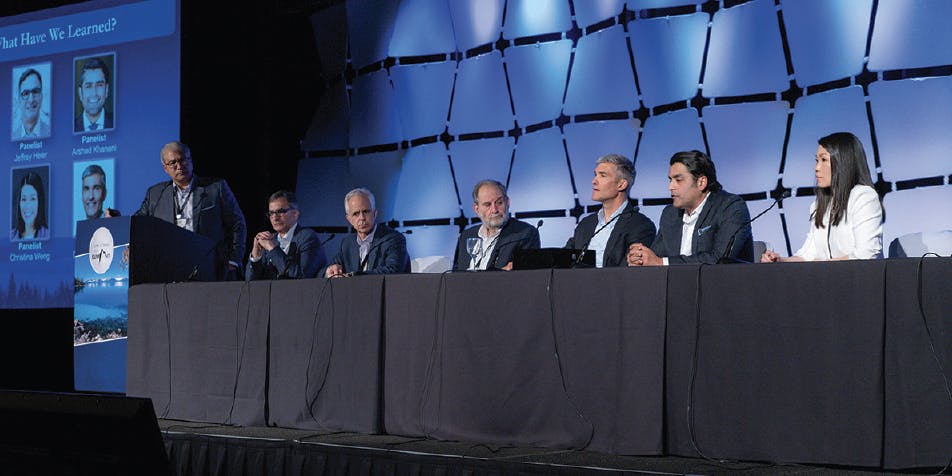
Figure. The experts had much to discuss during the unique “Clinical Trial Failures: What Have We Learned?” panel at this year’s CTS conference. Pictured here (left to right) are panelists Peter K. Kaiser, MD; Jeffrey S. Heier, MD; Carl D. Regillo, MD; David S. Boyer, MD; Charles C. Wykoff, MD, PhD; Arshad M. Khanani, MD, MA; and Christina Y. Weng, MD. Image courtesy of Tawnie Baranick, T Art Photos
LEARN FROM OUR MISTAKES
The day concluded with a session on lessons learned from trial failures (Figure). Dr. Regillo expressed his disappointment with KSI-301, and Peter K. Kaiser, MD, suggested that 12-week intervals may be proof that the researchers were trying too hard to improve different parameters. Dr. Wykoff mentioned that drugs targeting other pathways, such as tyrosine kinase inhibitors, cannot sacrifice efficacy for the sake of durability.
STAY TUNED
CTS is already gearing up for the 2023 meeting, with plans to bring together more retina specialists and industry partners who are interested in moving retina research forward.

_1784132761.jpg?auto=compress,format&w=75)





