


AT A GLANCE
- Many surgical techniques and modifications can help to improve the macular hole closure rate, including prolonged positioning and tamponade, retina tissue manipulation, and internal limiting membrane (ILM) flap techniques.
- The superior wide-base ILM flap transposition (SWIFT) technique is a non-rim-based distal ILM flap technique that involves harvesting a flap from the residual ILM.
- Postoperative evaluation of the flap status using indocyanine green fluorescence imaging helps to refine the surgical technique and improve outcomes.
- The SWIFT technique is a valuable approach for the management of refractory macular holes with previously removed ILM and for cases at high risk of non-closure.
Idiopathic macular holes (MHs) were considered untreatable until the 1990s when Kelly and Wendell reported that pars plana vitrectomy (PPV) and gas tamponade with face-down positioning resulted in the resolution of subretinal fluid associated with MH. In 30 (58%) of 52 eyes, they found that visual acuity improved by 2 or more lines in 78% of eyes.1
Since that initial report, advances in vitreoretinal surgery—including instrumentation, intraoperative visualization, and dye-assisted removal of the internal limiting membrane (ILM)—have led to improved surgical outcomes. Currently, PPV with the removal of the ILM and gas tamponade is the standard treatment for primary idiopathic MHs. The procedure is associated with an 85% to 95% closure rate.2-8
However, the surgical success rate is significantly lower (between 45% and 70%) for MHs with certain characteristics, such as large size, chronicity, refractory status, and myopic in nature.9,10 Many surgical techniques and modifications can help to improve the closure rate, including prolonged positioning and tamponade, retina tissue manipulation, and ILM flap techniques. In addition, lens capsule, autologous retinal transplant, and amniotic membrane grafts have been used in cases where the ILM may not be available for flap formation.11-22
Michalewska et al first reported on an inverted ILM flap technique that involved peeling of the ILM and leaving the base of the flap attached to the MH rim. The ILM flap was trimmed and folded to cover the MH. Several modifications to this technique have been described, including limiting the ILM peel to the temporal area and tucking the ILM into the MH. Numerous studies reported improved anatomic outcomes for the inverted ILM flap technique compared with ILM peel and removal, particularly for large and myopic MHs.11,12,23
WHEN THE MACULAR HOLE WON’T CLOSE
Conventional rim-based ILM flap techniques are not feasible in eyes with a persistent MH and previously removed ILM, and these cases continue to present a surgical challenge. Distal ILM flap techniques—including free ILM patch grafts and pedicle ILM flaps—and lens capsule free grafts have been described for the management of persistent MH with previously removed ILM. However, free flaps are unstable intraoperatively and postoperatively and are prone to displacement. Furthermore, the graft is frequently caught up within the surgical instruments.
Adjunct tools such as viscoelastics, perfluorocarbon liquid, and autologous serum or blood may help with positioning of the flap over the MH. Distal pedicle ILM flaps, although they remain attached to the retina at the base, are also prone to rotation and displacement by intraocular fluid currents.
The superior wide-base ILM flap transposition (SWIFT) technique is a non-rim-based distal ILM flap technique that involves harvesting a flap from the residual ILM (Video).18 During the procedure, a wide-base ILM flap is fashioned from the residual ILM, preferably superiorly (Figure 1).
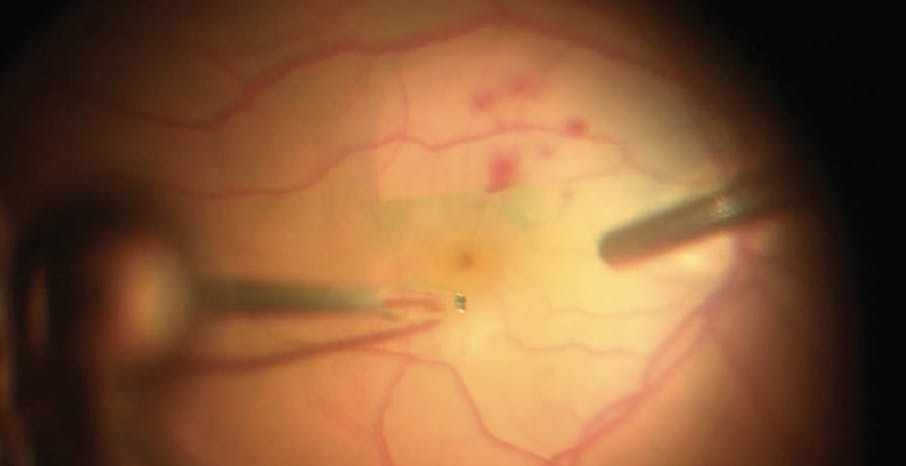
Video. Superior Wide-Base ILM Flap Transposition (SWIFT) Technique for Macular Hole Closure
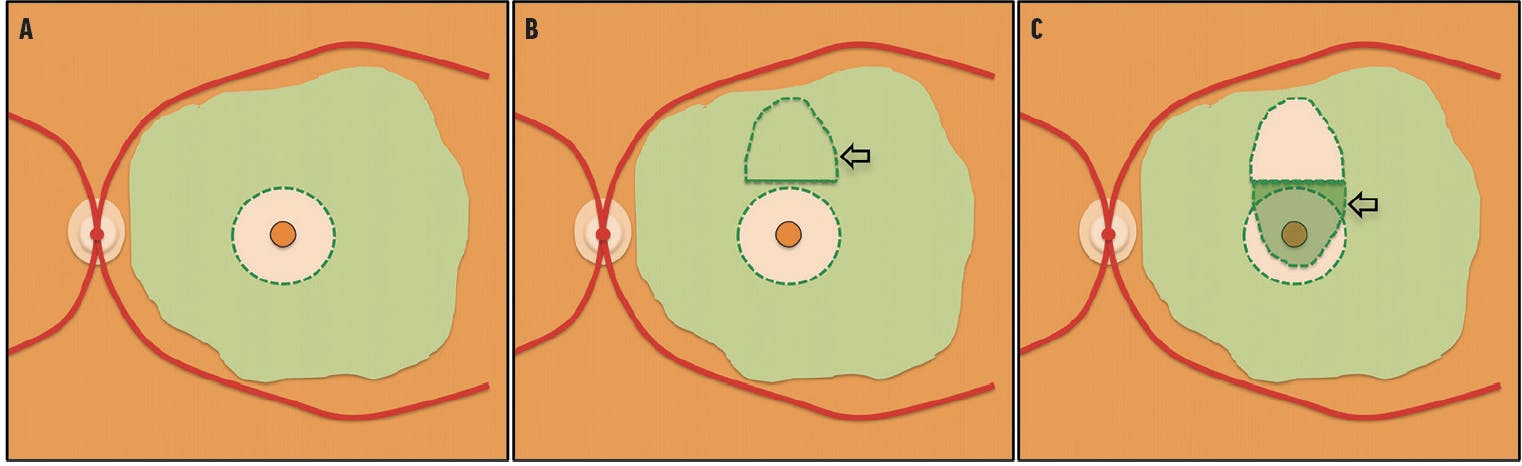
Figure 1. During the SWIFT technique, the ILM has been removed during a previous surgery or is removed at the time of the SWIFT procedure (A). An ILM flap is harvested from the superior residual ILM, leaving a narrow base that is preferably oriented horizontally (B). The ILM flap is inverted and manipulated to drape over the MH (C).
Other locations, such as the temporal macula, may be considered if the superior residual ILM is not accessible. The wide base confers some degree of flap stability, the superior location takes advantage of gravity to keep the flap in good position, and the wide width allows continued coverage of the MH in the case of flap rotation.
SWIFT TECHNIQUE
Following PPV, brilliant blue G or ICG tissue dye is administered to improve the visualization of the ILM (Figure 2). If the ILM was removed during a previous surgery, a wide-based flap is harvested from the residual ILM over the superior part of macula and inverted to cover the MH.18 If residual ILM is not available superiorly, the flap is harvested from the temporal or other areas. The base of the flap is preferably orientated horizontally. When the ILM is intact, it is removed 1 to 2 disc diameters around the MH, before or after harvesting the flap. Intraocular ILM forceps and loop membrane scrapers (ie, the Finesse Flex Loop [Alcon/Grieshaber]) are used to initiate and manipulate the flap.
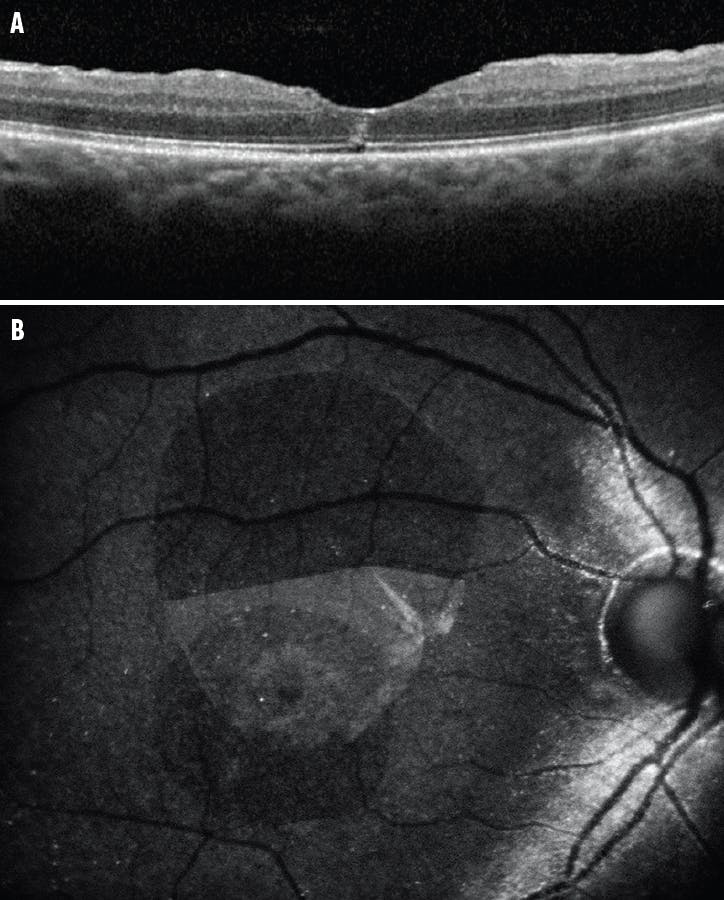
Figure 2. Postoperative OCT imaging and ICG fluorescence imaging in a patient who underwent an ICG-assisted SWIFT procedure. OCT imaging shows a closed MH with a U-pattern (A). ICG fluorescence imaging shows a hypofluorescent area superiorly (flap harvest site) and centrally (removed ILM), with the flap covering the MH (B). Note that the flap has a fold on the nasal aspect.
The ILM flap is inverted and positioned over the MH and a fluid-air exchange is performed. The infusion line is cleared of fluid by minimal fluid-air exchange prior to positioning the flap over the MH to minimize the chance of flap displacement by fluid currents. To help maintain the position of the flap during fluid-air exchange, the aspiration cannula is positioned inferior to the ILM flap and close to the retina.
Adjuncts such as viscoelastics and perfluorocarbon liquid are usually not required but may be used to stabilize the flap in certain cases. During gas infusion, the infusion cannula is directed away from the ILM flap to avoid flap displacement. The patient is positioned sitting up at the completion of the surgery. Postoperative positioning includes 1 week of downgaze.
STATS
In a series of 17 cases of MH with high-risk characteristics that underwent a SWIFT procedure, the MH closed in 16 (94%) eyes.18 In this series, 13 eyes had one or more high-risk characteristics, including high myopia, chronic MH, history of prior MH surgery and ILM removal, and MHs > 650 µm. Seven eyes had one high-risk characteristic, four eyes had two high-risk characteristics, and two eyes had three high-risk characteristics.
The position and integrity of the ILM flap was evaluated postoperatively by the detection of ICG fluorescence originating from the residual ILM. This imaging modality provided an en face image of the ILM flap and complements the OCT images. ICG fluorescence imaging showed the ILM flap completely covering the MH in 82% of study eyes. The flap coverage was partial in one eye, and there was no coverage in two eyes. The ILM flap was folded in four (24%) eyes but without visual consequences.18
LAST-MINUTE PEARLS
The SWIFT technique combines the advantages of ILM removal with those of an ILM flap. It may be a valuable technique for the management of refractory MHs with previously removed ILM and for cases at high risk of non-closure. Compared with other distal flap techniques, such as free ILM flap or pedicle flaps, the SWIFT flap may be more stable. The technique avoids tucking of the ILM flap into the MH, reducing the risk of surgical trauma to the retinal pigment epithelium and postoperative intraretinal ILM entrapment. Optimal ILM visualization is helpful for all flap techniques, and the SWIFT technique can become challenging in cases with significant media opacity, poor ILM staining, and extensive areas of myopic or geographic atrophy. There is a learning curve associated with the SWIFT technique, and postoperative evaluation of the flap status using ICG fluorescence imaging helps to refine the surgical technique and improve outcomes.24
1. Kelly NE, Wendel RT. Vitreous surgery for idiopathic macular holes. Results of a pilot study. Arch Ophthalmol. 1991;109(5):654-659.
2. Eckardt C, Eckardt U, Groos S, Luciano L, Reale E. Removal of the internal limiting membrane in macular holes. Clinical and morphological findings. Ophthalmologe. 1997;94(8):545-551.
3. Mester V, Kuhn F. Internal limiting membrane removal in the management of full-thickness macular holes. Am J Ophthalmol. 2000;129(6):769-777.
4. Tognetto D, Grandin R, Sanguinetti G, et al. Internal limiting membrane removal during macular hole surgery: results of a multicenter retrospective study. Ophthalmology. 2006;113(8):1401-1410.
5. Christensen UC, Kroyer K, Sander B, et al. Value of internal limiting membrane peeling in surgery for idiopathic macular hole stage 2 and 3: a randomised clinical trial. Br J Ophthalmol. 2009;93(8):1005-1015.
6. Lois N, Burr J, Norrie J, et al. Internal limiting membrane peeling versus no peeling for idiopathic full-thickness macular hole: a pragmatic randomized controlled trial. Invest Ophthalmol Vis Sci. 2011;52(3):1586-1592.
7. Ch’ng SW, Patton N, Ahmed M, et al. The Manchester Large Macular Hole Study: Is it time to reclassify large macular holes? Am J Ophthalmol. 2018;195:36-42.
8. Steel DH, Donachie PHJ, Aylward GW, et al. Factors affecting anatomical and visual outcome after macular hole surgery: findings from a large prospective UK cohort. Eye (Lond). 2021;35(1):316-325.
9. Valldeperas X, Wong D. Is it worth reoperating on macular holes? Ophthalmology. 2008;115(1):158-163.
10. Moisseiev E, Fabian ID, Moisseiev J, Barak A. Outcomes of repeated pars plana vitrectomy for persistent macular holes. Retina. 2013;33(6):1137-1143.
11. Michalewska Z, Michalewski J, Adelman RA, Nawrocki J. Inverted internal limiting membrane flap technique for large macular holes. Ophthalmology. 2010;117(10):2018-2025.
12. Michalewska Z, Michalewski J, Dulczewska-Cichecka K, Adelman RA, Nawrocki J. Temporal inverted internal limiting membrane flap technique versus classic inverted internal limiting membrane flap technique: a comparative study. Retina. 2015;35(9):1844-1850.
13. Szigiato AA, Gilani F, Walsh MK, Mandelcorn ED, Muni RH. Induction of macular detachment for the treatment of persistent or recurrent idiopathic macular holes. Retina. 2016;36(9):1694-1698.
14. Morizane Y, Shiraga F, Kimura S, et al. Autologous transplantation of the internal limiting membrane for refractory macular holes. Am J Ophthalmol. 2014;157(4):861-869.
15. Gekka T, Watanabe A, Ohkuma Y, et al. Pedicle internal limiting membrane transposition flap technique for refractory macular hole. Ophthalmic Surg Lasers Imaging Retina. 2015;46(10):1045-1046.
16. Felfeli T, Mandelcorn ED. Macular hole hydrodissection: surgical technique for the treatment of persistent, chronic, and large macular holes. Retina. 2019;39(4):743-752.
17. Chen SN, Yang CM. Lens capsular flap transplantation in the management of refractory macular hole from multiple etiologies. Retina. 2016;36(1):163-170.
18. Tabandeh H, Morozov A, Rezaei KA, Boyer DS. Superior wide-base internal limiting membrane flap transposition for macular holes: flap status and outcomes. Ophthalmol Retina. 2021;5(4):317-323.
19. Grewal DS, Charles S, Parolini B, Kadonosono K, Mahmoud TH. Autologous retinal transplant for refractory macular holes: Multicenter International Collaborative Study Group. Ophthalmology. 2019;126(10):1399-1408.
20. Grewal DS, Mahmoud TH. Autologous neurosensory retinal free flap for closure of refractory myopic macular holes. JAMA Ophthalmol. 2016;134(2):229-230.
21. Moysidis SN, Koulisis N, Adrean SD, et al. Autologous retinal transplantation for primary and refractory macular holes and macular hole retinal detachments: the global consortium. Ophthalmology. 2021;128(5):672-685.
22. Rizzo S, Caporossi T, Tartaro R, et al. A human amniotic membrane plug to promote retinal breaks repair and recurrent macular hole closure. Retina. 2019;39(suppl 1):S95-S103.
23. Rizzo S, Tartaro R, Barca F, Caporossi T, Bacherini D, Giansanti F. Internal limiting membrane peeling versus inverted flap technique for treatment of full-thickness macular holes: a comparative study in a large series of patients. Retina. 2018;38(suppl 1):S73-S78.
24. Tabandeh H. Fluorescence imaging of the ILM flap following macular hole surgery. Am J Ophthalmol Case Rep. 2021;24:101203.

_1784132761.jpg?auto=compress,format&w=75)





