




AT A GLANCE
- One of the most frequent indications for silicone scleral buckle removal is extrusion through the conjunctiva.
- Amniotic membrane grafts have been well reported in the reconstruction of the conjunctiva for numerous ocular surface diseases.
- When faced with an extruded scleral buckle, consider using scleral and amniotic patch grafts.
Scleral buckling remains a popular technique to repair retinal detachments (RDs), either as primary treatment or as an adjunct to pars plana vitrectomy (PPV).1 One of the most frequent indications for silicone scleral buckle removal is extrusion through the conjunctiva with rates of extrusion and infection ranging from 0.5% to 5.6%.2-9 Despite few implants being removed for suspected clinical infection (8.2%), a majority of the extruded and subsequently removed buckles have been shown to be colonized with bacteria.9 Observation of the exposed elements coupled with topical antibiotic drops has generally been found inadequate. Similarly, primary closure of a small defect may be attempted but is typically futile with frequent recurrence.10 Larger defects are difficult to close because of the location typically near the conjunctival fornix, loss of tissue integrity due to necrosis, and limited mobility of the surrounding conjunctival tissue due to scarring and adhesions.
Adjunct techniques such as the use of dehydrated amniotic membrane graft secured with fibrin sealant have been shown to successfully repair large conjunctival defects secondary to an extruded buckle.11
Here, we present a case of an extruded silicone scleral buckle with associated scleral thinning and a large conjunctival defect and the surgical steps we took to treat the patient.
THE CASE
A 73-year-old man presented to the emergency department 1 month after a scleral buckle revision with complaints of sudden worsening of ocular pain that woke him up in the middle of the night.
He had no past medical history, but his ocular history was robust. He underwent uncomplicated cataract surgery and IOL placement in the capsular bag in 2015, after which he developed an RD in his right eye that was repaired with PPV and gas tamponade. He experienced a redetachment in late 2015 that required repeat surgery with a scleral buckle, PPV, and gas tamponade. In July of 2021, he developed recurrent episodes of pain and discharge in his right eye. He was seen by his original surgeon who trimmed an “exposed suture,” following which his symptoms worsened. He returned to his surgeon and was told that his scleral buckle was exposed. He underwent multiple scleral buckle revisions, most recently in October 2021. Postoperatively, he was treated with 1% prednisolone acetate one drop four times per day and 0.5% ketorolac one drop twice per day in the right eye.
On examination in the emergency department, his VA was 20/40 OD and 20/20 OS. There were no afferent pupillary defects and IOPs were within normal limits. Extraocular motility was globally diminished in the right eye. The anterior segment examination was notable for an area of focal superonasal injection surrounding a full-thickness conjunctival defect with an extruded scleral buckle and an underlying area of significant scleral thinning (Figure 1).
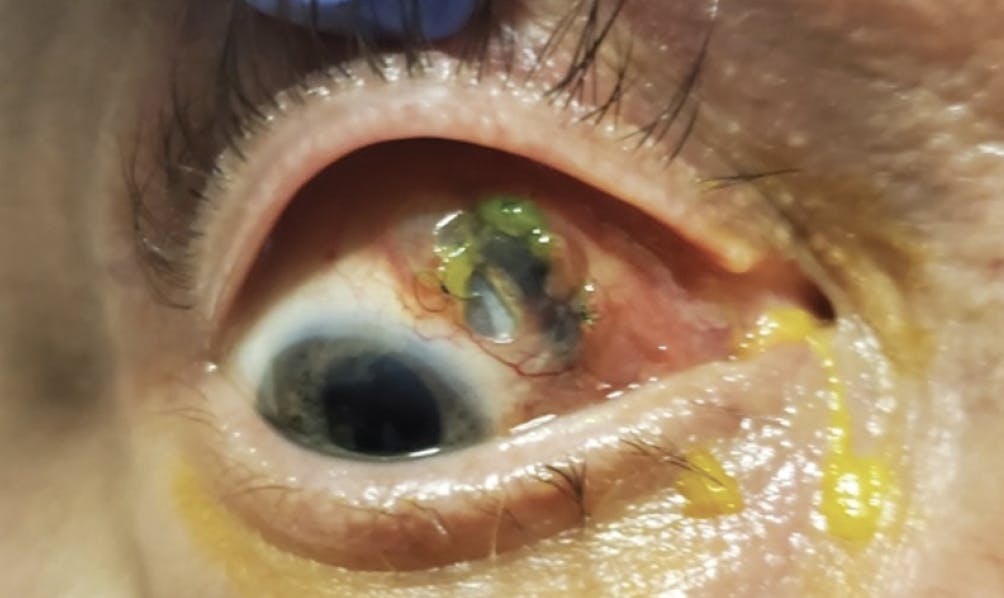
Figure 1. The anterior segment examination revealed an area of focal superonasal injection surrounding a full-thickness conjunctival defect with several loose nylon sutures, an extruded scleral buckle, and an underlying area of significant scleral thinning.
Fundoscopic examination of the right eye showed an attached retina supported on a scleral buckle without evidence of intrusion. The left eye was unremarkable. A CT scan of the orbits revealed the implanted scleral buckle with a somewhat diagonal orientation in the axial plane, but no evidence of pre- or post-septal cellulitis (Figure 2).
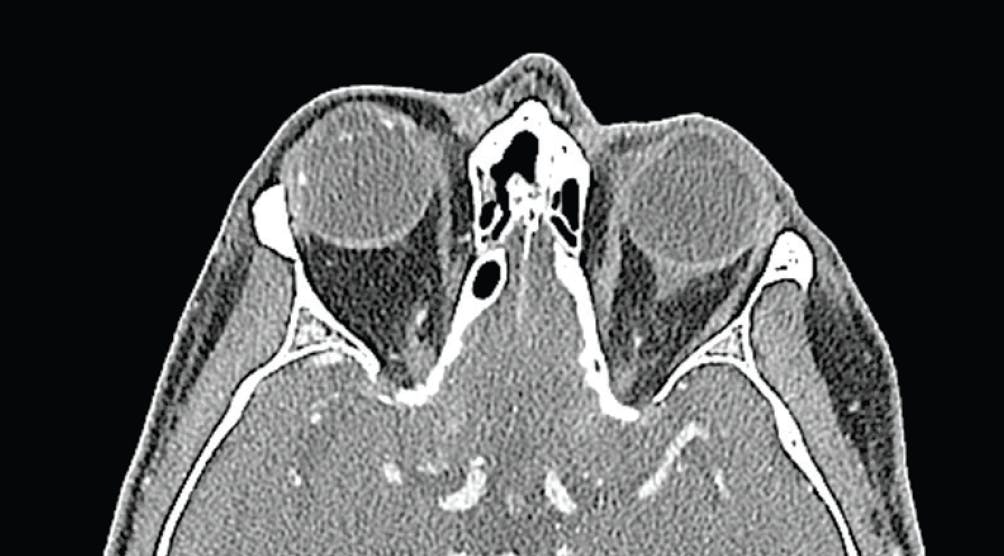
Figure 2. The CT scan revealed the implanted scleral buckle with a somewhat diagonal orientation in the axial plane, but no evidence of associated pre- or post-septal cellulitis.
The buckle and conjunctival defect were cultured for fungal, bacterial, and mycobacterial infections. Swabs were also sent for varicella zoster and herpes simplex virus detection via polymerase chain reaction. The patient was started on ofloxacin drops four times per day in the right eye and given doses of intravenous vancomycin and moxifloxacin in the emergency department. The patient was asked to discontinue the prednisolone acetate and ketorolac drops.
The patient was taken to the OR for scleral buckle removal, scleral patch graft, and amniotic membrane graft to close the large conjunctival defect (Video). Careful and meticulous dissection of the conjunctiva and Tenon’s capsule adjacent to the extruded scleral buckle was performed. The scleral buckle was cut adjacent to the existing conjunctival opening, held by the Watzke sleeve that was in the superonasal quadrant, and removed, limiting exposure of the scleral buckle tunnel to any potential pathogenic microorganisms. The subconjunctival and sub-Tenon’s space were gently irrigated with antibiotic rinse. Whole donor sclera was measured and trimmed to 1 mm larger than the area of the original defect. The trimmed donor sclera was tucked under the previously undermined conjunctiva and Tenon’s capsule and secured with 8-0 vicryl sutures.
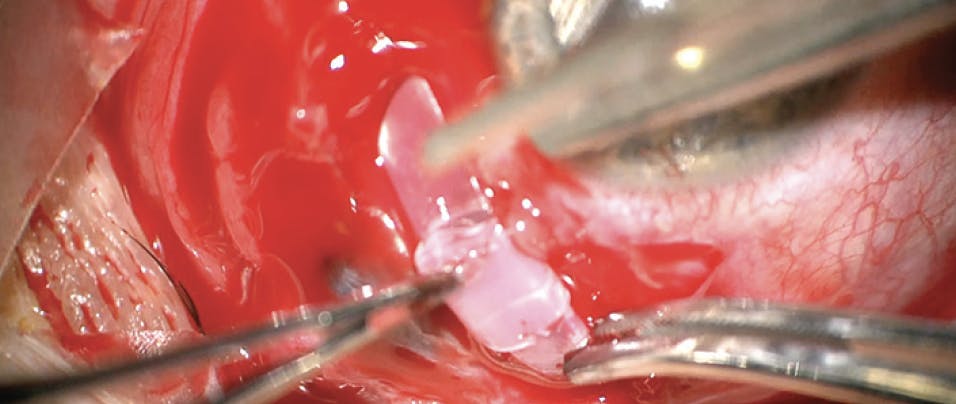
Video. Management of An Extruded Silicone Scleral Buckle
However, there was significant conjunctival scarring and tissue loss that prevented primary closure of the approximately 10 x 10 mm defect despite extensive tissue mobilization. Dehydrated amniotic membrane graft was hydrated, placed stromal side down over the donor sclera, tucked under the conjunctival edges, and secured using 8-0 vicryl sutures to help promote conjunctival growth over the graft and allow closure by secondary intention.
The donor sclera and amniotic membrane graft were trimmed to the limbus to prevent dellen formation. Subconjunctival antibiotics were given, and a large-diameter bandage contact lens was placed on the eye. Ofloxacin and 1% prednisolone acetate drops four times per day, in additional to oral moxifloxacin, were prescribed postoperatively. Bacterial cultures grew S. Epidermidis.
At postoperative week 1, the patient’s pain had resolved completely, VA was stable at 20/40 OD, and the conjunctival defect was well closed with the scleral patch graft in good position underneath the amniotic membrane graft. The patient followed up with his local vitreoretinal surgeon.
DISCUSSION
Exposed scleral buckles are at risk for becoming infected, and explantation is almost always required at that point. Primary conjunctival closure is the simplest procedure to correct an extruded buckle.10 However, this is typically successful only in cases with small conjunctival defects. Larger defects with tissue loss, scarring, and a location in the conjunctival fornix can be difficult to close or result in high wound tension and subsequent dehiscence or forniceal foreshortening.
In the case presented here, we were unsuccessful in undermining the surrounding conjunctiva and performing primary closure. Use of a scleral patch graft is the most frequently reported technique for repair of extruded scleral explants and is useful in the setting of scleral thinning.12-14 Several other materials have been reported to facilitate closure of the conjunctiva followed extruded scleral buckles, including pericardium, fascial grafts, periosteal patch grafts, and amniotic membrane grafts.11,15-17
Amniotic membrane grafts have been well reported in the reconstruction of the conjunctiva for numerous ocular surface diseases, in part due to their ability to stimulate epithelialization and exhibit antifibrotic, antiinflammatory, antiangiogenic, and antimicrobial properties.18 Importantly, they have an inherent lack of immunogenicity, which is important for their utility as a graft, and makes them a more appealing option compared with other allografts.18
THE PEARLS
This case of an extruded and infected silicone scleral buckle with associated scleral thinning and a large conjunctival defect required buckle removal, sutured donor scleral graft, and dehydrated amniotic membrane graft.
Extruded scleral buckles are intimidating cases, and although conservative treatment seems reasonable at first, eventual removal of the scleral buckle is often required. Primary closure of the defect can be attempted, but if that proves unsuccessful, consider using scleral and amniotic patch grafts in these complex cases.
1. Ryan EH, Joseph DP, Ryan CM, et al. Primary retinal detachment outcomes study: methodology and overall outcomes-primary retinal detachment outcomes study report number 1. Ophthalmol Retina. 2020;4(8):814-822.
2. Deokule S, Reginald A, Callear A. Scleral explant removal: the last decade. Eye Lond Engl. 2003;17(6):697-700.
3. Kazi MS, Sharma VR, Kumar S, Bhende P. Indications and outcomes of scleral buckle removal in a tertiary eye care center in South India. Oman J Ophthalmol. 2015;8(3):171-174.
4. Deutsch J, Aggarwal RK, Eagling EM. Removal of scleral explant elements: a 10-year retrospective study. Eye Lond Engl. 1992;6(6):570-573.
5. Hahn YS, Lincoff A, Lincoff H, Kreissig I. Infection after sponge implantation for scleral buckling. Am J Ophthalmol. 1979;87(2):180-185.
6. Russo CE, Ruiz RS. Silicone sponge rejection. Early and late complications in retinal detachment surgery. Arch Ophthalmol. 1971;85(6):647-650.
7. Lincoff H, Nadel A, O’Connor P. The changing character of the infected scleral implant. Arch Ophthalmol. 1970;84(4):421-423.
8. Tsui I. Scleral buckle removal: indications and outcomes. Surv Ophthalmol. 2012;57(3):253-263.
9. Moisseiev E, Fogel M, Fabian ID, Barak A, Moisseiev J, Alhalel A. Outcomes of scleral buckle removal: experience from the last decade. Curr Eye Res. 2017;42(5):766-770.
10. Kittredge KL, Conway BP. Management of the exposed scleral explant. Semin Ophthalmol. 1995;10(1):53-60.
11. Grewal DS, Mahmoud TH. Dehydrated allogenic human amniotic membrane graft for conjunctival surface reconstruction following removal of exposed scleral buckle. Ophthalmic Surg Lasers Imaging Retina. 2016;47(10):948-951.
12. Wilson RS, Parker JC. Scleral patch for exposed silicone buckles. Ophthalmic Surg. 1975;6(3):83-85.
13. Watzke RC. Scleral patch graft for exposed episcleral implants. Arch Ophthalmol. 1984;102(1):114-115.
14. Murdoch JR, Sampath R, Lavin MJ, Leatherbarrow B. Autogenous labial mucous membrane and banked scleral patch grafting for exposed retinal explants. Eye Lond Engl. 1997;11(1):43-46.
15. Weissgold DJ, Millay RH, Bochow TA. Rescue of exposed scleral buckles with cadaveric pericardial patch grafts. Ophthalmology. 2001;108(4):753-758.
16. Dresner SC, Boyer DS, Feinfield RE. Autogenous fascial grafts for exposed retinal buckles. Arch Ophthalmol. 1991;109(2):288-289.
17. Gupta SR, Anand R, Diwan S, Gupta N. Salvaging recurrent scleral buckle exposure with autologous periosteal patch graft. Retin Cases Brief Rep. 2014;8(3):178-182.
18. Jirsova K, Jones GLA. Amniotic membrane in ophthalmology: properties, preparation, storage and indications for grafting-a review. Cell Tissue Bank. 2017;18(2):193-204.


_1773249222.png?auto=compress,format&w=75)





