


AT A GLANCE
- Anatomical damage has been found after internal limiting membrane (ILM) removal, as it causes damage to Müller cells.
- ILM peeling can improve closure rates of full-thickness macular holes and lower rates of late postoperative recurrence.
- It is generally agreed that epiretinal membrane/ILM peeling does not improve visual acuity but decreases the recurrence rate of epiretinal membranes.
Internal limiting membrane (ILM) peeling is used in macular hole (MH) surgery for improved surgical outcomes. However, surgeons continue to debate the ideal peel diameter. For other indications such as rhegmatogenous retinal detachment (RRD) and epiretinal membrane (ERM), there is less overall guidance and consensus on the need for ILM peeling. Here, we discuss the controversies surrounding ILM peeling, including when and how much to peel and the risks involved.
DISADVANTAGES
Anatomical damage has been found after ILM removal, as it causes damage to Müller cells. Structural and histological changes occur after manipulation of the ILM.1 Studies have found that the size of the ILM peel was associated with an increased dissociated optic nerve fiber layer (DONFL) score.2 Microperimetry has also revealed decreased retinal sensitivities and an increase in the number of absolute and relative microscotomas after ILM peeling.3 Finally, there are risks associated with the dyes used, such as indocyanine green (ICG) or brilliant blue.4,5
HOW MUCH TO PEEL?
ILM peeling can improve closure rates of full-thickness MHs and lower rates of late postoperative recurrence despite no statistically significant improvement in visual acuity.6,7 Although there is widespread acceptance of ILM peeling in the case of a MH, there is no consensus on how wide to peel. While some will perform a conventional ILM peel (C-ILMP) with a diameter of 2 disc-diameters, others will use extended C-ILMP (EC-ILMP) of up to 4 disc-diameters. Modi et al found similar closure rates in 3-mm and 5-mm peel diameters with better visual acuity in the 3-mm group. Given the lack of improvement in anatomic or visual results and the damage to the retina caused by ILM peeling, the recommendation was made to keep the peel diameter as small as possible to relieve tangential traction without compromising the surgery success rate.8 However, research has yet to clarify if MHs can be stratified to determine whether some would benefit from a larger peel.
Yao et al evaluated 12-month results of C-ILMP versus EC-ILMP and stratified the results based on the MH closure index (MHCI). When the MHCI was < 0.5, the complete closure rate was 18% with C-ILMP and 76% for EC-ILMP, with better visual acuity at 12 months in the EC-ILMP group. With an MHCI > 0.5, there was no difference in complete closure rate or visual acuity at 12 months.9 Another study showed that closure rates in MHs with a minimum linear dimension larger than 400 µm were 46% in the C-ILMP group versus 76% in the EC-ILMP group.10 Two studies showed higher closure rates for EC-ILMP compared with C-ILMP in MHs greater than 400 µm, although there was no statistical difference in visual acuity.11,12 However, when stratified, there was an improvement for the EC-ILMP group with an MHCI < 0.5.12
Bottom line: There are likely methods to stratify risk associated with MHs and determine the optimal conventional ILM peel diameter.
WHEN TO PEEL
RRDs. The issue of when to peel the ILM in RRD repair surgery is highly debated in the literature. ERM has been shown to form after standard RRD repair without ILM peeling with rates varying from 6% to 34% and surgical rates of reoperation from 4% to 16%.13-15 Peeling the ILM at the time of RRD surgery may help reduce the rates of ERM formation (0%–6.5%) and reoperation (0%–2%).16-22
However, there is less consensus on postoperative visual acuity, with many authors showing no statistical improvement in visual acuity after ILM peeling in RRD.15,16,23 Others have stratified data to macula-on and macula-off RDs. With macula-on, some have found improvement in visual acuity with ILM peeling, while others have found no statistical improvement.16,18 For macula-off RD, some authors showed improvement in visual acuity after ILM peeling,17 some found no statistical difference,20,21 and some showed worse visual acuity.18,19,22
Likewise, redetachment rates have varied, with some showing higher redetachment rates without ILM peeling and others finding no statistical difference.16-18,20,21,23
There are also concerns regarding the safety of ILM peeling during RRD repair. Abdullah et al found worse visual acuity, more retinal dimples, less density of superficial capillary plexus on OCT angiography, and decreased mean amplitude of multifocal electroretinogram after ILM peeling.22 Eissa et al found worse visual acuity, decreased retinal sensitivity, and more retinal dimpling in the ILM peeling group compared with the group that did not undergo peeling.19
Given the relative consensus on increased postoperative ERM, but conflicting data on postoperative visual acuity and function, others are looking for alternative markers to influence the use of ILM peeling. Akiyama et al used retinal surface wrinkling as a proxy for likelihood of ERM development after RRD repair. At 6 months, they found no ERM formation after ILM peeling with patients who had retinal surface wrinkling, where patients without retinal surface wrinkling and without ILM peeling had a 14% rate of ERM formation. BCVA was similar between the two groups. However, this study had no control group of patients with wrinkling without ILM peeling.24
Bottom line: Overall, ERM formation is felt to be reduced in patients who undergo ILM peeling during RRD repair. However, the benefit or detriment to visual function is variable based on the study.
ERMs. The benefits and risks of ERM peeling alone versus combined ERM/ILM peeling remain hotly debated. To complicate things, ILM is often inadvertently removed when the ERM is peeled (Table).
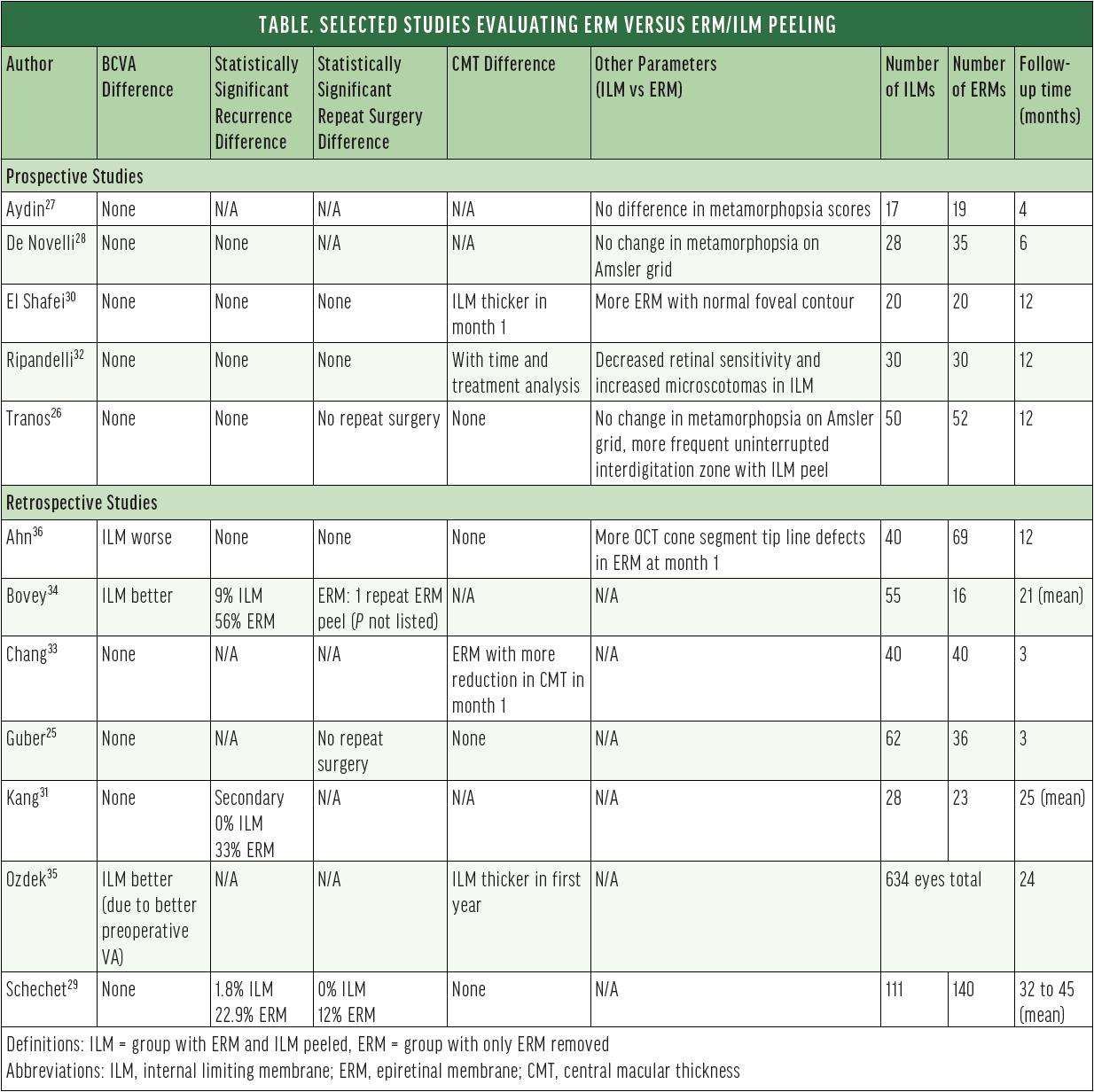
Most research has found no statistical difference in the postoperative BCVA when comparing ERM and ERM/ILM peeling.25-33 Bovey et al performed histology on ERMs removed from 71 patients and found an association between improved final visual acuity when ILM was removed in addition to ERM.34 Ozdek et al found better visual acuity after ERM/ILM peeling; however, this was felt to be due to better preoperative visual acuity in the ERM/ILM group.35 Ahn et al found worse BCVA in the ERM/ILM peeling group at month 1 but no statistical difference at subsequent visits.36
Many authors have found a decrease in recurrent ERM formation in the ERM/ILM groups, although only a small fraction of recurrent ERMs required surgery.29,34 Kang et al did find a significant decrease in recurrence for ERM/ILM peeling in ERMs that were secondary, but no difference in idiopathic ERM.31 Other authors did not see a statistically significant difference in recurrent ERM formation.26,28,30,32,36
Because many of the prospective studies were limited in the numbers of participants and others have been retrospective, some authors have used meta-analyses to further evaluate the differences after ILM peeling in ERM. A meta-analysis of seven randomized control studies found no statistical difference in visual acuity at 12 months, a larger ERM recurrence rate in the ERM group at 12 months, and an increased central macular thickness and reduced foveal sensitivity in the ERM/ILM peeling group.37 However, the authors cautioned that there was significant heterogeneity in the studies when comparing foveal sensitivity.37
There has been interest in ILM peeling’s effect on cystoid macular edema, with some authors finding an increase in thickening after ERM/ILM peeling compared with ERM alone.30,32,33,35 Still, this often resolves over time. Other authors did not observe a statistically significant difference between the two groups.26,29,36
Uemura et al used ICG staining and found visual field defects after ERM/ILM peeling, possibly due to ICG toxicity or the mechanical effects of ILM peeling itself.38 Ripandelli et al performed microperimetry and found decreased mean retinal sensitivity in the ERM/ILM peeling group in the 4-degree central area, as well as an increased number of microscotomas in the 12-degree, but not the 4-degree, central area.32 Evaluation by Amsler grid did not show a statistical difference in metamorphopsia.26,28 Aydin et al evaluated metamorphopsia using an M-chart but were unable to find a significant difference.27
Bottom line: It is generally agreed that ERM/ILM peeling does not improve the visual acuity but does decrease recurrence rate of ERM. The debate continues about whether ILM peeling causes side effects for patients and whether the risks outweigh the benefits.
TAKEHOME
For MH surgery, ILM peeling has improved closure rates, although the optimal amount of peeling is debatable. Given the risks of ILM removal, including DONFL, decreased retinal sensitivities, microscotomas, and eccentric MHs, surgeons should minimize the ILM peeling to allow closure of the hole without incurring additional risk to the patient. There is evidence that peeling the ILM in RRD and ERM may limit ERM formation or recurrence after surgery, but overall functional outcome improvements are debated.
Future large prospective clinical trials may further refine and develop a consensus on the best use of ILM peeling.
1. Almeida DR, Chin EK, Tarantola RM, et al. Effect of internal limiting membrane abrasion on retinal tissues in macular holes. Invest Ophthalmol Vis Sci. 2015;56(5):2783-2789.
2. Steel DH, Chen Y, Latimer J, White K, Avery PJ. Does internal limiting membrane peeling size matter? J Vitreoretinal Dis. 2017;1(1):27-33.
3. Tadayoni R, Svorenova I, Erginay A, Gaudric A, Massin P. Decreased retinal sensitivity after internal limiting membrane peeling for macular hole surgery. Br J Ophthalmol. 2012;96(12):1513-1516.
4. Gandorfer A, Haritoglou C, Kampik A. Toxicity of indocyanine green in vitreoretinal surgery. Dev Ophthalmol. 2008;42:69-81.
5. Soni A, Parameswarappa DC, Tyagi M, et al. Brilliant blue G toxicity in macular hole surgeries: A report on combined phototoxicity and dye-induced macular damage. In: Seminars in Ophthalmology. Taylor & Francis; 2022:117-122.
6. Rahimy E, McCannel CA. Impact of internal limiting membrane peeling on macular hole reopening: a systematic review and meta-analysis. Retina. 2016;36(4):679-687.
7. Cornish KS, Lois N, Scott N, et al. Vitrectomy with internal limiting membrane (ILM) peeling versus vitrectomy with no peeling for idiopathic full‐thickness macular hole (FTMH). Cochrane Data Syst Rev. 2013;(6).
8. Modi A, Giridhar A, Gopalakrishnan M. Comparative analysis of outcomes with variable diameter internal limiting membrane peeling in surgery for idiopathic macular hole repair. Retina. 2017;37(2):265-273.
9. Yao Y, Qu J, Dong C, et al. The impact of extent of internal limiting membrane peeling on anatomical outcomes of macular hole surgery: results of a 54‐week randomized clinical trial. Acta Ophthalmol. 2019;97(3):303-312.
10. Khodabande A, Mahmoudi A, Faghihi H, Bazvand F, Ebrahimi E, Riazi-Esfahani H. Outcomes of idiopathic full-thickness macular hole surgery: comparing two different ILM peeling sizes. J Ophthalmol. 2020;2020:1619450.
11. Sinawat S, Jumpawong S, Ratanapakorn T, Bhoomibunchoo C, Yospaiboon Y, Sinawat S. Efficacy of pars plana vitrectomy with internal limiting membrane peeling for treatment of large idiopathic full-thickness macular holes. Clin Ophthalmol. 2021;15:521-529.
12. Sinawat S, Srihatrai P, Sutra P, Yospaiboon Y, Sinawat S. Comparative study of 1 DD and 2 DD radius conventional internal limiting membrane peeling in large idiopathic full-thickness macular holes: a randomized controlled trial. Eye. 2021;35(9):2506-2513.
13. Heo MS, Kim HW, Lee JE, Lee SJ, Yun IH. The clinical features of macular pucker formation after pars plana vitrectomy for primary rhegmatogenous retinal detachment repair. Korean J Ophthalmol. 2012;26(5):355-3561.
14. Yannuzzi NA, Callaway NF, Sridhar J, Smiddy WE. Internal limiting membrane peeling during pars plana vitrectomy for rhegmatogenous retinal detachment: cost analysis, review of the literature, and meta-analysis. Retina. 2018;38(10):2081-2087.
15. Rao RC, Blinder KJ, Smith BT, Shah GK. Internal limiting membrane peeling for primary rhegmatogenous retinal detachment repair. Ophthalmology. 2013;120(5):1102-1103.e2.
16. Nam KY, Kim JY. Effect of internal limiting membrane peeling on the development of epiretinal membrane after pars plana vitrectomy for primary rhegmatogenous retinal detachment. Retina. 2015;35(5):880-885.
17. Garweg J, Deiss M, Pfister I, Gerhardt CDP. Impact of inner limiting membrane peeling on visual recovery after vitrectomy for primary rhegmatogenous retinal detachment involving the fovea. Retina. 2019;39(5):853-859.
18. Obata S, Kakinoki M, Sawada O, et al. Effect of internal limiting membrane peeling on postoperative visual acuity in macula-off
rhegmatogenous retinal detachment. Plos One. 2021;16(8):e0255827.
19. Eissa MGAM, Abdelhakim MASE, Macky TA, Khafagy MM, Mortada HA. Functional and structural outcomes of ILM peeling in uncomplicated macula-off RRD using microperimetry & en-face OCT. Graefes Arch Clin Exp Ophthalmol. 2018;256(2):249-2457.
20. Mahmood SA, Rizvi SF, Khan BAM, Khan TH. Role of concomitant internal limiting membrane (ILM) peeling during rhegmatogenous retinal detachment (RRD) surgery in preventing postoperative epiretinal membrane (ERM) formation. Pakistan J Med Sci. 2021;37(3):651-656.
21. Sousa K, Calvão-Santos G, Costa J, et al. Anatomical and functional results of ILM peeling vs. non-peeling in macula-off rhegmatogenous retinal detachment. Graefes Arch Clin Exp Ophthalmol. 2020;258(10):2105-2110.
22. Abdullah ME, Moharram HEM, Abdelhalim AS, Mourad KM, Abdelkader MF. Evaluation of primary internal limiting membrane peeling in cases with rhegmatogenous retinal detachment. Int J Retin Vitr. 2020;6(1):8.
23. Fallico M, Russo A, Longo A, et al. Internal limiting membrane peeling versus no peeling during primary vitrectomy for rhegmatogenous retinal detachment: A systematic review and meta-analysis. Plos One. 2018;13(7):e0201010.
24. Akiyama K, Fujinami K, Watanabe K, Matsuki T, Tsunoda K, Noda T. Retinal surface wrinkling as an indicator for internal limiting membrane peeling during vitrectomy for retinal detachment. Retina. 2021;41(8):1618-1626.
25. Guber J, Pereni I, Scholl HP, Guber I, Haynes RJ. Outcomes after epiretinal membrane surgery with or without internal limiting membrane peeling. Ophthalmol Ther. 2019;8(2):297-303.
26. Tranos P, Koukoula S, Charteris DG, et al. The role of internal limiting membrane peeling in epiretinal membrane surgery: a randomised controlled trial. Br J Ophthalmol. 2017;101(6):719-724.
27. Aydin T, Kerci SG, Karti O, Zengin MO, Kusbeci T. Effect of internal limiting membrane peeling on macular structure and metamorphopsia scores in idiopathic epiretinal membrane surgery. Open Ophthalmol J. 2020;14(1):1-8.
28. De Novelli FJ, Goldbaum M, Monteiro ML, Aggio FB, Takahashi WY. Surgical removal of epiretinal membrane with and without removal of internal limiting membrane: comparative study of visual acuity, features of optical coherence tomography, and recurrence rate. Retina. 2019;39(3):601-607.
29. Schechet SA, DeVience E, Thompson JT. The effect of internal limiting membrane peeling on idiopathic epiretinal membrane surgery, with a review of the literature. Retina. 2017;37(5):873-880.
30. El Shafei AM, Kamal M, Azab A, Nassef M. Idiopathic epiretinal membrane removal with and without internal limiting membrane peeling: a prospective comparative study. Delta J Ophthalmol. 2021;22(3):222.
31. Kang KT, Kim KS, Kim YC. Surgical results of idiopathic and secondary epiretinal membrane. Internat Ophthalmol. 2014;34(6):1227-1232.
32. Ripandelli G, Scarinci F, Piaggi P, et al. Macular pucker: to peel or not to peel the internal limiting membrane? A microperimetric response. Retina. 2015;35(3):498-507.
33. Chang S, Gregory-Roberts EM, Park S, Laud K, Smith SD, Hoang QV. Double peeling during vitrectomy for macular pucker: the Charles L. Schepens Lecture. JAMA Ophthalmol. 2013;131(4):525-530.
34. Bovey EH, Uffer S, Achache F. Surgery for epimacular membrane: impact of retinal internal limiting membrane removal on functional outcome. Retina. 2004;24(5):728-735.
35. Ozdek S, Ozdemir Zeydanli E, Karabas L, et al. Relation of anatomy with function following the surgical treatment of idiopathic epiretinal membrane: a multicenter retrospective study. Graefes Arch Clin Exp Ophthalmol. 2021;259(4):891-904.
36. Ahn SJ, Ahn J, Woo SJ, Park KH. Photoreceptor change and visual outcome after idiopathic epiretinal membrane removal with or without additional internal limiting membrane peeling. Retina. 2014;34(1):172-181.
37. Far PM, Yeung SC, Ma PE, et al. Effects of internal limiting membrane peel for idiopathic epiretinal membrane surgery: a systematic review of randomized controlled trials. Am J Ophthalmol. 2021;231:79-87.
38. Uemura A, Kanda S, Sakamoto Y, Kita H. Visual field defects after uneventful vitrectomy for epiretinal membrane with indocyanine green–assisted internal limiting membrane peeling. Am J Ophthalmol. 2003;136(2):252-257.

_1784132761.jpg?auto=compress,format&w=75)





