


AT A GLANCE
- Many techniques have been developed to address aphakia in the presence of poor capsular support, each with advantages and disadvantages.
- Current anterior chamber IOL models must be implanted through a large (approximately 6 mm) scleral tunnel or clear corneal wound.
- During sutureless intrascleral fixation, minimizing the manipulation of the haptics is important because breakage or kinking can lead to IOL tilt and dislocation.
- The choice of technique depends on many factors, and surgeons should perform the procedure with which they are the most comfortable.
Despite numerous surgical advances to address a cataractous crystalline lens, many challenges remain to address IOL placement in the presence of inadequate capsular support. Multiple techniques have been developed to address aphakia in the presence of poor capsular support, each with unique advantages and disadvantages.1
This article discusses some of the challenges associated with secondary IOL surgery and provides surgical pearls for various techniques.
ANTERIOR CHAMBER IOLS
The anterior chamber IOLs (ACIOLs) for aphakia currently available in the United States have open-looped haptics that rest in the angle. When sizing for these IOLs, surgeons often add 1 mm to the white-to-white (WTW) distance, but pannus and previous conjunctival surgery can affect the subjective WTW measurement. Because this technique requires estimation of the true angle-to-angle distance, surgeons can adjust the calipers slightly to account for the anatomic appearance of the external and internal structures. If the angle measurement falls between available ACIOL sizes, the lens can be rotated along a different meridian to facilitate suitable placement. We tend to choose a smaller size if the decision is equivocal because a smaller ACIOL can be rotated vertically (if initially placed horizontally) to achieve a tighter fit or later secured to the iris using 10-0 polypropylene sutures.2
We inject a miotic agent before placing the ACIOL to create a scaffold for the viscoelastic and the IOL and make it easier to perform a peripheral iridotomy (PI). A glide-sheet can help guide the ACIOL but can also gape the wound and lead to iatrogenic injury. We prefer to use Kelman-McPherson forceps to grasp and deliver the ACIOL into the distal angle and then use a second instrument to push the externalized haptic into the subincision angle (Figure 1). We find that temporarily clamping any posterior infusion during ACIOL insertion can help mitigate iris prolapse. Once the ACIOL is placed, it can be rotated using a second instrument. We recommend lifting each haptic centrally and anteriorly to ensure there is no iris tuck or capture.
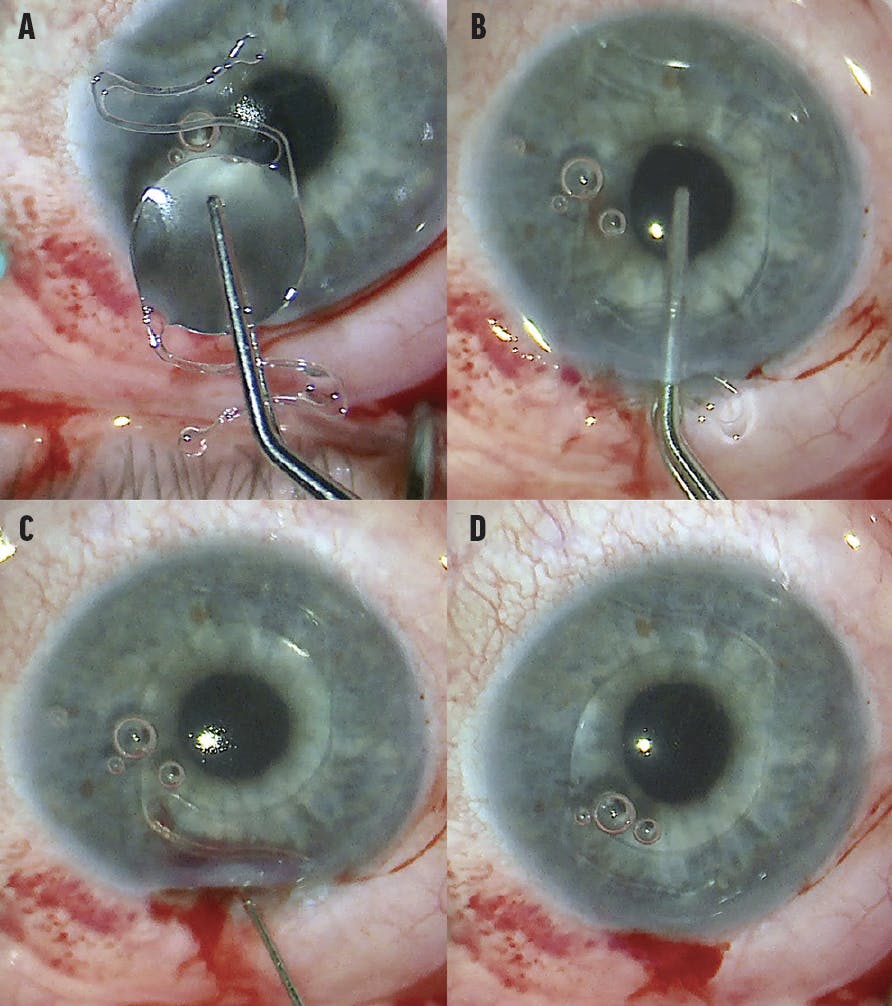
Figure 1. When inserting an ACIOL, we first grasp the IOL lengthwise across the optic using Kelman-McPherson forceps (A). We then insert the ACIOL into the eye and place the leading haptic directly into the distal angle (B). We use a second instrument to push the trailing haptic (C), which compresses the ACIOL and allows it to be fully inserted into the eye (D).
Current PMMA ACIOL models must be implanted through a large (approximately 6 mm) scleral tunnel or clear corneal wound. We perform clear corneal incisions and operate on the steep axis of the cornea to reduce astigmatism. We close the wound with a single 10-0 nylon suture in a cross-stitch pattern to spread out the radial forces and reduce surgically induced astigmatism (Figure 2). We recommend waiting at least 6 to 8 weeks before removing a suture for this size incision.
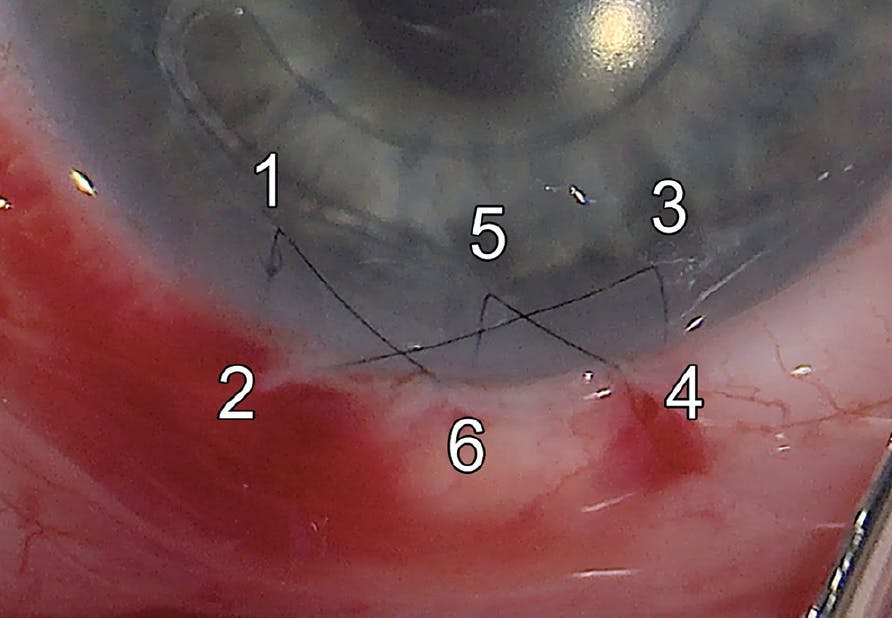
Figure 2. To create a cross-stitch pattern for large corneal wound closure, we pass a single 10-0 nylon suture from point 1 to 2, 3 to 4, and 5 to 6. We tie the loose ends (points 1 and 6) together and rotate the suture to bury the knot.
SUTURELESS INTRASCLERAL FIXATION
A bent 27- or thin-walled 30-gauge needle is used to create a scleral tunnel through which a three-piece IOL haptic is docked into the needle and then externalized.3 The technique can be modified by using trocars to create the scleral tunnel and microforceps to grasp and externalize the haptics.4-6 Cauterizing the tip of the externalized haptic to create a flange can help prevent subsequent dislocation of most three-piece IOLs.3,4 The haptic should be buried in the scleral tunnel opening, and the conjunctiva is retracted to prevent haptic exposure. In eyes that have undergone prior conjunctival surgery or have scarring, we often perform a small peritomy to expose the site of the scleral tunnel so that the conjunctiva and Tenon’s capsule can later be retracted over the haptic flange for adequate coverage.
Minimizing the manipulation of the haptics is important because breakage or kinking can lead to IOL tilt and dislocation. We have found that polyvinylidene fluoride haptics are more forgiving than PMMA haptics; thus, we almost exclusively use IOLs with polyvinylidene fluoride haptics for this technique (Video). We mark scleral tunnels 2 mm posterior to the limbus to approximate the zonular plane; however, most three-piece IOLs are 13 mm in width, placing the haptics on stretch. Caution should be taken in myopic eyes and those with a large WTW distance because tension on the haptics may be greater than in smaller eyes, which can lead to complications such as IOL dislocation or mispositioning. Scleral tunnels can be marked 14 mm apart to minimize haptic stretch, but care should be taken to avoid incising the ciliary body or angle structures.
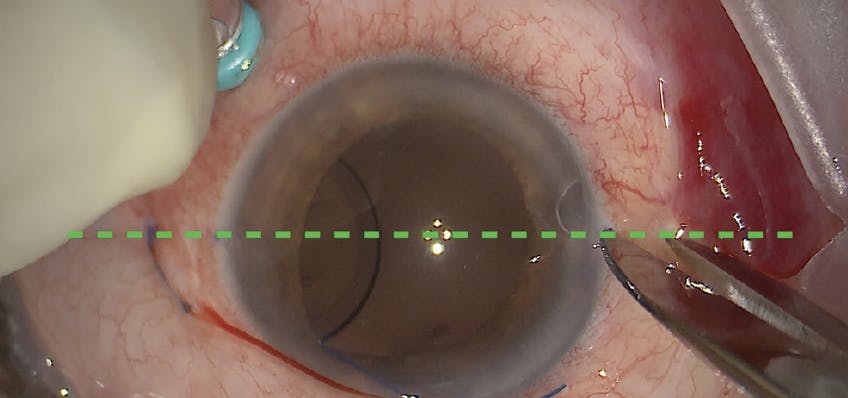
Video. Sutureless Intrascleral Fixation of a Secondary IOL: Modified Yamane Technique
If an existing three-piece IOL is being rescued, the surgeon must take care not to damage the haptics when removing residual capsule or lens material. Bringing the IOL into the anterior chamber, avoiding a 23-gauge vitrector, or employing a bimanual posterior chamber technique can help to minimize IOL damage. A large single-surgeon series using trocar-based fixation found increased rates of subsequent dislocation after the rescue of an existing IOL, suggesting that surgeons should have a low threshold for IOL exchange if there is significant manipulation of the existing IOL.4
Reverse pupillary block (RPB) is an uncommon complication that can lead to elevated IOP, iris-optic capture, IOL instability, and refractive change. The mechanism of RPB is unclear, but a flaccid iris may prevent aqueous humor flow and cause a reverse pressure gradient.7,8 In patients without an existing PI who develop RPB during the postoperative period, an outpatient laser PI can be performed to break the RPB and reestablish the proper IOP gradient (Figure 3). Patel et al demonstrated that the rate of RPB decreased from 3% to 0.4% with intraoperative PI, and they recommended performing a prophylactic PI in all cases of sutureless intrascleral fixation.4
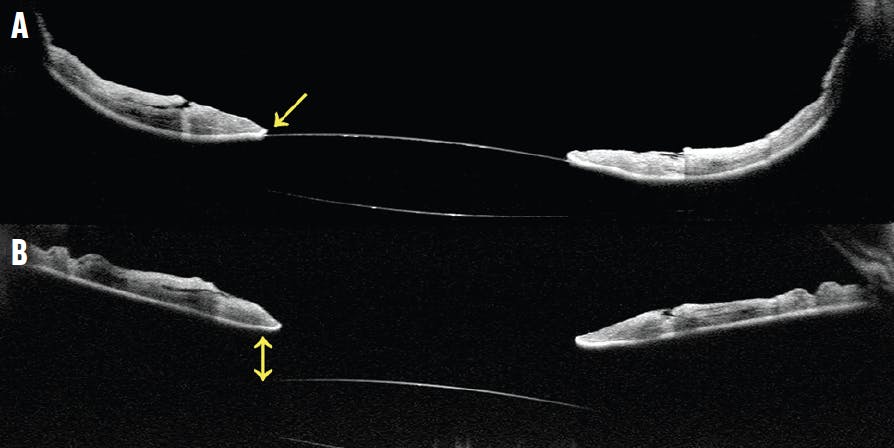
Figure 3. This patient with a sutureless intrascleral-fixated three-piece IOL presents with elevated IOP and RPB. The anterior segment OCT shows a hyperdeep anterior chamber with IOL touch (single arrow) from a posteriorly bowed iris (A). Immediately following outpatient PI, OCT imaging shows release of the IOL touch (double arrow) and flattening of the iris (B).
IOL tilt and decentration can occur with asymmetric, short, or obliquely placed scleral tunnels. When creating scleral tunnels, we use a relatively flat approach of approximately 15º to 30º from the scleral surface to ensure that the needle does not enter the eye prematurely and then advance the needle to create a tunnel that is 2 mm to 3 mm in length. Before rotating the needle completely into the eye, we gently tilt the needle to indent the sclera. If we do not see the sclera indent or buckle, we assume that the pass is too short and recreate the tunnel.
We favor externalizing a single haptic at a time so that the needles are not left unattended in the eye. Creating the main wound centrally or slightly to the left can help dock the trailing haptic. Once the first haptic has been externalized, we use the corneal light reflex to draw an imaginary line and help determine placement of the second scleral tunnel. If there is IOL tilt, it should be addressed at the time of surgery because the IOL positioning is unlikely to change significantly postoperatively. If a flange has been created, it can be trimmed to revise the haptic and scleral tunnel; however, the IOL should be exchanged if a significant amount of the haptic requires trimming.
SCLERAL SUTURE FIXATION
IOLs are scleral fixated using a polypropylene or PTFE (Gore-Tex, W.L. Gore) suture with a knot (typically), or a knotless double-flanged technique using a 5-0 polypropylene suture.9 Various IOLs with eyelets, including the CZ70BD (Alcon), Akreos AO60 (Bausch + Lomb), and enVista MX60E (Bausch + Lomb), facilitate suture fixation. We tend to use the hydrophobic acrylic MX60E with a pseudo-four-point fixation, which avoids the large incision required for the CZ70BD and the risk of opacification with gas tamponade or air during corneal surgery reported with the hydrophilic acrylic AO60.10-12
A conjunctival peritomy is performed, and paired stab incisions are made approximately 2 mm posterior to the limbus and 2 mm to 3 mm apart. The sclerotomy sites must be symmetrically placed to avoid IOL tilt. Although a 20-gauge microvitreoretinal blade can be used to create the stab incisions, smaller-gauge incisions such as those made with the trocar inserter blade may reduce the risk of postoperative transient hypotony. Larger sclerotomies can be closed using a dissolvable suture, but care must be taken to avoid cutting the fixation suture.
We prefer to use a 7-0 Gore-Tex suture because we find it causes minimal inflammation and has excellent tensile strength, minimal memory, and high visibility. Slipknots should be employed to help titrate the knot tension; overtightening the sutures can result in complications such as eyelet fracture.13 To minimize the risk of suture erosion through the conjunctiva, we make a partial-thickness, one-third depth scleral groove between the adjacent sclerotomies so that the suture can rest flush against the sclera. Care should be taken to rotate the knot into the eye to avoid conjunctival erosion.
For the MX60E, we pass the sutures through the eyelets externally, and we sometimes mark the Gore-Tex sutures to assist with orientation (Figure 4). The sutures are then passed through the corresponding sclerotomies, and the IOL is manually folded and delivered into the eye. Flipping the suture orientation during surgery can result in significant IOL tilt and subsequent iris chafing. We trim the haptics to avoid entanglement of the sutures during surgery and minimize the risk of iris chafing if there is mild IOL tilt.
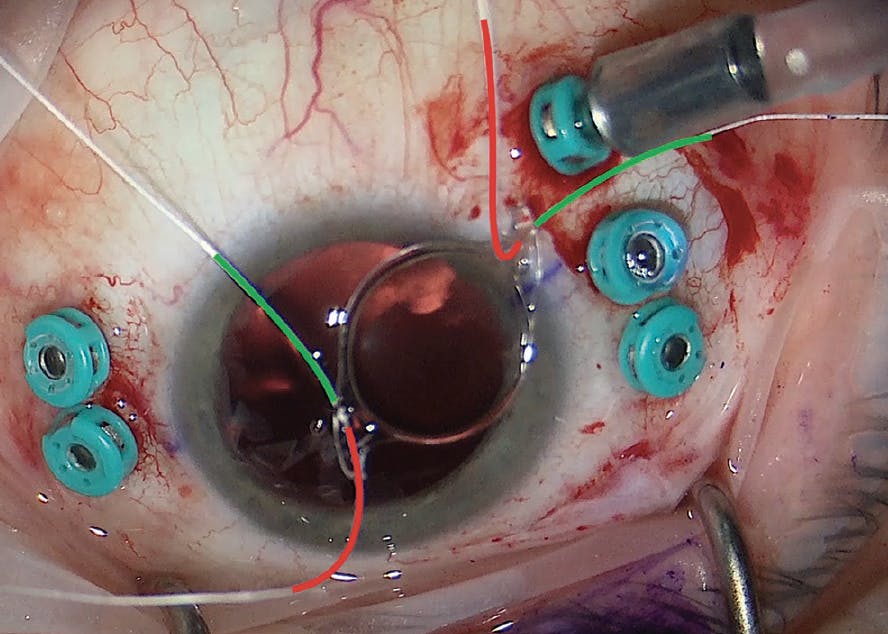
Figure 4. During this Gore-Tex suture fixation of an MX60E IOL, the haptics are trimmed, and the Gore-Tex suture is passed through each eyelet in opposite orientation to allow a pseudo-four-point fixation. The red lines denote the sutures anterior to the IOL, and the green lines denote sutures posterior to the IOL.
IRIS FIXATION
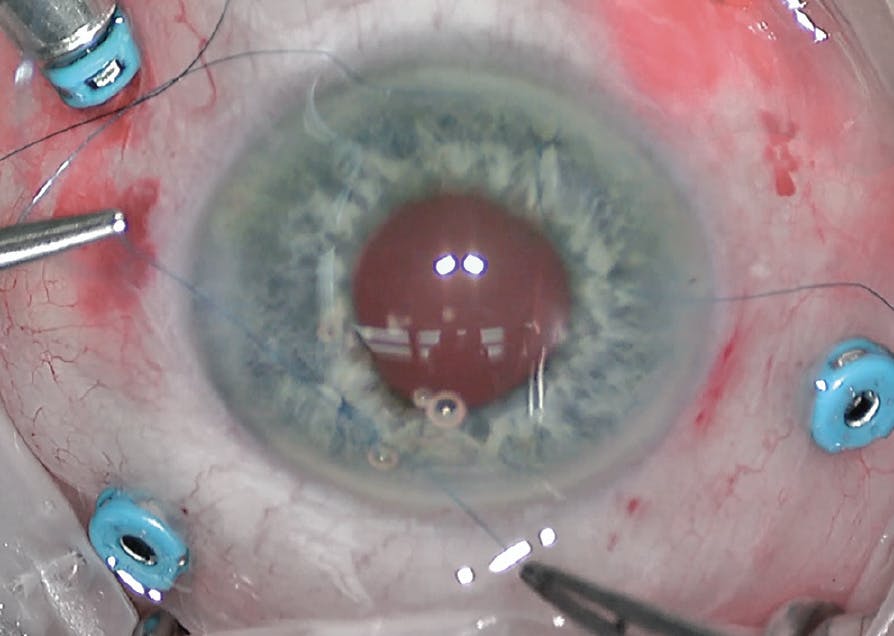
In patients with some capsular support but who are at risk of IOL decentration or dislocation due to capsular defects, we often opt to place a three-piece IOL in the sulcus and use 10-0 polypropylene sutures for iris fixation (Figure 5). Before suturing, we capture the IOL optic and leave the haptics in the sulcus space. This maneuver helps to stabilize the IOL while the haptics slightly indent the iris and allow visualization for suture placement. We use a Siepser sliding knot to secure the haptics to the midperipheral or peripheral iris and use microforceps to pull the pupil centrally to mitigate any corectopia before locking the knot. Once the knot has been locked, correcting an ovoid pupil without cutting the knots can become difficult.
CHOOSING THE RIGHT TECHNIQUE
There is no consensus on which secondary IOL technique is superior.1 Interest in scleral-fixated IOLs is growing, but studies have demonstrated a comparable safety profile, including a similar rate of corneal decompensation between ACIOL and posterior-fixation techniques.1,14,15
In older patients and those who require a large incision to remove rigid implants, we often select an ACIOL. In younger patients, those with anterior segment pathology, and those who do not require large sclerocorneal incisions, we prefer an acrylic lens with scleral fixation that can be performed using minimally invasive techniques. In patients with myopia and those with large WTW distances, we tend to avoid sutureless intrascleral fixation because the IOL haptics are on greater stretch than in smaller eyes; instead, we opt for Gore-Tex suture fixation or an ACIOL. In patients with partial capsular support, we prefer to place the lens within the ciliary sulcus with iris fixation.
Our choice of technique depends on multiple factors, and surgeons should perform the procedure with which they are the most comfortable.
Disclaimer: The use of implants and techniques, including Gore-Tex sutures, described in this article are off-label and not approved by the US FDA.
1. Shen JF, Deng S, Hammersmith KM, et al. Intraocular lens implantation in the absence of zonular support: an outcomes and safety update: a report by the American Academy of Ophthalmology. Ophthalmology. 2020;127(9):1234-1258.
2. Belkin A, Ofir S, Kleinmann G, et al. Iris fixation of unstable anterior chamber intraocular lenses. Cornea. 2015;34(12):1573-156.
3. Yamane S, Sato S, Maruyama-Inoue M, Kadonosono K. Flanged intrascleral intraocular lens fixation with double-needle technique. Ophthalmology. 2017;124(8):1136-1142.
4. Patel KG, Yazdani A, Abbey AM. Twenty-five and twenty-seven-gauge sutureless intrascleral fixation of intraocular lenses: clinical outcomes and comparative effectiveness of haptic flanging in a large single-surgeon series of 488 eyes. Retina. 2021;41(12):2485-2490.
5. Prasad S. Transconjunctival sutureless haptic fixation of posterior chamber IOL: a minimally traumatic approach for IOL rescue or secondary implantation. Retina. 2013;33(3):657-660.
6. Prenner JL, Feiner L, Wheatley HM, Connors D. A novel approach for posterior chamber intraocular lens placement or rescue via a sutureless scleral fixation technique. Retina. 2012;32(4):853-855.
7. Bang SP, Joo CK, Jun JH. Reverse pupillary block after implantation of a scleral-sutured posterior chamber intraocular lens: a retrospective, open study. BMC Ophthalmol. 2017;17(1):35.
8. Higashide T, Shimizu F, Nishimura A, Sugiyama K. Anterior segment optical coherence tomography findings of reverse pupillary block after scleral-fixated sutured posterior chamber intraocular lens implantation. J Cataract Refract Surg. 2009;35(9):1540-1547.
9. Canabrava S, Canêdo Domingos Lima AC, Ribeiro G. Four-flanged intrascleral intraocular lens fixation technique: no flaps, no knots, no glue. Cornea. 2020;39(4):527-528.
10. Belin PJ, Kim JH, Sheikh A, et al. Incidence and risk of scleral-fixated Akreos (AO60) lens opacification: a case series. J VitreoRet Dis. 2021;5(2):157-162.
11. Kalevar A, Dollin M, Gupta RR. Opacification of scleral-sutured Akreos AO60 intraocular lens after vitrectomy with gas tamponade: case series. Retin Cases Brief Rep. 2020;14(2):174-177.
12. Morgan-Warren PJ, Andreatta W, Patel AK. Opacification of hydrophilic intraocular lenses after Descemet stripping automated endothelial keratoplasty. Clin Ophthalmol. 2015;9:277-283.
13. Watane A, Botsford BW, Sood AB, et al. Scleral-sutured intraocular lens dislocations secondary to eyelet fractures. Am J Ophthalmol. 2021;221:273-278.
14. Chan TC, Lam JK, Jhanji V, Li EY. Comparison of outcomes of primary anterior chamber versus secondary scleral-fixated intraocular lens implantation in complicated cataract surgeries. Am J Ophthalmol. 2015;159(2):221-226.e2.
15. Kwong YY, Yuen HK, Lam RF, et al. Comparison of outcomes of primary scleral-fixated versus primary anterior chamber intraocular lens implantation in complicated cataract surgeries. Ophthalmology. 2007;114(1):80-85.

_1784132761.jpg?auto=compress,format&w=75)




