


AT A GLANCE
- In a healthy patient, a vitreous hemorrhage that was caused by an acute event, not a continuous process, may clear over time without intervention.
- RDs and retinal tears are, arguably, the most concerning cause of spontaneous vitreous hemorrhage because of the increased risk of permanent visual loss if not treated appropriately and in a timely manner.
- If a young, phakic myope with no history of diabetes presents with a fundus-obscuring vitreous hemorrhage, clinicians should have a low threshold to perform early vitrectomy.
We have all had this patient: phakic with a spontaneous dense vitreous hemorrhage in one eye. Vitreous hemorrhage is a relatively common problem, affecting an estimated seven cases per 100,000 per year—for reference, retinal detachment (RD) has an incidence of 12 cases per 100,000 per year.1
The first question is always, “do you have diabetes?” If the answer is “no,” your day just got a little longer. The list of possible underlying causes for vitreous hemorrhage is long and includes everything from retinal vascular disease, retinal tears and detachments, retinal vasculitis, retinal macroaneurysm, polypoidal disease, posterior vitreous detachment (PVD), and tumors (Figure 1).
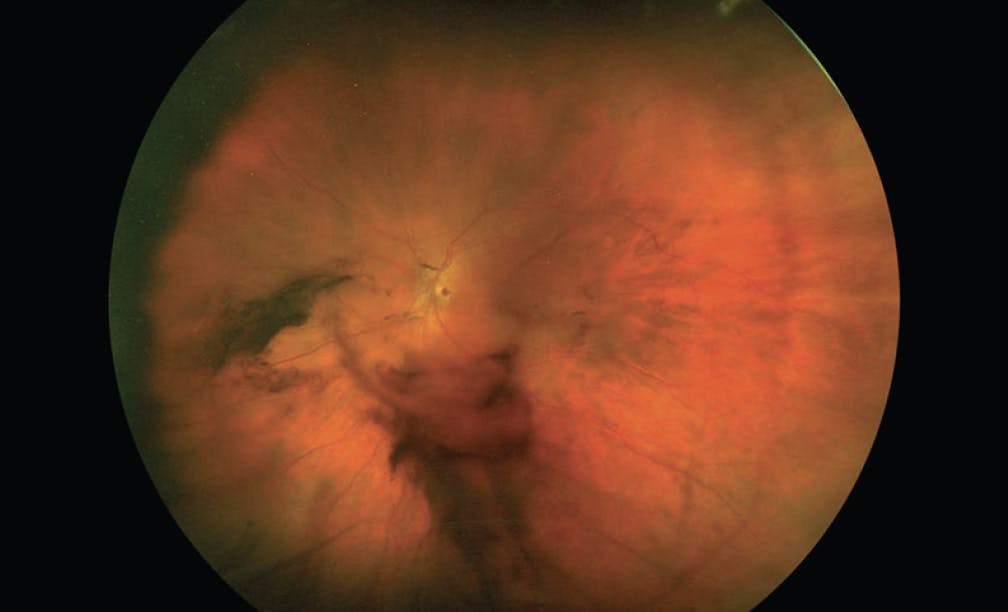
RDs and retinal tears are, arguably, the most concerning cause of spontaneous vitreous hemorrhage because of the increased risk of permanent visual loss if not treated appropriately and in a timely manner. For one, vitreous hemorrhage due to a retinal tear and/or RD comes with an increased risk of developing proliferative vitreoretinopathy (PVR), which decreases a patient’s chances of long-term anatomic success.2
One study of 441,517 eyes found that 2.37% presented with a delayed retinal break after the initial PVD with a median time of 38 (range 1 to 365) days. Most importantly, individuals with vitreous hemorrhage, lattice degeneration, and myopia were at a higher risk of developing delayed breaks than those who did not present with these findings.3
To prevent vision loss, clinicians must identify and treat RDs and tears that often accompany a spontaneous vitreous hemorrhage. The problem is that the hemorrhage often obscures the surgeon’s view of the retina, potentially hiding the causative pathology.
While B-scan ultrasonography is an important part of your workup for these patients, it’s not always the most sensitive tool (Figure 2). For example, shallow RDs and small or very posterior tears can be hard to locate on a B-scan, with a sensitivity in the range of 44% to 56%.4,5
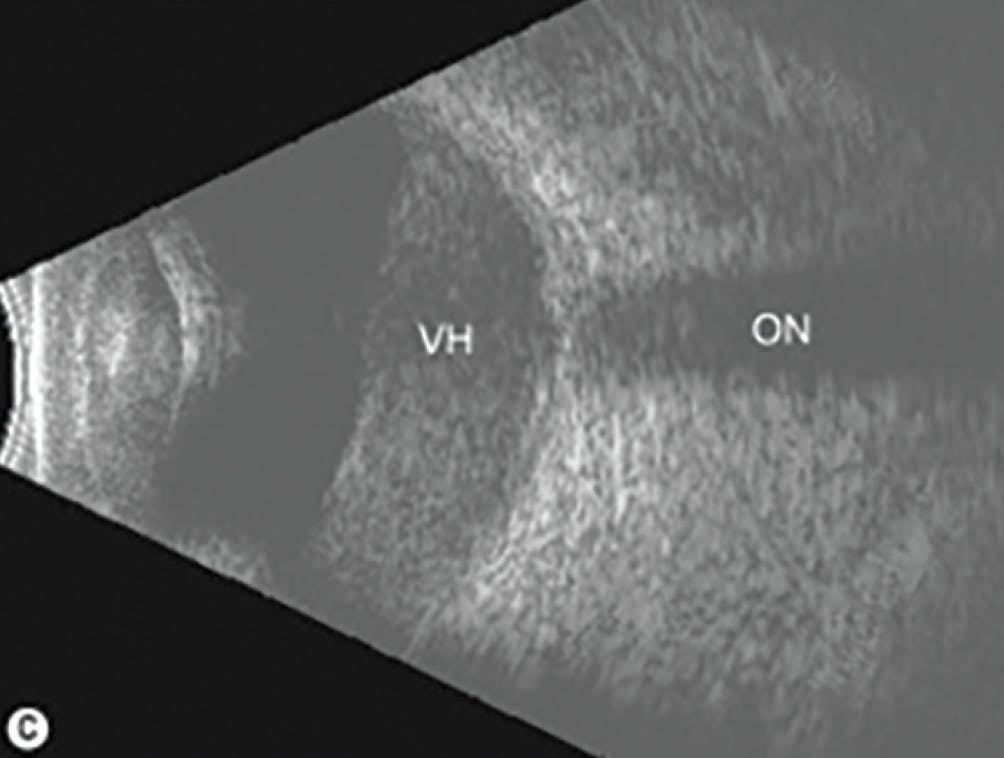
Figure 2. A B-scan demonstrating a dense vitreous hemorrhage overlying the macula (VH = vitreous hemorrhage, ON = optic nerve).
When faced with a non-diabetic vitreous hemorrhage that is obscuring your view (and the patient’s), you have two management avenues to consider: observe and follow closely to see if the hemorrhage dissipates or take the patient to the OR. Here, we discuss the pros and cons of each approach.
WAIT IT OUT
In a healthy patient, a hemorrhage that was caused by an acute event, not a continuous process, can clear over time, requiring only close observation. It may take anywhere from a few weeks to several months, but it could resolve on its own. This may be a reasonable approach, particularly if the patient is high-risk for complications from general anesthesia or if the clinician suspects a peripheral exudative hemorrhagic chorioretinopathy type lesion or a retinal artery macroaneurysm.
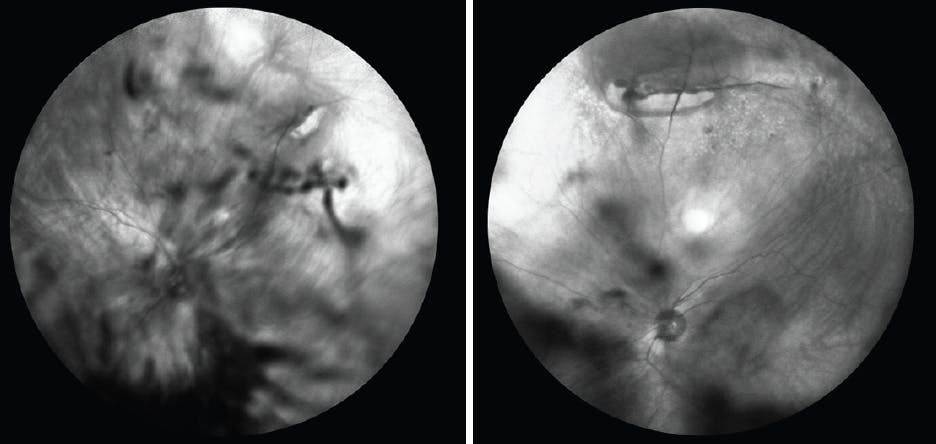
Nonetheless, waiting for the hemorrhage to clear comes with a concern that the hemorrhage is obscuring a complication that requires surgical intervention, particularly in the retinal periphery (Figure 3).
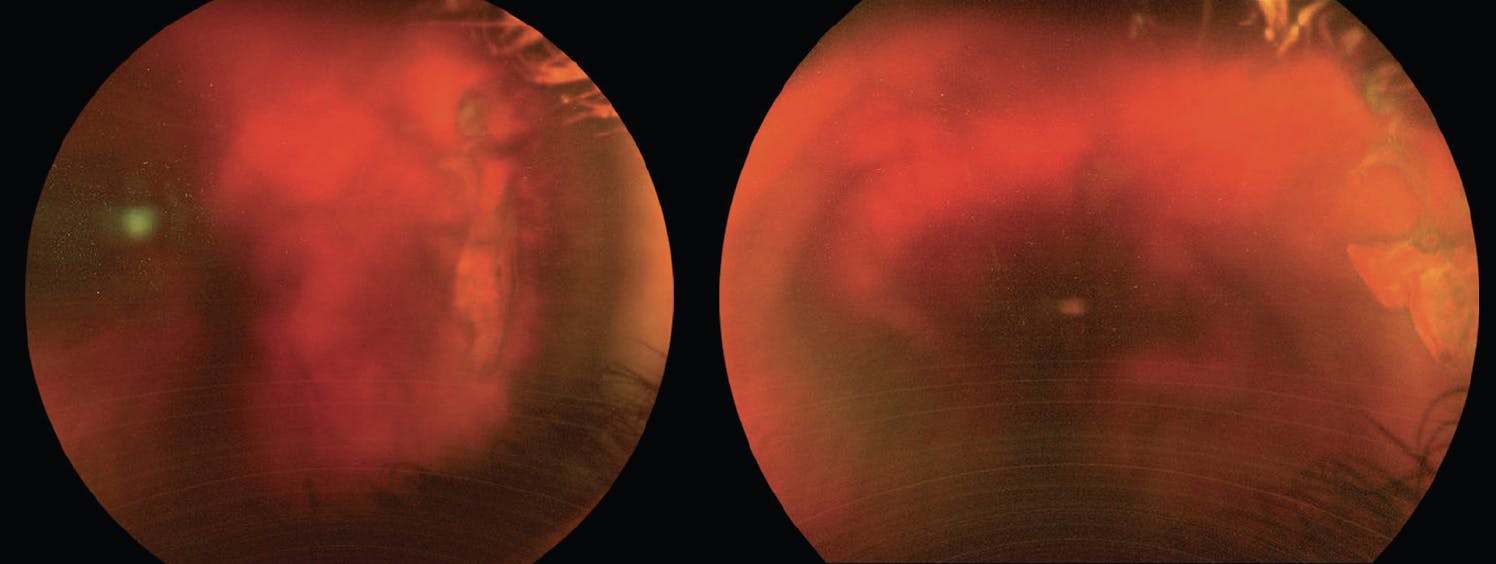
One study of 36 eyes with fundus-obscuring, unexplained vitreous hemorrhage looked into the outcomes of conservative management (regular follow-up and B-scan ultrasound) and found that, although no RDs were identified on the initial B-scan, 78% of cases required surgery to repair an RD identified on follow-up or to resolve a non-clearing vitreous hemorrhage.6 In addition, the researchers noted that a retinal tear was the cause of the hemorrhage in 76% of the patients younger than 80 years of age.6
Other researchers reported a 9-year series of RDs in patients with vitreous hemorrhage and found that 33% of eyes with fundus-obscuring vitreous hemorrhage developed an RD that was subsequently complicated by PVR.7
DON’T FEAR THE OR
The second treatment approach is early vitrectomy, an option that has become more appealing with recent advances in technology. Surgeons are now routinely performing 25- and 27-gauge vitrectomy that offers smaller incisions and minimal recovery time for the patient. Surgical intervention can clear the hemorrhage and provide the surgeon with the necessary visualization to properly rule out retinal tears and detachments—or address them intraoperatively if they are present.
The research is mounting in favor of early vitrectomy, although few randomized clinical trials have directly compared data on early versus delayed vitrectomy for fundus-obscuring vitreous hemorrhage. Tan et al looked at 40 eyes that underwent early vitrectomy for unexplained vitreous hemorrhage and found that 47% of eyes that showed no signs of a retinal tear on preoperative ultrasound had a tear intraoperatively—44% of which had multiple tears.8 In another series of 12 eyes that had undergone early vitrectomy for fundus-obscuring vitreous hemorrhage, only three eyes had an identifiable RD on preoperative ultrasound. Intraoperatively, nine eyes had a retinal tear (75%).
Our team sought to better understand the surgical and visual outcomes for adult patients with non-diabetic, fundus-obscuring vitreous hemorrhage undergoing either early (within 10 days of symptom onset) or delayed (after 10 days) surgery.9 We reviewed 275 patients who underwent surgery for vitreous hemorrhage over a 5-year period and included 52 eyes of 52 patients with an average age of 61 years. All patients underwent preoperative ultrasound, and the timing of the surgical intervention was at the clinician’s discretion. Eyes with a high suspicion for a retinal tear or RD on ultrasound underwent urgent vitrectomy and were excluded from the study.
IMAGING PEARLS
B-scan ultrasonography is the tool of choice when imaging dense vitreous hemorrhages, but it’s not perfect. In our study, ultrasound sensitivity was 24.3% for retinal tears and 62.5% for retinal detachments (RDs), which is quite low.9 Ultrasonography requires a skilled technician or physician, and without skilled ultrasonographers, pathology can easily be missed. Other imaging tools with some clinical utility include the following:
- OCT – Depending on the density of the hemorrhage, OCT may help clinicians confirm if the macula is attached or any obvious pathology that might inform the management decision.
- Fluorescein angiography – This may be useful, but the view may be just as limited as it is for ultrasound, and its invasiveness makes it less ideal.
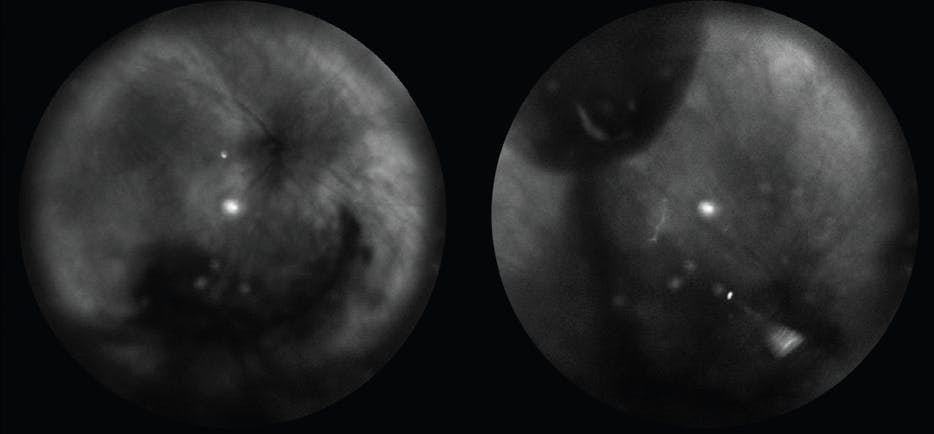
- Infrared imaging – This may be helpful when attempting to differentiate an RD from retinoschisis. RDs will appear dark and hyporeflective on infrared (Figure 1). Retinal tears with be hyperreflective, and retinoschsis appears isointense (Figure 2).
We found that, intraoperatively, 48% of study eyes had a retinal tear, and 24% had an RD. Preoperative VA was 20/400 and 20/200 in the early and delayed vitrectomy groups, respectively. Postoperatively, VA was 20/66 and 20/89, respectively. The results show no statically significant difference in visual outcomes between the early and later groups, although the mean number of operations was greater in the delayed group (1.1 versus 1.5). All the patients found to have a retinal tear or RD were younger than 80 years of age.9
Most importantly, we found that younger phakic patients presenting with a vitreous hemorrhage were more likely to have a retinal tear or RD compared with pseudophakic patients, with an increased odds ratio of 2.14.9
VITRECTOMY TIPS
Surgery for vitreous hemorrhage is always interesting because surgeons aren’t certain what is lying beneath the blood. In these patients, surgeons are mostly concerned with damaging the retina and causing iatrogenic breaks. Here are our tips for a successful surgery:
- Stay near the ports.
- If you can, try to start superonasally, unless there’s an obvious detachment or other concerns were obvious on the B-scan.
- Start slowly and ease your way in.
- Slowly make your way inward as you improve your view.
- Be sure you can always see the cutter, and keep the port facing up toward you until your view clears.
THE BOTTOM LINE
If a young, phakic, high myope with no diabetes presents with a fundus-obscuring vitreous hemorrhage, clinicians should have a low threshold to take them to the OR early. In fact, because of the high rate of tears and RDs identified intraoperatively, clinicians should consider early vitrectomy for most patients with non-diabetic vitreous hemorrhage.
Although conservative treatment may be appropriate for certain patients, poor visual outcomes are possible due to missed retinal tears, RD, and subsequent PVR, which leads to increased patient morbidity.
1. Lindgren G, Sjödell L, Lindblom B. A prospective study of dense spontaneous vitreous hemorrhage. Am J Ophthalmol. 1995;119(4):458-465.
2. Dhingra N, Pearce I, Wong D. Early vitrectomy for fundus-obscuring dense vitreous haemorrhage from presumptive retinal tears. Graefes Arch Clin Exp Ophthalmol. 2007;245(2):301-304.
3. Zhang T, Zhang J, Sun X, Tian J, Shi W, Yuan G. Early vitrectomy for dense vitreous hemorrhage in adults with non-traumatic and non-diabetic retinopathy. J Int Med Res. 2017;45(6):2065-2071.
4. Vangipuram G, et al. Timing of delayed retinal break in patients presenting with acute posterior vitreous detachment in the IRIS Registry. Presented at AAO 2021; New Orleans; November 12-15.
5. Sarrafizadeh R, Hassan TS, Ruby AJ, et al. Incidence of retinal detachment and visual outcome in eyes presenting with posterior vitreous separation and dense fundus-obscuring vitreous hemorrhage. Ophthalmology. 2001;108(12):2273-2278.
6. Yeung L, Liu L, Wu WC. Reducing the incidence of early postoperative vitreous haemorrhage by preoperative intravitreal bevacizumab in vitrectomy for diabetic tractional retinal detachment. Acta Ophthalmol. 2010;88(6):635-640.
7. Tan HS, Mura M, Bijl HM. Early vitrectomy for vitreous hemorrhage associated with retinal tears. Am J Ophthalmol. 2010;150(4):529-533.
8. Nagasaki H, Shinagawa K, Mochizuki M. Risk factors for proliferative vitreoretinopathy. Prog Retin Eye Res. 1998;17(1):77-98.
9. Connors D, Shah G, Blinder K, Dang S. Early versus delayed vitrectomy for nondiabetic vitreous hemorrhage. J VitreoRetinal Dis. 2018;2(2):87-90.

_1784132761.jpg?auto=compress,format&w=75)





