


Prepapillary vascular loop is a congenital retinal anomaly of either the arterial or the venous system.1 The embryonic origin of this condition is uncertain but is believed to be derived from the 100-mm stage of mesenchymal cells that originate in the papilla to vascularize the retina. These vessels project from the optic disc into the vitreous cavity and then return to vascularize the retina with no connection to the hyaloid artery.2 It is usually an asymptomatic, unilateral finding detected on routine examination, but 9% to 17% of cases are bilateral.3
The incidence of prepapillary vascular loop is approximately 1 in 9,000 patients. Symptoms can include sudden vision loss, vitreous hemorrhage, amaurosis fugax episodes, and/or scotoma associated with branch retinal artery occlusion (BRAO).3,4
Here we discuss the case of a patient who presented with a sudden scotoma in the upper visual field. An inferior BRAO was detected that was associated with a prepapillary vascular loop.
CASE REPORT
A healthy 37-year-old woman presented to the clinic complaining of sudden scotoma in her upper visual field for the last 24 hours. The patient denied any significant medical, surgical, or family history and reported no smoking, use of oral contraceptives, or trauma. An ophthalmic examination revealed a BCVA of 20/30 OU with no significant refractive error. The anterior segment examination of each eye was unremarkable, and IOP was 15 mm Hg OU.
Dilated fundoscopy of the left eye was normal. The right eye showed a type IV prepapillary vascular loop on ultra-widefield photography, according to the Mansour et al classification of the inferior retinal branch artery (Figure 1).5 Ultra-widefield fundus autofluorescence of the right eye revealed an area of inferior parapapillary hypoautofluorescence corresponding to the area of increased retinal edema, along with another, smaller area of hypoautofluorescence corresponding to a parapapillary hemorrhage (Figure 2).
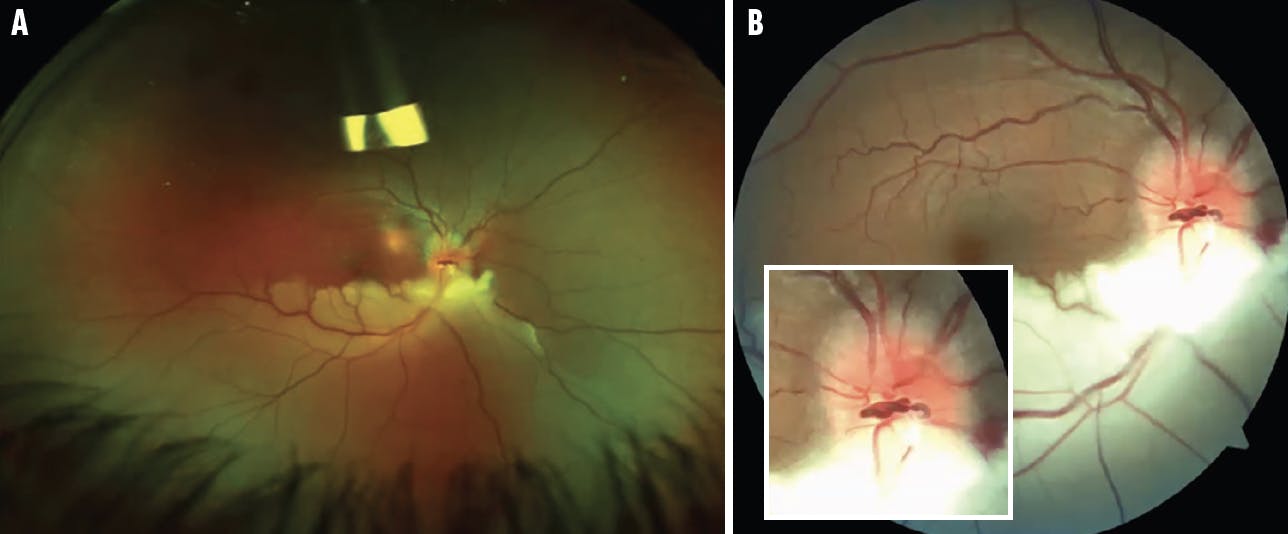
Figure 1. Ultra-widefield photography of the right eye showed an optic disc with blurred borders, a prepapillary vascular loop, and significant pallor due to edema of the inner layers of the macula and inferior retina that respects the fovea (A). A 45° photograph highlights the retinal pallor and fovea (B).
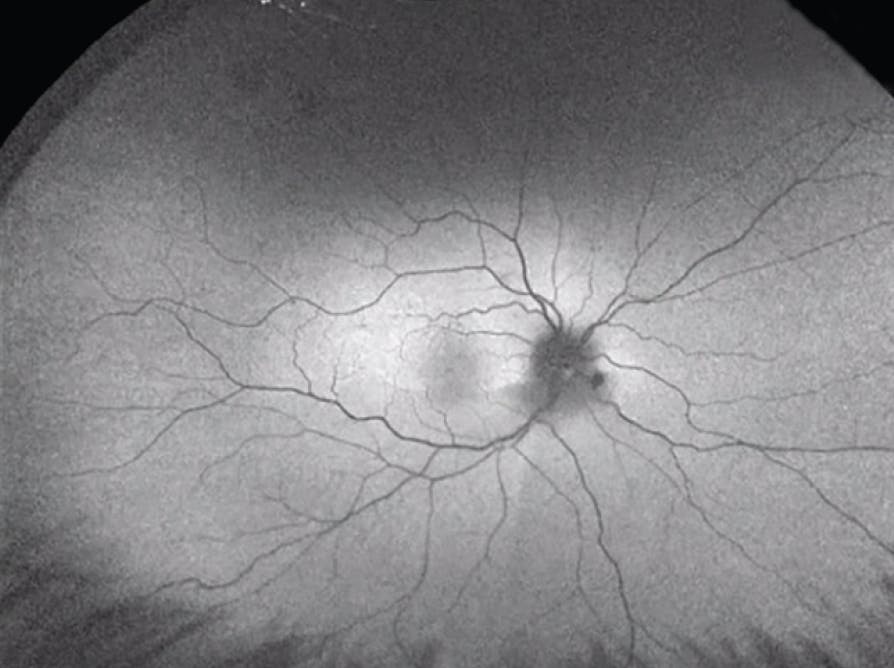
Figure 2. Ultra-widefield fundus autofluorescence showed hypoautofluorescence corresponding to the area of increased retinal edema and a smaller area of hypoautofluorescence corresponding to a parapapillary hemorrhage.
Fluorescein angiography revealed hypofluorescence due to the absence of filling of the vascular prepapillary loop and inferior temporal artery (Figure 3). Macular OCT showed hyperreflectivity of the internal retinal layers in the area of the inferior macula due to edema secondary to ischemia (Figure 4).
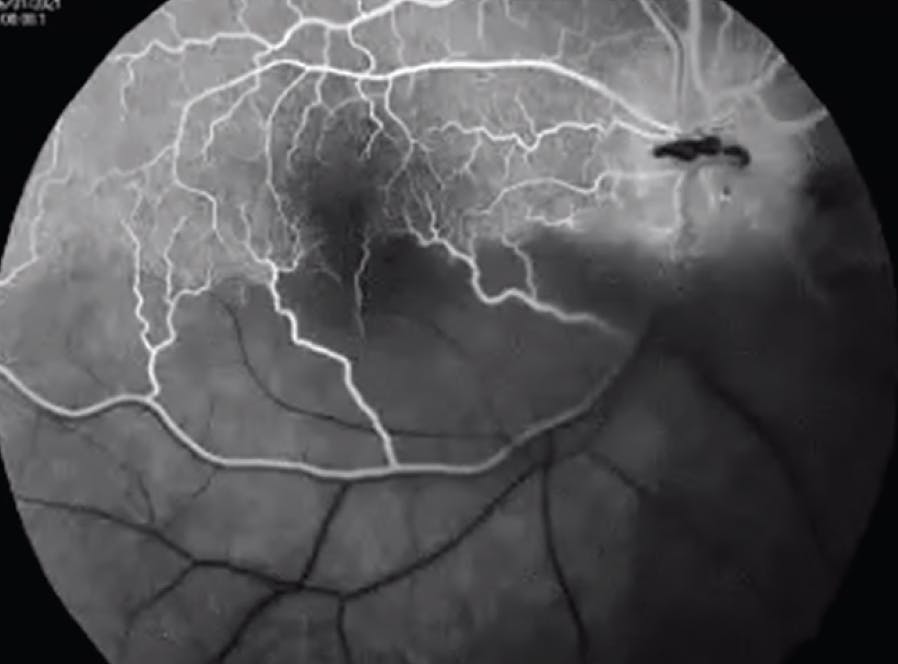
Figure 3. Fluorescein angiography of the arteriovenous phase showed filling of the superior arteries and hypofluorescence due to the absence of filling of the vascular loop and inferior arteries.
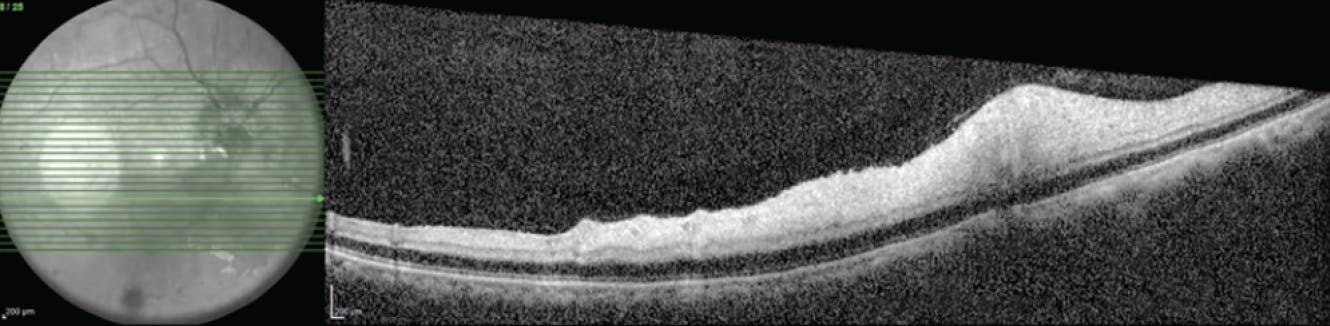
Figure 4. OCT showed hyperreflectivity of the internal layers in the area of the inferior macula due to edema secondary to ischemia that does not allow for delimitation of the cellular layers.
FURTHER TESTING
Given the young age at presentation with no relevant history, systemic testing was performed, including a complete blood count, basic metabolic panel, c-reactive protein, erythrocyte sedimentation rate, HIV serologic test, venereal disease research laboratory, fluorescent treponemal antibody-absorption, purified protein derivative, antinuclear antibodies, and antiphospholipid antibodies—all of which came back negative or within normal range. A cardiology referral was also made to help rule out a systemic condition, which showed normal results.
A diagnosis of BRAO associated with a prepapillary vascular loop was made with a recommendation to monitor the patient without further treatment due to adequate visual acuity. Fundus photography showed changes during the 3-month follow-up period, including reperfusion of the inferior temporal area and uncoiling of the vascular loop (Figure 5). BCVA remained 20/30 OU.
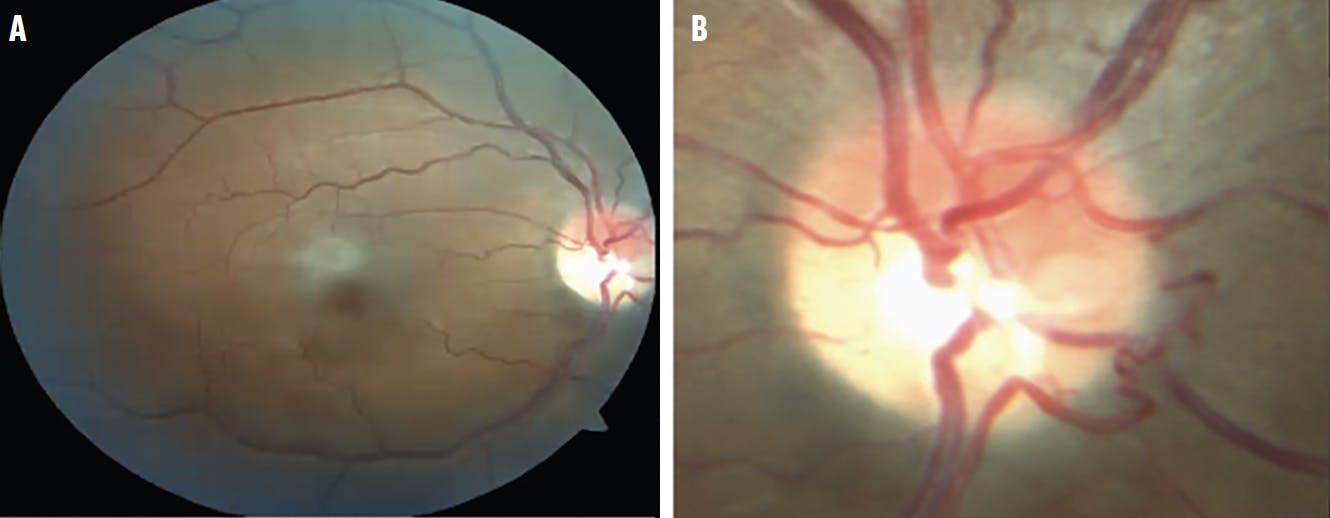
Figure 5. After 3 months of follow-up, the fundus photographs show reperfusion of the inferior temporal area (A) and uncoiling of the vascular loop, as well as some degree of reperfusion of the affected lower vessel (B).
MECHANISM OF OCCLUSION
BRAO secondary to a prepapillary vascular loop has an incidence of 4%,2 occurring most frequently in the lower vessels. Several mechanisms have been described to explain the development of occlusion in certain patients, including loop twisting, thrombosis, vitreous traction, trauma, or a combination of these factors.6 However, the most widely accepted theory is that hemodynamic turbulence within the vascular loop produces mechanical endothelial damage, resulting in the formation of an intraarterial clot and ultimately leading to an arterial or vein occlusion.7 Over time, the absence of blood flow leads to the collapse of the arterial walls, and the vascular loop is replaced by glial tissue.
BE WARY OF COMPLICATIONS
In the present case, the vascular loop disappeared over time. Although the exact mechanism of BRAO and uncoiling of the prepapillary vascular loop remains unclear, careful observation and monitoring of patients with a prepapillary vascular loop is crucial due to the potential for serious complications, such as vitreous hemorrhage, BRAO, and macroaneurysm rupture. It is also important to perform thorough testing in young patients to rule out systemic conditions associated with BRAO.
1. Leibreich R. Demonstration of disease of the eye: persistent hyaloid artery and vein. Trans Pathol Soc London. 2022;22:221-224.
2. Brown GC, Magargal L, Augsburger JJ, Shields JA. Preretinal arterial loops and retinal arterial occlusion. Am J Ophthalmol. 1979;8(5):646-651.
3. Degenhart W, Brown GC, Augsburger JJ, Magargal L. Prepapillary vascular loops. Ophthalmology. 1981;88(11):1126-1131.
4. Romano PE. Prepapillary vascular loops. Clin Exp Ophthalmol. 2001;29(2):90-91.
5. Mansour AM. Prepapillary vascular loop-a new classification. Eye (Lond). 2021;35(2):425-432.
6. Zermeno-Arce AJ, Ledesma-Gil G, Moreno-Mendoza R, Graue-Wiechers F. Arterial occlusion associated with a prepapillary vascular loop. Anatomical changes on the long term follow up. Arch Soc Esp Oftalmol (Engl Ed). 2019;94(8):405-408.
7. Bonneric JG, Boissonnot M, Rovira JC, Dighiero P. Prepapillary arterial loop and retinal arterial branch occlusion. J Fr Ophtalmol. 2007;30(3):e8.


_1784132761.jpg?auto=compress,format&w=75)




