


AT A GLANCE
- The authors found a high rate (between 20% and 25%) of uveitis in patients diagnosed with Ebola virus disease in Liberia.
- Limited patient access to trained care providers, supplies, and diagnostic technology hamper clinicians’ ability to properly diagnose the early stages of uveitis in patients in West Africa.
- Although research infrastructure has improved the region’s subspecialty service delivery, remaining challenges include patient-level and health system constraints that require strengthening.
Uveitis is a common eye condition in West Africa that can lead to blinding complications if not promptly diagnosed and effectively treated. Studies in Sierra Leone have shown that, after cataract, uveitis is the major cause of blindness.1 While the association with infectious disease (eg, toxoplasmosis, syphilis, varicella zoster, and herpes simplex) predominated in prior epidemiologic studies in Sierra Leone, the widespread availability of laboratory diagnostics to ascertain these diagnoses was limited.2
More recently, our research group and others have assessed the spectrum of uveitis in Ebola virus disease (EVD) survivors in Sierra Leone and Liberia. The high rate of uveitis—between 18% and 34%—suggests the potential effect of uveitis in EVD survivors.3-6 Importantly, a closer look at uveitis in EVD survivors and further examination of patient populations revealed broader areas of unmet need in education and awareness of uveitis and its complications for eye care personnel and the general medical community.
SCREENING AND CARE DELIVERY
Because of limited access to ophthalmologists and eye care professionals in Sierra Leone and many other West African countries, most patients are initially screened at a community level by ophthalmic nurses. Limited equipment may preclude the ability to assess very subtle eye conditions, including the early stages of uveitis. For example, the equipment may be limited to a vision chart, penlight, and a direct ophthalmoscope. While these tools can effectively diagnose dense white cataractous lenses, posterior synechiae, pupillary membranes, and corneal scarring, they may not allow the diagnosis of early stages of uveitis with findings such as anterior chamber cell/flare and anterior vitreous cell.
Combined with the high volume of patients in screening programs and limited equipment availability in some community based settings, the clinician’s ability to properly diagnose the early stages of uveitis may be hampered. Most patients present only when complications of uveitis have commenced, such as severe pain, redness, photophobia, or vision impairment that may be challenging to reverse. In developing countries, such as Sierra Leone, the importance of careful clinical assessment cannot be overestimated.
Despite these ongoing limitations, progress has been made through increased education and a more robust understanding of uveitis because of clinical experience with toxoplasmosis, EVD, and HIV-associated infectious diseases. In Sierra Leone in particular, the use of advanced ophthalmic imaging, such as ultra-widefield fundus photography and OCT, has allowed clinicians to more objectively document uveitis and retinal disease in patients with ocular inflammation. Additional resources through Ministry of Health and Sanitation (MOHS) laboratories, including Quantiferon-TB Gold testing, have also improved eye care providers’ ability to detect latent tuberculosis, which can also be associated with uveitis.
LESSONS FROM EBOLA
During the West African EVD outbreak from 2014 to 2016, our research group and others evaluated patients with EVD in Liberia and Sierra Leone, in collaboration with MOHS ophthalmologists and nongovernmental organizations. We found that 20% to 25% of EVD survivors in Liberia had uveitis.3 Moreover, the PREVAIL III study, an NIH-funded study that evaluated EVD survivors compared with close contacts, showed that while EVD survivors showed a high prevalence of uveitis (26%), close contact patients also showed a high prevalence of uveitis at 12%.4 These results from Liberia indicate a high baseline prevalence of ocular inflammation that warrants further assessment. EVD-associated uveitis is particularly vision-threatening. Specifically, more than 60% of eyes demonstrated vision impairment and nearly 40% met World Health Organization criteria for blindness (ie, VA of 20/400 or worse) at the time of uveitis diagnosis during EVD convalescence.3
We also observed gaps in clinical infrastructure, ophthalmic imaging, uveitis subspecialty training, and consumable items (eg, clinic supplies and ophthalmic medications). In total, these gaps made the diagnosis and management of complex uveitis syndromes particularly difficult. While discovering the association between uveitis and EVD was critical to the field’s understanding of EVD survivorship and the risk of vision impairment from uveitis, vision health systems must be equipped to care for uveitis and its sequelae.
ETIOLOGIES AND ONGOING NEEDS
More recently, our collaborative group conducted a cross-sectional epidemiology uveitis study.7 The study of 132 patients with uveitis in Sierra Leone showed that panuveitis was the predominant anatomic location (n = 51, 40%), followed by posterior uveitis (n = 36, 28%). Most patients (59%) were considered to have active uveitis at their initial presentation, and 40 patients (31%) showed bilateral disease. Of note, the mean VA of eyes affected with uveitis was 6/60 (Snellen VA of 20/200), and blindness (defined as VA of 3/60 or worse) was observed in 55 eyes (33%) with uveitis. Based on clinical assessment and laboratory services available in Sierra Leone, undifferentiated etiologies comprised most cases (n = 69, 53%), and toxoplasmosis was observed in a significant minority of patients (n = 47, 37%), while traumatic uveitis was also notable (n = 7, 5%). Based on these high levels of vision impairment, further research into the reasons for delayed presentation, etiologies of uveitis, and associated systemic diseases are warranted.7
TREATMENT PARADIGMS
Given the high rate of toxoplasmosis in the recent observational study and prior epidemiology work, initiation of antitoxoplasmosis therapy based on a clinical impression and provisional diagnosis is often the first treatment approach. Given the high rate of vision impairment at presentation, secondary complications, such as posterior synechiae, cataract, and vitreous opacity, often have already developed. Empiric treatment for toxoplasmosis includes cotrimoxazole tablets and pyrimethamine tablets, which are the most common and affordable medications. However, pyrimethamine has been used more recently for malaria prophylaxis and is now becoming difficult to acquire.
To complicate treatment further, patients often defer laboratory testing and radiologic imaging when these services are available on a fee-for-service basis because of the high prevalence of poverty. However, HIV serology is offered free of charge in most government hospital laboratories, and this is routinely requested for all our patients with uveitis of unknown etiology. The Treponema pallidum hemagglutinin test is also affordable and available for patients with uveitis, and blood glucose is checked, particularly for patients who require systemic corticosteroids.
For patients with presumed uveitis of noninfectious origin, oral corticosteroids may be used but only after proper counseling and consideration of other comorbidities, such as diabetes. Oral prednisolone tablets are used with a once-daily dose of 1 mg/kg body weight in the morning with meals. The latter directive is critical, as some patients cannot afford three daily meals. Additional medications, such as omeprazole, may be added based on past medical history or gastroesophageal reflux disease.
UNIQUE CHALLENGES IN DEVELOPING COUNTRIES
Following initiation of therapy, several patient-specific factors can be problematic, such as the affordability of repeat patient visits, transportation issues (including travel during the rainy season), and loss to follow-up. Further work on the reasons for nonadherence to therapy and follow-up are ongoing but are unique to each clinical setting and geography (eg, challenges with transportation to urban centers from distant, rural provinces due to rainy season and cost).
When caring for this population, clinicians must carefully judge each patient’s true socioeconomic status because patients often go to great lengths to drive down their costs of care. For example, a high- or middle-class family with an ill child may have a poorer relative or maid bring the child to the hospital to conceal their true socioeconomic status. Local partnerships and an understanding of the socioeconomic context can help to establish tiered levels of payment and research, which means patients are assessed regardless of socioeconomic status prior to appropriate care referral.
INFRASTRUCTURE, HUMAN CAPITAL, AND TRAINING
Given the challenges of uveitis care and the Sierra Leone experience, investment in ophthalmic infrastructure and the development of human capital, including physician and nonphysician ophthalmic personnel, is needed. For example, OCT and widefield fundus photography were unavailable 2 years ago but are now being used for the Sierra Leone MOHS and Lowell and Ruth Gess Eye Hospital Ebola Survivor study, which assesses the long-term ophthalmic manifestations of EVD in survivors in Sierra Leone (Figure). This existing research infrastructure may be used for additional uveitis and ophthalmic subspecialty research initiatives. Moreover, the existence of ophthalmic research equipment infrastructure and supplies, as well as the introduction of research processes, now provide additional skills through teaching scope availability, clinical care, and opportunities for training in scientific methodology.
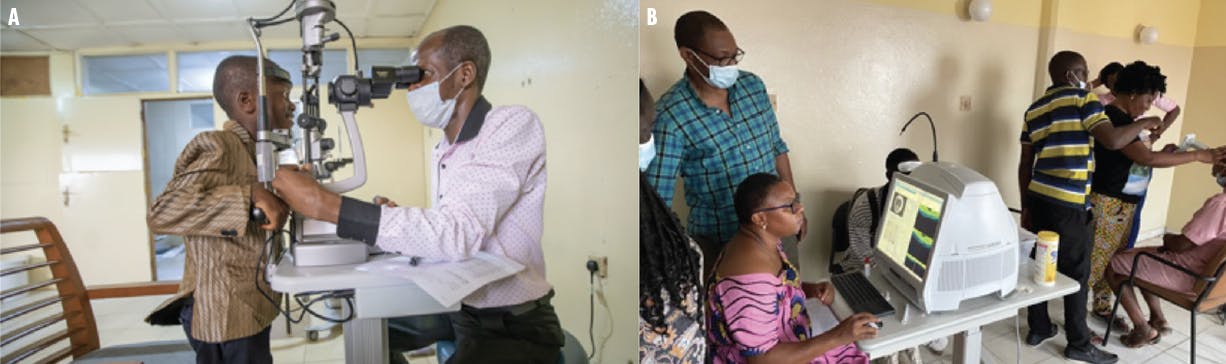
Figure. OCT imaging and fundus photography performed at Connaught Hospital in Sierra Leone (A). Slit lamp biomicroscope at the Lowell and Ruth Gess Eye Hospital, also in Sierra Leone (B). Photos obtained with patient consent.
FUTURE ENDEAVORS
Uveitis management in Sierra Leone and developing countries with a high rate of infectious diseases—including toxoplasmosis and EVD-associated uveitis—has provided a wealth of information about infectious pathologies and opportunities to provide complex care to underserved populations. The introduction of research infrastructure has improved the region’s ophthalmic imaging capabilities, research workflows, ophthalmic education, and ophthalmic subspecialty service delivery. However, remaining challenges include patient-level considerations (ie, treatment adherence, financial constraints, and delayed presentation) and health system constraints (ie, availability of molecular diagnostic testing for infectious disease syndromes, supply chain, and reagents for serologic testing).
Such constraints emphasize the need for strong clinical observation skills and empiric treatment and task-shifting to mid-level health care providers to allow ophthalmologists and optometrists to deal with rare or severe conditions. This can give the clinician more time to engage in further research, training, monitoring, and supportive supervision to build, improve, and sustain a robust health care system.
Authors’ note: This project was supported by the NEI/NIH. The content is the responsibility of the authors and does not represent the official views of the NIH or the Department of Health and Human Services; mention of products or organizations does not imply endorsement by the United States Government. Funding has also been provided by the Stanley Truhlsen Family Foundation, the ARVO Young Investigator Award, and a Macula Society Retina Research Grant.
1. Ronday MJ, Stilma JS, Barbe RF, Kijlstra A, Rothova A. Blindness from uveitis in a hospital population in Sierra Leone. Br J Ophthalmol. 1994;78(9):690-693.
2. Ronday MJ, Stilma JS, Barbe RF, et al. Aetiology of uveitis in Sierra Leone, west Africa. Br J Ophthalmol. 1996;80(11):956-961.
3. Shantha JG, Crozier I, Hayek BR, et al. Ophthalmic manifestations and causes of vision impairment in Ebola virus disease survivors in Monrovia, Liberia. Ophthalmology. 2017;124(2):170-177.
4. PREVAIL III Study Group. A longitudinal study of Ebola sequelae in Liberia. N Engl J Med. 2019;380:924-934.
5. Tiffany A, Vetter P, Mattia J, et al. Ebola virus disease complications as experienced by survivors in Sierra Leone. Clin Infect Dis. 2016;62(11):1360-1366.
6. Mattia JG, Vandy MJ, Chang JC, et al. Early clinical sequelae of Ebola virus disease in Sierra Leone: a cross-sectional study. Lancet Infect Dis. 2016;16(3):331-338.
7. Balendra S, Harrison-Williams, L, Mustapha J, et al. Aetiology and management of uveitis in a viral haemorrhagic fever zone (EMERGE) study. ARVO Abstract. 2023;144:B0206.


_1784132761.jpg?auto=compress,format&w=75)





