


Chronic hypotony after successful complex retinal detachment (RD) surgery is a frustrating problem that often leads to irreversible vison loss, phthisis, and corneal opacification in up to 10% of patients.1 Various nonsurgical and surgical procedures have been proposed to address this problem.2-4 However, visual and anatomical outcomes have historically been poor.
I hypothesize that earlier detection with improved diagnostics (ie, ultrasound biomicroscopy), use of intraoperative 3D visualization, and bimanual dissection of epiciliary proliferative tissue (which is often the root cause of hypotony after RD surgical repair) has the potential to salvage eyes that are otherwise destined to become phthisical.
ROLE OF EPICILIARY MEMBRANE
Although there are various reasons why hypotony may arise after RD repair (eg, sclerotomy leaks, cyclodialysis cleft, cyclitic membrane formation), it is presumably caused by chronic traction of the anterior vitreous base on the ciliary body; epiciliary membrane formation and iridociliary adhesion, resulting in low ciliary body detachment; and ciliary body damage and hyposecretion of aqueous humour.
Epiciliary membrane is an unspecified term describing proliferative tissue formation that usually occurs after multiple attempts at RD repair in the setting of proliferative vitreoretinopathy (PVR), where the retina finally reattaches with silicone oil tamponade, but the eye remains hypotonous (IOP < 5 mm Hg). The epiciliary membrane is comprised of various tissues, including vitreous base remnants, anterior retinal flap, PVR membranes in anterior PVR, capsular remnants, and cyclitic membranes, if inflammation is present. Signs of epiciliary membrane growth include decreasing IOP, hyperopic shift, intracameral oil accumulation, and corneal decompensation.
Hypotony in the presence of epiciliary membrane formation is multifactorial, as some degree of rerouting of aqueous outflow is present via areas of bare retinal pigment epithelium after a retinectomy. Postoperative inflammation also reduces aqueous humour production, and mechanical trauma to the ciliary processes after multiple surgical repairs is certainly possible. However, growth of epiciliary membranes, mostly due to proliferation of fibrous tissue, leads to ciliary body detachment, and membranes covering ciliary processes block the release of the humour. Direct destruction of ciliary processes causes irreversible damage to the secretory epithelium.
Prompt detection and surgical intervention is crucial to restore aqueous humour production and increase IOP to potentially revive a percentage of affected eyes.
SURGICAL PROCEDURE
The goals of surgery include the following:
1. releasing traction on the ciliary body, freeing the ciliary processes from compartmentalization to restore aqueous production;
2. freeing the ciliary processes from fibrous tissues that leads to their irreversible functional damage; and
3. lysing the iris-ciliary processes synechiae, which further compromise aqueous production.
I suggest the use of 23-gauge three-port vitrectomy with a chandelier light to allow for a bimanual technique (Video).
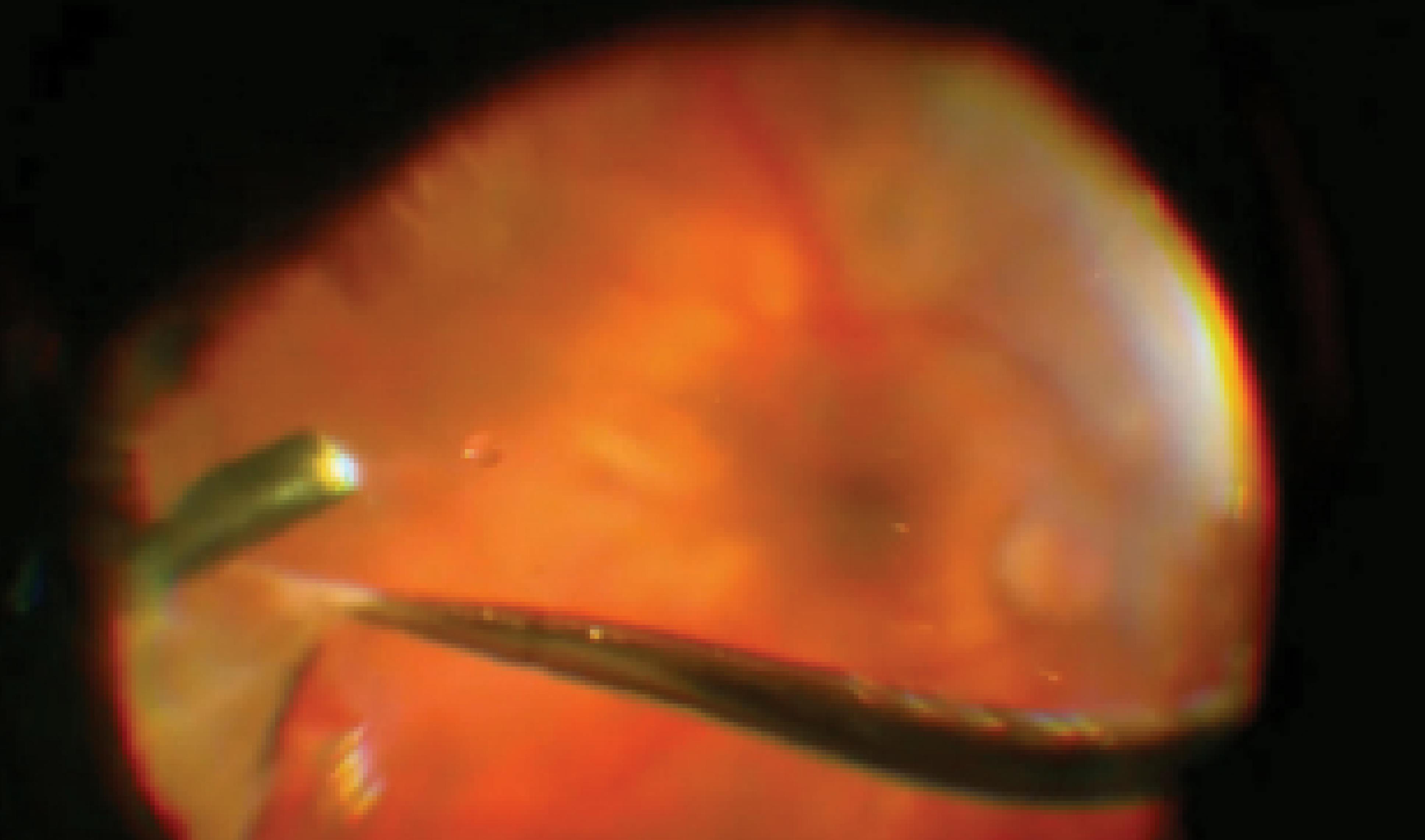
Video. Surgical Removal of Epiciliary Membrane
If available, intraoperative 3D visualization can enable better illumination and depth of focus. I use the foot-controlled Resight 700 Fundus Viewing System (Carl Zeiss Meditec) to visualize the ciliary body 360°, which appears covered with gray-white membranes. The ciliary processes may also be seen, but in more serious cases, these cannot be identified, as they are entrapped within the membrane complex.
It is crucial to manipulate the membranes gently because the adhesions to underlying tissue can cause choroidal damage. Bleeding must be promptly addressed to reduce the risk of PVR.
The vitreous base remnants should be meticulously shaved with high-speed, low pulsatile traction (dual blade) cutters with self-indentation. Epiciliary membranes should be removed by carefully pulling and separating them from the ciliary processes with serrated forceps or the vitreous cutter (Figure).
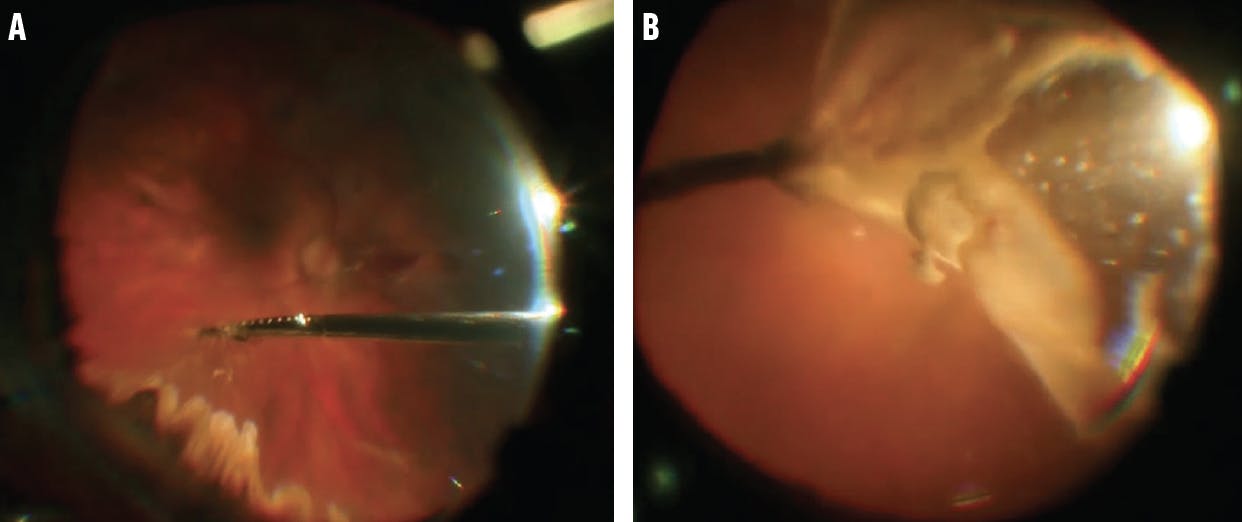
Figure. Removal of epiciliary membranes with serrated forceps under self-indentation with 3D visualization (A). The epiciliary membranes can be extensive, as depicted here (B).
If the membrane conglomerate includes the capsular bag, which is frequently the case, the capsular bag must be removed along with the IOL.
If the anterior retinal flap has not been removed in previous interventions, it must be completely removed at this point, as it contributes to the epiciliary membrane complex formation. In some cases, the lysis of iridociliary synechiae is difficult but must be attempted because the synechiae exert traction on the ciliary body, with consequent ciliary body detachment that covers the ciliary processes, further impairing aqueous humour production.
After epiciliary membrane removal and lysis of iridociliary synechiae, the anatomy of the ciliary body with ciliary processes can be observed, although often reduced in size and number. However, these processes can typically still produce an adequate amount of aqueous humour to restore some level of IOP. Intervening again after the initial improvement of IOP can be beneficial, as new proliferative tissue may emerge.
This novel surgical approach, in my experience, results in a 3- to 5-mm Hg increase in IOP, which can suffice to raise IOP to higher than 8 mm Hg for approximately one-third of eyes. Another one-third remain hypotonous with IOP between 3 mm Hg and 5 mm Hg, which can still prolong the eye’s viability and volume with some ambulatory vision. The remaining one-third will likely progress to phthisis, despite intervention. Similar outcomes have been reported, in which the lysis of adhesion between the iris and the ciliary body and its processes, as well as removal of lens remnants and other fibrocellular tissue, resulted in a final postoperative IOP increase of up to 15 mm Hg.4,5
PREVENTING EPICILIARY MEMBRANE FORMATION
Meticulous vitreous base shaving with self-indentation and 3D visualization, anterior retinal flap removal after retinectomy, meticulous removal of any bleeding, and strong antiinflammatory postoperative therapy (such as administration of intraocular methotrexate) is the best prevention against epiciliary membrane formation.
If the membrane does form, early detection is based on signs of low IOP in silicone oil-filled eyes, pupillary membranes, pupil dilatation, oil in the anterior chamber, and corneal decompensation. Radical dissection as described above can result in salvaging some eyes from progressing to phthisis, although visual outcomes in such cases usually do not show significant improvement.
WORTHWHILE TO TRY
Even with restoration of aqueous humour production and subsequent modest improvement in IOP, reduced aqueous humour production may persist due to irreversible damage to secretory ciliary processes function.
Despite the low reported success rates of such interventions by a number of authors,1,4,5 today’s improved capabilities of early detection, 3D intraoperative visualization, and improved instrumentation/surgical techniques make epiciliary membrane removal worth undertaking to attempt to preserve visual and anatomical function.
1. Quiram PA, Gonzales CR, Hu W, et al. Outcomes of vitrectomy with inferior retinectomy in patients with recurrent rhegmatogenous retinal detachments and proliferative vitreoretinopathy. Ophthalmology. 2006;113(11):2041-2047.
2. Yu YZ, Zou XL, Chen XG, et al. Chronic hypotony management using endoscopy-assisted vitrectomy after severe ocular trauma or vitrectomy. Int J Ophthalmol. 2023;16(6):947-954.
3. Cisiecki S, Bonińska K, Bednarski M. Encircling scleral buckling surgery for severe hypotony with ciliary body detachment on anterior segment swept-source optical coherence tomography: a case series. J Clin Med. 2022:11(16):4647.
4. MA Zarbin, RG Michels, WR Green. Dissection of epiciliary tissue to treat chronic hypotony after surgery for retinal detachment with proliferative vitreoretinopathy. Retina. 1991:11(2):208-213.
5. O’Connell SR, Majji AB, Humayun MS, de Juan Jr E. The surgical management of hypotony. Ophthalmology. 2000:107(2):318-323.


_1773249222.png?auto=compress,format&w=75)





