


AT A GLANCE
- According to the Association of American Medical Colleges, 3.6% of approximately 16,000 respondents to the 2022 matriculating medical students questionnaire identified as LGBTQ+.
- Organizations should have LGBTQ+ inclusive policies, signage, and representation, and they should recruit people who are diverse.
- The best way to change people’s minds is through their hearts—and that comes through sharing ourselves and being authentic and vulnerable.
Gathering a group of LGBTQ+ physicians who are open about it within our field is groundbreaking; it hasn’t been done before, and the need to do so has only recently come to the forefront. Thus, we have invited this wonderful group of retina specialists to talk about how we can be more inclusive in the clinic and touch on ways that our institutions can change policies to be more inclusive.
– Vivienne S. Hau, MD, PhD (she/her/hers)
BASIL K. WILLIAMS JR, MD (HE/HIM/HIS): IS IT IMPORTANT TO SHARE YOUR STATUS AS PART OF THE LGBTQ+ COMMUNITY?
Roberto Diaz-Rohena, MD (he/him/his): Sexual identity and gender identity are fundamental to who we are as three-dimensional people, and it defines who we truly are. I entered retina 30 years ago as probably the only Afro-Caribbean Latino man at the time, but it was a label I was comfortable with because it’s who I was as a young man.
But the field of retina in the ’90s consisted mostly of straight, older, married, white men, and it led me to believe erroneously that the best thing I could do as a gay man was to hide, which is what many of us did.
I thought that Dr. Diaz could be amazing at lecturing, teaching, doing research, and running a practice, and that would be enough in my professional role; Roberto would go to bars, meet men, maybe boyfriends, eventually meet the man that I legally married and that I could keep those two worlds apart. But it doesn’t work.
In retina, we see patients over and over and they begin to feel comfortable asking, “Are you married? Do you have a wife? What does she do? Do you have children?”
There comes a time when you decide that you can’t keep avoiding these questions because you are not ashamed of who you are. In the last 10 years, I decided to come out at work and answer the patients' questions because I know that my sexual identity is integral to who I am. Now the staff, administration, and colleagues all know I’m gay, and it is an amazing and powerful feeling because now I can talk about my husband openly. I can take him to meetings, talk about my life, and finally be my most authentic self (Figure 1).
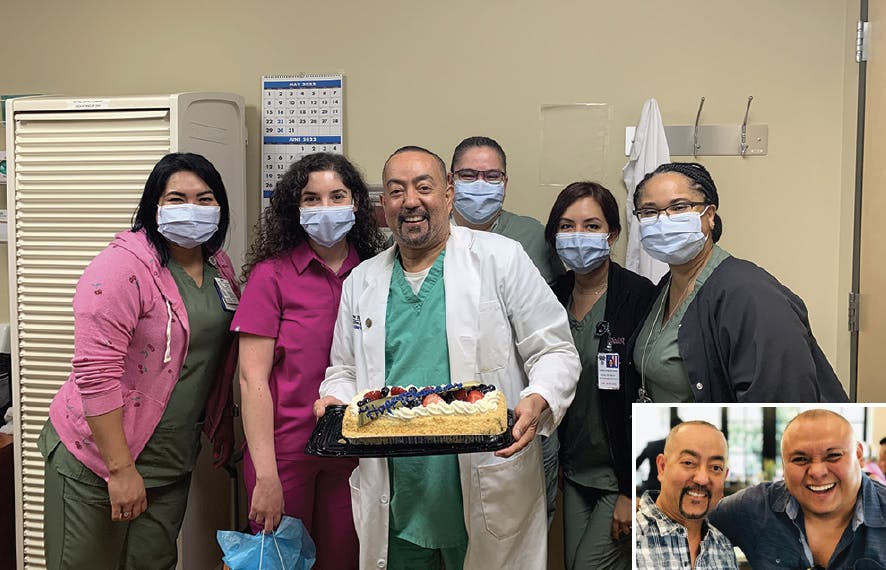
Figure 1. Dr. Diaz-Rohena enjoys a birthday in the office with staff and colleagues and spending time with his husband (inset).
DR. HAU: WHAT HURDLES HAVE YOU OVERCOME AS PART OF AN UNDERREPRESENTED GROUP IN RETINA?
Jessica Weinstein, MD (she/her/hers): This is a hard one because, first, I am a woman in retina. Retina used to be a male-dominated field, and you must contend with the usual problems like patients thinking you’re the nurse or the tech. But in terms of my LGBTQ+ identity, when I was a resident and I made a comment to one of my attendings about not feeling included, they said, “Well, you always say, ‘your girlfriend,’ and you always say it as if it’s a badge of honor. Why does that have to be such a big part of your identity?”
I had to ask them how that was any different from those who are constantly saying, “my fiancé.” You constantly hear that in the heterosexual community, and it’s the norm. One of the hurdles is simply explaining to people how you are left out and you aren’t included in things unless you put yourself out there. You want to be frustrated and you wonder why people don’t understand you.
To help others understand where you’re coming from, you need to have a lot of patience—and be prepared to come from a place of understanding, even when someone says something that may be hurtful or ignorant. We must be patient, take a step back, and find a way to explain ourselves without always getting defensive.
DR. WILLIAMS: HOW DO YOU NAVIGATE MOMENTS WHEN YOU PERCEIVE A BIAS WITH A COLLEAGUE OR PATIENT?
Brandon Johnson, MD (he/him/his): Very gingerly. Being a man of color and gay, I’ve experienced a variety of biases and microaggressions. When I have a difficult patient, I fall back on the fact that we often see patients at their worst. I don’t know what’s going on in their heads, so I try my best to not let the doctor-patient relationship get disrupted.
If they are being rude to my staff or are being discriminatory, I have no problem directly communicating about it with the patient. But I always do my best to deliver the best care possible, no matter what.
It’s also easy to fall into the habit of just ignoring the topic altogether, especially as a gay man. The medical community was so conservative when I was training, and I didn’t talk much about my personal life. I kept to myself for the most part. That does so much damage not only to the person who is keeping those secrets but also to the greater community that doesn’t realize the pressures that they’re putting on underrepresented groups.
That’s why it is important to have representation and talk about these issues so that the next generation doesn’t have to be afraid to be authentic.
Dr. Hau: The best way we can change people’s biases is by being ourselves (Figure 2). As more people get to know us, like our patients and colleagues, it changes their opinions. It’s hard to discriminate against someone you know and respect.

Figure 2. Dr. Hau and her team aren’t afraid to be themselves in the office, which makes for a fun (and often festive) work environment.
DR. HAU: WHAT ARE SOME OFFICE POLICIES THAT ARE IMPORTANT FOR INCLUSIVITY?
Steven Sanislo, MD (he/him/his): I am lucky because Stanford has always been a highly inclusive place. I spent a lot of my life suppressing even to myself that I was gay, but once I accepted myself and became open with friends and family, I was completely accepted at Stanford.
Before I even came out to myself, I had been working with a lot of these people and they knew me as a person, and you don’t tend to discriminate against people you know. It’s the others that you discriminate against.
The difficulty for me has been around patients because they are constantly wanting to know about your private life. At the very beginning of my practice, before I was out, many of my older patients would try to set me up with their daughters, and I would have to avoid that. It was uncomfortable.
After I was married and I came out, when patients asked about my wife and her profession, I would correct them and say, “I have a husband and he does this, and we have these kids.” Every patient accepted me for that and then they want to ask me about my kids, which is much easier to talk about.
Rising Numbers
The Association of American Medical Colleges’ matriculating medical student questionnaire recently started collecting information on sexual orientation. In 2022, 3.6% of approximately 16,000 respondents identified as LGBTQ+, so close to 600 medical students in this year’s first-year class.1 The numbers are growing, and the reality is that many of us just weren’t comfortable disclosing this information when we were training.
– Vivienne S. Hau, MD, PhD
1. Matriculating Student Questionnaire (MSQ). Association of American Medical Colleges. Accessed January 25, 2023. www.aamc.org/data-reports/students-residents/report/matriculating-student-questionnaire-msq
I’ve had several patients say, “You were a lot crabbier 10 years ago. You seem happier and joke more now.” If you can’t be out and honest with your patients and colleagues, you’re not going to be as happy, and patients will not relate to you on the same level.
Dr. Diaz-Rohena: Working at the Veterans Affairs (VA), I don’t fit a lot of the patients’ boxes. I’ve had patients say, “I know you’re gay, but that’s okay with me. You do good work.” It’s hard to know how to respond to that, but I think they are just trying to say that what matters is that we do a good job as physicians. Much of it has to do with the personal attention and the compassion that we give as physicians.
Dr. Williams: We’re talking a lot about experiences, being comfortable in your own skin, and the challenges of keeping some things hidden. But that’s something patients can feel to some degree, and your co-residents, co-fellows, and faculty don’t get to know you fully if you’re not expressing the full complete version of yourself.
That’s why it is so important to have a diverse and inclusive environment so people can be themselves, and we all benefit from that diversity.
DR. WILLIAMS: HOW CAN WE FOSTER AN ENVIRONMENT OF INCLUSION IN RETINA?
Dr. Weinstein: Organizations should have inclusive policies, signage, and representation. They should look at their recruitment statistics and, if there are deficits or a lack of representation, recruit those types of people because representation is important.
I used to work in Kentucky and North Carolina in medium-to-small cities, and now I’m in another medium-to-small city, and the diversity and inclusion policies are different than in places like Stanford. But there are national groups that can make sure that they are applying inclusive policies to all their offices, regardless of location.
Creating a space for people is important. Organizations such as the AAO and the American Society of Retina Specialists (ASRS) have diversity, equity, and inclusion (DEI) committees and task forces, LGBTQ+ committees, and mentoring programs to make sure that diversity and inclusion improves. If you don’t create an intentional task force, culture, or path for it to happen, it won’t.
Dr. Hau: Much has changed since the very first Retina Today DEI article with LGBTQ+ representation in 2021. Now, there are LGBTQ+ people in leadership, organizations like the AAO LGBTQ+ community, and the ASRS ad-hoc DEI committee that includes LGBTQ+ representation. We’ve come so far in a few short years.
DR. HAU: HOW CAN WE HELP COLLEAGUES APPROACH EACH PATIENT ENCOUNTER WITH INCLUSION IN MIND?
Dr. Diaz-Rohena: We all love to learn, and we’ve been learning our whole careers, so we must be willing to evolve in our awareness of LGBTQ+ issues. For example, I’m learning a lot about gender identity and pronouns. As we learn, we show more empathy and are less judgmental because we’re open to understanding. When we're less judgmental and more compassionate, we are more comfortable, our body language makes more sense, and we can work with patients. We may not understand them completely, but we can share some of the uniqueness of being human and being different.
We must accept that we don’t know all the answers, and we may not understand the ignorance, but we are willing to learn from it. The key is to show empathy.
DR. WILLIAMS: WHAT EDUCATIONAL RESOURCES ARE AVAILABLE FOR PRACTITIONERS WHO WANT TO LEARN MORE ABOUT LGBTQ+ PATIENTS AND THEIR NEEDS?
Dr. Sanislo: I once reached out to one of my trans patient’s primary care doctor, and I learned a lot from speaking with that doctor. When this patient first came to me, I treated them the same way I treat everyone else. I didn’t realize that I could have used some words that were different that might have been better for that particular patient. After talking with their physician, I learned to approach people who may be slightly different than myself in other ways.
You don’t treat everyone the same; you treat everyone the way that you think they would like to be treated. I’m sure that there are organizations too, but reaching out to other physicians, especially those who are involved in the community, can help. Become aware of physicians who are active within the LGBTQ+ community; they are very willing to talk with other doctors and help you on that journey.
Dr. Hau: We have many colleagues within medicine who may have certain expertise within this area and can connect. There are also some great websites and organizations, such as GLAAD (glaad.org) and the human rights campaign (hrc.org). Also, check out Retina Today’s DEI articles from the last two years. In the 2022 issue, I wrote an article that includes a section on resources to help when working with trans folks within the office.
LGBTQ+ TERMINOLOGY CHEAT SHEET
Language is inherently complex and continuously evolving, and terminology associated with the lesbian, gay, bisexual, transgender, and queer+ (LGBTQ+) community is no exception.*
Here are some common terms you may encounter when caring for this patient population.1
Gender
- Cisgender (adj.): Describes a person whose gender identity aligns with the sex they were assigned at birth.
- Gender dysphoria: Marked and persistent incongruence between a person’s experienced gender and assigned sex at birth.
- Intersex (adj.): Describes a person with one or more innate sex characteristics (such as genitals, internal reproductive organs, or chromosomes) that fall outside of traditional conceptions of male or female bodies.
- Nonbinary (adj.): Describes a person who experiences their gender identity and/or gender expression as outside the binary genders of man and woman.
- Transgender (adj.): Describes a person whose gender identity differs from the sex they were assigned at birth.
- Transition or gender affirming care: The process a person undertakes to bring their body and/or gender expression into alignment with their gender identity; may involve social, medical, or legal transitions. Note: A person is not required to transition socially, legally, or medically to be considered transgender. Transitioning is a unique experience for each individual and may involve all, none, or some of these processes.
- Social: may include going by a different name, using different pronouns (eg, she, he, or they), and dressing or otherwise presenting themselves differently
- Medical: may include procedures such as hormone replacement therapy and/or one or more gender confirmation surgeries.
- Legal: may include changing one’s name or sex on legal documents such as a passport, driver’s license, or bank account.
Sexuality
- Allosexual (adj.): Describes a person who experiences sexual attraction to others (ie, who is not asexual).
- Asexual (adj.): Describes a person who does not experience sexual attraction.
- Bisexual (adj.): Describes a person who has the potential to be physically, romantically, and/or emotionally attracted to people of more than one gender (not necessarily at the same time, in the same way, or to the same degree).
- Gay (adj.): Describes a person whose enduring physical, romantic, and/or emotional attractions are to people of the same sex.
- Lesbian (adj. or n.): A woman whose enduring physical, romantic, and/or emotional attraction is to other women; some lesbian women may also describe themselves as gay.
- Pansexual (adj.): Describes a person who has the capacity to form enduring physical, romantic, and/or emotional attractions to any person regardless of gender identity.
- Sexual orientation: A person’s enduring physical, romantic, and/or emotional attraction to another person (distinct from gender identity).
- Queer (adj.): Describes a person whose sexual orientation is not exclusively heterosexual (a term used by some but not all members of the LGBTQ+ community).
Language to Avoid
- Referring to a person as “biologically/genetically” a man, woman, boy, or girl.
- “Lifestyle” or “sexual preference” to refer to a person’s sexual orientation.
- Calling a person “homosexual” who identifies as lesbian, gay, bisexual, pansexual, or queer.
General
- Ally (n.): Describes a straight and/or cisgender person who supports and advocates for LGBTQ+ people.
- Closeted (adj.): Describes a person who is not open about their sexual orientation.
- Coming out: A lifelong process of self-acceptance that may or may not involve telling others about one’s sexuality.
- Out (adj.): Describes a person who self-identifies as gay, lesbian, bisexual, queer and/or transgender in their personal, public, and/or professional lives.
- Outing: The act of publicly revealing a person’s sexual orientation or gender identity without that person’s consent; considered inappropriate and potentially dangerous by many members of the LGBTQ+ community.
- Questioning (adj.): Describes a person who is in the process of exploring their sexual orientation and/or gender identity.
*This list, dated to March 2023, is not exhaustive, and the appropriate language is subject to change. In addition, there is no one “right” away to identify with any of the above terms. You can always ask your patients how they describe themselves (eg, what pronouns they use).
For additional resources on appropriate language to use for describing LGBTQ+ individuals or issues, check out: GLAAD The Human Rights Campaign
To download a PDF of this cheat sheet, click here.
1. GLAAD Media Reference Guide. Accessed February 8, 2023. www.glaad.org/reference/terms
DR. HAU: HOW CAN WE HELP LGBTQ+ PATIENTS FEEL MORE COMFORTABLE COMING TO OUR OFFICES?
Dr. Johnson: Being in a private practice, the onus is on the physician owner, so I set the tone. To set a tone of inclusivity and compassion, I enter the room with the mindset of curiosity and compassion, not fear and ignorance. If I am unsure of a patient’s pronouns, because of my own curiosity, I have a knee-jerk reaction to ask directly, “My pronouns are he/him/his; what are your pronouns?” The reactions to that approach have been very positive. I also make sure that I have options on my intake form for people who have different gender identities to make them feel welcome. The infrastructure that we have set up is traditionally binary, but that’s not the reality of how we practice and how we live.
Dr. Sanislo: The fact that our infrastructure is binary is a big problem. If the patient’s chart says male or female when that’s their chosen gender identity, I know to address that person as a woman or a man. If it said nonbinary or they, I would know to use their preferred pronoun. I think that would be great. In our EHR, there is a way to add their preferred gender identity rather than their sex assigned at birth, but it’s not something that pops up that you could see easily.
That would be very helpful because I don’t want to make someone feel uncomfortable by asking. For example, asking about their preferred pronouns might make them feel like they’re not very successful at portraying the gender that they believe they are, which could be uncomfortable for them.
Dr. Johnson: If I am in a situation where I feel like it is relevant or if I might be misgendering a patient in some way, I’ll ask. It feels uncomfortable for me, and it may feel uncomfortable for them, but that’s a risk that I’m willing to take because it may foster a more connected experience.
Dr. Hau: As a trans woman and knowing some who are nonbinary, it’s the mere fact that we are sensitive to the issue of gender that shows compassion and sensitivity. If a person is struggling with their gender identity or misrepresentation, they often don’t get asked. Therefore, making a policy that applies to everyone at intake to ask for their pronouns can make a big difference. It is part of our Kaiser Permanente EHR, and hopefully, most systems are moving toward that.
Another approach is simply sharing your own pronouns first—“Hi, my name is Dr. Vivienne Hau, and my pronouns are she, her, and hers”—which may prompt the person to be comfortable sharing their pronouns as well.
Dr. Diaz-Rohena: I don’t use ma’am or sir anymore in my clinics because I’ve gotten in trouble. So now I say, “Good afternoon, what brings you in? How can we help you?” to make it very gender neutral. At the VA, they added unisex bathrooms, which is very helpful. If your intake form has the legal and the preferred names, it gives you a head start before you meet the patient. When I walk in the room, it makes me more comfortable knowing that their legal name may be Joe, but their preferred name is Susan. Intake forms that use only male and female are so difficult because there’s fluidity that we must be aware of.
Dr. Weinstein: Many of us have put our foot in our mouth when we walk into a room and say something to the patient about their wife or husband and it’s actually their mother, father, or sister. Many of us have changed that approach and stopped making assumptions. When we are educating others about these LGBTQ+ changes, comparing it to something like this that they have already changed is easy enough and it makes it more familiar.
DR. WILLIAMS: WHAT PEARLS CAN YOU SHARE WITH LGBTQ+ TRAINEES?
Dr. Johnson: If I could talk to my 20-year-old self, I would say, “be your authentic self.” That might come with a lot of pain and hurt and trauma, but you either pay for it upfront or you pay for it later because I can tell you, as a 40-year-old who repressed my sense of self for years, it affected everything in my life from interpersonal relationships to my self-esteem and how I view myself. No one can be the best doctor if they split themselves—they’re not a whole person. Try to live as a whole person and it will allow you to be your best self and the best physician you can be.
Dr. Weinstein: Coming out of the closet or being your authentic self is still really hard. My advice is to try, but at the same time, you can present yourself the best that you can. Maybe you aren’t out to your grandmother but you’re comfortable with your medical school friends or colleagues. That’s okay. It doesn’t have to be perfect. We all come from different places, and I wish everyone would be comfortable and out, but it’s okay not to have it all figured out yet.
Dr. Sanislo: It’s very hard to change systems and the community you live in, but it’s easier to change by becoming a leader. When other people are drawn to you as an LGBTQ+ person they respect as a good physician and teacher, that will drive change. Change is driven by individual pioneers.
I encourage all of us who are in leadership positions to be our authentic selves to drive change in our communities and in our nation.
Dr. Diaz-Rohena: Hiding is a very important concept for us in the LGBTQ+ community. Often, we hide as long as we can. But when I was hiding, looking back 30 years, I lost the ability to have great relationships with some of my colleagues. We lose the ability to have good mentors, be it gay or straight, because we retreat and try to live a quiet life. The important aspects of mentorship and friendship are lost along the way. Getting to know all of you, I feel that I have the friends and mentors that I wish I had had 30 years ago.
Dr. Hau: I can’t tell you how much it would have meant to me as a trainee to have a group of LGBTQ+ physicians talking about their lives like this. I’m glad that we can do this now for our own trainees so that they have mentors and role models to show them that they have the potential to excel and become future leaders.
The best way to change people’s minds is through their hearts. And that comes through sharing ourselves, being authentic, and being a little bit vulnerable. If we were all more vulnerable with colleagues and patients, our relationships would be stronger and more fulfilling. I’ve found that to be the case for myself.
Hopefully, we have taught our field a little about our community and showed our colleagues how to be stronger allies to each other and patients who are LGBTQ+.
Want to hear the conversation as a Podcast? Click here or visit New Retina Radio on Eyetube at eyetube.net/podcasts.


-1_1678291312.jpg?auto=compress,format&w=70)


_1784132761.jpg?auto=compress,format&w=75)





