


Imagine being a tired, single mom of twin boys working full time while studying for the MCAT. Then you land an interview with the University of California, Riverside, School of Medicine. That’s where Jennifer Pinal, MD candidate (she/her/hers), found herself—and when the imposter syndrome started sneaking in. She remembers walking into the office of her mentor, Vivienne S. Hau, MD, PhD (she/her/hers), to share the amazing news, only to realize that she had no idea what to wear to the interview.
“Of all things to worry about,” Ms. Pinal told Retina Today. “No one else in my family is pursuing medicine and that has always been a part of the imposter syndrome with me. Here I am trying to blaze a trail for myself and my kids, and I’m picking apart how I look and act and speak.”
Dr. Hau, a member of the American Society of Retina Specialists (ASRS) Diversity, Equity, and Inclusion (DEI) Ad-Hoc Committee and current co-chair, knew just what to do.
“She gave me a good luck card, a pair of earrings, and a necklace to wear for my interview,” Ms. Pinal recalled. “I promised that, when I got into medical school, I would let Dr. Hau know that I got in because I wore her magic jewelry. And that’s exactly what I did.”
That kind of personal connection—the need to match lived experience, empathy, and common values with work experiences and conditions—is the foundation of the ASRS Underrepresented in Retina Mentorship Program (URMP), in which Ms. Pinal is now a participant.
“Mentorship programs such as this one can best serve students who come from non-traditional and low-income backgrounds, people with kids, or those with different cultural or sexual orientations,” Ms. Pinal explained. “There’s a lot to share, and there’s a lot to learn.”
The URMP, made possible in part through sponsorship by Genentech/Roche, Alcon, and DORC, is an innovative program that selects underrepresented or LGBTQ+ mentees who are committed to ophthalmology with an interest in the field of retina—such as Ms. Pinal—and connects them with mentors to help them become future leaders in retina. The idea of the program, as well as the ASRS DEI Ad-Hoc Committee, was born from the recognition of Keith Warren, MD, ASRS DEI Ad-Hoc Committee co-chair, that there was a severe lack of representation of certain races and ethnicities among retina specialists. He recruited Basil K. Williams Jr, MD; Jessica Randolph, MD; and Kristen Nwanyanwu, MD, MBA, to develop the URMP with the goal of increasing representation in retina by 50% by 2030. This year, the program will expand to include up to 24 mentors and 20 mentees and will focus primarily on residents.
“Our approach to mentorship is holistic: attentive to the identity, lived experiences, and aspirations of the mentee and mentor,” said Debon Lewis, MA, CEO and founder of Transformative Growth Partners, and the consultant who helped the ASRS develop the URMP (he/him/they). “We believe people learn best in community and are most effective when they live integrated lives—tending to both the personal and professional goals they set for themselves.”
He noted that while some mentoring programs are focused primarily on technical skills, this program is focused on “adaptive leadership development through emotional intelligence.” This model not only provides a space for mentees to develop, take risks, explore possibilities, and leverage the experiences of other professionals, but also serves as an “invitation for mentors and mentees from underrepresented backgrounds to show up fully and recognize their identities as assets to their success in the field of retina.”
The program has two tracks: the traditional track and the family track.
The traditional track pairs mentees and mentors together for a one-on-one mentoring relationship. Scott D. Walter, MD, MSc (he/him/his), volunteers as a traditional mentor. “There may not be anyone at your home institution who looks like you or represents your cultural or social background,” he told Retina Today in an interview. “This program is helping to bridge that gap. This allows us to connect people across the country and make those mentoring relationships happen.”
Dr. Walter also noted that this traditional pathway is more flexible and can work better for some people’s schedules. The family track, on the other hand, is more time intensive.
“We were specifically trying to focus on various resource limitations that some of the mentees might have,” Dr. Walter said. “For instance, we may prioritize mentees for the family mentorship program who are at smaller institutions with less access to retina faculty so that they could really get a family of people to help mentor them. Whereas some of the traditional mentees come from institutions with a lot of retina mentors, but they may need someone who can be their one-on-one career mentor from the perspective of an LGBTQ+ identification or an underrepresented minority identification.”
The family track is the “key innovation,” according to Mr. Lewis. The mentorship families are comprised of six to eight individuals each: two to four mentees and four mentors (a mix of residents, fellows, and junior and senior attendings) with diverse representation from underrepresented groups or LGBTQ+ communities. This helps introduce mentees to the field of retina and ophthalmology at multiple levels to maximize insights and connections.
“Leveraging a group approach to mentorship reflects the values of community and shared purpose,” Mr. Lewis said. “We wanted to wrap our arms around our mentees and provide them with a robust network of underrepresented retina specialists.”
Mentees in the family track attend three 1- to 2-hour virtual “shared learning experiences” (meetings) with their mentors, as well as two in-person retina meetings (ASRS and AAO; Figures 1-3).
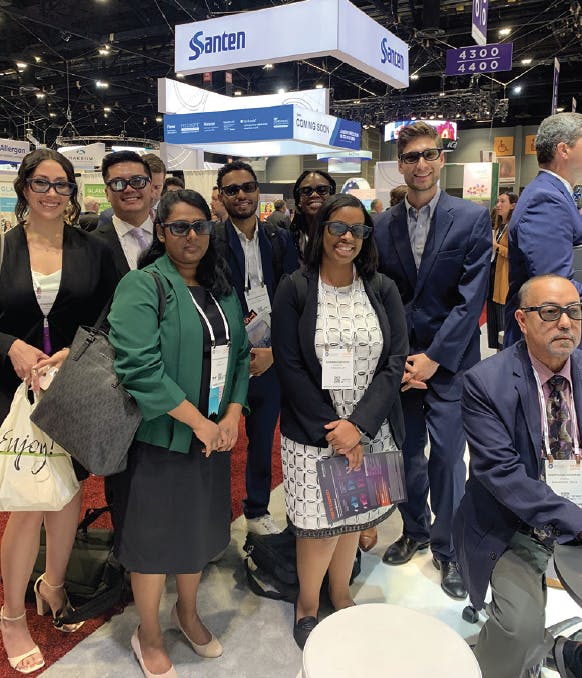
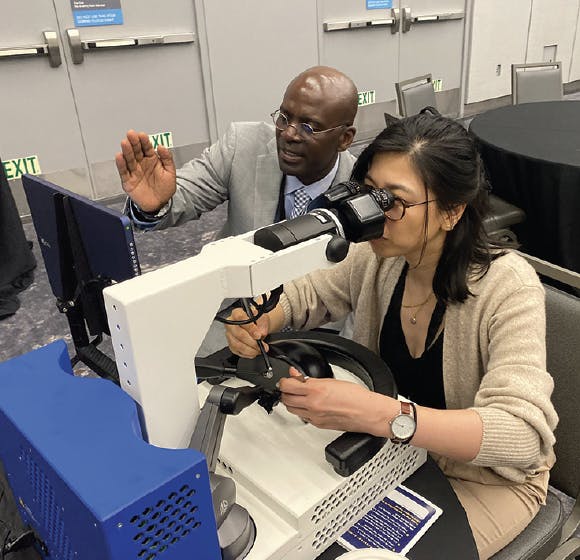
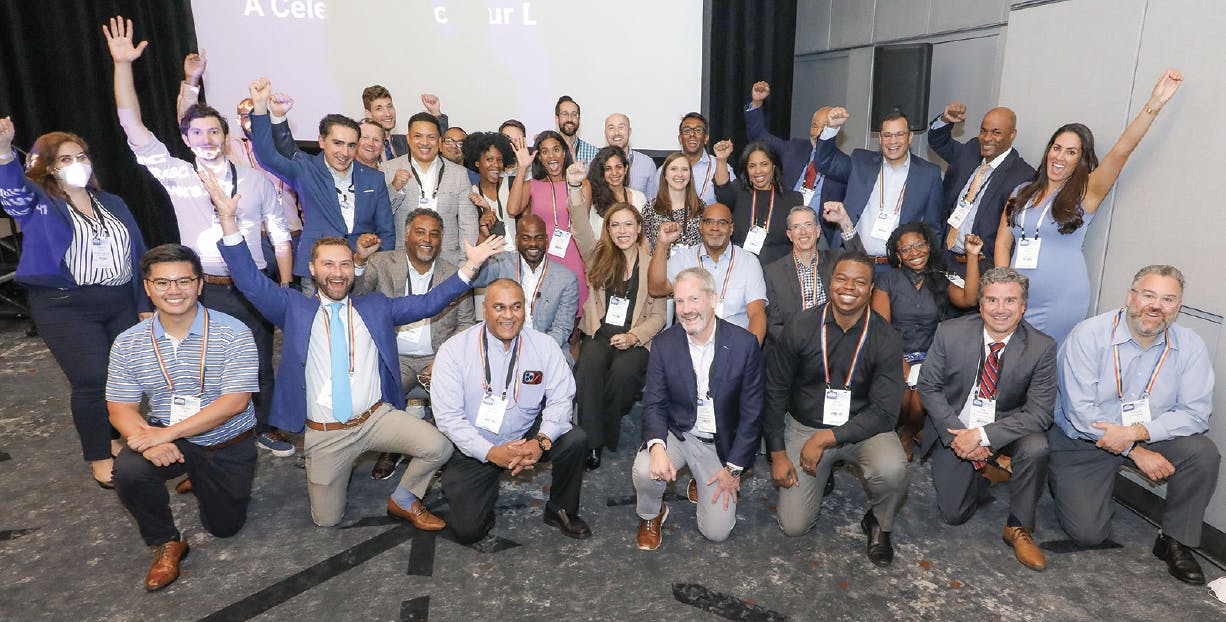
Akua Frimpong, an MD candidate and mentee in the URMP family track (she/her/hers), told Retina Today that this format differentiates URMP from other mentorship programs and that these interactions create a professional environment with more personal moments—a place where everyone is setting examples for each other, and it is OK to be vulnerable.
“I always have my agenda, and plan to talk about A, B, C, D, etc.,” she said. “Instead, the mentors will ask how I’m doing and how I am feeling. That wasn’t part of my agenda, but I always feel better after I talk about that. Because they ask, I feel comfortable sharing about what I have been working on and struggling with. This gives the mentors a chance to provide examples of ways they would approach the same situation.”
Each session pairs a mentor’s skill with an emotional intelligence-based conversation where participants can process content through open dialogue and space for reflection, connection, and practice.
“For example, we talk about different aspects of being a person of color in retina,” explained Roberto Diaz-Rohena, MD (he/him/his), a mentor for the URMP family track. “We’ll discuss imposter syndrome, the challenges we have overcome, and what could have been done differently.”
The benefits of being able to discuss imposter syndrome with mentors who can relate is a common thread for underrepresented groups making their way through medical school. “We often question if we belong because we don’t know anyone with our same background, who looks like us, or has the same values,” Anh H. Nguyen, MD, MS, a mentee in the URMP family track (she/her/hers), told Retina Today.
But through the URMP, Dr. Nguyen is meeting retina specialists with similar values who have already carved out a path in ophthalmology. “It’s nice to see people doing it and knowing that I can do it too,” she said.
“It has taken years for me to feel comfortable with who I am today as a retina specialist, as a gay man, as an Afro-Caribbean Latino,” Dr. Diaz-Rohena said. “These things take time, but it would be much easier if there were people along the way who looked like me and spoke like me to make it more comfortable.”
Dr. Walter encourages “protecting time” to connect with, support, and mentor others and share personal experiences. “It’s incredibly valuable and may be more important than what we think we need to be prioritizing,” he said.
Dr. Diaz-Rohena encourages prospective mentors to share their authentic self. “Learning to recognize who I am and sharing that with others and paying it forward was the key for me,” he said. “For the mentees, I want them to see a person who is three-dimensional. I can be funny, down to earth, intense with my work, and even a big nerd. I can work with a resident and have fun. We can laugh and also learn OCT and injections and treatments.”
Ultimately, “representation matters,” Mr. Lewis said. “This program is a testament to diversity and inclusion as it reflects practically all groups defined by the Association of American Medical Colleges as underrepresented in medicine in addition to the LGBTQ+ community.”
While still a young program, ASRS's URMP is already strengthening bonds in the field of retina and helping its participants feel seen, heard, valued, and uplifted.
-1_1678291312.jpg?auto=compress,format&w=70)


_1784132761.jpg?auto=compress,format&w=75)





