


AT A GLANCE
- The major challenge to starting retina programs in developing countries is access to resources.
- FOCUS is a nonprofit organization that aims to develop and improve eye care systems in the developing world.
- Retina programs in Haiti and Rwanda now provide retina care to a vast population in need, including patients with complex retinal detachments of all varieties, often with bilateral blindness.
- These programs are always in need of ongoing surgical training, equipment, and financial aid.
Resources are sorely needed to create and maintain retina programs in the developing world, but it can be done. I would know because I have helped to develop three retina surgery sites in Haiti and Rwanda and have a fourth in the works in Burundi, Africa.
HOW IT STARTED
My first experience with global ophthalmology came as a mid-career retina specialist. In 2014, I traveled to Port-au-Prince, Haiti, and had a successful week of teaching vitrectomy surgery to Reginald Taverne, MD. Dr. Taverne is a comprehensive ophthalmologist who completed a residency in Haiti and then a second one in Israel. During that second residency, he was exposed to medical retina and learned scleral buckling for retinal detachment repair, although he was already well-known in Port-au-Prince for providing those services. He had a driving desire to perform vitrectomy and had acquired a vitrectomy machine (Accurus, Alcon) but needed instrumentation, a widefield viewing system, and other equipment. After much planning, my son and I visited Dr. Taverne with everything we needed to complete 12 complex vitrectomies in his small office-based OR in Port-au-Prince (Figure 1); it was a life-altering event for all of us.
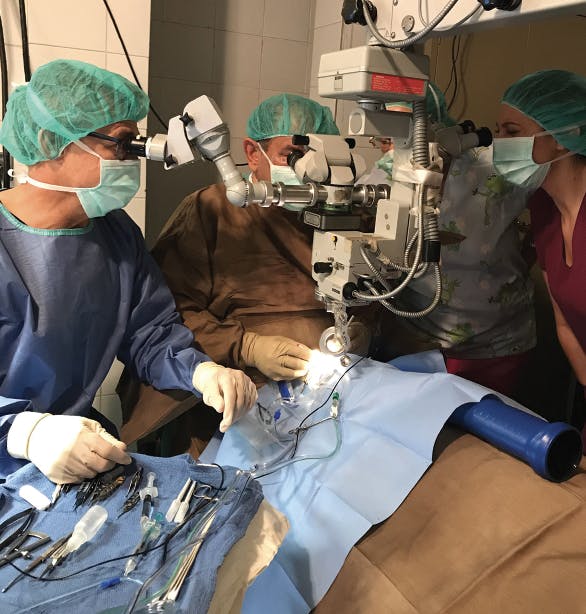
Figure 1. Dr. Alter (left) and Dr. Taverne (middle) performed vitrectomy in his office-based OR in Port au Prince, Haiti.
Since then, I have made 25 trips to Haiti and recruited other visiting retina surgeons to make similar trips. In 2018, Dr. Taverne was awarded a vitreoretinal fellowship certificate signed by six members of the American Society of Retina Specialists at the annual Haitian Society of Ophthalmology meeting in Port-au-Prince. Dr. Taverne has now become the vitreoretinal mentor and is currently training Shakespeare Saintil, MD (Figure 2). Dr. Saintil is a recent graduate of the residency program in Haiti and completed a FOCUS/USAID ROP fellowship as part of an USAID CBP grant that supports the development of pediatric eye care services in Haiti.
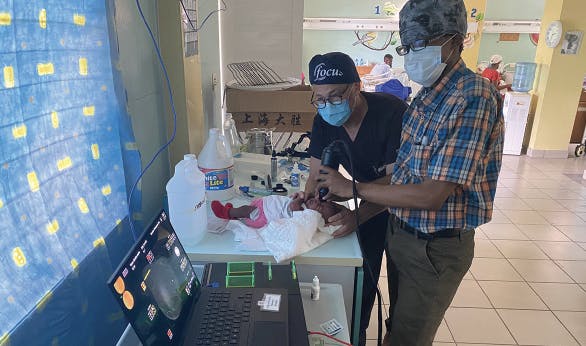
Figure 2. Dr. Alter (left) and Dr. Saintil (right) performed widefield fundus photography at St. Damien Hospital in Port au Prince, Haiti.
GROWTH
During my trips to Haiti, I helped to start a second program in Cap-Haïtien with Luc Dupuy Pierre, MD, a talented comprehensive ophthalmologist who had visited Port-au-Prince. This second project required more extensive planning and logistics because the existing clinic did not have a vitrectomy machine. In the end, I had to design and build a crate to ship one with the other required equipment.
Over the next few years, several visiting retina specialists have trained with Dr. Dupuy, and he continues to perform vitrectomy regularly. Unfortunately, the vitrectomy machine is no longer supported, and manufacturer support is limited in countries that have a US State Department level 4 warning (do not travel)—all of which has hampered success in Cap-Haïtien. Private donations are all that support this program.
We continue to expand our support of ophthalmology in Haiti despite the political turmoil and unrest, but travel has become challenging. We made three trips in 2021 after being vaccinated against COVID-19, but now the worsening security situation in Haiti has prevented further visits.
BRANCHING OUT
In May 2022, I made my first trip to Rwanda to help develop a retina program at the Rwanda International Institute of Ophthalmology (RIIO). Although travel is more difficult, the governmental and institutional capacities are much stronger in Rwanda than in Haiti, and safety is not an issue. During my second visit to RIIO in October 2022, we completed the first vitrectomies at the Kibagabaga Hospital that houses the residency program. John Cropsey, MD, a missionary doctor who trained at Wills Eye Hospital in Philadelphia and spent the last 10 years in Burundi, recently relocated to help full-time at RIIO.
PROGRAM SPECIFICS
Proper planning and preparation are key to the success of any new program in the developing world, and nothing should be taken for granted. For example, reliable sources of electricity and compressed air are a given in developed countries but are often not available or reliable in other parts of the world. Unless the electricity is very reliable, a generator and/or battery backup with an inverter is necessary.
Many other obstacles exist, including the cost per case. In addition, the used vitrectomy platforms are no longer supported, and newer machines are expensive. Hopefully, we will have a better supply of used machines in the next few years as the next generation of technology comes along.
The case mix in Haiti is mostly complex retinal detachments of all varieties, often with bilateral blindness. There are many ethical and practical considerations when deciding whom to operate on while actively training local retina surgeons. This typically leads to a very steep learning curve. Because the number of patients needing retina surgery far exceeds the program’s capacity, we usually make case selections based on monocular status and youth.
HELPING HANDS
These programs were made possible by FOCUS, a 501c3 that was founded by three ophthalmologists in 1961 and aims to develop and improve eye care systems in the developing world. The organization’s main mission is to train, mentor, and equip eye care professionals and residency programs in the developing world to reduce the burden of blindness. In addition, FOCUS has developed subspecialty fellowships in Haiti for recent graduates and now has fellows in training for pediatrics, retina, glaucoma, and cornea.
FOCUS has built a strong team of ophthalmologists with experience in global ophthalmology. Working with several nongovernmental organizations such as SEE International, corporate sponsors like the Alcon Foundation, and academic global ophthalmology programs like Wills Eye Hospital, Moran Eye Center, and the University of Illinois Chicago, FOCUS has concentrated on strengthening the ophthalmology residency program at Hôpital de l’Universite d’Etat d’Haiti (HUEH), the state hospital in Port-au-Prince, and the new residency at the nearby Grace Hospital. Projects have included the following: installing water cisterns, storage solutions, examination lanes and equipment, high-speed internet, surgical beds, and surgical video capabilities with large screens; building a full wet lab with two microscopes and four operating microscopes; equipping the OR with green laser, Nd:YAG laser, indirect laser, B-scan, A-scan, and indirect ophthalmoscopes; training clinical coordinators; and providing lenses to all residents. In addition, electricity at HUEH is only available about 25% of the time, and the generator must be turned on manually and is often out of diesel fuel. Because electricity often goes out during cases, we installed solar panels with marine battery backup. We hope to install a similar or larger unit for the clinic.
Successful resident training at HUEH has been challenging with the lack of full-time attendings and part-time attendings who are poorly compensated and cannot provide appropriate coverage. In addition, the 3-year residency is often interrupted by strikes, lockouts, protests, and other disruptive events. To address this, FOCUS now offers post-graduate subspecialty training with a commitment to stay at HUEH after graduation to train residents. This has provided a critical mass of knowledge at HUEH and provides more continuity and support for residents. FOCUS also provides stipends and five fellowships in various subspecialties who have a responsibility to attend and train junior residents.
WHAT’S NEXT
HUEH’s ophthalmology department is now the best department in the hospital by far, but there is still much to do. We are currently renovating part of the clinic that was damaged by the 2021 earthquake to house the subspecialty clinics that we hope to have fully operational in 2023.
Our next mission is establishing a retina center in Burundi with Jean Claude Niyonzima, MD, who is fully retina trained and needs help with equipment and supplies.
Compared with anterior segment surgery in the developing world, there is scant participation by retina specialists. I would like to encourage more retina specialists to get involved—you will likely find significant enjoyment in participating. Surgical projects in the developing world need more than our talents because the biggest obstacle is often the lack of resources. I always encourage visiting surgeons to donate their time, expertise, and financial support in a balanced way; if the country had ample resources, they wouldn’t need our help in the first place.
To learn more about FOCUS and how you can help, visit 1focus.org.


-1_1678291312.jpg?auto=compress,format&w=70)


_1784132761.jpg?auto=compress,format&w=75)





