


AT A GLANCE
- United in Stride is a program, run by the Massachusetts Association for the Blind and Visually Impaired, that registers guides so that visually impaired athletes can connect with them.
- Guides who are also eye doctors are invaluable for visually impaired athletes; where else could a patient spend hours with someone who has intimate knowledge of the vision journey they are on?
- An astute retina practice should be prepared to make timely referrals for low vision services when the patient needs it, not only at the time of diagnosis.
In the face of adversity, you need to focus on what you can do, not on what you can’t do and the barriers that present themselves,” Richard Hunter, a renowned endurance athlete, told Retina Today in an interview. While his Ironman, 100-mile endurance run, and 27 marathons (and counting) speak for themselves, his advice comes from experience with adversity far beyond the rigors of a marathon course. After all, he completed all these events after experiencing rapid vision loss due to retinitis pigmentosa (RP).
HOW IT ALL BEGAN
Mr. Hunter vividly remembers receiving the diagnosis as a 22-year-old second lieutenant in the US Marine Corp. Doctors noted an abnormality during a routine eye examination, and within days he was told he had RP, was going to go blind, and was being discharged from the Marines.
“It felt like I was receiving a death sentence,” he recalled. “I didn’t have any family history of RP at that time and didn’t know anyone who was blind. Everything I had done up to that moment was to pursue my dream of being an officer in the military.”
With his dreams dashed and a discharge slip within a year, Mr. Hunter had to reassemble his life.
“I was numb and couldn’t even start thinking long-term—and I didn’t even have any noticeable functional vision impairment at the time.”
Mr. Hunter enjoyed good vision without the need for accommodations for 14 years, but the fear of losing his vision loomed, with the yearly follow-ups with his retina specialist to remind him of it.
Once his vision began deteriorating, he knew he had to do something. He was a school psychologist and a part-time lecturer for the graduate department at Sacramento State, yet he found himself on disability retirement and taking mobility classes, learning to read braille, and working with assistive technology. But what bugged him most was the drive to do something other than shuffle around the house.
“I needed to be a positive role model to my daughters and show them that you could still be relevant and set ambitious goals in the face of adversity,” he explained. “Many people with vision loss become depressed and isolated, and I didn’t want my daughters to see me laying around being sad. There’s no way you make it through life without adversity, whether it’s personal health issues, family things, or death. I thought, ‘well, if my daughters are going to face adversity in their life, what kind of example can I set for them?’”
He thought through all his strengths and talents, and one thing he could do, sighted or not, was run. But just running wasn’t enough for this former Marine. He wanted to set an ambitious goal and wondered if he could qualify for the Boston Marathon.
He ran his first Boston Marathon in 2008 after qualifying for his age group (not as a visually impaired runner). And the rest, as they say, is history.
THE NEXT MOUNTAIN TO CLIMB
When Mr. Hunter began his running career, he didn’t know of a single visually impaired athlete, and the learning curve was steep, he recalled. He vowed to shorten that learning curve for others, and he has since pioneered several initiatives to make good on that personal goal.
First, Mr. Hunter helped to establish the Marathon National Championships for the visually impaired, which is held in conjunction with the California International Marathon (Figure). He started from scratch with just two athletes running in the inaugural race in 2007—since then, it has swelled to include nearly 50 visually impaired runner prior to COVID-19 pandemic.1
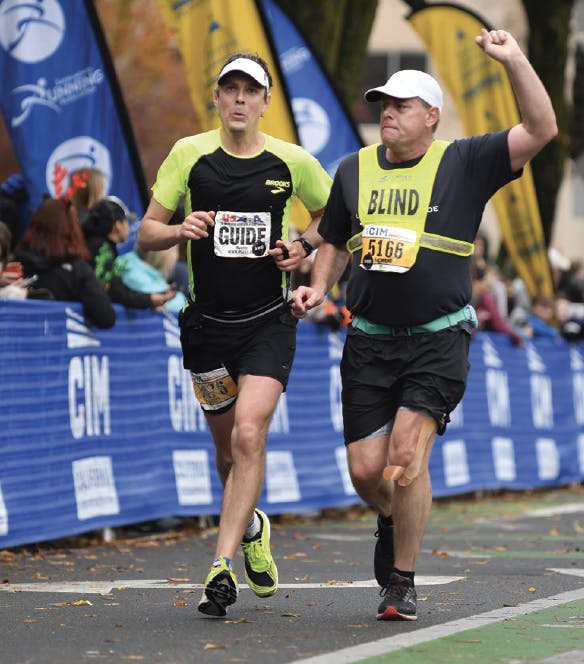
Figure. In 2019, Richard Hunter completed the California International Marathon with his guide, Scott Jurek.
Image courtesy of Richard Hunter
In addition to tracking down and personally inviting visually impaired runners from all over the world, Mr. Hunter also developed the extensive guide network that was necessary to guide the visually impaired runners once they got to the race course.
Like most runners who are visually impared or blind, Mr. Hunter runs with a guide, which inevitably garners some attention on the course.
“I was doing all these different races, and there would be other people running the course who would see us out there and ask how they could get involved in guiding,” he said. “Of course, my answer used to be something like, ‘how good is your memory? Here’s my email address. When you get home, send me an email.’”
He realized that, unless you happened to know one of a handful of visually impaired runners, the information just wasn’t out there. There was a huge need, and Mr. Hunter decided that he would find a way to help others network and connect with guides. He approached the nonprofit Massachusetts Association for the Blind and Visually Impaired with his idea, and together they founded United in Stride, a program that registers guides so that visually impaired athletes can connect with them. Now, runners don’t have to memorize an email address while chugging through mile 18 of their marathon—they can search online by zip code.
The outpouring of support for the guide program has been wonderful, according to Mr. Hunter. “I’m hearing stories and seeing things in the news about United in Stride and how important it was because they met a new friend, and they met running guides that helped them prepare and run in a race.”
While it’s heart-warming to see other endurance runners attain their goals, that’s not all United in Stride is meant for, according to Mr. Hunter. He is working on expanding its scope so that all visually impaired people, wherever they are in their vision and fitness journeys, can connect with volunteers looking to help them get out and participate.
“There are visually impaired people who want to power walk and jog in every community across the United States if they only had it modeled for them and had resources to do it. United in Stride has been a great resource for people who’ve been runners, but it was always intended to be a resource for power walkers, joggers, and runners—people who may never run a race but just need to find power walking or jogging partners.”
THE RETINA CONNECTION
Guiding the blind is where the story intersects with the field of retina, beyond Mr. Hunter’s excellent retina specialist (Joel A. Pearlman, MD, at Retina Consultants Medical Group in Sacramento, California, in case you were wondering). That’s how he met Vivienne S. Hau, MD, PhD, a clinical assistant professor and surgical vitreoretinal specialist at Kaiser Permanente in Riverside, California—known as scalpel among her running buddies.
Dr. Hau runs her own marathons but also guides the blind in theirs. She and Mr. Hunter have been running together for years, and they teamed up in 2019 to support the first all-blind team of runners for the 199-mile Hood to Coast Relay. Mr. Hunter was the co-captain of the team (10 blind/visually impaired runners and 10 guides), while Dr. Hau was the logistics lead. The team finished in 186th place of more than 1,000 teams, averaging less than an 8 min/mile pace.
What Advice Can You Offer Retina Specialists Who Are Treating Patients With Inherited Retinal Diseases And Visual Impairment?
Richard Hunter: While many cling to the hope for a cure or treatment for themselves or a loved one, hope for the future needs to be more than the possibility of a cure. Once someone experiences the life-changing effects of vision impairment, hope also must be about believing that they can live a fulfilling life regardless of their vision impairment.
Retina specialists delivering the news of a diagnosis need to fully appreciate that their patient is receiving news that can be quite traumatic, especially if there is the prospect of irreversible and permanent vision loss. Those of us on the receiving end of that conversation are far from having a positive outlook in the near term.
Because doctors have limited time with their patients, I personally believe that the team needs to include someone on staff, like a nurse navigator, who has more time to educate, intervene, and follow up with patients. It would make a big difference if a retina specialist would be able to say, “You have just received some very difficult news and it’s a lot to take in; I’m going to have our navigator talk with you and your family before you go home and follow up with you in a few days. You will have many questions and we want to help.”
I am fortunate to have a wonderful trusting relationship with my retina specialist, Joel A. Pearlman, MD, PhD. He takes an interest in who I am as a person and has a wonderful bedside manner. He takes the time to share relevant X-linked and RPGR RP research and has gone out of his way several times to direct me to important resources. I have faith that Dr. Pearlman will know what is best for me, and I trust any advice he offers because of this positive relationship.
Retina specialists will not have a cure for everyone, so the human connection becomes critical. They are the first responders to those receiving that life-changing diagnosis. The hope they offer is more than the hope of a treatment that may be 5 or 10 years away. Hope starts with compassionate treatment and a human-to-human connection to timely resources. For many of us, the greatest hope for the future is meeting others who are thriving and who have similar interests. If the retina practice is the only touchpoint for patients, it becomes increasingly important that someone on the staff has a relationship with the patient to facilitate timely introductions to individuals and programs. Hope does not come in the form of a flyer or a link on a website. It must come through a trusting relationship.
“I have so much respect and admiration for Dr. Hau,” Mr. Hunter said. “She has made a point of developing friendships with visually impaired athletes and has learned our stories, which she can share directly with her patients. By volunteering to guide runners like me, she shows by her actions that she cares. I’m confident that this fosters a higher level of trust with her patients whose vision she cannot restore.”
Guides who are also eye doctors are a rare find but are the most valuable, in Mr. Hunter’s opinion. Where else could a patient spend hours with someone who has intimate knowledge of the vision journey they are on? Beyond the day-to-day information gathering such a pairing can enable, having doctors involved in the cause shows patients that they care. And at the end of the day, caring is what matters most.
“I hope that there are more people out there like Dr. Hau and Dr. Pearlman who take an interest in my story,” Mr. Hunter said. “When we know that retinal specialists care about us, whether they can fix our eyes or not, and they take personal interest in making sure that we’re being directed at the right time to the right people, it’s helpful.”
Mr. Hunter added that, for many with inherited retinal diseases, the vision journey is life-long. He had no need for low vision services for 14 years before his vision deteriorated, and any referral at the initial diagnosis was a waste. He needed those later in his journey, and an astute retina practice should be prepared to make those timely referrals when needed, he suggested.
“I’m going to continue to see my retinal specialist every year that I walk this earth, but I’m not always going to be in a rehabilitation program,” he explained. “We’ll all have seasons of challenges and victories during this constant adjustment to life, with maybe decreasing vision or blindness.”
“People who are traumatized by a diagnosis are going to have questions and fears,” Mr. Hunter continued. “Often, they’re not going to know a single other person with vision loss. The retina specialists know all of them, and they are in a unique position to be a first responder. If they direct their patients to the right resources at the right time, it could literally be the difference between life and death.”
Want to know more about United in Stride? Click here.
1. USABA Marathon National Championships 2022 - Sponsored by Allworth Financial. Accessed January 19, 2023. usabamnc.corvin.org/2022


-1_1678291312.jpg?auto=compress,format&w=70)

_1784132761.jpg?auto=compress,format&w=75)





