


AT A GLANCE
- Multiculturalism can be defined as the degree to which an individual knows, identifies with, and internalizes more than one culture.
- Individuals who are multicultural often have more creative minds, perform better at problem-solving tasks, and are more successful leaders.
- When patients are nonnative English speakers and require translation services, consider learning how to say hello and goodbye in their language.
- Having a practice where patients feel seen and heard leads to an improved patient experience and increased adherence to treatment and follow-up.
“Buenas Días!” The first patient of the day is through the door. She is an 87-year-old woman from the Dominican Republic who requires frequent visits due to severe proliferative diabetic retinopathy with diabetic macular edema. Although she does not speak English, she can navigate the office by herself. When asked about her experience at NYC Retina, she states, “It is not just that they speak Spanish. It is the way I am treated from the front desk to the doctors. It is the warmth I feel when I am here. It is the jokes the doctors tell to make me at ease. Though I don’t enjoy getting injections or lasers, I love coming to the office. I feel like a human being.”
The Harvard Review defines multiculturalism within individuals as the degree to which they know, identify with, and internalize more than one culture.1 Individuals who are multicultural often have more creative minds, perform better at problem-solving tasks, and are more successful leaders in many areas of life, including medicine.1,2
THE PATIENTS
Our practice, NYC Retina, is a retina-only practice with offices in Manhattan and Queens. As such, we serve one of the most culturally diverse areas in the world. All our physicians and staff are multicultural and multilingual to meet the unique demands of practicing in such a proverbial melting pot. Our team speaks a total of 10 languages, but this is only a small sampling of the 160 languages spoken in Queens County.3
When patients are nonnative English speakers and require translation services, we still make it a point to learn how to say hello and goodbye in their language. Patients appreciate this extra effort and often respond with a chuckle or a smile.
In addition to speaking a patient’s language, we work to recognize and celebrate the multicultural fabric of our patient population. For example, in 1 day, we looked up the best recipe for khachapuri, the meaning of Guru Nanak Jayanti, and how a certain gesture communicates respect to the elderly in Filipino culture.
From the physician’s perspective, we see tremendous cultural differences in how patients communicate and prefer to receive information. For example, patients from certain backgrounds hesitate to ask questions of the physician, whom they perceive as a figure of authority. It is important to bridge that divide, and patients appreciate the effort to explain their diagnosis and the treatment options.
THE PROVIDERS
As a multicultural individual myself, I (J.S.) find enormous satisfaction in understanding where my patients are coming from and learning about their backgrounds and customs. I find that doing this consistently builds strong patient-doctor relationships and empowers the patient to be more engaged in their care.
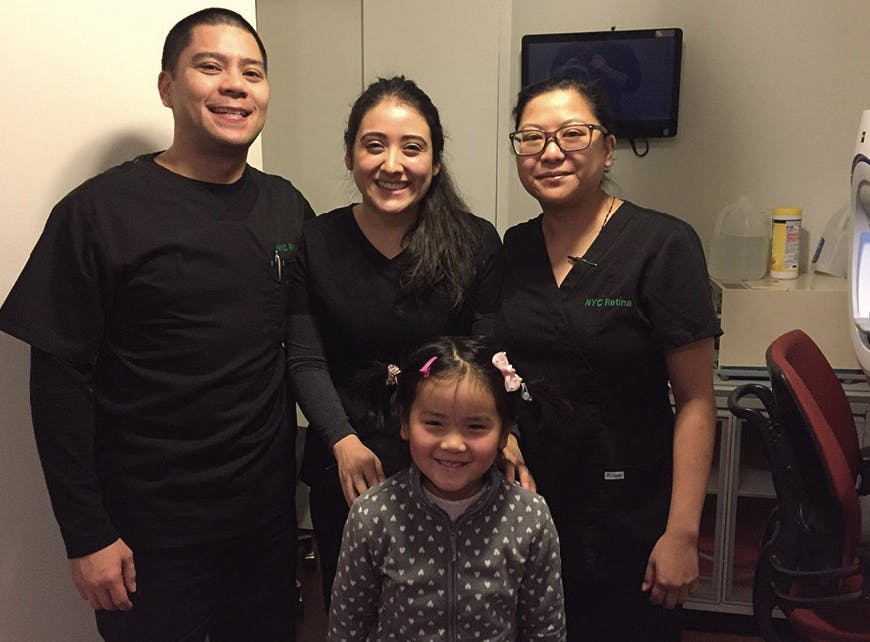
I (J.F.) enjoy talking to my patients about the holidays they celebrate, their traditions, and their families. Recently, I saw a patient from Sierra Leone who spoke Krio, an English-based creole language. I was surprised that I could understand him!
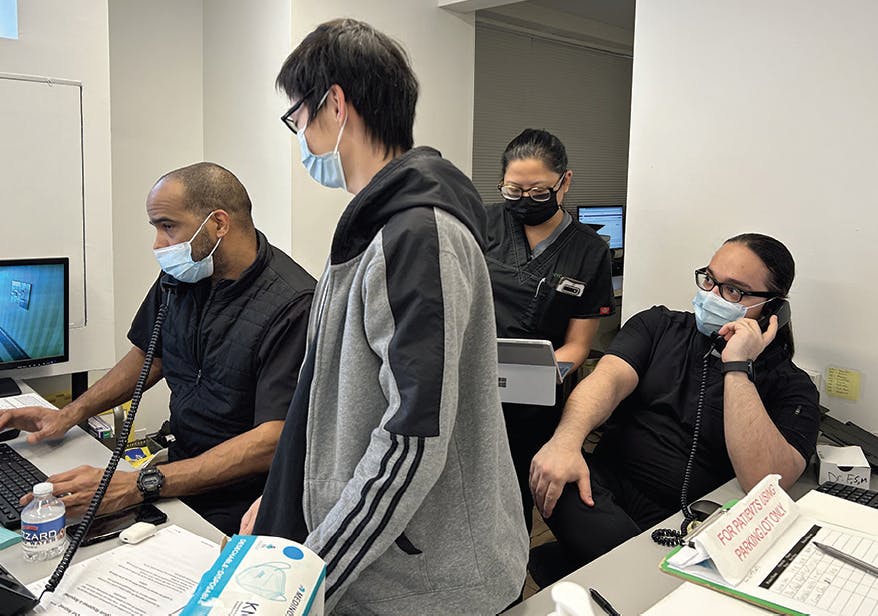
Figure 2. To help communicate with patients, front desk staff answer calls and make appointments in several languages.
As a fellow in this practice, I (C.M.) was immediately struck by the multiculturalism and inclusivity within the practice. Our patients appreciate that we respect them as individuals and try to understand where they are coming from when they voice their concerns or fears. In addition, the diversity of pathology has been tremendous; besides the usual bread-and-butter retinal diseases, we see a wide range of rare cases of posterior uveitis and inherited retinal disease that only occur in certain populations.
THE VALUE OF PHYSICIAN/PATIENT CONCORDANCE
By T.Y. Alvin Liu, MD

Have you ever had a patient drive 3 hours to see you? And not because you are the only retina specialist within 3 hours—but because you speak their language? I have, and it was a humbling reminder of the value of cultural sensitivity and diversity within our field.
I am originally from Hong Kong, and although I have been in the United States since high school, my family still lives in Hong Kong. I go between the two worlds often, and I speak both Cantonese and Mandarin. Like many who speak another language, I am not overly confident when explaining precise medical terms to my patients and still use a translator at times. Nonetheless, I have noticed that my patients appreciate my effort to connect with them in their preferred language. For example, I often introduce myself in Cantonese or Mandarin, say a few things and chitchat, and then switch to using English and a translator to ensure I convey the medical information properly. From the patient’s point of view, having doctors who show cultural sensitivity is very important.
Often, the conditions that we treat—such as wet AMD or retinal vascular diseases—require repeated injections, and many patients, even native English speakers don’t, understand that it is a chronic condition that requires ongoing treatment. Thorough education is crucial for every patient, but it can be particularly important for patients whose first language isn’t English. That’s when retina specialists should use an official translator to help explain everything in a culturally sensitive way and to convey that it is not a one-time treatment. Physicians should also do their best to have family members present when explaining this to build trust with the patient and their support network.
That patient who drove so far to see me was lucky with her diagnosis of stable dry AMD, making it a quick appointment that did not require frequent visits (yet). Still, it was an important reminder that speaking the same language, and connecting culturally, can significantly affect a patient’s care.
T. Y. Alvin Liu, MD
Assistant Professor of Ophthalmology, Wilmer Eye Institute, Johns Hopkins Medicine, Baltimore
Director, Wilmer Precision Ophthalmology Center of Excellence
tliu25@jhmi.edu
Financial disclosure: None
THE STAFF
We believe that our practice’s multiculturalism has contributed to increased staff satisfaction and improved staff retention rates.
“It is satisfying to come to work every day,” our scribe, Nancy, said. “The patients we see are so grateful to be able to communicate with us freely. They bring pictures of their families and home-cooked food. I feel that I am part of something amazing and that we are making a difference in people’s lives.”
“When speaking with a patient from Ecuador, Dr. Shulman knew that the word cataract (catarata) is used to refer to a pterygium and was able to clarify some of the confusion the patient had about the risk of cataract formation after her retina surgery,” Althea, our office manager, explained. “The doctors can tailor how they educate patients to the patient’s cultural background. This is a unique aspect of our practice.”
According to Joel, one of our technicians, “our retina patients often see multiple eye providers such as glaucoma specialists or comprehensive ophthalmologists. Many patients tell me that they wait for their retina appointment for the doctors to explain to them what is going on with all their other conditions in a way they can understand.”
Patient Testimonials from NYC Retina:
“When I met Dr. Feistmann, he was able to guide my mother through the eye examination in Bengali. I couldn’t believe it! She left the office with a big smile on her face and brags about him to all her friends.”
“Dr. Shulman examined and treated my mother, who is a Russian speaker. My mom has a multitude of ocular issues, and I am a physician myself, but I could not have explained more clearly the diagnosis, prognosis, and plan of treatment. On one particular visit, Dr. Shulman was able to pick up on my mom’s nervousness before a procedure. She took her hand, looked her in the eye, and asked her what was bothering her. Dr. Shulman seems to have a sixth sense when communicating with my mother.”
“Dr. Mei was able to reassure me in Cantonese during my surgery. Since I was awake, it was nice to hear a friendly voice and understand what was going on. She also made sure to go over the instructions on how to position my head and use my drops after surgery.”
GO MULTICULTURAL
There is increasing pressure on all medical practices to increase productivity, and often the unfortunate side effect of this process is the dehumanization of the physician-patient encounter. We experience this ourselves when we are in the patient role and feel that every effort should be made to create a practice in which patients feel heard, seen, and recognized. This leads to improved patient experience and increased adherence to the prescribed treatment and follow-up. Fostering a multicultural practice is our way of taking a step in that direction.
Want to highlight your own multicultural practice?
Send your story to rhepp@bmctoday.com.
1. Fitzsimmons S, Vora D, Martin L, Raheem S, Pekerti A, Lakshman C. What makes you “multicultural”. Harvard Bus Rev. December 2, 2019. Accessed January 16, 2023. Hbr.org/2019/12/what-makes-you-multicultural
2. Sierpina VS, Kreitzer MJ, MacKenzie E, Sierpina M. Regaining our humanity through story. Explore. 2007;3(6):626-632.
3. Lubin G. Welcome to the language capital of the world: Queens, New York. World Economic Forum. February 22, 2017. Accessed January 16, 2023. www.weforum.org/agenda/2017/02/queens-in-new-york-has-more-languages-than-anywhere-in-the-world


-1_1678291312.jpg?auto=compress,format&w=70)

_1784132761.jpg?auto=compress,format&w=75)





