



AT A GLANCE
- The adoption of multimodal imaging led to an updated definition of AMD stages and progression.
- The new nomenclature to classify AMD-related atrophy on OCT includes incomplete retinal pigment epithelium (RPE) and outer retinal atrophy and complete RPE and outer retinal atrophy.
- Visual function is decreasing before foveal involvement is diagnosed, and there is a large variation in visual acuity.
AMD is a multifactorial disease that involves an ill-defined interaction between aging, genetics, and environmental factors that are associated with oxidative stress, inflammation, and impaired extracellular matrix functioning within the retina, predominantly at the macula. AMD classification—traditionally tied to the presence and size of drusen and the presence of pigmentary changes or other signs of atrophy—provides prognostic estimates of disease progression. Unlike early AMD, intermediate AMD (iAMD) has a higher progression rate to late AMD, defined as either the development of geographic atrophy (GA) or subfoveal macular neovascularization (MNV).1 One study found that the 5-year risk of progression to advanced AMD was 0.4% for eyes without large drusen or pigmentary abnormalities and 47% for eyes with bilateral large drusen and pigmentary abnormalities.2
GA now has a treatment option with the approval of pegcetacoplan (Syfovre, Apellis Pharmaceuticals). Significant research is underway to better understand the potential treatment paradigm for patients with iAMD, especially selecting those with high-risk imaging features for progression to late AMD.3 As such, clinicians must be able to identify patients with iAMD who are at a high risk for progression.
A NEW STANDARD FOR AMD IMAGING
While ophthalmoscopy and color fundus photography (CFP) have been the standard for the examination and staging in AMD, the adoption of other imaging modalities—such as fundus autofluorescence (FAF), near-infrared imaging (NIR), and OCT—led the Classification of Atrophy Meeting (CAM) group to update the definition of the stages of AMD and progression. Now, multimodal imaging should be routine for proper diagnosis and prognostication of AMD.
OCT was particularly highlighted for its ability to4:
- provide greater accuracy in the evaluation of the retina in a volumetric fashion, given the high axial resolution;
- allow clinicians to independently evaluate each retinal layer and detect early signs of pathology;
- produce an en face image, which can be used to demarcate the borders of atrophy and directly correlate with other imaging modalities;
- calculate related enlargement rates over time; and
- provide as many scans as needed in a single visit.
Drusen and Hyper-Reflective Foci
Various OCT imaging studies have assessed the classical risk factors of AMD progression rates, such as drusen burden and pigmentary changes (visualized on OCT as hyper-reflective foci [HRF]). They found an increased risk of progression with increased baseline drusen area and volume measurements, as well as the presence of HRF.2,5,6
Abdelfattah et al found that eyes with a drusen volume of at least 0.03 mm3 had a four-fold increased risk of developing MNV or GA within 2 years, while Christenbury et al found a five-fold increased risk of developing GA within 2 years in eyes with HRF compared with eyes without baseline HRF.7,8
Reticular Pseudodrusen and Calcified Drusen
Reticular pseudodrusen (RPD), also known as subretinal drusenoid deposits, are commonly found in the superior regions of the macula and represent an increased risk of AMD progression.9-12 Chan et al found that the prevalence of RPD (best imaged with NIR imaging) varied with AMD staging, with the highest prevalence in eyes with iAMD (62.6%).11 Furthermore, Zweifel et al showed that the presence of RPD was associated with a nearly three-fold increased risk of progression to late AMD.12
Calcified drusen (CaD) are prevalent in iAMD and are of high prognostic value for the development of late AMD.13-16 Tan et al found that heterogeneous internal reflectivity within drusen (caused by multilobular nodules of crystalline calcium phosphate) was present in 45% of eyes with iAMD and was associated with the development of late AMD within 1 year (odds ratio: 6.36).16 Liu et al found that 42.7% of eyes with iAMD had CaD, and the majority of CaD develop into areas of GA, regardless of the exact B-scan appearance.13 Thus, CaD should be accounted for in AMD risk assessment.
Defining Atrophy on OCT
Because GA was originally defined on CFP, the CAM group developed new nomenclature to classify AMD-related atrophy on OCT: incomplete retinal pigment epithelium (RPE) and outer retinal atrophy (iRORA) and complete RPE and outer retinal atrophy (cRORA, Figure 1). cRORA corresponds to an area of at least 250 µm on a single horizontal B-scan showing the following:
1. attenuation or complete loss of the RPE, alongside
2. a corresponding hyper-transmission defect (hyperTD) through the area of RPE change, and
3. signs of photoreceptor degeneration, such as subsidence of the inner nuclear layer (INL) or the outer plexiform layer; thinning of the outer nuclear layer; presence of a hyporeflective wedge in the Henle fiber layer; or disruption of the external limiting membrane (ELM) or ellipsoid zone (EZ), all in the absence of an RPE tear.
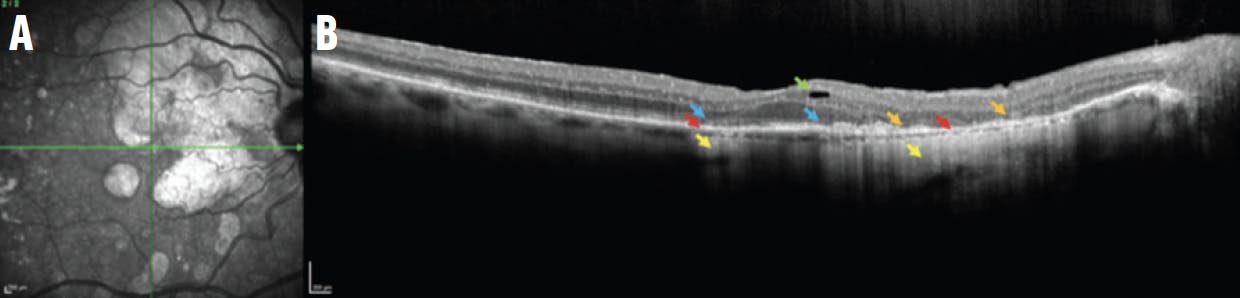
Figure 1. NIR imaging (A) and an OCT B-scan of a cRORA lesion (B) show disruption of the ELM and EZ (blue arrows) and regions of RPE attenuation (red arrows) with associated hyperTDs into the choroid (yellow arrows). There are areas of photoreceptor degeneration (orange arrows) and an incidental degenerative cyst (green arrow).
iRORA refers to a horizontal B-scan area that has some, but not all, of the features of cRORA (Figures 2 and 3).4,17
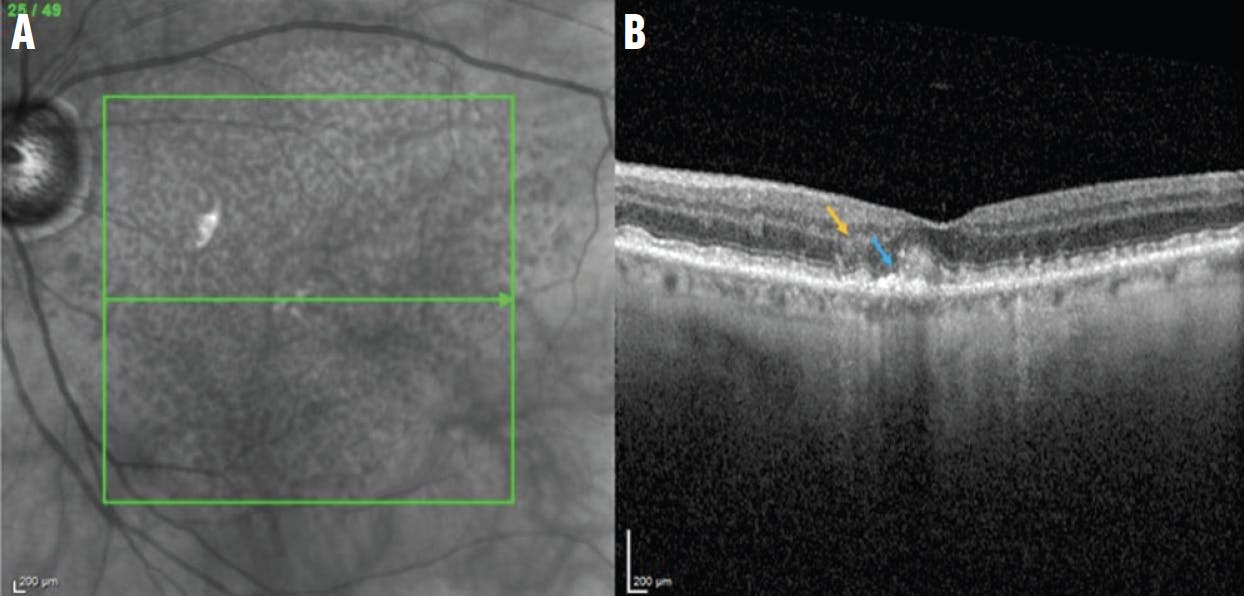
Figure 2. NIR imaging (A) and an OCT B-scan of an iRORA lesion (B) show disruption of the ELM and EZ (blue arrow) and subsidence of the INL (orange arrow).
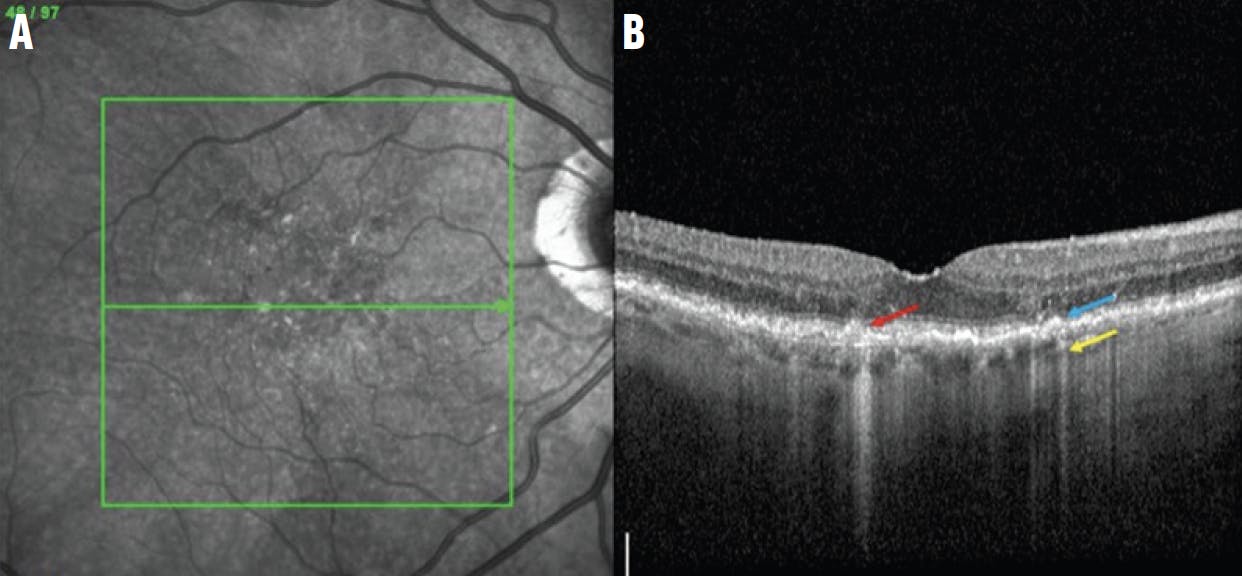
Figure 3. NIR imaging (A) and an OCT B-scan of an iRORA lesion (B) show disruption of the ELM and EZ (blue arrow) and focal attenuation of the RPE (red arrow) with associated hyperTDs into the choroid (yellow arrow).
Researchers are working to determine the utility of identifying iRORA lesions and assessing their risk of progression to cRORA on OCT and/or GA on CFP.
Although there is some variability in stratifying the risk of progression, iRORA features imply an enhanced risk of progression to cRORA. For example, Corradetti et al found that approximately 93% of iRORA lesions converted to cRORA within 24 months, while Wu et al found that iRORA lesions convert to GA on CFP at a rate of about 3% by 24 months and 10% by 30 months.18,19
Another OCT precursor to GA is nascent GA (nGA), which is defined as having a hyporeflective wedge in the Henle fiber layer and/or subsidence of the INL and outer plexiform layer with or without RPE or hyperTDs; Wu et al found that nGA had a much higher conversion rate to GA on CFP than iRORA within 24 months (38% vs 3%).19,20
Atrophy can be seen much earlier on OCT than on CFP, and nGA has more specific criteria than iRORA. Therefore, these findings show that iRORA will convert to cRORA (ie, true irreversible retinal atrophy) in a relatively short time but may remain undetected on CFP until much later.
In addition, iRORA may signify that irreversible functional damage has already occurred (ie, iRORA and related visual changes may be clinically similar to cRORA and related visual changes). Trivizki et al showed that many cRORA lesions are miscategorized as iRORA because the iRORA diagnostic criteria fail to incorporate all dimensions of atrophic lesions; the atrophic area would meet cRORA criteria if vertical and diagonal B-scans were evaluated with the horizontal B-scans.21
En Face HyperTD
As an alternative to OCT-mediated iRORA/cRORA, hyperTDs into the choroidal layer—seen as bright areas on en face OCT images positioned in the sub-RPE segmentation with borders from 64 µm to 400 µm under Bruch membrane—provide a reliable, reproducible, and independent feature and risk factor for GA.22-24 Compared with iRORA/cRORA grading criteria, the grading of hyperTDs via en face images allows for: a lesion’s greatest linear dimension (GLD) to be measured in any vector (not only horizontally); direct visual comparison with other AMD imaging modalities, such as CFP, NIR, and FAF; and a rapid assessment of the entire scan region. Studies show that hyperTDs with a GLD of at least 250 µm will likely persist for at least 3 years, correlate strongly with nGA (79%), and signify an 80-fold risk of the formation of cRORA within 3 years. While hyperTDs of smaller sizes were found to be transient and not as highly correlated to developing atrophy, they may still signify areas of at-risk RPE, as the areas may qualify as iRORA.23,24
RISK ASSESSMENT AFTER GA
Once iRORA/cRORA, nGA, or hyperTDs form in an eye, more lesions are likely to develop in the same eye and the fellow eye. Additionally, once GA develops on OCT and/or CFP, certain characteristics (ie, larger lesions, multifocality, and an extrafoveal location) are associated with increased growth rates.25-30 Notably, although sub-foveal GA lesions can correlate with large drops in visual acuity, visual function is decreasing before foveal involvement is diagnosed, and there is a large variation in visual acuity even when imaging suggests highly affected visual acuity. Therefore, visual acuity is not a reliable tracker of disease severity.30,31
Finally, as the CAM group recommended, multimodal imaging such as FAF can provide additional risk-assessment information. While GA corresponds to hypoautofluorescence, GA growth rates differ depending on the extent and pattern of hyperautofluorescence. Absence of hyperautofluoresence or focal patterns of hyperautofluorescence relate to slow GA growth rates (0.38 to 0.81 mm2/year), diffuse and banded patterns have greater than double the growth rates (1.77 to 1.81 mm2/year), and the “diffuse-trickling” subtype pattern has the highest growth rate (3.02 mm2/year).32 Additionally, the extent of hyperautofluorescence surrounding GA lesions, representing at-risk RPE, positively correlates with GA growth rates on a per lesion basis.33
Our understanding of the presence and characteristics of drusen, CaD, HRF, RPD, iRORA/cRORA, nGA, and hyperTDs and the risks associated with these imaging findings are clinically relevant in determining which patients will benefit the most from early treatment.
1. Fleckenstein M, Keenan TDL, Guymer RH, et al. Age-related macular degeneration. Nat Rev Dis Primers. 2021;7(1):31.
2. Ferris FL, Davis MD, Clemons TE, et al. A simplified severity scale for age-related macular degeneration: AREDS Report No. 18. Arch Ophthalmol. 2005;123(11):1570-1574.
3. Flores R, Carneiro A, Tenreiro S, Seabra MC. Retinal progression biomarkers of early and intermediate age-related macular degeneration. Life (Basel). 2021;12(1):36.
4. Sadda SR, Guymer R, Holz FG, et al. Consensus definition for atrophy associated with age-related macular degeneration on OCT: Classification of Atrophy Report 3. Ophthalmology. 2018;125(4):537-548.
5. de Sisternes L, Simon N, Tibshirani R, Leng T, Rubin DL. Quantitative SD-OCT imaging biomarkers as indicators of age-related macular degeneration progression. Invest Ophthalmol Vis Sci. 2014;55(11):7093-7103.
6. Nathoo NA, Or C, Young M, et al. Optical coherence tomography-based measurement of drusen load predicts development of advanced age-related macular degeneration. Am J Ophthalmol. 2014;158(4):757-761 e1.
7. Abdelfattah NS, Zhang H, Boyer DS, et al. Drusen volume as a predictor of disease progression in patients with late age-related macular degeneration in the fellow eye. Invest Ophthalmol Vis Sci. 2016;57(4):1839-1846.
8. Christenbury JG, Folgar FA, O’Connell RV, et al. Progression of intermediate age-related macular degeneration with proliferation and inner retinal migration of hyperreflective foci. Ophthalmology. 2013;120(5):1038-1045.
9. Gregori G, Wang F, Rosenfeld PJ, et al. Spectral domain optical coherence tomography imaging of drusen in nonexudative age-related macular degeneration. Ophthalmology. 2011;118(7):1373-1379.
10. Waugh N, Loveman E, Colquitt J, et al. Treatments for dry age-related macular degeneration and Stargardt disease: a systematic review. Health Technol Assess. 2018;22(27):1-168.
11. Chan H, Cougnard-Gregoire A, Delyfer MN, et al. Multimodal imaging of reticular pseudodrusen in a population-based setting: The Alienor Study. Invest Ophthalmol Vis Sci. 2016;57(7):3058-3065.
12. Zweifel SA, Imamura Y, Spaide TC, Fujiwara T, Spaide RF. Prevalence and significance of subretinal drusenoid deposits (reticular pseudodrusen) in age-related macular degeneration. Ophthalmology. 2010;117(9):1775-1781.
13. Liu J, Laiginhas R, Shen M, et al. Multimodal imaging and en face OCT detection of calcified drusen in eyes with age-related macular degeneration. Ophthalmol Sci. 2022;2(2): 100162.
14. Bonnet C, Querques G, Zerbib J, et al. Hyperreflective pyramidal structures on optical coherence tomography in geographic atrophy areas. Retina. 2014;34(8):1524-1530.
15. Suzuki M, Curcio CA, Mullins RF, Spaide RF. Refractile drusen: clinical imaging and candidate histology. Retina. 2015;35(5):859-865.
16. Tan ACS, Pilgrim MG, Fearn S, et al. Calcified nodules in retinal drusen are associated with disease progression in age-related macular degeneration. Sci Transl Med. 2018;10(466):eaat4544.
17. Guymer RH, Rosenfeld PJ, Curcio CA, et al. incomplete retinal pigment epithelial and outer retinal atrophy in age-related macular degeneration: Classification of Atrophy Meeting Report 4. Ophthalmology. 2020;127(3):394-409.
18. Corradetti G, Corvi F, Nittala MG, et al. Natural history of incomplete retinal pigment epithelial and outer retinal atrophy in age-related macular degeneration. Can J Ophthalmol. 2021;56(5):325-334.
19. Wu Z, Goh KL, Hodgson LAB, Guymer RH. incomplete retinal pigment epithelial and outer retinal atrophy: longitudinal evaluation in age-related macular degeneration. Ophthalmology. 2023;130(2):205-212.
20. Wu Z, Luu CD, Ayton LN, et al. Optical coherence tomography-defined changes preceding the development of drusen-associated atrophy in age-related macular degeneration. Ophthalmology. 2014;121(12):2415-2422.
21. Trivizki O. When is iRORA really cRORA? Paper presented at Angiogenesis, Angiogenesis, Exudation, and Degeneration; February 10, 2023; Virtual.
22. Liu J, Laiginhas R, Corvi F, et al. Diagnosing persistent hypertransmission defects on en face OCT imaging of age-related macular degeneration. Ophthalmol Retina. 2022;6(5):387-397.
23. Shi Y, Yang J, Feuer W, Gregori G, Rosenfeld PJ. Persistent hypertransmission defects on en face OCT imaging as a stand-alone precursor for the future formation of geographic atrophy. Ophthalmol Retina. 2021;5(12):1214-1225.
24. Laiginhas R, Shi Y, Shen M, et al. Persistent hypertransmission defects detected on en face swept source optical computed tomography images predict the formation of geographic atrophy in age-related macular degeneration. Am J Ophthalmol. 2022;237:58-70.
25. Laiginhas R, Liu J, Shen M, et al. Multimodal imaging, OCT B-scan localization, and en face OCT detection of macular hyperpigmentation in eyes with intermediate age-related macular degeneration. Ophthalmol Sci. 2022;2(2):100116.
26. Wang J, Ying GS. Growth rate of geographic atrophy secondary to age-related macular degeneration: a meta-analysis of natural history studies and implications for designing future trials. Ophthalmic Res. 2021;64(2):205-215.
27. Liu J, Shen M, Laiginhas R, et al. Onset and progression of persistent choroidal hypertransmission defects in intermediate AMD: a novel clinical trial endpoint: hypertransmission defects as a clinical trial endpoint. Am J Ophthalmol. 2023;S0002-9394(23):114-119.
28. Heesterbeek TJ, Lores-Motta L, Hoyng CB, Lechanteur YTE, den Hollander AI. Risk factors for progression of age-related macular degeneration. Ophthalmic Physiol Opt. 2020;40(2):140-170.
29. Sunness JS, Margalit E, Srikumaran D, et al. The long-term natural history of geographic atrophy from age-related macular degeneration: enlargement of atrophy and implications for interventional clinical trials. Ophthalmology. 2007;114(2):271-277.
30. Fleckenstein M, Mitchell P, Freund KB, et al. The progression of geographic atrophy secondary to age-related macular degeneration. Ophthalmology. 2018;125(3):369-390.
31. Heier JS, Pieramici D, Chakravarthy U, et al. Visual function decline resulting from geographic atrophy: results from the Chroma and Spectri phase 3 trials. Ophthalmol Retina. 2020;4(7):673-688.
32. Holz FG, Bindewald-Wittich A, Fleckenstein M, et al. Progression of geographic atrophy and impact of fundus autofluorescence patterns in age-related macular degeneration. Am J Ophthalmol. 2007;143(3):463-472.
33. Allingham MJ, Nie Q, Lad EM, et al. Semiautomatic segmentation of rim area focal hyperautofluorescence predicts progression of geographic atrophy due to dry age-related macular degeneration. Invest Ophthalmol Vis Sci. 2016;57(4):2283-2239.


_1784132761.jpg?auto=compress,format&w=75)





