


AT A GLANCE
- The introduction of biosimilars may lower overall health care spending on biologics.
- Michigan insurers announced that new patient approval for aflibercept (Eylea, Regeneron) will first require a failure to both off-label bevacizumab (Avastin, Genentech/Roche) and ranibizumab-nuna (Byooviz, Samsung Bioepis/Biogen).
- Bevacizumab-vikg (Outlook Therapeutics), if approved, may not affect access to off-label bevacizumab.
There are two categories of prescription drugs: small molecules and biologics. Small molecules (conventional drugs) are simple and chemically synthesized; biologics are large, complex molecules manufactured via living organisms. The price of biologics is significantly higher than conventional drugs, and in 2021, biologics accounted for 46% of net drug spending, despite being only 3% of all prescription drugs by volume.1,2
In ophthalmology, biologics such as anti-VEGF agents account for the second largest Medicare Part B drug expenditure (Figure 1).3 Aflibercept (Eylea, Regeneron) and ranibizumab (Lucentis, Genentch/Roche) continue to be ranked the 2nd and 6th highest drug cost, respectively–accounting for 12% of all Medicare Part B spending within the last 5 years.3
In this article, we discuss the introduction of biosimilars into our ecosystem to address this growing cost, and what it might mean for our day-to-day practice.
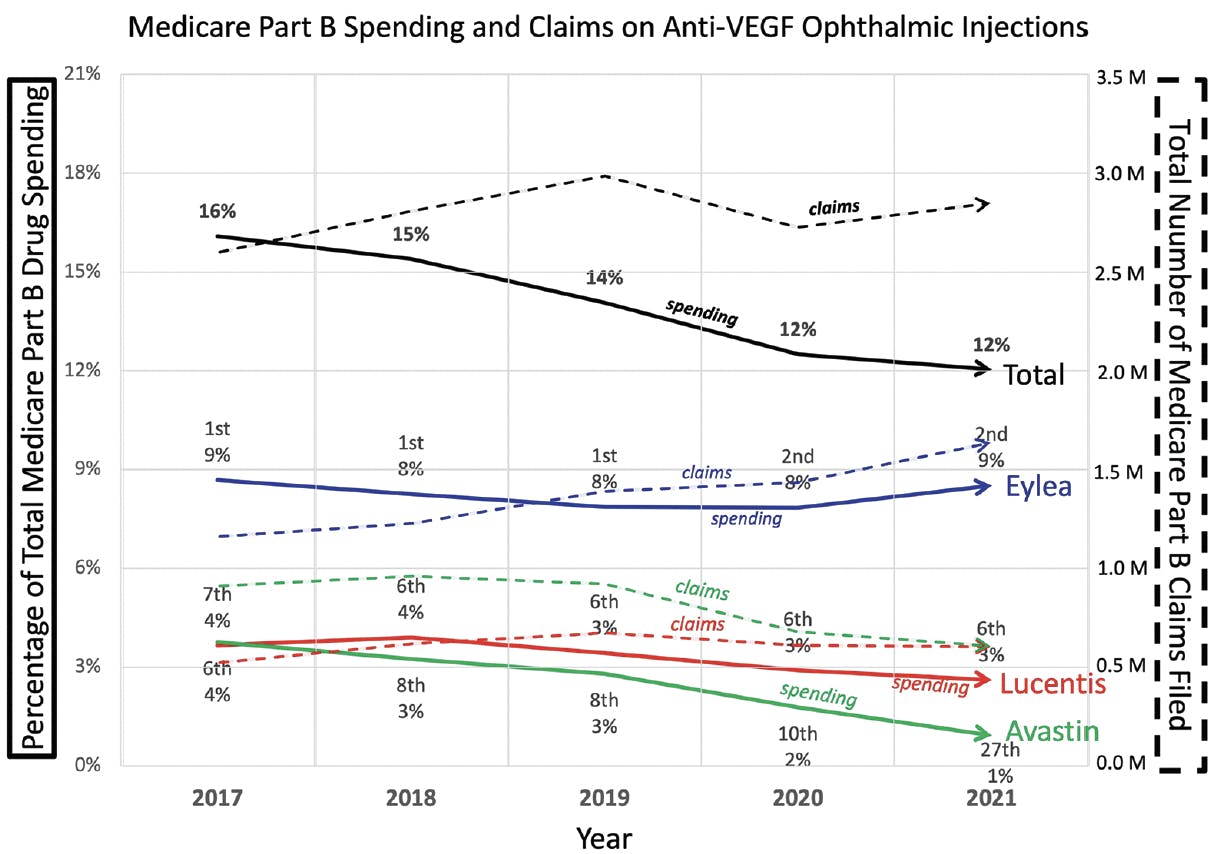
Figure 1. The three commonly used anti-VEGF injections in ophthalmology account for 14% of Medicare Part B drug cost over the 5-year period. The number of claims and total spending continue to increase largely due to increased use of the higher-price aflibercept over the lower-cost off-labeled bevacizumab. The three anti-VEGF drugs claimed the top 10 highest Medicare Part B drug spendings up until the year 2021 when bevacizumab dropped down to 27th on the list, while aflibercept and ranibizumab maintained the second and sixth highest medication expenditure. Of note, reported bevacizumab claims may be for nonophthalmic indications, but given the sheer volume, ophthalmic use is likely the major contributor.3
CUTTING COSTS
To curtail the rising cost of biologics, the FDA promotes the development of biosimilars via an abbreviated approval pathway. Biosimilars are highly analytically similar to or interchangeable with an FDA-approved biologic, a reference product. The FDA has approved 40 biosimilars, 22 of which are available to patients.4 Biosimilar competition is driving prices down for both biosimilars and reference products, contributing to an estimated $7 billion in savings in 2021.1
The Centers for Medicare and Medicaid Services will incorporate approved biosimilars into the Average Sales Price (ASP) payment methodology. When a biosimilar is first introduced, Medicare’s payment will be based on the Wholesale Acquisition Cost (WAC) listed by the manufacturer plus 3% while the ASP is being established. After two quarters, Medicare reimbursement is based on the ASP, which will factor in rebates and discounts reported by the drug manufacturer. Furthermore, under the Inflation Reduction Act, Medicare will pay the ASP plus 8% of the reference product’s ASP, rather than the traditional 6%, for certain biosimilar products for a 5-year period.6
A review of biosimilars introduced over the past 5 years shows a trend for biosimilars to use a high WAC, high rebate strategy. A biosimilar manufacturer often lists the initial WAC at an approximate 30% reduction of the reference product’s retail price, although that strategy is variable. Increased use of biosimilars, along with the high rebates and discounts, quickly drives the ASP and Medicare allowable down each quarter. Within 5 years of increasing market share, a biosimilar’s ASP will have dropped by more than 50% of its initial WAC listed price and the reference product’s ASP at the time the biosimilar was launched.1 This reimbursement model incentivizes early use of biosimilars, and the net effect leads to a reduction in overall health care spending.
WHAT THIS MEANS FOR RETINA
In ophthalmology, there are two approved biosimilars: ranibizumab-nuna (Byooviz, Samsung Bioepis/Biogen) and ranibizumab-eqrn (Cimerli, Coherus). A review of the Medicare allowable for anti-VEGF injections over the last decade shows a steady decline in the price of anti-VEGF agents as the exclusivity end date of the drug nears (Figure 2).6 If ophthalmology follows the oncology market trends, the incorporation of biosimilars into practice could trigger a rapid decline in ASP for the biosimilar and reference drug.
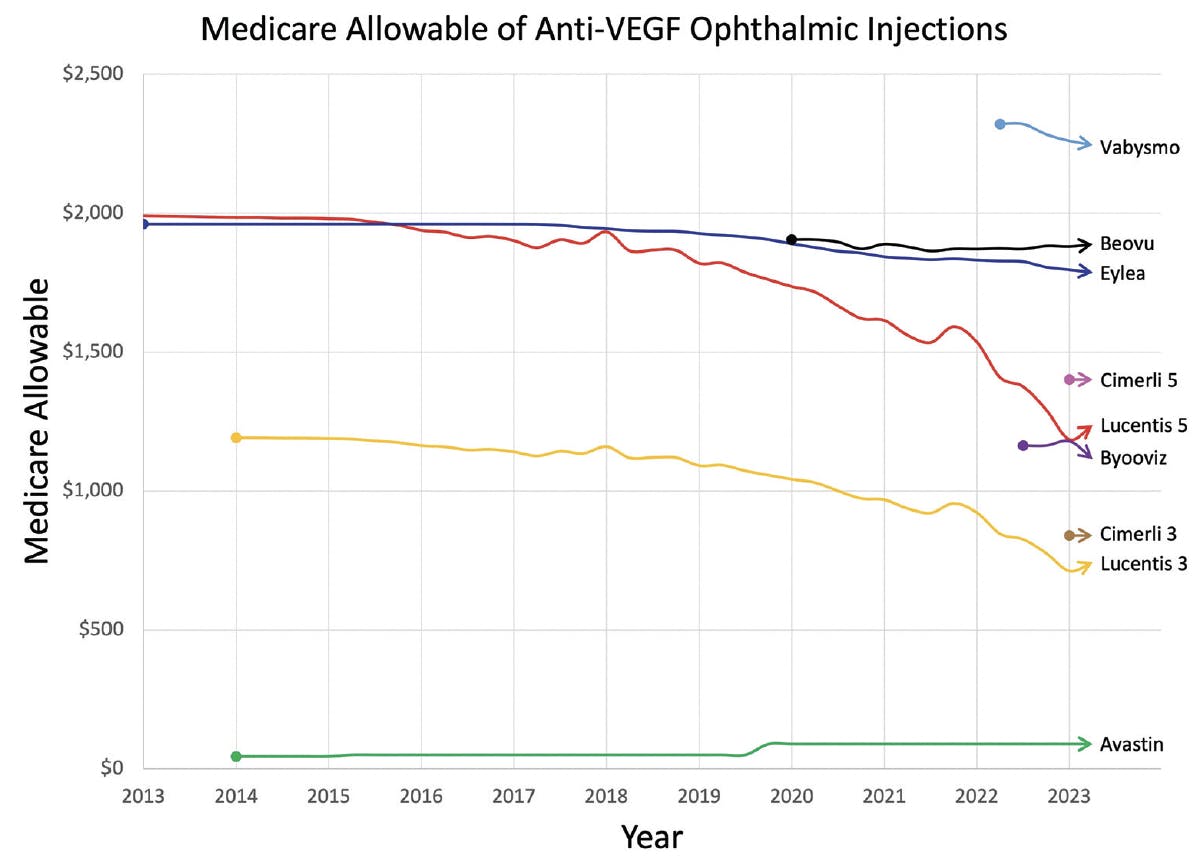
Figure 2. Starting around 2019, aflibercept started to claim more market share from ranibizumab and bevacizumab. The combination of redistribution of shares, exclusivity end-date nearing, and increasing rebates/discounts led to a steady decline in ranibizumab’s ASP and the Medicare allowable. Ranibizumab-nuna was initially priced at a 42% reduced cost than retail 0.5 mg ranibizumab and both 0.3 mg and 0.5 mg ranibizumab-eqrn (Cimerli 3 and 5) at a 30% reduced cost compared with 0.3 mg and 0.5 mg ranibizumab. However, given the declining ASP of ranibizumab, in quarter 2 of 2023 ranibizumab-nuna ASP plus 8% reimbursement represented only a 10% in cost saving compared with brand ranibizumab for the quarter. Both 0.3 mg and 0.5 mg ranibizumab-eqrn WAC plus 3% led to a price increase of 13% compared with the respective reference products’ ASP that quarter.6
Insurance companies, particularly Medicare Advantage plans, may accelerate the early use of biosimilars via step therapy requirements. Given that in 2023, a single beneficiary has an average of 43 available Medicare Advantage plans, incorporation of biosimilars into variable and constantly changing step therapy protocols will only add to the administrative burden for practices.7
Recently, Blue Cross Blue Shield of Michigan and Blue Care Network announced that new patient approval for aflibercept will first require a failure to both off-label bevacizumab and ranibizumab-nuna.8 Interestingly, branded ranibizumab and faricimab-svoa (Vabysmo, Genentech/Roche) do not require ranibizumab-nuna failure per these insurers’ updated guidelines.9,10 Per a discussion with Regeneron representation, there are plans to counter the recent incorporation of biosimilars in step therapy for aflibercept in Michigan, but these changes confirm that the use of biosimilars in step therapy should be anticipated.
FINANCIAL RAMIFICATIONS
Unlike in oncology, the potential cost savings of biosimilars in ophthalmology is thought to be limited, as a less expensive alternative to branded anti-VEGF drugs already exists in off-label use of repackaged bevacizumab (Avastin, Genentech/Roche). The widespread use of repackaged bevacizumab has saved billions of dollars compared with brand-name drugs since 2006.11 There is growing concern that the anticipated FDA approval of bevacizumab-vikg (Lytenava, Outlook Therapeutics) will threaten access to repackaged bevacizumab.12 The Drug Quality Security Act regulates that 503B outsourcing facilities cannot compound a drug that is “essentially a copy of an approved drug.”13 The definition of “essentially a copy” has never been articulated, nor has it been argued in court to establish precedent. However, if bevacizumab-vikg obtains FDA approval, it will be designated as a new molecular entity, further labeling it as containing new active moieties that the FDA has not previously approved. Unlike simple molecule drugs, the complexity of biologics creates inherent variability, making it impossible to create an identical biologic. This suggests that, if bevacizumab-vikg is approved, it may not affect access to repackaged bevacizumab by compounding pharmacies, although this may be contested and further settled in court.
THE BOTTOM LINE
The introduction of ophthalmic biosimilars may lower overall health care spending with time and increasing market share. Insurers may force early use by incorporating biosimilars into step therapy protocols. With longer-acting anti-VEGF drugs on the horizon, there is growing concern that biosimilar step therapy may hinder advance treatment options for patients. Furthermore, bevacizumab biosimilars have the potential to threaten the availability of off-label bevacizumab. Although biosimilars will be an increasingly important aspect of anti-VEGF therapy, many questions remain.
1. The U.S. Generic & Biosimilar Medicines Savings Report. Association for Accessible Medicines. September 2022. Accessed May 2, 2023. bit.ly/3LQWHbf
2. Biosimilars in the United States 2023-2027: Competition, Savings, and Sustainability. The IQVIA Institute for Human Data Science. Accessed May 2, 2023. bit.ly/42Er23z
3. Medicare Part B Spending by Drug. Centers for Medicare & Medicaid Services. Accessed May 2, 2023. bit.ly/3VSCeaH
4. FDA-TRACK: Center for Drug Evaluation & Research - Pre-Approval Safety Review - Biosimilars Dashboard. FDA. Accessed May 2, 2023. bit.ly/3VQr6el
5. Inflation Reduction Act. Public law 117–169. August 16, 2022.
6. Medicare Part B drug average sales price. Centers for Medicare & Medicaid Services. Accessed May 2, 2023. bit.ly/3LSxYn9
7. Freed MB, Biniek JF, Damico A, Neuman T. Medicare Advantage 2023 Spotlight: First Look. Kaiser Family Foundation. November 10, 2022. Accessed May 2, 2023. bit.ly/3MbSq3L
8. Eylea (aflibercept). Blue Cross, Blue Shield of Michigan / Blue Care Network. Accessed May 2, 2023. bit.ly/3B8PXRc
9. Ranibizumab Policy. Blue Cross, Blue Shield of Michigan / Blue Care Network. Accessed May 2, 2023. bit.ly/3LNZQIT
10. Vabysmo (faricimab-svoa). Blue Cross, Blue Shield of Michigan / Blue Care Network. Accessed May 2, 2023. bit.ly/3pshWZB
11. Glasser DB, Parikh R, Lum F, Williams GA. Intravitreal anti-vascular endothelial growth factor cost savings achievable with increased bevacizumab reimbursement and use. Ophthalmology. 2020;127(12):1688-1692.
12. Zhang C, Friedman S, Mruthyunjaya P, Parikh R. The biosimilar paradox: how anti-VEGF biosimilars will increase patient and overall healthcare costs [preprint published online April 26, 2023]. Ophthalmology.
13. Title 21-Food and Drugs. Chapter 9-Federal Food, Drug, and Cosmetic Act. Subchapter V-Drugs and Devices. Part A-Drugs and Devices. Sec. 353b-Outsourcing facilities. U.S. Government Publishing Office. Accessed May 2, 2023. bit.ly/42mmnUa


_1784132761.jpg?auto=compress,format&w=75)





