


AT A GLANCE
- The use of remote monitoring and AI is inevitable in the field of retina. However, concerns related to workflow, liability, and reimbursement hinder its adoption in day-to-day practice.
- Cardiology has found remote monitoring and AI to be fundamental to modern practice, benefitting both patients and providers.
- By learning about cardiology’s experience with adopting remote monitoring and AI in clinical practice, ophthalmologists can anticipate (and adjust for) the new era in medicine.
The more ophthalmology embraces remote monitoring, the better it can meet the needs of patients and reduce treatment burden. As regulatory bodies move closer to approving home-based imaging platforms, such as home OCT and AI-based software, ophthalmologists must prepare for more data-driven care.
To learn more about what this transition entails, ophthalmology can turn to other specialties with experience in widespread adoption of AI and remote monitoring. Although we practice in separate domains of medicine—retina (Dr. Kim) and cardiology (Dr. Singh)—we share a passion for improving patient care through technology. Here, we discuss cardiology’s adoption of remote monitoring and AI and how these experiences can inform ophthalmology’s forthcoming embrace of such innovation.
STATE OF PLAY IN OPHTHALMOLOGY
Some remote monitoring platforms in ophthalmology leverage AI, while others only transmit information from real-world settings to a clinical log. For example, home tonometry with the iCare Home (iCare) has yet to include AI systems that anticipate IOP spikes or request data from specific timepoints to create a robust profile of pressure changes. Still, the ability to capture and transmit on-demand IOP data between patient appointments builds a more complete picture than what was previously available.
Other remote monitoring platforms have already incorporated AI. The ForeseeHome AMD Monitoring Program (Notal Vision) uses an AI algorithm to interpret at-home tests captured by patients with intermediate AMD who are at risk of conversion to wet AMD. If the algorithm detects a statistically significant change in testing from baseline, the in-house clinical team at the monitoring center will review the results and alert the patient’s provider (Figure). Patients continue to visit the clinic for in-person examinations, with at-home testing serving as an adjunctive monitoring system.
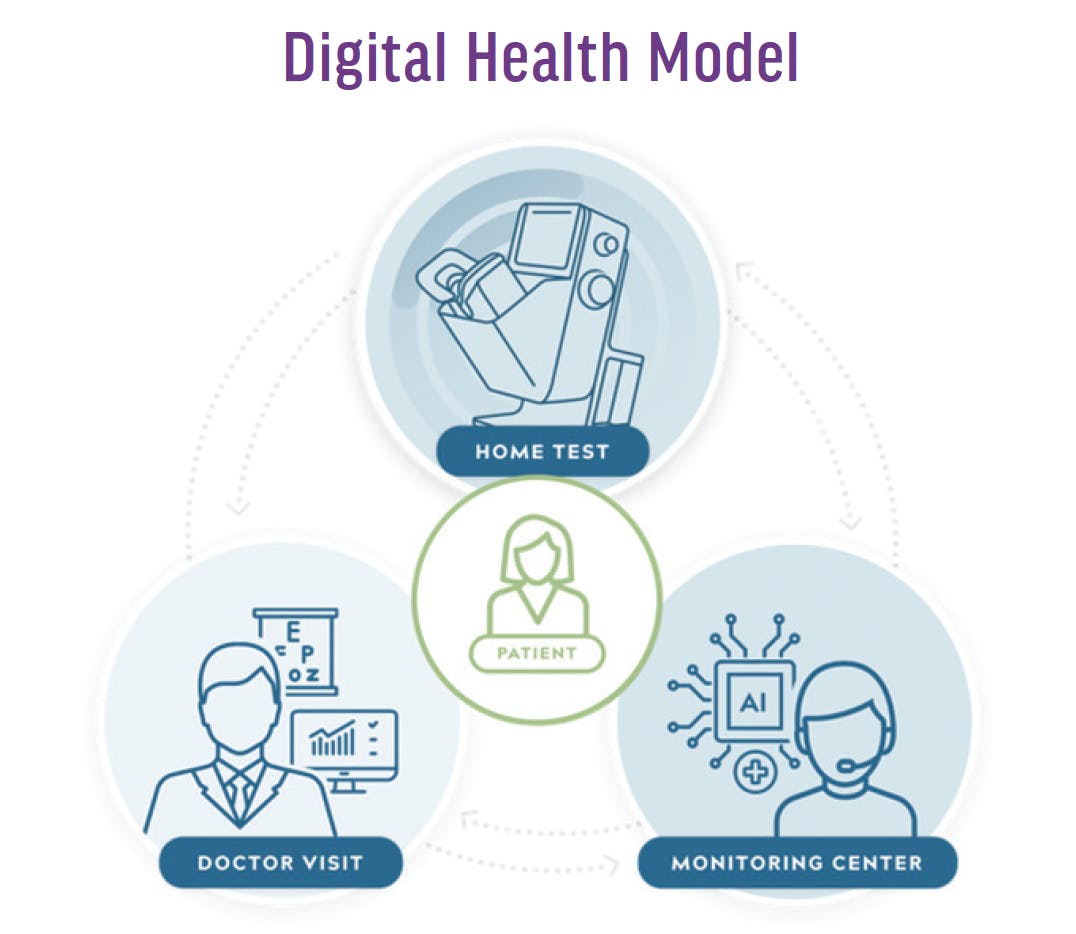
Figure. Patients remain at the center of a health care framework that leverages digital remote monitoring, with monitoring centers and health care providers collaborating to provide more precise care.
Home OCT, currently an investigational technology, may play a critical role in the management of wet AMD. Given the cost, treatment burden, chronicity, and complexity of managing this disease, retina specialists are likely to adopt such a tool to better personalize and simplify care.
Still, home OCT may fuel anxieties related to reimbursement for imaging interpretation and the fear of being swamped by alerts delivering too many false positives.
REMOTE MONITORING IN CARDIOLOGY
Cardiology’s experience with remote data capture began decades ago with the advent of pacemakers that use trans-telephonic monitoring to relay data to clinics.1 Now, devices such as implantable cardioverter-defibrillators can transmit data to clinics and, through the use of focused AI algorithms, predict when patients are most likely to need in-person care.
Many in cardiology shied away from adopting these technologies at first, fearful that patient care would be compromised or that clinic routine disruptions would be too severe. But today, cardiology has embraced remote monitoring and AI systems as tenets of the specialty, rather than threats.
As patients and providers grow comfortable with these innovations, cardiology is edging toward exception-based care: the practice of only seeing patients in the clinic when they require in-person examination based on remote monitoring data. Patients still visit the clinic but far less frequently than they did before the era of remote monitoring. By leveraging narrow AI—a system designed to complete a specific task—cardiology has helped build models that anticipate acute crises before they occur.
OVERLAPPING QUESTIONS
Under an exception-based care model, patients benefit via reduced treatment burden and more personalized care. This is true of cardiology now, and may be the future of ophthalmology if home OCT comes to fruition. Patients could be monitored with home OCT between their regular office visits, and physicians could respond when retinal fluid crosses a set threshold. The process may offer an unprecedented view of how patients’ eyes respond to different therapies, potentially assisting in individualized management.
This is good news for patients. But what about providers? The questions that ophthalmologists pose are valid and largely overlap with those first asked by cardiologists. How will remote monitoring disrupt carefully choreographed workflows and clinic schedules? How will it affect reimbursement? Will retina specialists be liable for unreviewed data that could potentially have been used for a preventive diagnosis?
Workflow
Cardiologists learned quickly that too many remote monitoring alerts led to clinics drowning in pings and patients experiencing unnecessary anxiety. By adjusting the threshold for triggering alerts, cardiologists identified sweet spots that work for them and their practices.
Similarly, ophthalmologists may be able to customize appropriate disease marker triggers. For example, we could determine which type of retinal fluid (eg, intraretinal vs subretinal, foveal vs extrafoveal) and how much of it should activate a prompt physician review of home OCT imaging.
In cardiology, technicians were cross-trained to review remote monitoring alerts, serving as a buffer between the AI algorithm and the provider. This had two effects: First, it improved confidence in the overall system, building patient and provider trust in remote monitoring/AI frameworks. Second, it created a new, engaging field in which technicians could grow.
There are worries that exception-based care will create erratic scheduling, with clinics packed on some days and slow on others. While practices will have to reserve space for patients who need to be seen promptly, clinics will remain busy regardless of urgent patient demand. Cardiologists and ophthalmologists both see a wide spectrum of patients, and if the experience of cardiology holds true for ophthalmology, then eye care clinics will remain as busy in the age of remote monitoring as they were in the era before it. Retina specialists are already accustomed to taking emergency appointments; remote monitoring tools will help determine the urgency of these visits and offer more data-driven care.
Reimbursement
Cardiologists are reimbursed for reviewing remote alerts and have ensured that reimbursement is commensurate with their value and effort by demonstrating that remote monitoring strategies save health care systems time and money and improve patient outcomes. Luckily, conclusions in the literature regarding the efficacy of remote monitoring in cardiology echo efficacy findings from remote monitoring studies evaluating the ForeseeHome over 10 years.2,3
Ophthalmology next needs to demonstrate that remote monitoring leads to cost savings for health care systems, which can be used to justify reimbursement. The pathway of physician reimbursement and remote monitoring was already walked by cardiology, and a coalition of ophthalmology providers, industry, and advocacy groups can refer to this map when seeking reimbursement.
Clinical volume didn’t decrease after remote monitoring became a common cardiology tool, which in turn meant that overall revenue didn’t take a hit either.4,5 The same can be expected in ophthalmology, a field in which the growing number of patients continues to exceed the limited number of providers, and new treatments continue to emerge.
Liability
To our knowledge, increased liability has not been an issue for cardiology thus far, in part because cardiologists ensure that patients understand the specific use of remote monitoring data. Physicians are only expected to monitor the parameters related to the device’s indication.
It will be important for ophthalmologists to set appropriate expectations regarding the use of remote monitoring tools. Patients must understand that remote monitoring does not replace physician-determined visits, and overall vigilance toward the state of their vision remains paramount.
NEXT STEPS
We often overlook one of the chief impediments to the adoption of new technology: doctors themselves. Providers often resist adopting new technology due to their concern for patient health and convenience. However, if these new technologies improve health outcomes and patient convenience, ophthalmologists should consider adopting these innovations as they become available.
Ophthalmology sits in an advantageous position when it comes to adopting remote monitoring and leveraging AI systems to improve patient care. Unlike cardiology, which monitors patients passively via implantable devices, ophthalmology possesses more control because patients can actively perform tests and improve their monitoring adherence with teleconnected devices at home. These hands-on patients are active participants in their own outcomes and successes.
For ophthalmology, adoption of remote monitoring systems that leverage AI algorithms to improve patient care, reduce treatment burden, and offer personalized medicine need not come at the expense of reduced reimbursement, disrupted clinical routine, and increased liability. In fact, the opposite may be true: A clinic prepared to integrate innovations that expand its patient base may improve patient care, see increased revenue, and widen its clinical reach without incurring any substantive costs or disruptions. By embracing the lessons learned from cardiology, ophthalmology can more easily navigate the future.
1. Theuns DA, Jordaens LS. Remote monitoring in implantable defibrillator therapy. Neth Heart J. 2008;16(2):53-56.
2. Health Quality Ontario. Remote monitoring of implantable cardioverter-defibrillators, cardiac resynchronization therapy and permanent pacemakers: a health technology assessment. Ont Health Technol Assess Ser. 2018;18(7):1-199.
3. Mathai M, Reddy S, Elman MJ, et al; ALOFT study group. Analysis of the long-term visual outcomes of ForeseeHome remote telemonitoring: the ALOFT study. Ophthalmol Retina. 2022;6(10):922-929.
4. Cardiologists in the US – Market size, industry analysis, trends and forecasts (2024-2029). IBISWorld. June 2023. Accessed April 4, 2024. www.ibisworld.com/united-states/market-research-reports/cardiologists-industry/#IndustryStatisticsAndTrends
5. Scott M, Baykaner T, Bunch TJ, et al. Contemporary trends in cardiac electrophysiology procedures in the United States, and impact of a global pandemic. Heart Rhythm O2. 2023;4(3):193-199.


_1784132761.jpg?auto=compress,format&w=75)





