


AT A GLANCE
- In a recent longitudinal study, the authors detailed the early stages of retinal neovascularization using both en face OCT and en face OCT angiography (OCTA) in eyes with diabetic retinopathy.
- OCTA’s capacity to detect flow signals above the internal limiting membrane has provided a more reliable method to categorize lesions.
- By pinpointing neovascularization precursors instead of relying on indirect retinal features to forecast progression risk, we may be able to achieve greater precision in identifying eyes on the verge of developing proliferative diabetic retinopathy.
While OCT has enhanced the objective diagnosis of diabetic macular edema (DME), early detection of proliferative diabetic retinopathy (PDR) remains challenging for ophthalmologists and often requires a thorough dilated fundus examination or fluorescein angiography (FA).1 Recent advances in OCT angiography (OCTA) not only enable the identification of retinal neovascularization (RNV) above the internal limiting membrane (ILM), but also offer a wider field of view, making OCTA a promising tool.2-4 Additionally, structural OCT can be instrumental in detecting RNV, particularly in distinguishing it from intraretinal microvascular abnormalities (IRMA).5,6 In a recent longitudinal study, we detailed the early stages of RNV using both en face OCT and en face OCTA in eyes with DR.7,8
PUTTING THE THEORY TO THE TEST
We conducted a cross-sectional study to analyze the sensitivity and specificity of en face OCT and en face OCTA for the detection of clinically occult RNV in nonproliferative DR (NPDR).9 We obtained four high-resolution scans (600 x 600 sampling densities over 9 x 9 mm) and generated a 17 x 17 mm widefield OCTA scan. We created two different custom slabs for en face OCT and en face OCTA to optimize RNV detection (Figure 1). RNV lesions were identified using a combination of en face OCT, en face OCTA with custom vitreoretinal interface slab, and cross-sectional OCTA.
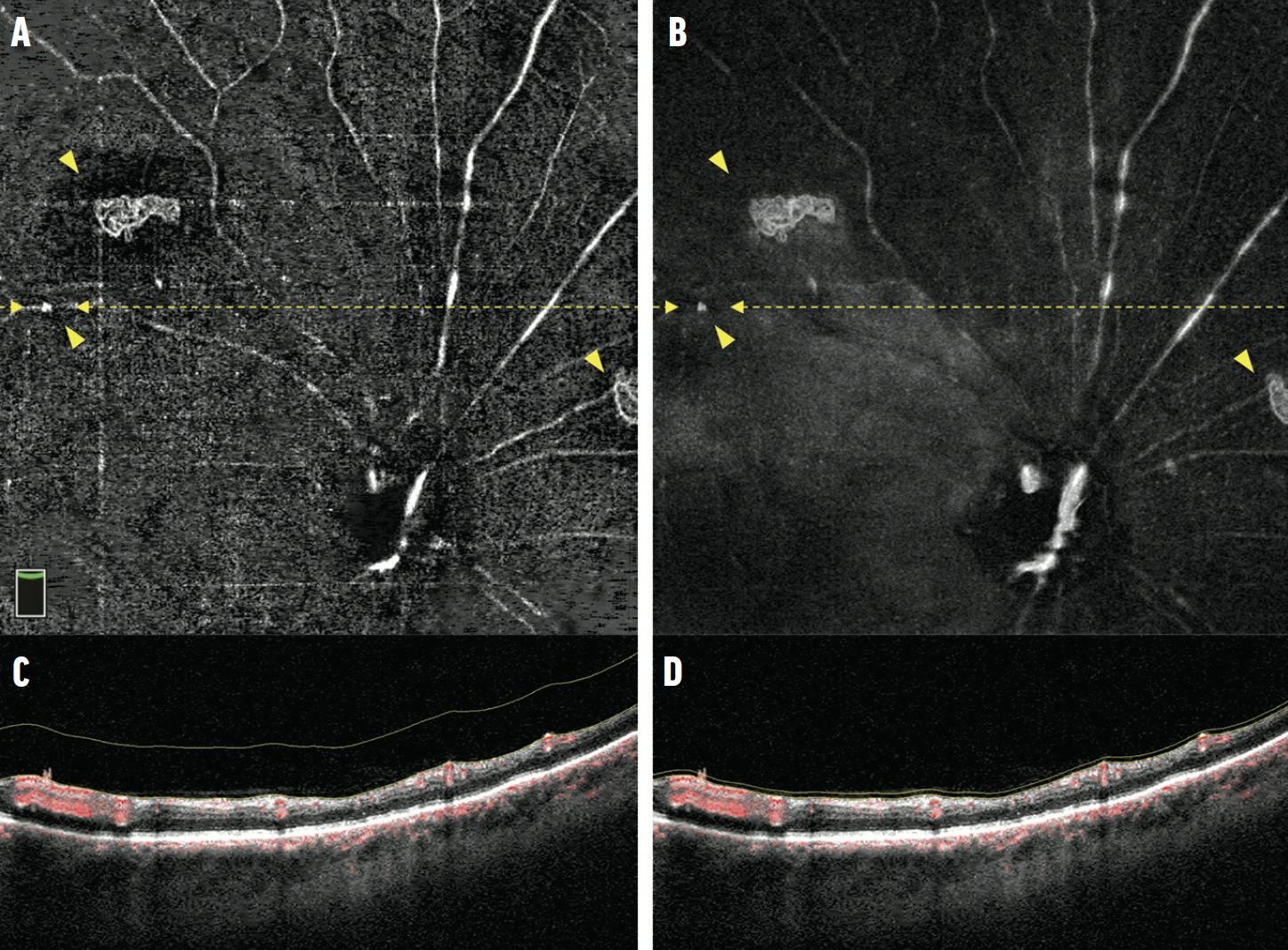
Figure 1. RNV lesions (yellow arrows) on en face OCTA (A) and en face OCT (B). Cross-sectional images (C and D) from the location of the dashed lines show a small RNV tuft.
Of the 63 enrolled eyes, 27 (43%) had severe NPDR, 16 (25%) had moderate NPDR, and 20 (32%) had mild NPDR. Combining en face OCT, en face OCTA, and cross-sectional OCTA, the graders detected 42 RNV lesions in 12 (19%) eyes. Of these, eight (67%) were severe NPDR, two (17%) were moderate NPDR, and two (17%) were mild NPDR. The sensitivity of en face OCT alone for detecting eyes with RNV was similar to that of en face OCTA alone (100% vs 92%), whereas the specificity of en face OCT alone was significantly lower than that of en face OCTA alone (32% vs 73%). For detecting individual RNV lesions, en face OCT had a sensitivity of 100% compared with a sensitivity of 67% for en face OCTA. A combination of en face OCT and en face OCTA detected subclinical RNV in eyes with NPDR that was barely detectable on color fundus photography (Figure 2).
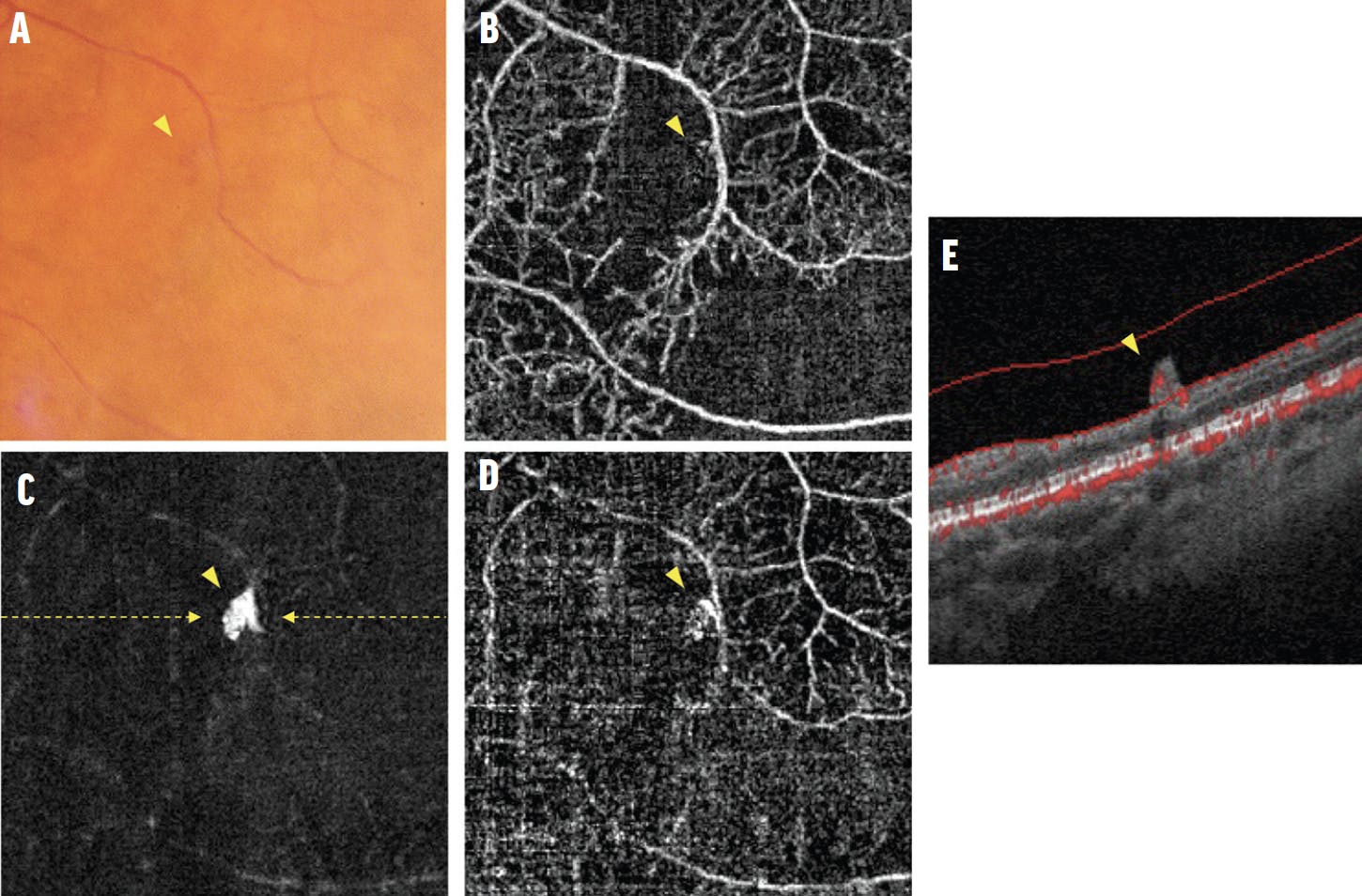
Figure 2. Multimodal imaging of subclinical RNV. Color fundus photography (A) and en face OCTA (B) of the whole retinal slab barely show RNV. However, en face OCT (C) and en face OCTA (D) with the vitreoretinal interface slab illustrate RNV. A cross-sectional OCTA (E) demonstrates a flow signal breaching the ILM, confirming RNV.
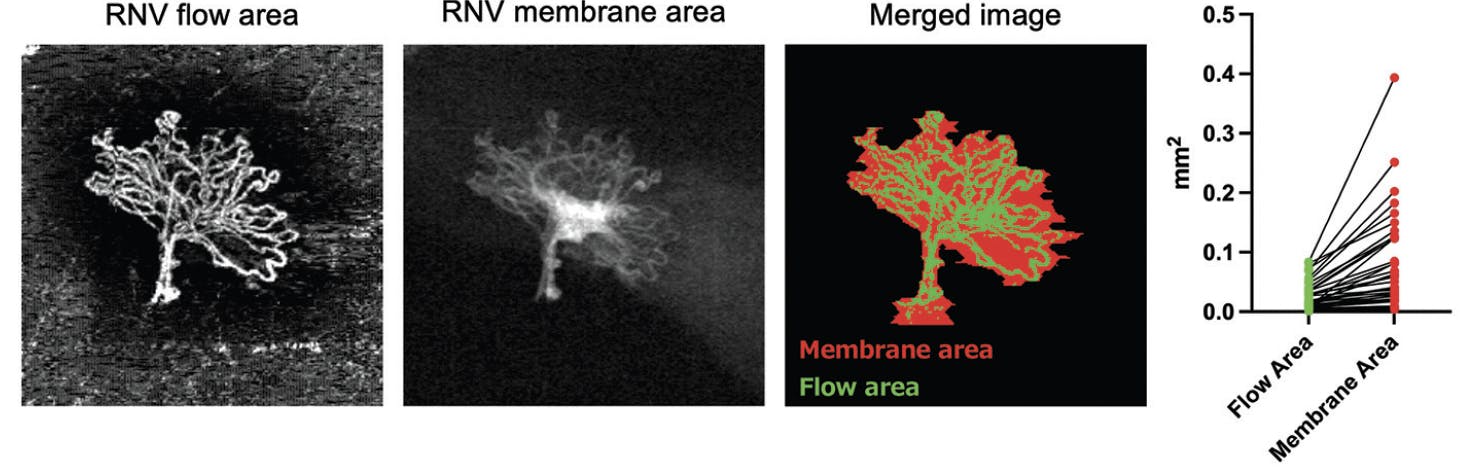
We also measured the RNV flow area captured by OCTA and the RNV membrane area captured by OCT (Figure 3). The mean membrane area of an RNV lesion on en face OCT was larger than the mean flow area on en face OCTA by a factor of 3.4 (standard deviation: 2.8). When comparing the area of RNV flow of the 14 RNV lesions that the graders missed with en face OCTA to grader-detected RNV, the area of missed RNV lesions was significantly smaller than that of manually detectable RNV.
DECIPHERING THE RESULTS
The clinical significance of the small RNV lesions detected by en face OCT remains uncertain. It’s also undetermined if their early detection and intervention could substantially mitigate the risk of vision impairment. However, prior longitudinal studies have shown that these small RNV lesions can grow.7,8 Based on this, we postulate that if RNV initially progresses through a subclinical phase, as observed in our study, then identifying subclinical RNV could more accurately predict the imminent risk of advancing to overt PDR than photographic grading. By pinpointing RNV precursors instead of relying on indirect retinal features such as intraretinal hemorrhages to forecast progression risk, we may achieve greater precision in identifying eyes at risk of developing PDR.
It’s important to emphasize that OCTA played a crucial role in verifying the nature of the epiretinal lesions in our study. Lee et al highlighted the value of structural OCT in differentiating between IRMA and neovascularization.5 The study drew attention to the unique histological insights that OCT B-scan can provide, which FA might miss. It also featured cases that were clinically diagnosed as RNV on OCT but did not exhibit leakage on FA. The team posited that while FA is beneficial, it isn’t the best tool for determining whether a lesion qualifies as neovascularization elsewhere. Moreover, they acknowledged instances where clinical examination and structural OCT findings diverged on classifying a lesion as either IRMA or RNV. Given the technology available when this study was conducted in 2015, there was no definitive means to ascertain the nature of such lesions. However, with the advent of OCTA, the capability to detect flow signals above the ILM has provided a more reliable method to categorize a lesion. This approach aligns more closely with histological findings as opposed to relying solely on clinical examination, FA, or structural OCT.
Caveats
One primary constraint of our study is the relatively limited field of view. Previous studies have shown a high sensitivity (ranging from 73% to 100%) for detecting eyes with RNV using OCTA. However, a single 12 x 12 mm OCTA and a 15 x 9 mm montaged OCTA are estimated to identify only about 40% of individual RNV lesions that ultra-widefield FA can detect. To expand the field of view without compromising the image resolution and quality, further imaging advances are necessary.
Another drawback is that neither en face OCT nor en face OCTA was highly specific for RNV detection when used individually. A common reason for false-positive RNV detection was vessel crossings in en face OCT. As a result, analyzing cross-sectional OCTA (superimposed on OCT) was essential to ascertain if the hyperreflective material on OCT or the flow signal on OCTA above the ILM represented RNV.
Additionally, widefield OCTA entails numerous B-scans—with this study using 2,400 for a 17 x 17 mm scan—making it cumbersome for routine use. Nonetheless, with enough training, an automated algorithm could discern false-positive lesions, enhancing the specificity of these imaging techniques for RNV detection.
KEY TAKEAWAY
Given that a single OCTA scan can produce both en face OCT and en face OCTA, we believe that integrating these two imaging techniques presents an optimal approach for RNV screening. For detecting individual RNV lesions, en face OCT was significantly more sensitive than en face OCTA because the area of RNV membrane on en face OCT was larger than the area of RNV flow on en face OCTA. Thus, en face OCT may be a valuable tool for the initial screening of areas of small RNV in eyes with DR.
1. Pearce E, Sivaprasad S. A review of advancements and evidence gaps in diabetic retinopathy screening models. Clin Ophthalmol Auckl N Z. 2020;14:3285-3296.
2. Hirano T, Hoshiyama K, Hirabayashi K, et al. Vitreoretinal interface slab in OCT angiography for detecting diabetic retinal neovascularization. Ophthalmol Retina. 2020;4:588-594.
3. Schwartz R, Khalid H, Sivaprasad S, et al. Objective evaluation of proliferative diabetic retinopathy using OCT. Ophthalmol Retina. 2020;4:164-174.
4. Russell JF, Flynn HW, Sridhar J, et al. Distribution of diabetic neovascularization on ultra-widefield fluorescein angiography and on simulated widefield OCT angiography. Am J Ophthalmol. 2019;207:110-120.
5. Lee CS, Lee AY, Sim DA, et al. Reevaluating the definition of intraretinal microvascular abnormalities and neovascularization elsewhere in diabetic retinopathy using optical coherence tomography and fluorescein angiography. Am J Ophthalmol. 2015;159:101-110.e1.
6. Russell JF, Shi Y, Scott NL, et al. Longitudinal angiographic evidence that intraretinal microvascular abnormalities can evolve into neovascularization. Ophthalmol Retina. 2020;4:1146-1150.
7. Tsuboi K, Ishida Y, Wakabayashi T, Kamei M. Presumed glial sprouts as a predictor of preretinal neovascularization in retinal vein occlusion. JAMA Ophthalmol. 2022;140.
8. Tsuboi K, Mazloumi M, Guo Y, et al. Early sign of retinal neovascularization evolution in diabetic retinopathy: a longitudinal OCT angiography study. Ophthalmol Sci. 2023:100382.
9. Tsuboi K, Mazloumi M, Guo Y, et al. Utility of en face OCT for the detection of clinically unsuspected retinal neovascularization in patients with diabetic retinopathy. Ophthalmol Retina. 2023;7(8):683-691.


_1784132761.jpg?auto=compress,format&w=75)





